Startup Taxes & Financials 101, with Adam Spector, Alex Roytenberg, and Betty Kayton
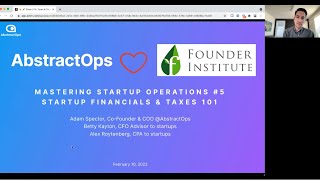
In this Founder Institute webinar, host Ryan Micheletti moderates a panel of startup finance experts—Adam Spector (COO, AbstractOps), CFO advisor Betty Caden, and CPA/bookkeeper Alex Roitenberg—to give founders a hands‑on overview of U.S.‑centric tax, accounting, and financial management for early‑stage companies. The discussion moves from high‑level financial planning (burn‑rate, cash runway, and simple cash‑flow modeling) to the mechanics of bookkeeping (monthly cadence, cash vs. accrual, QuickBooks toggles) and the three core financial statements (P&L, balance sheet, cash‑flow). They explain key metrics such as EBITDA, bookings, backlog, and deferred revenue, and why SaaS founders must track churn, active customers, and headcount. The panel covers compliance topics: GAAP vs. IFRS, revenue‑recognition rules, depreciation, R&D tax credits, sales‑and‑use tax, nexus, foreign reporting (Forms 5471/5472), and the tax implications of self‑funding, loans, owner contributions, and SAFEs. Practical advice on entity and bank‑account set‑up, avoiding commingling, choosing a business credit card, and selecting bookkeeping/accounting providers (QuickBooks, Mercury, Zeni, Pilot, offshore vs. on‑shore) is interspersed with live Q&A. The overarching message is that early, accurate bookkeeping and cash‑flow awareness are cheap, protect the corporate veil, and make fundraising and audits far smoother.
Chapters
All right, we are live. Hello and welcome everyone to our Startup Taxes and Financials 101 event. My name is Ryan Micheletti and I am head of operations for the Founder Institute. For those of you who don't know, Founder Institute is the world's largest pre-seed startup accelerator. We've launched over 5,500 companies across 200 cities with the largest mentor network in the world of over 21,000 mentors. And so part of my role at FI is to work with great startup leaders, mentors, and founders from all over the world to help them build impactful global companies. So if you're interested in learning more about Founder Institute, we're currently enrolling across 6 continents, including the Founder Institute Silicon Valley program, which starts next week. So you can go to fi.co/enrolling or simply reply back to any of the emails we'll send you, and we can send you a list of open applications. So Today we have a very timely topic. It's that time of the year again, at least here in the US, where you have to file your taxes. And it's a dreaded topic that a lot of people try to avoid, but I actually really like it. And it's for legitimate reasons. I have a finance background, but I think that knowing and understanding the finance side of your business is one of the more kind of dreaded and harder pieces to understand. But once you understand it, you feel like you're able to run your business a lot more smoothly and you have that really good understanding of what it is that you need to do from a compliance perspective. So whether it's startup taxes, bookkeeping, accounting, financial management, these are critical components to running your startup. And a lot of companies fail due to their lack of paying attention and prioritizing their financials. And so today we've got a really great event. This is another installment of our Mastering Startup Operations series featuring Adam Spector, AbstractOps, and his team of experts. And so we also have a great international audience today. So be sure to say hello in the chat chat, tell us where you're from, and let us know if you have questions because we want to get your questions answered. A lot of this is going to be US-facing, but there might be some general guidelines and policies that we, we can share. But for the most part, we'll be speaking from the US side of things. And so what we'll do is in a moment we'll introduce all of the founders that are— or all the mentors that are here today, um, and then we'll do a quick presentation, probably about like 30 minutes or so, that goes over the, the basics of startup financial taxes. And then throughout this entire presentation, we'll be pausing to be able to give you a chance to ask questions. So if at any point you have questions, go ahead and put it into the chat and we'll be sure to get to them. And then finally, at the very end of this, at about 6 PM Pacific, we're going to open up a networking event on Airmeet so you can meet some of the people who are here on the panel today. You can meet with other audience members and attendees. So without further ado, I'd love to introduce my friend, Adam Spector, co-founder and COO of AbstractOps. So Adam, do you wanna do a quick intro on yourself and maybe introduce the panel?
Absolutely, Ryan, thank you so much. It's always a pleasure to be here. It's great for me to do these Mastering Startup Operations discussions because like one of the key goals that I have as a founder and investor is helping these overall startup ecosystem enlarge and increase. I truly believe that the more startups there are in the world, the better the world is. The more businesses that are starting and ideas and just progress we're making is a real value add. So hopefully these sessions are really valuable for the people on this call to improve your business and improve how you run it. As I mentioned on the screen, I'm the co-founder and COO of AbstractOps. We're a startup ourselves with a core focus on automating a lot of the back office work. That the kind of back office admin work that startups have to do to build their business. And we want to take that off your plate so you can get— go and focus on what you do best, which is hopefully building out that great product and then getting customers for that product. So I'll also introduce Betty Caden, who is actually one of our advisors at AbstractOps. She is one of these amazing CFO leaders in Silicon Valley. She's a longtime leader. She's advised a number of different companies. She also happened to be the 4th employee and 1st CFO of Dropbox. So she's seen it all. And also Alex Roitenberg, who happens to be the AbstractOps accountant and bookkeeper. So also know them well and someone we recommend deeply, but he's a CPA with over 20 years of experience and has a firm that works with a huge number of startups, making sure your books are taken care of so you can, once again, get back to focusing on what you do best. So throughout the presentation, there's gonna be a number of areas where we're gonna stop and give you a chance to ask questions. So don't hold back, put 'em in the chat. Ryan's gonna be paying attention to it. Alex and Betty will as well. And make sure to drop those in there and we'll make sure to get them answered. I also wanna apologize for Betty that she is not on video right now. Despite being in Silicon Valley, Her internet is really acting up, and so she is not able to be on video, but she is still here with us, and I know has a ton to tell everybody as well. So without further ado, so key overview of the agenda. We're gonna talk about a number of things. It's gonna be a ton of information. We're gonna try to go through it fast, but in a slow enough way so the wisdom is imparted to everybody. And once again, please ask questions as we go through it. So startup 101 type stuff. Look, at a high level, right, you know, for startups and a lot of the startups in this call, you might be self-funded, then you probably get angel funding or family funding, really friends and family, and then angel and then venture. But the key thing about money as a startup is what really, really matters is your overall burn rate, right? How much money is coming in or how much money do you have in the bank minus the overall costs that you have. So, you know, over time you take those two things and you take cash on hand plus cash coming in, subtract it from your costs, and that equals the amount of time you have to survive. At a really high level, that's the most basic level of financial planning that I think every startup should do. It's simple, put it into a spreadsheet and plan how much time you have to live. We'll talk a lot more about planning overall, but like at a high level, like burn rate's critical. Bookkeeping, look, Key thing is you wanna try to do this monthly. That's what you wanna try to do 'cause you want your books to be in place 'cause guess what? If you understand your books, which kind of like your expenses and like a lot of transactional costs, that will help you predict your overall expenses. And finally, accounting is a little bit more about taxes and insights into your overall business to help you understand what's happening there. So I'm going to turn this over to Betty related to— oh, sorry, about planning with me. Sorry, but let me go with this one. Sorry. Look, as a founder, and I'm a 3-time founder, I've invested in 40+ different startups. As a founder though, one of the key things that I highly recommend people do is make sure you create a plan. Make sure you understand what the work you you're trying to do, once again, the expenses that you have, cash on hand, and figure out what that plan looks like and project, hey, like, what do I think revenues are going to look like 6 months from now, 12 months from now? What if I launch a different product line? What's that going to look like? Um, those are some of the key things you want to try to put into your plan. Um, obviously include hiring as well, maybe some basic margins, right? Are you going to have 80% SaaS margins, or are you going to have, uh, 20% services margins? Those are things you should be asking yourself and trying to put into a basic plan. However, as Dwight Eisenhower said, right, plans are nothing, but planning is everything, right? The plan, the best-laid plans go out the window the moment you kind of step into battle. And that's what does happen with startups, right? The plan that we have, even at AbstractOps, we think pretty decent about planning. But you know what, in a year, 6 months to a year, if we are exactly on target with our plan, I will be shocked. Because things change really, really quickly at a startup. But what's important is to try to plan things out so you know what to do in the future and where that's taking you as a business. So that is overall a really critical element, is to at least attempt to have some level of plan, because that's the story. That plan is the story that you tell to your team, it's the story that you tell to yourself, it's the story that you tell to your investors, um, and hopefully then you achieve to it as well. So, um, over to you, Betty, for, uh, financial statements.
Hi, so I just want to add one last comment about the plan. Just like Adam said, you never end up doing exactly what the plan says, but the idea is ask yourself all the questions. What happens if this goes on? And what happens if that? And how about this? And it's asking all those questions, you get a huge amount of mileage out of answering the questions and asking them and thinking about what could go wrong and what could I do differently. So anyway, I love planning even though, as Adam said, it never turns out the way you expect it. So, let's talk about financial statements. I noticed from the chats, and thank you guys for all talking about it, that over half the people look like they're coming in from overseas. So, I'm going to put a little bit of international that isn't in the deck as we're coming along. So, there are 3 classic financial statements. You've probably heard of these. I don't know if you guys took accounting school. or if you went to, you know, economics or anything like that. An income statement, which everybody calls the P&L, which stands for profit and loss. The P&L is the thing that says what are your innies and what are your outies? What's your revenue and expense, and how much money did you make at the end of the day? So, if you take in $100, that's your P, your profit, $100, you got a revenue of $100, you have expenses of $80, 100 minus 80 is 20. That's your profit. That's pretty easy. Um, the next one's a balance sheet, and a balance sheet says what are your assets and what are your liabilities. You have $2,000 in the bank. That's an asset. You've got $500 of inventory. Great, assets are $1,500. Your liabilities, that's how much money you owe everybody. So the balance sheet just says, do your assets exceed your liabilities? You always hope you do, because you don't want to be bankrupt. So, you always want to make sure you've got cash in the bank, which is part of the last slide, which is plan ahead. So, if you know today you're going to run out of money in July, then you need to take the time now to start planning ahead so you don't run out of money in July. The third one's the cash flow statement, and this is the one that's the most important when you're a startup. Yeah, the income statement, if PricewaterhouseCoopers is going to audit your financials, you really care about the income statement. And if you're going to go public, you really care about a balance sheet. But for right now, today, as a startup, what you really want is the cash flow statement. How much money left my bank account this month and how much came in this month? And if it's got a plus at the bottom, that's great. Most startups, though, lose money at the beginning. Most startups lose money for the first year, maybe 2 years. As long as you don't lose more than you expected, you don't lose more than you planned, You're okay. Gee, we thought we were gonna lose $20,000 this month. We only lost $18,000. Isn't that great? We only lost $18,000 this month. It sounds crazy, but it means you're running ahead of plan. You'll hear me say a million times, cash is king. If you've got cash, you have time to figure out what's going on, figure out what to fix, and figure out what to take care of it. If you don't have cash, you're really outta luck. So let's go on to the next slide.
And I'll just add, and Betty, I'll add really quickly on that point from the startup founder perspective. This is of course also the way to get cash, is not just by your income, but also by fundraising, right? This is where you might have money in the bank to start with to help provide that coverage as you're building out your product until you start actually receiving real revenues. That's where venture money can help make sure you have that cash, because cash is king, and it means you, enables you to build out your product and get it into market to start making that money. It's really— this is like why you get venture, is to provide that cash and that cash cushion as you're losing all this money up front.
So this is kind of a summary of what a financial chart might look like. This has 5 years. You're a startup, you're probably only going to do 3 months, 4 months, 5 months. You're probably not going to go out this far, but the idea is, is that you're looking at what your key indicators are. And I'm assuming from looking at the names that most of you guys are in the software business. So most folks, as you get going, you're going to care about how many customers you have. You're going to care about bookings and backlog, and we'll talk about those on the next slide, so don't worry if you don't know what they are. Revenue, that's what came in. Cost of sales, that's what it cost to generate the revenue. So let's say you're in a software company. Well, that $17 that's shown there in cost of sales, That's what you might pay Amazon Web Services, or you might pay Azure in order to do your hosting. So you got $83 to start. You had to give $17 right off the bat out to AWS. That leaves you $67. And now you've got to look at your operating expenses. And that's going to be payroll and rent if you have it. You're going to pay other software services. Hopefully you're going to use Dropbox, and you'll pay them some money. And then you're going to earn some money down at the bottom, net income. Income. There's a line below that called EBITDA. What the heck is EBITDA? That's a number that investors really like to see, and you'll notice it's pretty close in the case of this sample company to net income. And EBITDA stands for income before interest, taxes, depreciation, and amortization. Bottom line is, it's kind of the stuff that really matters. If you take the net income and you add back The interest, eh, that doesn't really count. Taxes doesn't really count. Depreciation doesn't really count. It's a better judge of the business to look at the EBITDA line. So, when you have whoever your bookkeeper is, they'll generally give you EBITDA. And at the beginning, you don't care. The first year, maybe it doesn't matter so much. As you get to the second and third year, it does really start to matter. Headcount, really important. In most companies, 75-80% of your cost is for people. Whether they're employees or whether they're consultants or advisors, that's generally where your cost goes. And it's also, you don't like firing people. So if you need to move out of a building or you stop paying for Salesforce.com or whatever you're using, that's not so bad, but you really don't want to fire people. So it's a good idea to keep track of that. And then cash, cash is king. That's the second time I get to say that. So just keep an eye on your cash balance and negative. Oh my goodness, what is it without new investment? Well, gosh, this company better go out and raise $1 million because we're going to be negative $800,000 a couple years out. So we'd better have a plan for fundraising. So that's kind of the ins and outs of the financial chart. This is still pretty much the same worldwide, but the next slide we're going to get to, Adam, this is a very United States-centric chart.
Yeah, and before we go there, I think this is a good opportunity to see if there's any questions related to these first slides. And as Ryan's looked looking through those, I'll just add one other point, which is for a lot of startups, the sort of spreadsheet that Betty shows here on this slide, you know what, if you just have it for 2 years, right, broken out even by month, you're probably fine, right? As we talk about planning, like any startup that is an example is when I talk with companies about fundraising or they want to pitch me for an investment, anyone who's projecting out 4 to 5 years into the future, I completely ignore what they have there because that's all going to be thrown out. It's good to have— once again, it's good to have those plans, but in some ways having the granularity on a monthly basis might be even more valuable with the same sort of information here. So Ryan, are there any questions about the first sort of few slides?
There's some questions in there. They're not super relevant about taxes or financials, so I've answered a few of them here. So let's keep going and then we'll pause again.
Great. Okay, so Accounting 101. This is kind of the words, and this is, to a lot of you this isn't going to matter a lot because this is kind of if you've already raised your first $300,000, $500,000, and you're moving on beyond that. So for those of you that haven't raised a lot of money, don't sweat this, but just be aware of it so it's not a surprise as you get bigger and bigger. The most important thing here, which is worldwide, is cash versus accrual basis. So let's give an example. Let's pretend that you're paying the rent, and let's say you have to pay $1,000 in rent every month. Well, if you look at a column for each financial statement, it goes $1,000, $1,000, $1,000, $1,000, $1,000. Great, you understand that. But let's say one month you don't have the money and you don't pay the rent this month. So you have $1,000, $1,000, a zero because you skipped it, and then $2,000 because you paid two months at the same time. So you have 1, 1, 1, 0, 2/1/1/1. Well, if you're looking at it and you're trying to analyze your expenses, you go, "Wow, you know, our expenses doubled this month." No, no, no, that's just timing. So cash basis says you look at how much you spent, which in this case is 1/1/1/0 to 1/1/1. Accrual basis, nah, you smooth that all out. What you do is you look at when you should have paid for it as opposed to when you really did pay for it. So, if you take that same chart we just did on the last slide, and you look at it on an accrual basis, it's going to be 1, 1, 1, 1, 1. It gets smoothed out. So, now, I noticed some folks in the chat are talking about QuickBooks. I'm assuming most of you folks are going to use QuickBooks. QuickBooks has a button on it. You just click on the button that says cash basis, and it gives them to you, and you click on a different button on QuickBooks, and it gives you accrual basis. So you, even though you only enter the stuff once, you just click on the right button and you get a different view of it. So it's just a great idea to understand that the accrual basis lets you look at what should have happened as opposed to what did, and it makes it a lot easier to understand what really happened. Because let's say you stop paying bills for a month. Well, it didn't mean your expenses stopped. It just means you kick them down the road. You're going to pay them the next month.
Hey Betty, is there, is there a better option for startups in early stage? Do they do cash or accrual, or does it not matter?
Um, I, I, my recommendation is if you have good accountants like Adam's team, that you do accrual from the beginning. And the reason is it takes maybe an extra 5% more time to do it right, but then when you're going out and you're trying to explain it to investors down the road, you have the data there. You can look at it. You're doing accrual, but remember You just click on the button in QuickBooks, and you can still look at it from a cash basis. So, if you do accrual, you get to do both. If you only do cash basis, sorry, you're out of luck. You don't have the data for the accrual. And as you get bigger, by the time you've raised $3 million, you've got to be on accrual basis. They're going to demand it. So, if you can afford it and do the extra 10% extra work, it might cost you a couple hundred bucks to go over to accrual to start with, but then you never have to go back and redo and rework anything. So anyway, I just recommend you kind of start it right to start with. But then again, you know, I'm a finance person. To me, you know, you always want to do it right if you can. Okay, so let's go down to the next row, big purchases. Let's say I go out and I buy a $100 laptop. Okay, I'm just going to record it as office supply expense, $100, it's done, it's over with. But let's say I have to buy a $20,000 machine. I need a 3D printer. I need a $20,000 3D printer. Well, gosh, I'm not going to expense that all in one month, even though I wrote a check and I paid the whole $20,000 up front. The accounting rules say that, look, this thing's going to last you a long time. It's going to last you 2 or 3 years. You take the cost of the 3D printer and you divide it by 36 months. So when you report it on your financial statements, even though the whole $20,000 in cash went out the door, It's $20,000 divided by 36 every month, and that's called depreciation. So you show it each month as a level expense. And for tax purposes, in some countries you don't get to deduct the whole $36,000. In some countries you have to spread that over time when you do your tax return also. So there's a big difference here between a little expense and a big expense, and most people pick in the United States $2,500 as the cutoff point for that. So, I think we kind of beat that one to death. EBITDA, we talked about it on the last slide. Here's what it is in writing, and yes, they are going to send out the slides so you don't have to take all these notes. Okay, there's a thing called GAAP, Generally Accepted Accounting Principles, pronounced gap. This is U.S. only, so every country in the world is different, except the U.S. does GAAP. So, if you're planning on going public on the United States Stock Exchange, you are going to follow U.S. GAAP. The entire rest of the world does IFRS, which is International Financial Reporting Standards. So IFRS is everybody on the phone except the US guys, and each country has its own rules about revenue recognition, and this is a big deal. So let's just say for a second that we're— I'm going to pick on Dropbox because I love Dropbox. We signed a contract with Dropbox, and we're going to pay $1,200 this year for Dropbox. $1,200 for a year. Well, okay, $1,200 divided by 12 is $100 a month. So, it's $100 a month, but I'm paying it all up front. I'm writing a check right now for $1,200. So, GAAP says, "Wait a second, you don't get that whole $1,200 credit right away 'cause you have to go produce all that software. You have to, for the next entire year, you've gotta be alive, not go bankrupt, keep your software up." and support them right on right now. So here's what we're doing on the gap. It's going to be revenue of $100 a month, $100, $100, $100, $100, 12 times. Even though I got the cash, the whole $1,200 up front. So we talked about how to finance your startup. Well, gosh, would you rather bill them $1,200 up front and get the whole money now, or would you rather bill them 12 different bills each month, $100 at a time? Oh my God, that's twice 12 times as much work, you have to do 12 times as many invoices, and it takes a whole year to get the money. So where you can, bill them all up front. Get the money up front if you can. Let the customers finance you. They don't want stock options, they don't want interest, they don't want a piece of the company. If you can, get your customers to do that. So GAAP is a big deal when it comes to revenue in the software business. And then there's all kinds of other goofy rules. For example, GAAP says that you have to record a cost on your financial statements for stock options. Well, that's the stupidest thing I ever heard of, because when you give somebody a stock option, it doesn't cost you anything. You just hand them a piece of paper. It's dilutive, meaning you give up some of your equity, but it doesn't cost anything. But GAAP, US GAAP, says you have to record it. So if you're going to do real GAAP financial statements, you need a really solid accountant that's going to help you do that. Most companies pretty much ignore GAAP for the first year or two until they start raising some money, and they say, look, we're going to keep good books, but we're not going to be GAAP compliant. Or for foreigners, we're not going to be IFRS compliant. We'll do a good job. We're just not going to follow all the stupid rules. We'll only follow the good rules. And we talked about FTEs on the last slide. It does include your contractors. Somebody asked a quick question about what happens if your equipment goes bad. Remember that 3D printer that we bought that was going to last 36 months? It breaks in month 9. We have to throw it out. It's gone. You then have to go in and say, "Oops, 36 months divide by 9, there's 25 left." The remaining $2,536 will hit your income statement the day you throw the machine out, because you can't say you're depreciated if it's not here anymore. It's gone. Okay, so onto this slide. This one's a little complicated. If you're not into accounting, you may want to just tune me out and ignore me for the next 2 minutes while we go through this, but I think you may find it interesting if you're especially in the software business. So let's go look at this. Remember we said we just signed a contract with Dropbox, and we're going to sign a 12-month contract. It's for $100 a month. So on the left slide, you see that word bookings, a new order. We had just had a booking. $100 times 12 is $1,200. We have a signed contract. I'm holding it in my grubby little paws, and it says $1,200. So that $1,200 goes into this bucket. So you now have a backlog of $1,200 because you've received an order and you haven't billed it. Okay, now let's look at the next green arrow going to the right. We just billed $100 this month. We put in $1,200, but we only billed the first month $100. There's $1,100 left in the backlog. And so $100 at a time goes over to the right side into the second bucket, and that $100 comes over there, and then you get to book revenue. So the idea of a backlog is it's an order that you haven't billed yet. Now I'm going to quickly change this, and then we'll move on to something else. We're going to say we just booked the whole $1,200 just like we did last time, but this time we have a super, super person like Adam and Alex running the company, and they said, "We're going to bill the whole $1,200." right up front, the same day it's signed. So $1,200 goes into the bucket, and guess what? $1,200 comes out of the bucket. We billed the entire $1,200. It moves over to the right side. And we'd get billings. The billing is $1,200, but we only get revenue of $100. Even though we got the cash up front, we have it all here, we only get credit $100 at a time. So in the right bucket, we're gonna get 12 coming in, and one at a time coming out. And that's called deferred revenue. And deferred revenue just means we sent the bill, but we haven't done the work yet. So in theory, if the company goes bankrupt or closes down, you have to give them a refund of the money. So this is a liability. So if you bill $1,200 up front, only deliver 2 months, and the company closes up, you're supposed to give them back the $1,000 because they paid you for work you didn't do. So that kind of gets us through there, and then we're on—
Before we go to that, Betty, are there quick questions, Ryan, from the team just about accounting? These are the two kind of main accounting slides.
Betty answered the one, and it was about the second piece of equipment, and then there's something here about like GAAP for land conservation. You know, GAAP applies to, you know, all US companies. Yeah, nothing, nothing in here that I would say stop. So let's keep going.
Great. Okay. And I'm, I'm, we're running slow, so I'm gonna have to speed it up so I leave Alex time for all of his good slides. Um, the next one is about KPI, key performance indicators, and they're different for every business. There's no one size fits all where everybody's all the same, but a KPI is basically what can you look at on one page, maybe two pages, what 10, 12, 15 numbers that says, am I doing well? It's like a red light, green light, orange light. Are they doing bad or not? So every customer's different. Here I think for software, we'd say how many customers and how many of them are active? Yeah, maybe 1,000 customers signed up, but nobody logged in last month. Well gosh, if they're not active, they're probably gonna cancel next month. Why would they keep paying you $10 a month if they're not using it? and you'd also wanna track from the last slide, remember that bucket, bookings, billings, backlog, and revenue, that's the last set of buckets. And then if we're in the software business, what's our recurring revenue? How much is next month gonna be? The churn rate, that's how many people cancel. So, let's take an example. Let's say this month we have $10,000 in revenue, and next month we have $10,000 in revenue. and you go, "God, that's great. Isn't it the same? It's wonderful. It was 10, it's still 10." And I'm gonna go, "Wait a minute, not necessarily. Let's pretend that you had 10 last month and 6 of them canceled. Uh-oh, there's only 4 left over. 10, 6 canceled, 4, and 6 brand new guys just showed up, so it's 10." Well, that's not a very good company if 60% of your customers cancel and you have to go out every month and scrounge new guys to fill up the cancellations. So, it's not enough just to look at your revenue, you also have to look at the churn rate on how that all turned up. Headcount, how many, are we hiring too fast, are we hiring too slow, how much cash, and that all-important question which is, when are we going to run out of cash? And that's the really important part. And I'm just noticing another question coming in about R&D expense. For those of you in the United States, there are some very special rules about keeping track of your research expense and filing for the government to basically pay you cash for the refund. So even if you pay no tax, the government will actually write you a check in some cases for research, for hiring certain key people, and for being in certain locations like an enterprise credit. So make sure you talk to your tax advisor and your professionals to learn which ones you're eligible for. And then a lot of other countries other than the US have similar programs. They're usually called innovation bonuses or innovation credits or research credits. So anyway, that gives you some ideas, and I've overstayed my time, so I better shut up so Alex can keep going on the rest of these.
Good evening, everybody. Betty, thank you, and Adam and Ryan as well, thank you for the introduction. So we'll get started with the accounting and bookkeeping side of things and then move on to the taxes. So When you're looking at or thinking about bookkeeping, there's a couple of things that a lot of people think about is, do I start— am I starting too early or am I starting too late? So the way that we look at it is, hey, if you start too early, what's the worst case scenario with that is that you're going to end up paying for QuickBooks for roughly 1 or 2 months earlier than you really need to. The issues that we're seeing with people who wait too long is that there's a couple of things. One is getting getting the information with certain banks become a complexity once it's after 90 days from that transaction transpiring. Um, so it ends up being more work for you, the founder, as well as for the accounting team in order to get that information into the system. So what ends up happening is that the accountants might actually end up charging you additional money for the additional time that they end up spending. So instead of it being an automated feed, directly from the bank into the accounting system. It ends up being manually, uh, punched in. Um, some founders will say, hey, I can do it myself, I don't need to hire an accountant yet, we only have 10 or 15 transactions a month, we'll be okay. The issue there is if the transactions aren't done correctly, um, the accountants when they come in to do things will end up having to redo work. So you've just spent time that you don't need to on a on a task that you're not perhaps most optimal to do. And then sometimes— go ahead, Adam.
I was going to say, as, as, um, at AbstractOps, we have a lot of our customers come in who don't have accountants or bookkeepers, and this is something that comes up over and over and over again where they were trying to do it themselves or they just weren't doing anything, and it becomes a massive hassle for them to clean it all up. They have to pay way more— they have to pay at least as much money as they would have paid early on just to have a bookkeeper or accountant working with them to start with, um, and they have a ton of cleanup to do. So I highly recommend you don't try to do it yourself unless you literally went to school to be a bookkeeper or accountant and have that knowledge yourself. This isn't an area that's worth using your time to do. You have way bigger fish to fry, such as, you know, getting your product at the door and getting customers, than trying to even manage even the 15 different transactions you have. It might seem like a small amount, but why are you spending time trying to become an expert when getting a low-cost bookkeeper might only be $100 or $150 a month for the lower end. But even just someone to just make sure this stuff is sort of done correctly, it's a low expense for the amount of time it might take you to probably do it wrong anyways.
And what we've actually seen quite a few times and what we've had to do is just basically take the existing QuickBooks instance that some people have or a different software and just basically dump it and create, go from scratch, because going from scratch is sometimes easier and less of an issue than trying to correct something that's in existence that's just not working. Um, so now we've talked about the recording of it, but the other big thing that we want to discuss is making sure that, um, you bifurcate between your personal bank account and your business bank account. If you are setting up a business, what you don't want to do is you don't want to use your personal checking account to receive funds from clients, from investors, or anybody else. And you also don't want to use your personal checking account in order to make payments for vendors, suppliers, contractors, or employees. The big risk behind that is a couple of factors. One is if you have a commingling of funds, what is possible is that your corporate veil, or the reason that you set up an LLC or corporation, for protection against liabilities might go away. And also, the other big factor is that you may end up having to— you may end up improperly recording transactions. Transactions that should have been recorded on the company's books and records as an expense might end up slipping through the cracks and not being picked up. And then the other big factor is many accountants will not work with you if you end up commingling assets, because it ends up being a lot more work for them.
[Speaker:TREY_LOCKERBIE] Alex, one other question for you on this as well. So as a founder, let's say I'm self-funding. Early on, I'm self-funding. What should I do? Should I just take $1,000 out of my bank account and write a check to my corporation's bank account and deposit it right there, just at my desk, sitting there, write a check, turn around and deposit it? Is that the best thing to do? Or how do I make sure I don't commingle if I'm self-funding, as an example.
So if you're self-funding, great, uh, question, Adam. Um, that whether it's a check or an ACH or a wire, that is usually the best way to go about it. Um, when people are self-funding, our usual recommendation is for somebody to use the same bank account as their personal funds are in, because if you're self-funding it and you're in the same bank, so if you're doing a Chase to Chase, say, Citi, Bank of America to Bank of America, whichever, um, when you do that transfer online, it's almost instantaneous. So as a result of it, there's no need for you to wait 2 to 3 days for that ACH or wire to clear. Uh, there's no additional cost to transfer from one checking account to the other one. Um, and it also helps, um, individuals who are trying to keep the amount of cash that's in the business, um, a little bit tighter. They're able to transfer those, that, those funds a little bit more frequently and a little bit easier. So once the business has started, you've incorporated the business, we have a recommended financial stack for somebody to use. One is, hey, if you're going to be a startup, you need a bank. You don't necessarily need a bank that has physical locations. A great bank that we've had great success with is Mercury Bank. Really simple and easy to sign up and use online. The other big one that we usually recommend is to have a business credit card. There's a big difference, and we'll cover it a little bit more detail later on. There's a big difference between debit cards and a credit card. My usual recommendation, if you get a debit card in the mail, melt it and throw it out and get yourself a credit card. Um, a credit card gives you additional layer of security separation from the checking account. And any charges. Our recommendations are the usual: the RAMPS, the DIVI, the BRICS. Software, we've discussed this before, QuickBooks Online. And if you're selling online through your website or through an app and accepting credit cards, something like Stripe would be a great product for you to use.
There's a, there's a question here along those lines, Alex, that I think is important, which is like, would you consider these early funds, right? So do you like There's two scenarios. You could give your, your business the money as like a loan, or it could be like an owner contribution. What do you recommend for early startups and what's best for tax purposes?
So the big question is, are you looking to get that money refunded, naturally refunded, but repaid to you after you raise your seed or Series A, or are you okay with leaving that money within the business and having that as additional capital invested. If somebody is looking to get that, those funds repaid to them, it would, it should be set up as a loan within the books as well as just generally record keeping. The other big thing around that is it's a question of duration of the funds being loaned out to the business. So if the funds are being loaned out to the business for over 90 days and you don't have an agreement from between the business and the person who's given the loan to the business, if it's over 90 days, the IRS can reclassify it as an equity investment, which can cause issues for you if you're trying to distribute out the funds at a later point in time.
All right. Is this a good time to pause for questions or should we—
Sure.
Okay. There's a couple here that it talks— actually, there's just one here. It's around someone who basically paid a development firm that didn't do the work and they lost $12,000. Are there any, like, tax benefits that they can, they can take advantage of, or is this just simply an expense on the P&L and therefore reduces their tax basis?
Um, so it's an expense for P&L purposes. Um, the ability to claim it as an R&D tax credit or expense is a little iffy. Uh, the other big question is, was that $12,000 paid to a U.S. firm or an international firm? If it's paid to an international firm outside of the U.S., you can't claim it for R&D tax credits no matter what. So it would just purely be an expense that's on the books, and then you would go from there.
All right. There's a question here from Sam. How do you account for a SAFE note, especially a warrant with an unvalued company? Yeah. So I mean, this goes to like cap tables and managing SAFEs. So it's a little bit out of the scope of this, but do you have any recommendations?
Yeah.
So the way we look at SAFEs, and I guess how most of Silicon Valley looks at SAFEs, especially within the YC world, is that it's treated on the balance sheet as an equity investment. By the investors. So we'd pick it up as an equity investment, increase your cash basis balance, and then also increase the equity balance in your account. So I think this also leads us to the next part within the bookkeeping is— and Betty touched on this as well as Adam earlier in the presentation. Difference between cash and accrual basis, where I'm not going to go into the mechanics of it on a month-to-month or period-by-period basis. The way we look at— we get this question of should we do cash or accrual basis. If you're— the way we look at it is if you're going to be an operational business that you're going to be open for the next, call it, 10, 15, 20 years, and you think that you're never going to really be raising money and you're just going to operate the business, um, for something along those lines, to make the appropriate decisions, I think cash basis is probably going to be the easiest for somebody to maintain. If you are a business that is planning to grow, raise funds, um, and expand, for that you're going to be most appropriate for you to use an accrual basis of accounting. And also the big thing to remember is that if you have your books set up on accrual basis, you can very easily— same as what Beto mentioned— you could very easily look at the difference between cash and accrual. If you have your books purely in cash basis, it's almost impossible for you— it would be a very heavy lift for you to go from cash to accrual. So we usually recommend to do accrual basis of accounting. You also don't necessarily have to go into extreme detail, um, on the accrual basis. And what I mean by that is materiality. So if you end up, um, buying an annual subscription for something and it's $120, it's not really super, um, cost-effective or operational necessary for you to amortize that $120 expense, $10 a month, where we usually go on the accrual basis and break up the monthly subscriptions is roughly $750 to $1,000 a month or so, because at that point you actually are materially changing or affecting how it's going to be reflected on your financial statements. Um, the fact that I'm myself or another accountant might be doing your books doesn't mean that you don't need to look at them. The worst thing in the world for you to do is to not review your transactions within your bank account, at least call it once a week, or for you to not review your financial statements at least once a month when you get them from your accountant. Most of the times when you get your financial statements from your accountants, you will also get a list of questions because we can't always know what all of those transactions that happened during the month, how they actually affected your business. So make sure you know your numbers, make sure you know where they're moving to, and review the banking transactions. Call it once a week on a Friday afternoon to make sure that there's no fraud or surprises there.
So, Alex, quick question for you, then I want to make sure we get through. We have another kind of few slides that I think are really critical, so we should go speed it up a little bit. But one quick question for you. If I have a bookkeeper, do I need an accountant? Or if I have an accountant, do I need a bookkeeper? And why are they different?
That's a usual— that's a constant question that we have. So bookkeepers are there to record your transactions. Accountants are there to review and advise you on what's going on. Some of the accountants can also do the work of a bookkeeper. So the better the accountant, the more experienced they are, they'll be able to give you more value, but they might be a little bit more expensive than a bookkeeper only. Taxes. Most people think of taxes as just income taxes. The other things to remember is there's sales and use, payroll, franchise, state minimum taxes, international taxes. When let's say you have developers in Canada and you're in the US, So cross-border VAT. The US, I think, is one of the few countries that doesn't have a VAT or GST tax. And then also foreign reporting requirements. This is very important on the foreign reporting side. If you have international investors or international founders in the sense that you don't have a green card or US passport holder, you need to do extensive foreign reporting. With the IRS, the penalties start with those at $25,000 per form missing. So if you have two founders who are international, they didn't do the proper 5471, 5472 reporting, it's $25,000 per person that there's going to be a penalty on it. For sales and use, there's a reason why it's called sales and use. State of California does not charge sales tax on software. State of New York does charge sales tax on software. If you buy software from some companies in California and you're a New York-based company, they may not charge sales tax on that transaction. That is when— that's the sales tax on it. But if you are a New York-California and you used a software that did not have sales tax collected, you need to report use tax to the state of New York and pay that sales tax.
And there are companies out there for everyone who knows— for everyone, there are startups that actually— not even startups, big companies now that help you calculate your sales tax as well, because it can be relatively confusing. And to know what should be charged when, there are tools that will help automate some of that.
The other one that trips a lot of people up is W-2 or 1099. 1099 contractor. The big question is, are they only working with you versus working potentially with other individuals or businesses? Um, you want to make sure that you get your classification of full-time employee or part-time employee as W-2 versus a 1099 contractor done correctly, because if that's not done correctly, the IRS can come back to you years later and collect Social Security and Medicare plus penalties and interest. On any payments that were made to contractors that were deemed by the IRS to be W-2 employees. With 1099 contractors or international contractors, what you need to collect are W-8s and W-9 forms. W-9s are for U.S., U.S. individuals or businesses. So if they have a U.S. EIN or a U.S. Social Security number, they will issue you a W-9. If it's a U.S. individual who's currently living in Australia and working there remotely, because they have a Social Security number, they still need to issue you a W-9, and you would still need to issue them a 1099. If you have an international business, they would issue you a W-8BENI. It ends in an E because it's an entity, and if it's an individual who's working for you internationally, you need to get a W-8. Then you don't need to issue any 1099s if you have a W-8, but what you do have to do is you need to maintain the records on your side to make sure that if the IRS comes in to audit you, why didn't you offer a W-8 to this, um, a 1099 to this person? You show them W-8 and you should be covered. Um, business credit cards, debit cards, as we talked before A debit card is directly linked to your checking account. So if somebody fakes your debit card, they can drain your checking account. If you use a credit card, it gives you an additional layer of protection. It helps you with— helps you with your cash flow. As Betty mentioned, cash flow is king. And you also have the added benefits, loyalty points and things of that nature. And so a couple of things on the tax side, um, to be aware of. R&D tax credits, a lot of people have talked about it, but there's also other tax credits that are actually available. There's tax credits if you have 401(k) programs for your business. There's also tax credits last year that were created because of COVID so make sure that you're maximizing the tax credits that are available to your business as much as possible. Um, where do you have to file nexus? What is your connection to a state? There's two reasons that you might be having to file in a particular state. One, the easiest one to explain, is physical connection or physical nexus. You have an employee, an office, or a warehouse. Now the trickier one, this is as a result of Wayfair There was a court decision that went to the Supreme Court back in 2018. The decision was that if you have enough of an economic connection, a business transaction in a particular state, and it's based on where your clients physically sit or transact business in, then in that case you would need to, um, have a connection and file in that state. Rule of thumb, if you have over $100,000 worth of economic transactions in a particular state you would need to then file in that state. Um, the other big reason why you want to make sure that you file your taxes— investors. Investors do not want for you to have liabilities or issues that are dragging on from historically. So what ends up happening, we do this for a number of VCs, we come in and do audits, uh, or reviews of taxes that were filed by target companies, and anytime that you have possible exposures either on sales tax, payroll, or actual tax return filings, that will trigger holdbacks or a percentage of the investment to be held back until you actually file taxes. The other thing to remember, extensions are an extension to file, not an extension to pay. There are certain taxes that need to be paid even if your company is not making a profit. Easiest example, Delaware franchise returns are due March 1st. Minimum payments for corporation, $450. LLC, it's— I think it's $350. States, California, $800. Massachusetts, $456. So make sure that it's not just federal taxes. I haven't made a profit, I don't need to pay taxes. There's also state fees that need to be paid. This goes back to the other forms of taxes, minimum taxes, franchise tax, state tax.
So this is the last slide. So just key takeaways for everyone to know. Look, number 1, get a bookkeeper and accountant. Literally, you can get low-cost ones for about $100 a month, all the way up to $1,000 or $1,500 a month, but it's not expensive given your time. Build basic financial cash projection models. That's super critical. Compliance, it's much lower cost to comply and will make your investors happy that, A, you know what you're doing, two, you have your stuff together, and three, they're not investing in something that has a ton of liabilities sitting around that they didn't know about. And as I mentioned, make sure you get some of the key tech off the bat. There's some great, great tools, bank account, credit cards, QuickBooks, things like that. To make you successful. Um, it's not that— so overall, it's not difficult to do this. Do it sooner rather than later. Um, you'll be very grateful and happy. So, um, what questions can we answer in the next 5 minutes? And we can certainly go over a little bit as well.
Yeah, so I really appreciate you guys joining tonight. This was great going into the deep dive here. Um, so, and also thank you for answering questions here in the chat. Um, Rami asks, what are some good R&D tax credit resources and what are some of the minimal requirements to qualify?
I'll talk about some of the resources, and I don't know, Alex or Betty, if you want to talk about the minimum requirements. But there are a ton of great companies out there that do R&D tax credits. We're at AbstractOps big fans of NeoTax. We've also written a detailed blog about all the different players that are out there. So Just if you do a search for R&D tax credits and AbstractOps, you should see a blog post that outlines all the different major players that are out there. They all have pros and cons in many different ways, so check out ones you like. Feel free to send our team some questions. We can maybe help you figure out the right software to use. And then on the minimums, Alex or Betty.
Yeah, my position on this, it's a question of the amount of time that you're going to spend and what the output is going to be. Uh, rule of thumb, quick back-of-the-envelope calculation, 10% of whatever your expenses are. Um, my view on this is if you're not going to get at least $1,000 of credit, basically $10,000 of expenses, it's not worth it. Um, because one, the bookkeeping company or the accountants might charge you an additional fee, payroll company might charge you an additional fee, and then the actual R&D study is going to charge you a fee. And if your credit is $500, you're going to end up paying more in services than the actual credit itself.
That's really great insight there. There's a question here too around what ways to find the best bookkeepers or accountants for tech startups. Well, we have some great accountants here, but any recommendations for early-stage companies?
Yeah, so we've done detailed research on this topic at ObjectOps as well. This is part of the work that we do for all of our clients. We also, I believe, have a blog post about this to some extent, but the truth is it's actually fairly— we obviously recommend Alex, Alex and his team are who we use, but we actually have internally a list of different companies that range anywhere from, once again, $100 all the way up to $1,000. You have Alex's team, you have outsourced teams that might be in India, you have things like Zeny Financial, or a little bit more expensive, you have Pilot. There's a variety of different software tools, but it really comes down to how much you want to pay, to some extent, the complexity of your books, and your expectations going forward. So in some ways, it's a little bit hard to research, which is why we've done a lot of research ourselves internally for our our customers. But I don't know if Alex, you might have other thoughts there too, but it sort of depends.
Yeah.
And it's also a question of what you're looking for. If you're just looking for like, hey, the only thing I care about is just a P&L statement, just so that I can say it's done. You can use something that's offshore. If you're looking for actual, hey, I have a question, we're doing XYZ, we're looking to raise funds in 6 months and so on and so forth, you might want something a little bit more onshore. Um, ourselves, Zeni, um, Pilot, it different point, uh, point in time of the business. And then the other big question is, um, making sure that they fit into what business you're doing. Um, certain companies have certain specialties.
Yeah, and I'll actually add, just to give people color on that, I mean, at AbstractOps, we started with an outsourced firm They're great. We still recommend them to a lot of our earlier stage clients. And then we, as we continue to grow and raise more money, we moved over to Alex and his team as we kind of matured as a business.
Let me just be the wet blanket here and just add something in, which is you can't just hire a bookkeeper and ignore them and expect the books to be right. You have to be involved. You have to give them the right inputs. You can't just give them a stack of receipts. You have to say, hey, you know, the reason we bought that $5,000 is that was for for our marketing guy. Well, it gets charged to marketing expense. No, no, no, that $5,000 laptop went to our VP of engineering. Well, in one case it's eligible for a research and development credit, you get a tax credit because it went to the engineering guy, and the other one it went to the sales guy. So just remember, yes, you want to hire a great bookkeeper, but you're not off the hook. You still have to give them the right inputs. Garbage in, garbage out.
Yep, that's sage advice. I think that's you know, a really great note to end on here. So founders, hopefully this was valuable. We'll do more of this in the future as well. And, and big thanks to Adam, Betty, and Alex for joining us tonight. We're out of time, but we're going to go ahead and move over to Airmeet where we're going to do some networking. Everyone here will get a copy of the webinar in their email over the next few days. And for founders that are interested in being backed by one of the top pre-seed programs in the world, go to fi.co/join to apply to the closest program near you. So Thank you, everyone. Really appreciate your time and have a great evening.










