A press release should be data-rich and journalist-friendly, while your email pitch needs to grab attention with concrete numbers about market size and social proof. Use the journalist's name in the subject line and include links to your professional profiles to reduce friction.
Chapters
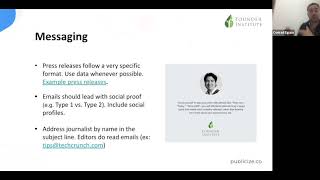
The third is messaging. I think this is actually one of our favorite quotes from Jonathan about company messaging that we actually share across our team and publicize. The, um, with messaging, it's important when you communicate to the media that you have essentially two primary documents. You're going to want to have a press release which follows a very specific format. We actually have a bunch of examples if you want to see. With these, it's really important to use as much data as possible. So as an example, a lot of founders will say, um, You know, hey, this is a really big market. I don't really even know what big means, you know, as opposed to 100 million, etc. Something to keep in mind with press releases is that a lot of people think that the role of the press release is to sell the journalists on why they should cover the story, but that's actually not its purpose. The purpose of the email pitch is to explain why it's a really interesting story. The purpose of a press release is basically once a journalist decides that they're interested, to basically make it as easy as possible for them to write an article. And the reason for that is many journalists around the US and other countries, they, um, they live in really expensive cities, whether it's New York, whether it's San Francisco, etc. And in many cases, they're paid a relatively small amount per article, so they have to author a lot of articles. And it's important basically to make it as easy as possible for them to do so, kind of reduce that friction. When you're authoring an email pitch, It's important to lead with social proof. I actually call it type 1 versus type 2. Type 1 is the, hey, if you're an alumni founder, it infers, hey, you're really ambitious, et cetera. Maybe you— or maybe you're a Harvard Business School graduate, et cetera. These kind of things people can infer. Type 2 is actually the other end of the spectrum. Let's say you have an interesting story. You used to be a sports star, or you used to be homeless, or maybe you're a very young, a young founder. I remember I got this email a little while back from this founder and they said, "TechCrunch would never write about me. I'm only, I'm this 13-year-old founder from Australia." And I said, "No, you don't understand. That's why they will write about you. There are not many 13-year-old founders that are emailing TechCrunch. You really stand out with that." I recommend including links to social profiles as well, LinkedIn, et cetera. Unfortunately, there are a lot of fake stories that are sent out, and by including social proof, you're basically saying, "Hey, I'm putting my name behind this story." It is really important to address a journalist by name in the subject line, and editors do, keep in mind, read emails. Just as a data point, back in the day at VentureBeat, about half the stories were sent to tips@venturebeat.com. So those emails are read.