t-Form - Rapid Packaging
Benjamin Moore's T-Form cuts thermoforming packaging timelines from months to under a day using web-based quoting, automated CAD, and machine-learning mold design. The company has grown 50% quarter-on-quarter since 2016 and targets a $1.5 billion market of automotive suppliers.
Chapters
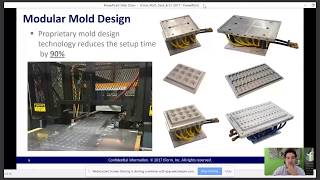
Hey, my name is Benjamin Moore, and I am the founder and CEO of T-Form. My background is in engineering, design, and manufacturing, and through that experience, I really saw a problem in industry where other manufacturing companies were struggling to get custom thermoform packaging made, and they're really struggling in 3 different ways. They were trying to— it took too long to get through the quoting and the design phase. It took too long to actually get their packaging once they actually did an order. And because it was custom-formed plastic packaging, the molds are really expensive. So, uh, we provided a solution where we automated that thermoform process. We cut that quoting time to less than a day. We provided them packaging sooner in less than 4 weeks, and we cut that mold cost in about half. So how we did that, we concentrated first in the first phase of quoting and design where we build a web application that allowed us to give a designer or an engineer real-time quoting as they design their packaging. And next, after we were awarded the job, we would actually use proprietary mold technology between machine learning and 3D printing to reduce the time it took to go from a concept to a final part by 75%. And that reduced the overall cost by about 50%. And by doing that, we actually use a modular mold design, and that allows us to save time between setups of custom jobs by about 90%. And with that modular design, it allows us to have scalability. We can do engineering and design, mold manufacturing, and plastic production all in-house here at our Greenville facility, and then ship molds across the globe as we develop the recipes so we can do production for the final packaging closer to our customer. Since we launched in January 2016, we've had about 50% quarter-on-quarter growth, and we're trending and on track with that for Q3 of this year. And we're making money really 3 different ways. First is the one-time setup fee, which is in the design phase and also the mold production phase. The next is the custom production of the actual packaging itself. And then we do provide stock trays, which is used as a commodity item for a lot of manufacturing companies. We've acquired customers several different ways since we began. We've collected that data and showcased that our customer acquisition cost is about $2,000. And we divide those customers up into 3 categories: small, midsize, and large. The market for this custom thermoform packaging is growing about 16% annual growth rate. And we target the area closest to home. And that region that we target is about $1.5 billion in current revenue. And that's for custom low-volume thermoform packaging. So we're looking to do a fundraise of $1.5 million to do a plant expansion for capital equipment. Also, our goal is to add about 35 customers in those two higher customer lifetime values of the large and the midsize and increase annual recurring revenue to over $5 million. That's it for me, guys. Thanks. All right.
Awesome, man. Let me bring myself back up here. Cool.
All right.
So that was Ben Moore. Once again, anybody that has questions, please get them in there. Definitely an interesting company and actually building stuff, which is not that common anymore. So, all right, Ben, I'm going to make you large here.
All right.
So I had, you know, a quick question. So you said about 16% growth per year in this type of manufacturing, because honestly, when I, you know, I don't know the first thing about manufacturing.
Right? Yeah.
And probably a lot of the people that you talk to, at least in the tech industry, don't either. You know, the growth is there, the margins are there. You know, do you see a big opportunity in growth just for the market itself for the types of stuff that you guys are producing?
Yes. And that is mainly because of the type of manufacturing that's happening closer to home in the United States. We're starting to do lower volume custom manufacturing that requires custom packaging more often during design changes. So with that, it requires a lot more packaging, and that's kind of the industry we're riding in.
Okay. So even just now, every day, I mean, you know, I'm a marketing guy, so the 5 Ps of marketing, packaging is one of them. It seems like sometimes even today when I go into a 7-Eleven, like people are taking that to like the nth degree.
Right.
The packaging. So that's kind of, you guys are part of that as well.
Yeah. Okay, cool.
So let's see, we had some like, who is your ideal customer? Right. So you had mentioned, you know, medium-sized, you know, people that are creating this type of packaging, but who could, you know, maybe even some brands out there that people would understand or the types of products and the type of volume that you guys typically want to be creating?
Yeah, so for automotive manufacturing is probably our largest customer base. Okay. And that's nice because automotive manufacturers are changing designs about every 8 years. And we live in the tier 2 to tier 3 supplier range, where they're changing things in the car like electronics, airbags for doors, airbags for the steering wheel. And so as those design iterations happen from year to year, we have to remake the packaging, which requires a custom mold every single time to produce that. So we're trying to hit those customers that have a really long design cycle, but once they're locked in, they will make something for several years, but then have a lot of design iterations as well. Okay.
Interesting. Kevin asks, how are you able to reduce the CAD design time so quickly?
So we, we actually automated a lot of the design process. So we, we wrote some scripts and wrote program that takes the raw product in terms of what our customer has, and we wrap packaging around that. And then we actually have the ability to speed that design into our mold. So the mold is actually designed as the piece or the packaging is being designed. All happening in the background.
Okay, so you're kind of parallel processing these, these two parts to reduce the time. Okay, so definitely there's some people on here that know more about manufacturing than I do. Mick asks, is it all injected molded, or are there a variety of types of packaging to be varied by the customer's needs?
So the process that we do here is actually called thermoforming, and we do We take a thin sheet of plastic, we heat it up and vacuum or thermoform it around the mold, and then we cut it out to the final shape. So we actually don't do injection molding, but the molds are similar in a lot of ways. Okay.
And Roby asks, I think I'm pronouncing that correctly, but how accurate is the initial quote using your CAD system? So, go ahead.
Okay, yeah, I just saw his question pop up. The quoting algorithms that we use is based off of not only the mold manufacturing and mold design, but also the production of the plastic packaging part itself. And so we always go back and that's part of the machine learning process is go back and hit our initial algorithm the first time and see how accurate we were. And we're within 95% accurate each time that we do a quote for the jobs that we process so far.
Okay. And then just to switch it up a little bit off of just the, the, the real manufacturing details, Marina had asked how difficult is it to pursue your customers to switch their manufacturing process, right? So basically the question there is how high of a switching cost is there for some of the clients that you're working with where you're the new upstart trying to convince them to use you?
Yeah, the sales cycle is actually really long as well. So we try to work with a customer early in the design phase, knowing that it may take 6 months to a year to close them as a full long-term customer. So sometimes it can be extremely hard. We have to give some freebies, maybe do a discounted mold to start with, and that's how we get our foot in the door. And then once we do that, we spread pretty quickly through their company doing all their new type of packaging.
Okay.
All right.
Let me see if there's one last question here. Okay. So Charlize actually just asked, you know, who are your main competitors in this space? Fair question.
Yeah. So there's actually about 168 thermoforming packaging companies in North America. So we have quite a few competitors, but they're more legacy companies. They're not really working on the leading edge of technology. So even though there's a lot of competitors in the market, we're able to execute a lot quicker and we're bringing mold technology and CAD design technology into a very old legacy type of manufacturing process. We're one of the few people that we can tell that are doing that right now.
Okay, awesome. Well, thank you very much.










