The $100,000 Veteran Pitch Competition, with Navy Seal, Author & CEO Mark Divine
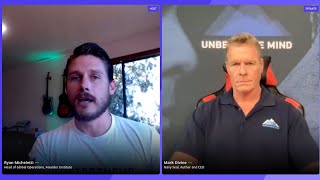
The video captures the live‑hosted $100,000 Veteran Pitch Competition organized by the Founder Institute’s Veteran Fund. After a keynote from former Navy SEAL Mark Divine on the "exponential mindset," a panel of investor judges (Emily McMahon, James Africana, Mike Shcherbakov, Taylor McLemore) evaluates seven veteran‑led startups. The segment covered in this transcript focuses on the Q&A with Brian Ferguson, founder of Candalytics, a healthcare analytics platform that uses wearable data to combat clinician burnout. Ferguson explains how the solution originated as a services business, evolved into a data platform, and leverages binge‑worthy educational content to drive adoption among frontline clinicians. He details the privacy‑by‑design approach (anonymized, blinded data) and the partnership with Whoop to ensure security. Judges probe behavior‑change challenges, data privacy concerns, and scaling adoption. The discussion transitions to the networking portion of the event, the judges’ deliberation, and the announcement that Candalytics wins the $100,000 prize. The host then outlines post‑event resources for all finalists, including connections to the Founder Institute, Veteran Founder Initiative, and Techstars, emphasizing the broader mission to support veteran entrepreneurs.
Chapters
Good morning, everyone, and welcome to the $100,000 Veteran Pitch Competition. We are coming at you live from Silicon Valley, and we have a global audience today. So make sure that you say hello in the chat and tell us where you're tuning in from. My name is Ryan Micheletti, and I'm Head of Global Operations for the Founder Institute. As most of you know, the Founder Institute is the world's largest pre-seed startup accelerator. Since 2009, we've helped launch over 5,000 companies across 200 cities with the largest mentor network in the world of 21,000 mentors. It is my honor and privilege to host the event today with an incredible lineup of veteran entrepreneurs, speakers, and investors. I've been helping build the veteran ecosystem since 2012, uh, first as the co-founder of VetTech, which was the very first veteran startup accelerator based in Silicon Valley. And over the last decade, I've been working with the startup community, having launched over 500 startups directly through the Founder Institute program and the VetTech Accelerator. So my mission over the last 10 years has been to help unite the veteran startup ecosystem to support, lead, and accelerate the creation of veteran-led startups. My personal belief is that this generation of veteran entrepreneurs will become the greatest generation of world and business leaders, and now is the time to empower these veterans to build companies and technologies that will positively impact humanity. And so that's why I'm excited to officially announce the launch of the Veteran Fund, which is a $10 million pre-seed fund to invest in great startups led by our nation's heroes. So I'd like to take a moment to thank all of the partners who have come together to support this event, including Patriot Bootcamp, PenFed, Bunker Labs, Warrior Rising, Vets in Tech, Techstars, and the Veterans Trust, among many others. And so I'd also like to give a very special shout out to Mike Frazier. Mike, I see you here in the audience. Mike is an Air Force veteran and member of our community who's helped lead the way to pave a better future for veteran startup founders. So without Mike, this event and the Veteran Fund would not be possible, as he is the first investor in LP that is investing in the Veteran Fund. So we had over 500 people register to attend this event and 140 founders applied to pitch. The competition was very fierce and we've selected 7 finalists who will present to you today. So let's go ahead and get started. In a moment, I'll introduce Mark. Mark is going to give the keynote today on exponential mindset for the exponential age. Then I'll introduce our panel of investor judges who will be the pitch competition judges. Once the pitches are complete, we'll do some light networking using Airmeet while the judges convene backstage to select a winner. And finally, once the winner is announced, we'll have a heavier networking session so that everyone here has a chance to meet with other veteran entrepreneurs, investors, mentors, and partners. And so as a reminder, this is a live international event. So say hello to everyone in the chat. And if at any time you have questions, go ahead and put it in the chat. So we'll try to get to them during the Q&A portion of each of the pitch sessions. So I'd like to introduce Mark Devine. So Mark is an expert in human performance as displayed in mental toughness, leadership, and physical readiness based on an integral warrior-leader model, which I'm really interested to learn more about. Um, he's developed that and he's taught it to executives, top athletes, professionals, first responders, and of course warriors as well. Um, he's founded several highly successful companies including SEALFIT, NavySEALS.com, and he also co-founded the Coronado Brewing Company. Mark, next time I'm down in Coronado, I will, uh, definitely stop by. So Mark, welcome. Thank you for coming out to support veteran founders. How are you doing today?
Ryan, I'm doing great. I'm really honored to be here. Thanks so much for inviting me. Thanks for the Founders Institute. Vets really appreciate the support. And I agree with your assertion that veterans make phenomenal entrepreneurs and they have a global perspective and they are going to, we are going to lead the this world to a more positive, peaceful, and prosperous place for all. So thank you for doing your part.
Amen, brother. I'll let you jump in with the presentation and feel free to take it away. Yeah.
All right.
Who—
yeah, when Ryan asked me— well, thanks everyone for being here. And I've only got about 20 minutes, so we're going to get right at it. And then we'll have a little time for Q&A if anyone's got a couple of questions. I've got a hard stop at the 30 mark here. So when Ryan asked me what a topic was, I said, well, you know, we're entrepreneurs and we're dealing in an exponential age. And so I thought, well, let's do something on that. And entrepreneurs need to really understand what's going on in this environment if you want to, you know, obviously succeed and succeed at a high level. But the other part about that is in order to deal with an exponential age, we have to develop a certain type of mindset for that, and I'm calling it the exponential mindset. So how do we develop an exponential mindset for an exponential age? So let's first talk about an exponential age, and this won't be anything new, but I, you know, it's helpful to kind of summarize what we're talking about here. We're in this age now where, um, certainly very different than when I launched the Coronado Brewing Company back in 1996. We were in the linear age still in '96, although the internet was just kind of coming online, you know, his first iteration after the Netflix— not Netflix, but Netscape browser came, you know, democratized access to the internet away from DARPA and the early kind of techno users in academia. And so I remember actually using AOL and a real web browser called WebCrawler to scrape some information for my business plan The Coronado Brewing Company, which I wrote in my closet while I was in Hawaii at SEAL Delivery Vehicle Team One, 1995, late '95. How interesting. I had a dial-up connection and it took forever, but unbelievably there was information that I could find, especially from the Craft Brewers Association had a website up there in 1995. Super cool. But guess what? Here we are, 2021. The speed of technology development is just rapidly accelerating. And it's— and we've all heard about Moore's Law and how, you know, we're just compressing more and more into less and less time. So the speed of tech development is just accelerating. It's going exponential. You've ever seen any exponential curves, you know that everything starts out slow, and then when all the conditions for the network effect take hold, then you just get this hockey stick. Well, of course, we want to see that with our revenue growth and our customer acquisition with our companies, but it's It's happening also all around us with all different types of technologies. That's also leading to a rapid decrease in cost. When I launched my first website, I mean, it was a, a very kludgy affair. It was very, very expensive. Navyseal.com, you know, we had this e-commerce platform and, you know, we had, we had all sorts of developmental money into that. And now you can do it point and click, right? With, with, uh, with a real simple piece of software. The costs have come down. Software has democratized access to a global platform. Now, that is incredible. So you have an opportunity right now as entrepreneurs to meet a global audience where they are with open source, decentralized, and universally language software that, you know, can be programmed by your kid It's phenomenal. So it's— there's no better time to get into business, but you also have to recognize that whatever business you get into will be a technology business first and foremost. Even if you're going to provide, you know, CBD oils, right, you're going to have a technology platform that will be able to access a global audience. So you need to be thinking about What's my, what we call digital unicorn platform, regardless of what your product or service is, how am I going to communicate with, to mobilize a global community of followers, of clients, of customers, of vendors, right, in this integrated holistic system that your business is gonna operate from? 5G connectivity will be very soon connecting the entire planet. We have new simulated human realities coming online with the metaverse, and language is no longer a barrier. For one reason, because most people do or conduct business or commerce in English, but also you have the ability to translate language universally through things like Google's Universal Language Translator. Eventually, that might be a chip implanted in us, like Star Trek, where we can just understand all languages. So the age of the linear, the human, the linear age, the skills that were valuable for leadership and entrepreneurship have been taken over or will be soon supplanted by artificial intelligence. Planning, decision-making, a lot of that stuff will be, you know, a lot of the rational linear things that we had to get good at, what I'll call horizontal skills, are being taken over and done better by AI and robotics. So anything that you learned in school up to this date is probably obsolete. And the Newtonian laws of cause and effect, which are relevant in terms of making things, are not relevant in terms of what you need to develop as an exponential leader. And those things are replaced with the themes or the skills of creation. The skills that are going to allow you to thrive in an exponential technological age are creativity, conceptual ideation, being able to conceptualize things that don't exist that an AI or a robot isn't going to be able to see, agility and adaptability, which you have in spades as a veteran, the ability to contextualize things from multiple perspectives, and the ability to transform yourself, your team, and your organizations continually. So we as individuals, our teams, and our organizations, which now will look and act a lot like organisms, will become continuously transformative, meaning there is no stable state, right? You're always going to be reinventing yourself. You're always going to be seeking to disrupt yourself and to put yourself out of business. You're always going to be, as an organism, organization, as a team, and then individually, you're always going to be trying to replace the previous version of yourself which got you to where you are today, because you recognize it's not going to be relevant to where you want to go tomorrow. So, that can be a little scary, right? We have these mental structures that we spend our— it seems like we spend our entire formative years developing through school and sports and family and religion and politics. And then we rely on those structures to make meaning and suddenly they stop working for us. And then we're staring at this abyss and wondering what the hell is on the other side. And a lot of people fall back Well, this is something I learned in the SEALs. You don't fall back, right? You run toward the sound of gunfire. You run to where the information is. You run to where the mystery is, because the creative, the creative answer lies in the unknown. It doesn't lie in falling back on the known, the linear, the cause and effect. It doesn't work anymore. So it brings me to kind of part 2 here. Given this scenario of us living in this exponential age with increasing speed of tech development, decreasing cost, democratization of software, open source, decentralized, universal, global, 5G connectivity, metaverse coming online, universal languaging, and entering this new age where conceptual skills are the main source of your leadership power. The question is, how do we develop that? How do we develop an exponential mindset? I already mentioned that I think veterans have a leg up than everyone else because we've been talking now for the past couple years about how the military environment of VUCA— volatile, uncertain, complex, and ambiguous— is an extraordinarily powerful learning ground and developmental ground to develop an adaptable and agile mindset or way of being, which is what's required for our organizations/organisms to thrive in a world that looks a lot like VUCA battlefield of, you know, of the military environment. And so we already have adaptability as veterans and we already have Agility, the ability to move quickly. And so now we got to apply these skills of resiliency to our own growth. And we need to take a new perspective on growth, on our own development as leaders and entrepreneurs and as just human beings. They're all intertwined, right? We can't— we don't— this idea that we are one way at work or as we develop our organizations and we're another way at home, it's not valid anymore, right? We are who we are wherever we are. And so it's incumbent upon us to bring, develop and bring the best version of ourselves, the most creative, the most expansive, the most inclusive version of ourselves to whatever environments we operate, to include the teams that we develop or create and develop to run our organizations or to navigate our organizations through VUCA. So adaptability, agility form the foundation of resiliency, which then allow us to give us the courage to develop ourselves in these new ways that are uncharted terrain. Not unlike standing at the edge of that parachute, you know, of that ramp for your very first freefall jump. And it's nighttime and you're gonna be, and you're like, holy shit, I'm gonna hurl myself off the edge of this ramp. And plunge 125 miles, 120 miles an hour down to earth. And, you know, if I don't pull my parachute, then I'm dead. That takes a little courage. But when you do that and you just experience the thrill of the free fall, and then the, the complete utter exhilaration of seeing that parachute above you, thank God, and you float to the ground, it changes your perspective. Life is suddenly different. That's what it's like. That's what I mean by stepping into the abyss of developing an exponential mindset. So let's talk about this exponential mindset. The qualities of the exponential mindset, I can, um, I posit that they'll come from what I'm calling the zero point. The zero point is the transition between using your mind, and I'm not just talking about your brain here, but using your mind, your whole mind, in a linear causative way, which is what we were trained to do and what we were led to believe was the way that our minds work, and we cross that Rubicon to use them and be able to use them in an exponential way. So the zero point can also be likened to like the still point when all rational thoughts have dissolved, and yet you're left with total knowingness of something. You know the direction to go. You know what's right. You have an overwhelming sense of being on target, on point. We could also call that flow. There's many nuances to flow, but one of the things that I think is true from my perspective is that flow happens when you get out of your head and into this still point that I'm talking about, where information is flowing directly from whatever word you want to insert, right, to explain universal intelligence, the field of all things, the matrix, and you have access to that, and that information is flowing to you, and your vessel, your mental vessel, is pure enough and clear enough to be able to receive it and act upon it, and the acting is spontaneous, it's intuitive, it is connecting with other people, meaning it's expansive and inclusive as opposed to contracting and exclusive. So as I'm talking, you can see that, that literally almost 99% of all the decision-making that's being made in the world today, with the exception of enlightened entrepreneurs like you, is contracting and excluding and actually doing some harm. When you operate from this still point, the zero point, you can do no harm. Because you're, you're operating with 3 qualities that have universal value. One is truth. Falsehood cannot exist in the still point. It's just a level of truth, and it's up to your mental capacity to discern the truth. And truth, especially in business and entrepreneurship, is always the right path, no matter how challenging it is. And this is what, you know, takes courage. Courage to follow that truth and to speak your truth and to build a company based on truth. The second quality is wisdom. Everything up to the still point, everything that happens in the linear causal world, everything that's going to be now replaced by AI and robotics is about knowledge. Data and knowledge. Everything on the other side of the still point is wisdom, and there's a very palpable difference between knowledge and wisdom. The difference is knowledge comes from rational thinking and wisdom comes from heart thinking. And so the still point opens up a direct pathway, like an elevator, a high-speed elevator to your heart's intelligence. We now, of course, know from medical communities studying the heart and organizations like HeartMath that the heart actually has neurological processing capacity and neurotransmitters. It is part of our brain system, but it's more than that. It is what brings the mind its wisdom. And then the third quality is love.
Right.
This is another area that I think we as military veterans really understand more than the average entrepreneur or the average individual, because we've seen love displayed in its many different forms, you know, in a far more acute and rich manner than most people. You know, the love for your teammate, for example. I mean, I don't— there's not a single person in this room who hasn't hugged their teammate and said, I love you, man, or, you know, woman. You wouldn't say, I love you, woman, of course, but, um, I would probably say, I love you, man, to my female teammates. That's just old school, but you know what I mean. That, that is a unique form of love. We don't have a word for that in our language. Or the love for your country while you can still respect those other cultures, or maybe not respect the cultures but respect the individuals in them. —so a love for all humans, a love for the sameness while we appreciate the differences and even fight for what's right for us, a love that is so intense for your teammates that you're willing to lay down your life for them. This is incredible, right? This comes from the still point. So how do we develop these qualities? First of all, let me just reinforce why they're important. These are important because these are the skills of the Conceptual Age: creativity, wisdom, spontaneity, intuitive, intuitiveness, and love. Truth, wisdom, and love. These are the skills. This is gonna— what's— these are the skills that are going to differentiate us from AI, even if AI takes a human form, and it's going to be what keeps us human. And so we as entrepreneurs need to develop these skills and continue to become self-evolutionary, and then build these skills into our teams so our teams become evolutionary, and then build them into our organization so our organisms of our organization become evolutionary. So that we can stay ahead of the technology and maintain our humanness. Now, how do we train this? First of all, you have to recognize that it's an inside job. These skills, there's no amount of doing that are going to bring you these skills. You know, you're not going to go back and get your PhD and find these skills. I can attest to that because I'm in my PhD program right now and there's no discussion of this stuff. I want to do my dissertation on, as a matter of fact, Second is to— so it's an inside job, meaning we've got— you've got to spend time every day on the inside, meaning looking inward through contemplation, meditation, journaling, visualization. This is what we teach at Unbeatable Mind, my company you see behind me. Secondarily, to begin to recognize and accept the holographic model of humanity. And, and this is where quantum physics is starting to merge with Eastern metaphysics. The quantum view of reality is that everything that we see and experience outside of us is actually a manifestation or projection of what is inside of us, of our mind. And so we want to create a billion-dollar company that serves— possibly serves a billion people and has a positive healing effect on the planet, then first see it in your mind and believe it, and then it'll happen. But it won't happen unless you also do a lot of work and you have a team who also sees and believes it. So this is why we want to train these skills together with our team. For instance, at my company Unbeatable Mind, we box breathe before every meeting and we practice future visualizations of the end states that we're looking for. As world-centric leaders and warriors impacting over 100 million people in a positive way to create a more peaceful and prosperous world. So we visualize that together because we recognize that the holographic nature of the human experience is that if we can see it inside, it's just a matter of time before we can create it on the outside. The third way we train is to develop ourselves in an integrated manner. This is what Ryan was alluding to, this 5— we call it the 5 Mountain Path. So we train ourselves physically, mentally, emotionally, intuitively, and spiritually, and we integrate those. So our morning routine, our exercise regimen, our evening routine, and then these spot drills or these moments we take during the day all reintegrate us as human beings. We recognize after a period of time of training like that that our body is our mind, our body is the projection of the mind, and everything around us can be made better through the quality of our thinking. And fourth, in this, I'm curious, if we were talking in person, I would ask you to raise your hands, but if anyone has experienced psychedelics, well, we have the saying, you can't unsee that shit. I think that every entrepreneur in this room, if you haven't had the psychedelic experience, either ayahuasca or psilocybin, or DMT, 5-MeO-DMT, then please do, because you can't unsee that shit. That is a direct unity experience that will give you a landmark or a trail marker when you go back and do your meditation to say, wow, that's where I come from. That's where all source comes from. It is unified. We are all the same. We come from the same fabric of reality, having this uniquely individuated experience. That's truth with a capital T. That's love with a capital L. Remember that. You will, because you can't unsee that shit, and it'll make you a better entrepreneur. Fifth, and I gotta wrap this up, but recognize that the team is the new leader. It's not about you. Yeah, you might be the entrepreneur, you might be the founder, owner, whatever, but it's all about your team. Your job as a leader is to get the hell out of the way and to help your team unlock its massive potential. So you are first and foremost a coach, you're a trainer, you lead by example. Yes, you set the strategy and vision, whatnot. You've got to be, you know, fired up in that and do your work every day. But your job is to unlock the potential of your team and let the team lead. You're going to get 20 times the results. And last, through these practices of self, working on yourself every day through self-mastery, working with your team every day through team mastery, and then baking this culture of mastery into your organization, you will develop organizational flow. And when the organization is flowing and all the team members and yourself are flowing, then, then you've reached that zero point. And you have access to all creativity and all knowledge and all wisdom, and you will build your businesses with love, and you'll meet Ryan's vision of making the world a better place through your actions. Thank you so much for allowing me to present. I wish I could meet you all in person. Good luck for those of you in the competitions. Good luck with your businesses. You guys are going to crush it, and I look forward to watching your progress.
As we say in the SEALs, hoo-yah! Mark, that was amazing. I absolutely love this keynote. I can see why we've been brought together today. We're going to deep dive into this over a beer next time I'm down there, so I'm looking forward to that. I know you got to run. Let's go ahead. You can go ahead and jump off here because you have that other presentation. And once again, thank you so much for joining us. I really appreciate your support.
Thank you very much, Ryan. Take care.
Alright, thank you everyone. So we're going to go ahead and transition to the pitch portion of the event, and I'd like to invite all the judges up here to the stage. So before we do judge introductions, let me just quickly explain how this is going to work. So we have 7 finalists that are pitching today. We'll play their 3-minute pitch, and the judges will have 3 minutes to ask questions live here at the event. The audience can also ask questions in the chat. And so when the finalists are done speaking with the judges, they can go through the chat and answer the questions that you have. And once we run through all of the presentations, we're going to start the very first networking session of the event today so that the judges can meet backstage and select the winner. Once we select the winner, we'll pull everyone back here and we'll announce them, and then we'll kick off the second networking session of the, of the day. So first up, I would like to welcome Emily McMahon. Emily, come on up to the stage. Thanks for joining us. Let me just kick this off and say, give you a big thank you for joining us. I know you're super busy with the Academy Investor Network. Just so everyone here knows, Emily is a general partner at the Academy Investor Network, which is a seed stage venture fund and an investment syndicate for graduates in the US military service academies. So Emily, do you want to do a quick introduction? And then James, if you can come up at the stage as well.
Absolutely. So first off, Ryan, I just want to say thank you so much for inviting me to come be a judge for this. I'm super excited today. As Ryan mentioned, I'm a general partner with Academy Investor Network Ventures. We invest in deep technology startups, primarily focused on dual use, and like you said, military veteran-led startups. And I'm also proud to be on the board of directors for Patriot Bootcamp. And I know I've seen a number of folks today from the audience there. Yeah, I just want to say I'm really excited today to hear the pitches and just be a part of this community. So thanks so much.
Amazing. Yeah, we've got a great turnout of PBC alumni. So thank you everyone for joining. Next up, James, welcome. Let me just do a quick intro on you, then I'll turn it over. So James is a partner at Regolith Ventures. As a Department of Defense contracting officer, James has experience operating in a wide spectrum of commercial and government sectors. He's helped over 90 companies scale and commercialize their technology in the defense and commercial sectors. So James, do you want to do a quick intro and, and welcome to the event?
Awesome, thank you very much, Ryan. So like Ryan said, uh, my name is James Africana. I'm a partner over at Regal Ventures. Uh, we primarily invest in, uh, dual-use, so government-commercial, uh, companies, primarily focusing on, uh, artificial intelligence, machine learning, aerospace and human performance. But before that, I was an active duty Air Force contracting officer. And like Ryan said, I worked in a lot of different defense innovation hubs, really helping out startups and really getting down to the roots. But other than that, super honored to be a part of this panel and super, super impressed by the companies that have gone through.
Amazing. Thank you, James. Next up, I'd like to invite Mike Shcherbakov and Taylor McLemore. Mike is the CEO at the Greatness Collective and a general partner at the Veteran Fund. Mike has led the business accelerator, Greatness Ventures, to thousands of investor mentors and hundreds of companies in their impact portfolio. Mike, you've also done a lot of work in the venture philanthropy space. I know you build homes down in Mexico and you organize these trips. So impact is really at the core of what you do. And I think maybe that's what inspired you to help launch the Veteran Fund. So let me turn it over to you for a quick intro.
That's right. Thanks so much again for putting this together, Ryan. So yeah, as you mentioned, I served on active duty for 5 years as a United States Marine and kind of dove headfirst into the startup world. And after launching Founder Institute here in San Diego, knew that I was going to come back and serve the veteran community in a big way. So I'm really excited to announce the launch of the Veteran Fund today. So really more than a fund, we are— our investment thesis is to invest in these pre-seed startups led by our nation's heroes, we are really aiming to be more of an ecosystem. So I do want to say for the 150 startups that pitched and didn't make it as a finalist, or if you're in the audience and you're inspired by startups and stories that you hear today, we want to be that resource. So we offer fellowships to Founder Institute programs, we connect the dots to other investment and funding partners, and we just want to be that hub in the ecosystem that when a veteran founder has an idea, has a great startup, needs funding and beyond, we're the ones that help them out. So you can learn more at veteran.fund, and I'm excited to hear the pitches. Thanks again, Ryan. Awesome.
Thanks, Mike. And I appreciate your, your help with everything launching FI San Diego. And let me just say a quick word on that. You know, we do have a veteran scholarship and fellowship at Founder Institute so that veterans can join the program for free. We will help you get the traction and funding and beyond. And I'd also like to say, like, what I love about the veteran community is that you have all these different organizations, whether it's Founder Institute or Bunker Labs or Patriot Bootcamp, and everyone works cohesively to support the veteran startup ecosystem. And so it's my pleasure to introduce Taylor. I mean, Taylor, you're one of the OGs of the veteran tech startup ecosystem. So thanks for joining us today. You're both the founder and board of director at Patriot Bootcamp. You're also a managing director at Techstars. And so really excited to have you here. Do you wanna do a quick introduction?
Sure, thank you so much and really appreciate the opportunity to be here, uh, and especially with other amazing, uh, supporters and community builders. So Patriot Bootcamp supports veterans and military spouses that are on their journey to become startup founders or a nonprofit, and we appreciate deep partnership with all the organizations mentioned, and that hopefully we're just one of the on-ramps, uh, that is making sure that you have a good path to great resources that really care about your success above all else, because this thing that you all are either doing or considering is really hard. And so we want to make sure that you've got a good path forward. I also, as you mentioned, I'm at Techstars, the global platform to support entrepreneurs. We run 50+ accelerators globally. I focus on the workforce and future of workspace there. And I'm always— count me as a resource if you're trying to find a connection point into Techstars, if that's part of the path that you're pursuing. Would love to make sure you get connected to the right places.
Love it. Techstars is a phenomenal program. Founders Institute loves working with companies that come out of Techstars and sending our alumni to Techstars as well. So Taylor, really excited about the parallels here. So let's go ahead and get started with the pitch videos. The first one is going to be Empec led by CEO Herbert Dwyer. We're going to go ahead and play that video and then Herb, we're going to bring you up to the stage for the Q&A part of the event. Hello everyone.
It's an honor to be here today. My name is Herbert Dwyer, CEO, co-founder of Empec and U.S. Marine. I served the United States Marine Corps with a special intelligence unit as an NSA task cryptologist. My team's mission was to find terrorists and intercept or disrupt their communications and break advanced codes in order to save civilian lives and defeat our nation's enemies. My leadership and operational training are what led me to co-found Empec. MPEK has developed an integrated mobile and cloud-based app to help the $2.7 billion market of energy engineers, asset managers, and building owners digitize their historically pen-and-paper-heavy commercial equipment data capture processes. Professionals who audit, repair, and replace building energy equipment are still stuck in the analog era, utilizing nearly this exact process shown in the slide. I know this because I was one of them too. I've completed over 300 energy equipment audits using pen and paper. Surprisingly, pen and paper data capture are the norm in this industry. It's time-consuming and fraught with errors. Having worked as a Marine for one of the most efficient organizations in the world, the United States Marine Corps, I figured there must be a better way for a very large industry that still relies on pen and paper. While a small handful of industry professionals have turned to smart form software to digitize their age-old analog ways, the Impact team decided to leverage AI machine learning to provide the market with the fastest and most accurate scalable method to capture, record, and report equipment data. Since the release of MVP, we have seen some of the largest players are in our industry to include the U.S. Army and Marine Corps drop their pen and paper, and decide to use their smartphones instead. Our first of its kind fast site survey technology is a major industry game changer, saving our customers on average 70% of their time. For example, an engineer being paid fully loaded $100,000 a year, the savings could equate up to $70,000 per year per employee. Customer feedback thus far has been very positive, and now the challenge is to acquire market share as quickly as possible. We make money not only from SaaS fees but also from other sub-products we sell like peer-to-peer equipment financing and in the future data monetization. Our team has over 120 years in the it, equipment finance, real estate, and management industries and is the perfect team to scale this solution. I hope you choose Empec as the winner of this Veteran Founder Competition. We have the solution, we have the traction, we have the team. All we need is your support. Thanks again. Happy to take any questions that you may have.
All right, awesome. Herb, it's great to see you. Thanks for coming out to pitch. Let me, let me turn it over to the judges. And again, founders in the audience, you can go ahead and ask questions of Herb, and then after Herb's done here, he'll be able to jump over there. So for the judges here, does anyone want to start off with a question? Let me ask you this, Herb. I'll kick it off. You know, I'm a little bit familiar with MPEG, and so why is right now the time to grow your company quickly? I know you just released the FastSight survey tool, but what was that insight that really kickstarted your growth in that direction versus the financing route that you previously took?
Well, you know, we determined that, you know, capital is just really a race to the bottom. It will become a pricing issue, and we didn't want to play that game. We wanted value-add, and we really wanted to bring a technology to the market that really made an impactful difference, uh, and obviously, um, and be a big disruption in the industries that we all came from, uh, that is still relying on analog processes to do their job.
I'll jump in with one. What have you learned about willingness to pay within your customer segment, and how's that informing your, your march towards product market fit?
Yeah, you know, it's a really interesting question, um, and we get that often. The— it's not really around a willingness to pay, uh, so much as how much value are we adding to the day-to-day for these particular, um, people. You know, we found that the, the specific users aren't really the, the payment decision makers, it's really their bosses. So we're really, um, talking to two different types of, of groups and people when we're out pitching and, you know, to customers and onboarding various customers. But yeah, the willingness to pay is really about how much value that we've added, and we do have a process that we walk them through to compute the value add that we have and make it into a numeric number that makes sense to a manager, to a purchaser.
I've got a question, Herbert. How would you use the winnings from the pitch competition if if you were to win?
Yeah, specifically, we would actually hire within one of our three stools, which is marketing, sales, and it, depending on when the money would actually come, would be dependent on where we would invest the time. But right now it's really about people and about scale. So more than likely it would be put towards hiring a new worker.
Let's do one more question. Go ahead. Yeah, Herb, I'll just jump in.
It looked like your growth strategy, you're at 1,000 users now, aiming to scale to 32,000. I was going to ask you, what is— how do you plan on doing that? And when you talk about pipeline, can you elaborate on your pipeline?
Yeah, so really, the pipeline is twofold. There's the fast site survey, which is the SaaS side of the house, and then we have— which it brings financing opportunities. So there is a separate finance pipeline, but let me just address the fast site survey because that is our main driver of the pipeline. So as I mentioned earlier, there's a three-legged stool. It's sales, marketing, and it. It is really being driven by the feedback that we get in real time from our customers. So it's an iteration sort of build. But of course, around sales and marketing, it's really about reach out. We're getting to a point where word of mouth, it's super important in conservative industries like engineering, HVAC. They do things in old school to get the word of mouth out. But a lot of that has to do with a quality product. It has to be, you know, do with getting out to these conferences, to making phone calls, like literally picking up the phone phone, making hundreds of calls a week, and we do that every single week. That's part of the game plan, you know, and there's a lot of, you know, online activities as well, you know, social media, you know, email strategies, you know, press campaigns, things like that. They all kind of all fit together into our marketing strategy.
Amazing. Herbert, thank you for joining us, and congrats on being selected as one of the finalists. I see a couple questions here in the chat for you, so we're going to go ahead and move over to the second pitch, and, uh, we'll see you on the other side. Appreciate it. All right, our second pitch for today is Mountain Aerospace Research Solutions, led by CEO Aaron Davis. Um, they're based in Boulder City, Nevada, and they're the manufacturer of the Fenris engine, which is a revolutionary new rocket engine that will help reduce emissions and improve space access. So let's go ahead and get the video going. And I'm the CEO of Mountain Aerospace Research Solutions.
You can find us online at MarsEngines.com. I'm a former United States Marine Corps Aviation Ordnanceman and combat veteran. My co-founder Scott is an astrophysicist and aerospace engineer with 16 years in the industry. Our advisory team has a wide range of experience and aptitudes. Some are legends in the aerospace industry, others in the realm of business. Each of them has earned my trust and respect through their dedication to our mission. This is our new engine, the Fenris Mk-II X-Ray. It is at the pinnacle of what's possible in propulsion. Nothing else comes close. Our company has cracked one of the toughest problems facing the aerospace industry. These are a couple articles on our first successful test. They were published in Wired and Ars Technica. The problem facing the aerospace world is that both rocket engine and jet engines have almost been perfected, and yet they lack the power and efficiency needed in order to reduce emissions and launch costs. This is why we're going to dominate the propulsion propulsion market. Both jet and rocket engines have their respective uses, however neither one is good at both. Our engine is better than either at both. This is a visual representation that shows the problem we have solved. Currently the areas in red represent the portion of each vehicle dedicated specifically to fuel. It is clear to see how inefficient each type of vehicle is. Just imagine if 95% of your car was dedicated to carrying fuel. Our engines are going to change the entire landscape of the aerospace industry. We can offer our customers what nobody else can. A way to increase payloads while reducing all other costs. All while reducing or eliminating greenhouse gas emissions. Our engines are a massive net positive for everyone on this planet. How much better? This much better. These are real numbers on real engines. SpaceX currently has the best traditional rocket engine followed by EnergiaMash. From Russia. Our engines are vastly more powerful and efficient than either. This is a visual of our fuel efficiency compared to their engines. Less is more in this instance. On these charts from Berkeley, you can see our engine stacked up against other engines when it comes to putting payload in different orbits. In these graphs, being vertical and to the left is where you want to be. In terms of payloads delivered to each orbit, we dominate other options currently in use in terms of cost and and performance. We've made steady and consistent progress for the last 4 years. We expect 2022 to be the first year we turn a profit. We have excellent per-unit margins and the intellectual property to defend our place in the market, with 4 patents issued on our unique engine. The global total market for our engine is $74 billion per year. We're going to try and take the whole thing. With our advantage in cost and performance, it is not unreasonable for us to expect success in that regard. I would like to thank everyone in attendance today, and I look forward to making your future faster and more efficient. Thank you.
All right, Aaron, welcome. Uh, you're working on some revolutionary stuff here. I mean, we're talking about like air-breathing rocket engines that are vastly superior than other ones. So like, how did you come up with this idea?
You know, I was just like any other idea— where do they come from? Nobody really knows. Uh, I hired my co-founder to prove me wrong because I don't have a background in aerospace as far as design and, you know, not a rocket scientist by trade. I'm a Marine. So I have to assume that I'm wrong in the beginning. So that's why I hired Scott, and 4 years later, he's my, you know, vice president.
Yeah. Awesome. Judges, I'll turn it over to you. Who'd like to start with the question?
I'm happy to kick it off, Ryan. Aaron, great presentation, by the way. Fascinating technology. This seems like a company that requires a lot more time and a lot more money than just $100,000. How do you plan on being efficient with that capital, and do you foresee it requiring a lot more capital?
Well, we've gone as far as we have based on, based on us just bootstrapping. We're approaching our second large-scale test here this spring. As soon as we get some customers from the commercial side or some SBIRs, which we're applying for, from the government, we should be able to continue development and move this into the realm of, uh, you know, flying full-time on, you know, commercial and military vehicles. So it takes time. Aerospace is slow, it's capital intensive, but it's worth it. It's important to everybody on this planet.
I have a question, Aaron, um, in terms of, uh, you In terms of traction, have you received any sort of LOIs? Have you engaged any customers over in the commercial and defense side?
We are currently in non-disc— we have a few customers interested. Everything's kind of pending our next test. So a lot of our discussions are under NDA right now because our customers have specific needs that I can't really, you know, vocalize in this open forum. But, um, as you know, hypersonics are really big right now. It's a huge market. Uh, Defense Department's very interested, and like I said, nothing, nothing else comes close to this. Nobody has an answer for what we've got.
Let's do, uh, let's do one last question, then we'll, we'll move forward.
How defensible is this intellectual property versus how much is speed of market capture going to be important for your long-term success?
Our patents are well executed. They're very clear. They're extremely defensible. There's only one way to do this, and we've come up with a way to do it. So for the next 25 years, as far as I'm concerned, this is our product.
Impressive stuff. Thanks.
Thank you.
Awesome. Thank you, Aaron. I see that there's a couple of people that want to connect with you in the chat here. Glenn, good to see you. Thanks for joining us today. Let's go ahead and move on to the third pitch of today, which is Enrichly. The founder is Margo Baines. So Margo, we'll bring you up in a moment. Let's go ahead and get the pitch started.
Behavior and suicide have one thing in common amongst youth, and that's unhealthy self-esteem. What if I told you there are over 60 million children around the world that suffer from this? Well, my name is Margo Jordan and I am the founder of Enrichly. We are strategically leveraging technology and data for kids. To date, we already have 9 licensees in 2 countries. We have over 1,000 enrollments in the platform, and we've delivered over 60 school contracts. And that's unhealthy self-esteem. What if I told you there are over 60 million children around the world that suffer from this? Well, my name is Margo Jordan, and I am the founder of Enrichly. We are strategically leveraging technology and data for kids. To date, we already have 9 licensees in 2 countries. We have over 1,000 enrollments in the platform, and we've delivered over 60 school contracts. 75% of kids ages 7 through 11 suffer from low self-esteem, and 68% of those kids face unreached potential. There's literally been a 57% increase in suicide death due to low self-esteem in kids. When a child has unhealthy self-esteem, the parent is faced with a child who might be bullied, they have unhealthy coping skills, and they may be socially awkward. The schools are faced with an increase in teen pregnancies and student violence and a decrease in academic achievement and overall student involvement. But with my background in finance as a military veteran with a passion for social impact, I've been molded into the perfect leader for this company, and I've put together a team with a combined 50 years of relevant experience. So we're the experts in self-esteem development. In '16, we produced amazing conferences. In '17, we built the brick and mortar. And in '18, we won contracts with schools, all centered around self- self-esteem development. But when the pandemic hit, we needed a way to pivot and continue that impact. So we developed the first prerequisite to social and emotional learning through our self-esteem-based e-learning platform and gaming app. Our self-esteem modules can be implemented via our platform in weekly sessions in schools. Parents have the option to subscribe to our platform for unlimited access to the courses, content, and curriculum. Our AI-backed gamification integrates invisible learning our system creates experiences based on the user's responses. The data that we collect is actionable because we're measuring things like a child's growth mindset, their grit, and most important, their self-esteem. Our ability to connect parents with trusted mental health resources ensures the appropriate intervention. And our competitive landscape is strong because there aren't any other platforms strategically targeting self-esteem development in a peer-driven fashion. This allows us to confidently say we'll capture 10% of this market by year 3. Our revenue model is brilliant because we're generating sales through licensees, parent subscriptions, and school contracts, giving us an 80% plus profit margin. Our customer acquisition strategy is to the point. We'll use youth conferences to funnel our customers through, and I will attend speaking engagements. We're also going to use the power of social media and tap in with mom influencers. Lastly, we will put funding towards digital ads and mailers. This underwrites our capabilities to gross $124 million in revenue by year 3. We're currently raising $1.3 million on a SAFE, and we need your help. Back our platform and help us tackle this issue of unhealthy self-esteem in kids globally.
All right, Margo, welcome. Uh, first of all, I absolutely love the problem you're solving. I mean, Instagram and TikTok has just shatter the morale of children. And so I would love to kind of get an idea from you. Like, what was the— like, you seem like you're an expert in the space, but what really kickstarted your journey to help with self-esteem?
Thanks for asking the question. So growing up in Milwaukee, Wisconsin, as a little girl, I suffered from low self-esteem, and as a result, I had unhealthy coping mechanisms, and that led to a lot of unhealthy decisions. I saw that was a problem with a lot of the kids that I grew up with. So I went to the military, I developed some sense of self-discipline, um, valuing myself, and I really learned how to love myself so that I can reach my full potential. Um, I went into corporate America and I was not really doing what I loved, and I figured out a way to make an impact while generating revenue. So in essence, I am creating opportunities for both shareholders and stakeholders. Awesome.
I'll turn it over to the judges. Who'd like to ask the first question?
Margo, um, Mikey, I just had a question. It's, you have an impressive number of school contracts, which is sometimes a tough market to crack into. Can you share more about that, sort of your strategy and how you've been successful in that? And are there any, like any other partnerships that might be of interest that are sort of comparable to schools, um, similar to that?
Yeah, great question. So we actually— my first startup was called Chicks with Class, and I generated a lot of relationships by developing the self-esteem learning programs for girls ultimately. And the schools would always ask, do you have anything for boys? Because the kids fell in love with the curriculum, the engagement. The teachers saw how their behaviors were changing, how the grades were being impacted, And we really retained all of those relationships, and it was literally word of mouth. They heard about our program, they heard about what we were doing and how we were improving the students, and they just wanted to bring us on. And that continued after the pandemic when we switched to this platform here. And the teachers, they love it even more because it gives the kids the ability to go— they can sit in their homerooms and they log into the platform and they're learning about self-esteem We talk about things like bullying, social media. We also bring in tween celebrities, and that really decreases the churn rate, and it really increases the engagement. That tween celebrity piece is key to our target audience. And thinking about future relationships, we're working with larger youth-led organizations. We're also going to transition for the technology to be used amongst other larger organizations. Organizations because healthy self-esteem is not just an issue with children, it's also an issue with adults. So that's something that we're transitioning into, and a lot of our customers have been asking us to offer that for adults as well.
And Margo, I just want to say, very inspiring mission. At this stage of startups, as investors, we often bet more on the jockey than the horse, and you are— you're a winner, whatever you end up doing. So I want to congratulate you. On the traction you have so far. You do have some aggressive growth targets going— I saw $300K in revenue, then $1.2, and jumping to $56 and $120 million. Based on your growth strategy, a lot of that was around conferences, and my question is kind of two parts, and then the other part was you speaking at these events. Given what's happened with COVID and obviously conferences not happening, how does that affect your growth strategy, and how do you still plan to execute on those lofty and optimistic targets? Great question.
So we don't see any intimidation when it comes to reaching those targets, really, because our revenue is generated from parent subscriptions. I just did a TEDx talk. I haven't launched it yet, but as soon as I do launch it, I do plan to get millions of views on the nourishment of self-esteem. That's also going to lead people to want to subscribe to the platform. So not only are we going going to attend speaking engagements, but the youth conferences will funnel the customers through, even if they're virtual. Being in a virtual world is where we are now. So as opposed to reaching, I don't know, 300 people at a youth conference, we can open it up globally so that we have hundreds and thousands of children and their parents viewing our platform, viewing the speaking engagements, and they're connecting with us from their homes, but they're in an entirely different country. This is why we've already expanded into Dubai and Canada, and we have licensees in all of these different geographical areas.
I have a question for you, and I'd love to ask this. Maybe this will be the last one. So you have your team. I didn't see anyone that was kind of like the CTO or the person with gaming experience, but can you dive in a little bit more as to like, who on your team are you looking for? Because venues like this, right, there may be someone in the audience who's really inspired by what you're doing. So how can the people in the audience help? Who are you looking to attract as part of your team?
Great question. So Cass Milner, he's actually one of our advisors. He's an expert in artificial intelligence. Right now we're doing the legwork and we're sort of bootstrapping the discovery phase by bringing in human experts. Efforts to really develop the algorithms for the platform and for the artificial intelligence. So we're really looking for people who understand what artificial intelligence needs to have implemented in order for us to reach the targeted goal. So we're, we're outsourcing the development of the technology with the company that's local here in Houston. They're really amazing at what they do, but we do plan to bring them in-house Um, but any software or engineer, um, development personnel who has a passion for changing our world through self-esteem development, who can understand how self-esteem plays a huge part in all of these other growth areas of not only children but adults as well, you'd be a perfect fit for our team. Um, we're not only looking for returns in revenue, but looking for returns and impact. So really building out this technology perfect, semi-perfect, um, in these beginning stages is super imperative going forward. And as we, um, iterate changes and as we go through these experimentation phases. So anyone who, um, has a passion for social impact, who has a passion for children, uh, you know, I have my LinkedIn information in my profile.
All right, awesome. Thank you, Margo. And just for everyone here, after the event is, is over and we start the networking piece, all of the founders are going to have a table with their name and their, their company name on it. So if you want to connect with Margo or with Aaron or anyone from today, they'll be at that table and be able to interact with you. So, Margo, thank you once again. I love what you're doing and excited to help. Thank you. All right, let's go ahead and get to our fourth pitch of today, uh, Candalitics. The founder is Clark Yuan. 3D data revolution is upon us.
Hello, my name is Clark and I'm the founder and CEO of Candalitics. We are a startup team of Army veterans, engineers, and students from MIT and Harvard, and our mission is to democratize access to 3D data and enhance human interaction with the physical world. As the winner of the Pentagon's inaugural Defense Innovation Accelerator, My teammates and I have conducted over 250 customer discovery interviews to understand the current capabilities and gaps within the field of 3D data. And what we discovered is that although advancements in 3D data collection sensors have evolved rapidly to a point where you now have LiDAR sensors on the newest iPhone 12 and 13 Pros, the digital infrastructure has yet to catch up. This is the gap that Candlelight will fill, and to show you what that means through a case study, I want you to imagine that you're an airfield manager at a deployed airbase. Your runway has just been attacked by a barrage of mortars, and now your airfield is completely disabled by craters of varying sizes. You send a drone out to capture videos and photos of the damages, but all it tells you is where the craters are, not how deep or how wide they are. So you deploy teams of civil engineers to manually measure the craters to assess how much reconstruction material will be needed. But this puts your airmen at risk of unexploded ordnances and a chance for human error in a very stressful environment. With our 3D analytics capabilities, the Air Force will be able to measure multiple craters simultaneously down to a millimeter margin of error. In fact, we've just signed a customer agreement with the 6th Air Refueling Wing at MacDill Air Force Base to solve this very problem. And to give you a little sneak peek of our product, which You can essentially think of as the Google Drive for 3D data. Here you can see our landing page with a nice little preview window for the user's 3D scan. And once you click into your file, you'll be able to access the launchpad with a suite of analytical tools such as a 3D visualizer, the ability to detect changes, uh, an option to convert 3D models to 2D sketches, and also take linear and volumetric count measurements. The best part about all of this is that you can easily access and share your 3D projects from any web-enabled device. And we have the ideal team and partners to deliver this transformative solution. My COO and I are both Army veterans, and we have product development R&D agreements with a Navy lab and the MIT Lincoln Laboratory. But we need your support. At this juncture of our company's growth, Canalytix will absolutely soar with your investment support. We will use your capital to quickly scale our engineering team and methodically expand into tangential government and commercial markets. What started out as nothing more than an idea just over a year ago has now flourished into a dedicated team that is on the brink of making 3D data accessible and insightful to anyone from anywhere in the world, and we invite you to come along with us on our journey.
Thank you. All right, nice job, Clark. So let me, let me just ask the first question here. You said you started this a year ago. I mean, you've made great progress for a year. What sparked the initial idea for the company?
Yeah, so about a little over a year ago, last summer during the height of the pandemic, my co-founders and I came together. We're— most of us were veterans and we wanted to scratch our entrepreneurial itch. So we decided to apply for the Pentagon's Defense Innovation Accelerator program. The accelerator basically basically pairs teams of entrepreneurs with DOD laboratories. They have been developing, you know, technology with taxpayer dollars. And our job is basically to identify additional markets that had been basically, that were prime for some of the defense technologies to serve the commercial interest as well. So we're paired with this Navy laboratory out in San Diego, the Restore Lab out of Naval Information Warfare Center Pacific. The lab had been, you know, experimenting with LiDAR 3D data to digitally document naval ships, we did over 250 customer discovery interviews and realized that a lot of industries actually understand the utility and usefulness of 3D data. They just lack the digital infrastructure to really visualize, analyze, and most importantly, share this 3D data over a medium such as the web. Most of them store their 3D data locally on external hard drives. And that's really what kind of launched the idea for us to build a digital platform for both governments and enterprise users to share the 3D data in an insightful way.
I'll jump in with a question. I think, you know, this is such a meaningful space for collaboration that you all are enabling. There's a lot of product roadmap surface area, though. How are you balancing sort of storage and accessibility dimensions versus interaction and usability dimensions? Because that seems like a meaningful challenge to figure out in the early days?
Yeah, so initially most of our product demands are being driven by the SBIR and SETR contracts that we've received. And obviously, as we think about sequencing our product development, the first step is to create a visualizer that will allow users to visualize, uh, the 3D data that they just captured, you know, whether it's with their LiDAR sensor on their iPhone 13s or, you know, with a, you know, uh, you know, more military-grade LiDAR sensor. The next step is to create the initial platform for you to upload it store it and to be able to manage that data yourself. And then we add on the bells and whistles of the additional tools. So the visualizer is already complete. We are well on our way to having our MVP launched by the end of January. And the additional tools that we'll add on initially is the differential analysis algorithm, which is also complete. We demonstrated this technology for the Coast Guard, and this is what the Air Force is really interested in, because when you take a base scan of an airfield and then you overlay a second scan, say post-attack or post-hurricane, some sort of post-event, you can very quickly identify where the damages are and, you know, like what the differential looks like in real, real near real-time 3D. Great, congrats on the progress.
I have a quick question. Um, so what current phase are you in the SBIR/STTR program, and, uh, what are the— basically, what traction do you have for follow-on contracts more in the phase 3 and beyond realm?
Yeah, so great question. We were actually up until 6 AM yesterday but we finally submitted our Phase 2s for both the SBIR and STTR for the AFWERX open call challenge. So the Phase 1 was great. We were awarded that in March of this year. Spent the summer talking to various Air Force stakeholders, landed on the 6th Air Refueling Wing down in Tampa. So they are our primary customers for this technology. They're going to be piloting the technology, and we have them in mind when we're developing. But in addition to that, we've also spoken with Red Horse units, you know, large construction and recovery units, but most importantly, also with the Air Force Civil Engineering Center, AFCEC. And AFCEC basically is in charge of the schoolhouse, in charge of the training and doctrine. And they're very interested in this technology from an airfield damage recovery perspective, especially with great power competition, you know, ramping up, you know, how do we deploy this technology to potential future battlefields and how do we get this out into the Air Force as a whole? So I think once we test our technology, assuming that we're awarded these Phase 2s for both the SBIR and STTR, we're really kind of angling towards AFCAC for, you know, greater enterprise distribution amongst the Air Force.
Yes, Clark, it's good to see you again. I know you pitched this morning, I believe, at the PenFed event. So just want to say, what— who do you think is your next key hire for your company right now, or hires?
Yeah, so the $100K capital will go directly into the product development team expansion. We're looking to bring on another full-stack developer to help our product developer right now, Parth, quickly scale this solution. We can build the MVP on our own right now and we think we can build this within the next 2 to 3 months. But as we start to scale some of these bells and whistles and really start to scale some of our software developments, we're going to be expanding the software development team pretty pretty quickly here.
Clark, just a quick question. By the way, very compelling technology, great presentation. Competitive landscape, is there anyone else out there doing what you're doing? And then it seems like you're on a really great growth track. What are the— what's the biggest hurdle that you see coming up ahead?
Yeah, so we've definitely done our homework in the competitive landscape, and you can think of companies like Esri or Textron, ClearEdge 3D, Pixies. There are a lot of companies out there who are trying to build visualizers and analytics capabilities for 3D data. However, what we found is that most of these companies build standalone desktop solutions and applications. That's our biggest competitive strategy or distinguisher here is that we're building this application and capabilities directly onto a web browser. You can access it from your phone, from any web-enabled device, At the same time, also giving people and users an option to do offline data download. So if you're in a signal-denied environment, like with the Coast Guard on the high seas, you can at least capture the 3D data, upload it, and visualize it. But some of the more advanced analytics capabilities, you will be able to access that once you get onto a web-enabled device.
All right, awesome. Clark, thank you for joining us. Great presentation. The fifth pitch of today, I'd like to invite Dr. Matt for Venture Up. So The next company is Proven Performance Technology, also known as The Predictors. Let's go ahead and get the video started.
Greetings all, I'm Matt Proventure, and I had the privilege of serving the Navy for 27 years as an orthopedic surgeon. I served at the West Coast, East Coast SEAL teams overseas, and also had the opportunity to spend 5 years with the New England Patriots as their head team physician. Well, for the past 6 years, I've worked at Steadman Clinic in Vail, Colorado, getting professional athletes and service members back in the fight. And this is where we began our story, helping our Navy Special Forces by developing a human performance program that emphasized injury prevention and wellness through data-driven insights. Through this, we're able to save the government $30 million a year in training resources. Well, who are we at Proven Performance? We've taken our battle-tested data and given it to the fans to provide them a competitive advantage in fantasy sports and wagering, use our predictive analytics and behind-the-scenes information. The gambling market as well as fantasy market is huge, approaching $750 billion a year by '23. Why we're different. We're one of the first to tie injury to performance. 10 years of data. We've interpreted millions of data points with huge AI and ML and robust behind this, as well as an elite orthopedic team where we, we've interpreted the injuries. We have 100 years of sideline experience on our team. We have a web and iOS product called thepredictors.com. It's very robust and arms fans with a lot of data to help them win. We started a Fox Sports partnership, now in our second year, and we're their number one digital media product this year. And we had more than 19 million views in 2020 in a continued partnership as their head of performance and injury analytics. We have numerous revenue streams. You can see here advertising, B2B, media, user subscriptions, and we're building all of those verticals with these products. The BUS score, banged up score, showing how health matters. This is very important and the cornerstone of who we are. Predicted fantasy points, player performance score. We can predict numerous points and we're as good as any in the game matching with the top 3 fantasy point predictors. We also have fantasy knowledge house. How do running backs do after ACL surgery? How do wide receivers do with hamstrings? We have hundreds of these and we're able to push this out with an API. Gambling data, super important. We're excited about this. Health matters, it moves the needle. And we have Moneyline Mauler. Proven performance management team is exceptional. We have a great team, both US as well as overseas. Many of these are veterans themselves. And what will we do with the investment to get better and improve? Product one, the bus scores, media presence, gambling API, and a gambling house partnership. I want to thank you for your time and kind consideration. I look forward to questions.
All right. I see Chris, our Las Vegas director, is very interested in the gambling part of this. So, Chris, I'll make sure to connect you and Dr. P. Welcome, Dr. Provencher. Great pitch. I'm going to turn it over to the judges to ask the first question. Well, I'm happy to ask the first question then. So you have a ton of amazing experience here, right? I mean, you were head physician for the SEALs and then you moved over to the New England Patriots. What have you seen in terms of this technology being applied to spaces outside of gambling? Because I would assume you went to the coaches first and you said, hey, we've got this prediction technology. What do you— what are other applications that you've seen?
Yeah, Ryan, thank you. And that's a really important question because where we really started was in the military. We wanted to be able to know where to dedicate our resources by using big data and better testing. We had a lot of stuff on paper, a lot of stuff on spreadsheets, and through that we were able to help our warriors perform better. And so the great news about this is I'm still involved indirectly and directly through this exact project product with numerous companies that are helping with data and development. So what we've learned and our lessons are going directly to certain companies, including companies such as Spear and Titus that are helping our warriors perform better. And you're also right, Ryan, we brought this in-house to, you know, a team like the New England Patriots where I was head team physician for multiple years. And, you know, Bill Belichick in his top secret ways, he loved it, and we were able to really develop algorithms of performance. And really, the cornerstone of it was injuries and how you get better and how our players, how our special operators, how our military folks, how our Marines and men and women did. And that's— that was a cornerstone. This is how we developed. And now we've found a way to take that to the outside and use data from— that we've collected from the NFL and many others to put this out there arming the fans with some battle-tested analytics.
So I'd love to jump in on that point. There's so much growth and opportunity in this space. Well, it's also been a category that's been around for decades, which is exciting. But how much are you thinking about growth as a platform partnership approach? Because a lot of the audiences have already been developed versus really trying to own audience.
Sorry, I did that. I'm sorry, I missed the last part.
Sure. So, sorry.
Go-to-market strategy, reliance on partners that have already built audience versus your desire to also build your own audience that would be owned.
Hopefully that came through.
Yeah, you know, it's amazing. I didn't know the audience that we could potentially have. And when we partnered with Fox Sports as their first head of injury and performance analytics, We found that there's an incredible thirst. If you turn on the television, you turn on Fox Sports, you turn on ESPN, what's on the bottom ticker of all games is the injuries. And so health matters. Injuries matter. Health matters. And that's one of our sayings. And so, Chris, I think to answer your question, we've found that we can grow this brand organically, and we've found that now with millions of followers, 25 million views already this year just in the NFL season. Season, which is by far their number one digital media product. They're committing a lot of resources to it. But on the other end, we still have our own company and our own data sets that we are hoping in a B2B world to be able to work with very large sports data companies that I think you alluded to, to be able to get their analytics better. And so we have a whole data set that we can weave in, but we, we do know there's an incredible thirst for it. At 25 million unique views.
Thank you. Any final questions from the judges? Okay, Dr. Proventure, thank you for joining us today, and I look forward to reconnecting. Thank you all. Yeah, the second to last pitch is Canopy Aerospace, the founder Matt Shea. So let's go ahead and get that started, and then we'll bring Matt up to answer questions.
Hello, my name is Matt Shea, and we are Canopy Aerospace. Protection at Scale for Space Exploration. I'm a second-year MBA student at Chicago Booth and 8-year Air Force veteran. My partner and co-founder, John Howard, is a PhD in materials science and CTO of his own composites manufacturing company. Canopy Aerospace is composites manufacturing that provides commercial thermal protection systems for the emerging space and hypersonic industries through advanced manufacturing processes and smart composites. Thermal protection systems, or TPS, is the exterior shielding that protects reusable launch vehicles during reentry environments for temperatures as high as 3,000 degrees. Thermal protection is one of the most critical components of space exploration, yet the hardest to obtain. It's expensive to make, it takes years to develop, industry knowledge is limited, and we're unable to monitor their structural integrity in flight. So what does it look like today? An average space company receives seed funding and begins a long development cycle. TPS is often the last component companies think about, and when they do, there are two options. Option 1: companies such as SpaceX will license the technology from NASA and vertically integrate their own materials. Or option 2: a startup will hire a third-party supplier to license from NASA and develop the materials they need. These processes are often lengthy and end up burning through financial capital that can instead be committed to other business operations. This ultimately leads to more space companies failing because of this massive and costly supplier bottleneck. Our vision is to become the specialized industry experts in thermal protection with technology developed over decades from NASA labs. We'll become the low-cost provider with the speed to match industry demands. We'll provide collaborative development and smart composites to enable a new generation of flight safety and maintenance. So how do we know the demand is real? Over the last few months, we've spoken to over 55 people in the industry, from potential customers to industry experts to investors and advisors in space. As we continue to develop the market picture, the current data for TPS demand is unsettling. Industry voices have signaled that there is high demand, low supply, and a critical supplier bottleneck forming. The commercial space and hypersonic industries are in their nascent stages, but that are quickly developing and growing with a lagging supply chain. As a critical manufacturer and supplier, our goal is to enable a future space economy to develop and succeed. For a more accurate picture, we've identified more than 100 launch companies and have developed a bottom-up analysis for our beachhead market in reusable rockets. Using a 25% sample size, we identified a potential $2.6 billion market opportunity with a 41% compounded annual growth rate by 2030 in this subsegment alone. Our projected runway is $5.5 million to establish initial operations. We plan to de-risk ourselves by developing the technical expertise, processes, and IP that will enable future growth. Thank you, and I look forward to your questions. All right, Matt, welcome.
So let me— first of all, I'm loving the amount of space companies. There was actually a couple more that had applied to pitch, so bravo. It's obviously a growing segment. You know, I'd love to kind of get some perspective here on your team. You're going into this like manufacturing segment for thermal protection. Like, what sparked the, the aha moment that you decided you want to go out and create this as like a manufacturing company to develop the industry?
Sure. So, um, the idea for the program actually came through a startup studio, uh, FedTech Federal Accelerator Program. Um, still going through the program as well, but, and paired up with the NASA Thermal Protection Team and their portfolio of TPS to look at ways to commercialize it for the industry and find different use cases. And through initial customer discovery calls, found that there was a very high demand for this material commercially. And a lot of these companies just had a really hard time procuring securing it, and they would have to vertically integrate. It's a very long product development timeline, and it's capital that they could definitely use elsewhere instead of vertically integrating it.
Judges, what questions do you have?
Yeah, I'm happy to jump in. Matt, great presentation. As a fellow space nerd, I love— like Ryan said— that there's so many great companies working on this. This, similar to the earlier presentation the Mars engine seems like it's something that's incredibly capital intensive. What are your thoughts on future rounds that you're going to need to raise to pull this off? And again, it does seem very early. Are there any early milestones that you can hit to prove a little more traction and give us assurance as investors instead of— I know you've done some customer samples and you've talked to a couple of potential customers.
Yeah, you're right. Um, thanks for the question, Mike. Um, that, that is something we, we do want to prove early on, and we, we are early stage. Um, but the first thing we, we want to do is prototype, and that's where some of that $100,000 capital would go towards, is the raw material costs, so that we can push out an early prototype in the next 3 months to prove that we can actually manufacture these advanced, uh, materials. The, the second part of that would be Completing some R&D on the advanced manufacturing process, which would allow us to reduce the cost by up to 25%, which would even lower the barrier of access to space even more. But actual experience we're looking for as we are developing the knowledge to make these materials, we do plan on making some key hires to accelerate that growth and that, and that technical knowledge knowledge to build a more defensible technical barrier. And we are speaking to a few industry veterans who have worked at NASA, SpaceX, uh, that we could potentially bring on board if we had the capital.
Let's do one more question from the judges. There's a question here from the audience. Um, so Chris, uh, Foltz, you mentioned that there's a lot of use for this type of technology outside outside of just the space industry. So, Matt, are there other industries that could potentially use your technology? Yeah, of course.
So the first one I mentioned was hypersonic, commercial hypersonic flights. So for terrestrial applications, but on, you know, getting outside of the aerospace industry, there are nuclear reactor applications as well as automotive applications as well. And even in the space of cryogenics. However, for the time being, we're focused on the immediate demand and need, which is within the space and hypersonic economy. Awesome.
Well, thank you, Matt, for joining us today. Arena Labs is going to be our final pitch today. The CEO is Brian Ferguson. Let's go ahead and play the video, and then we'll bring him up for questions.
I'm the founder of Arena Labs, and I'm excited to share with you Arena Strive, healthcare's first performance coach. Now, the last 2 years have elevated in a way we couldn't have imagined the role of frontline clinicians all over the world. But well before the COVID-19 pandemic, this mantra of endure really pervaded healthcare. And amazingly, frontline clinicians, despite what they're asked to do in terms of carrying a load for society, are not given the same tools, training, and technology that we give to Navy SEALs, elite athletes, and creative performers all over the world. When you combine that sort of perfect cocktail over the last 2 years, it's created this crisis in healthcare where 1 in 3 frontline clinicians is thinking about leaving the field. Prior to the pandemic, roughly 40% of physicians had at least one symptom of burnout. Today that's risen to 60%. And the problem with burnout is an end state that you can't reverse engineer, but it is avoidable. And that's the entire premise of Arena Strive. Another way, when you look at people who perform on stage for a living, people people perform in high-stakes athletic environments like the Olympics or people who come out of the military. We know there are proven tools, human factors, and performance science that allow people to better manage stress and pressure and prevent burnout. Over the last 3 years, we've been embedded in hospitals all over the country. We started as a partner with the Cleveland Clinic. We watched hundreds of surgeries and interviewed thousands of staff, and eventually that led us to building a scalable solution that is part content but is ultimately a data platform. We meet clinicians where they are and first and foremost offer really dynamic high-def content built specifically for frontline nurses and physicians on something like the toll of poor sleep on performance. This is Dr. Andrew Huberman, a neuroscientist at Stanford, teaching not only the science of sleep, but why and how it matters to a frontline nurse or physician. We take that content, roll it into our platform with 180 videos that are certified for continuing medical education, and we pair that with a wearable sensor. We've partnered with Whoop, an industry leader, and they provide us with insights around sleep, rest, and recovery. So then the aggregate, we can take that and turn it around for an asynchronous coaching experience for a frontline nurse or doctor. These types of personalized analytics and feedback have never been offered in medicine, and they, they allow for this bespoke understanding of stress and pressure on a daily basis. But again, in the aggregate for a team, it allows a hospital to start to understand trends around things like sleep or stress by days of the week. But most importantly, for the first time in history, we're offering frontline leaders and administrators a proactive understanding and a data-driven approach to burnout so that they can better manage their people. We're not only offering protocols at the individual level, but a strategic opportunity for hospitals to better manage their teams and their most important asset, which is their frontline doctors and nurses. We're incredibly proud of our partners from the Cleveland Clinic and the University of Pennsylvania and the University of Toronto. And we roll out 3 more beta tests later this year.
Thank you. All right, Brian, welcome. How are you doing today?
Hey, good, good, good to see you.
Thanks again for having me. Likewise. So let me just start with the first question. Question here. You know, what I love is like we have you and then we have Margo. Both of you have been able to scale in industries that are actually like very hard to get into— hospital systems, schools. Um, and so, you know, what was— how did you originally break into all these different partnerships with the different hospital systems you're working with? A bit of serendipity.
Um, I do— you know, Margo's point, I, I find, um, education and healthcare actually very similar. I call them legacy industries coming out of the 20th century that are really grappling with the 21st century. And it's very similar to the military and government. And obviously spent the first part of my career in that field. I think part of it is when you connect to the human narrative in an inspiring way, people are willing to listen. When you come in with just technology, there's a bit of skepticism and it's hard to break in. But because we're rooted in a human narrative around performance that's aspirational and gets ahead of burnout, people find it refreshing. And then frankly, we're just, you know, we're lucky. One of our early partners is a heart surgeon at the Cleveland Clinic Heart and Vascular Institute. And so when you, you know, we were fortunate out of the gate to work with a marquee institution like that. And similar to, you know, my background is in special operations. When you look at how special operations changed the field of the military, thinking about performance, there's this tip of the spear analogy. When you, when you start at the pinnacle and you create a solution, you then can democratize it. And so since we've worked with an institution like the Cleveland Clinic, it's allowed us access to a lot of other hospitals that are looking at, you know, an industry leader that way to see what are they doing to take care of their people.
Amazing. Let me turn it over to the judges.
I'm happy to jump in. Brian, wonderful presentation. Love the mission behind what you're doing. How do you envision— behavior change is very tricky. How do you envision mass adoption for the frontline workers? I understand how the analytics will help out the hospitals to understand what's happening behind the scenes and hopefully prevent some of the burnout and suicides and all that that's happening. How do you incentivize the frontline workers to actually use this knowing that wearing a Whoop is one thing, but entering multiple data points is challenging given how much they're already juggling?
Yeah, that's where we spend most of our time thinking, Mike. Oh, we started off as a services business before we became a data platform. There's a few things that are compelling about healthcare. One is that the way that most people in healthcare are trained is focused on technical skill acquisition. So as a surgeon, you know, how to cut open a chest, how to, you know, transplant a heart. At the nursing level, how to do counts in a, you know, for in when scrubbed into a case. Most people in healthcare are hungry for solutions that help them feel a sense of agency. We say we can't change how stressful medicine is, but we can change how people respond to stress and how equipped they feel. What we found generally— this, this is not 100% true, I don't want to sound pollyannish— but when we give people these tools and an access to a whole new world of thinking about human factors and managing stress, it illuminates a different path that people, again, are really hungry for. So when we were running workshops as a services business, we frankly couldn't do enough of it. And so now the challenge we've found that the reason we start with content is if we just, to your point, if we just try to put whoops on nurses and physicians, not only is it a behavior challenge, but people are a bit skeptical over why are you trying to monitor me? But our, the mantra of our content platform is be binge-worthy with swagger. So binge-worthy as in, is this something people would watch on their vacation and be excited about? And we can reach that as a, when that's the end goal and we get there, what we find is not only do people love our content, but they're hungry to watch it on their own. And by watching the content, they're then learning why these things around monitoring data around sleep and stress are important. And we see those adoption rates go up. So to date, you know, we've started with what we call medical learners or in places like the Cleveland Clinic where it's high performers, and we've seen really high rates of adoption. But that continues to be as we look at real large-scale adoption, we continue to think about the behavioral psychology. And, you know, we're doing a lot of work right now around awards and engagement with the platform. But so far, we, you know, we've been very fortunate to see that people are just eager for this kind of content.
Let's do one more question from the audience. From the judges.
I'll jump in if no one else has a question. I'm just interested, what is adoption looking like? So it sounds like there's a lot of thirst for this, but are you also seeing any friction of people saying, wow, that's a lot of really personal stuff to share with my hospital? Are you getting any feedback like that? And how are you sort of adjusting based on that if so?
Yeah, I mean, like anything in the 21st century, We're all being collected on data. It's a matter of what's that contract. We take this idea of being a trusted teammate as being the core of how we work with hospitals. So we sell as a B2B, but we build this for B2C. And so when we're working with a hospital, we actually just this morning, we're working with Hoag Hospital in California right now. And so the, you know, the, what we talk about there is number one, how do we go in and message to frontline clinicians? And so the way we've built the platform is you're gonna get coached and you're gonna get data But anything above you is blinded and anonymized. So, you know, if Bryan Ferguson is a nurse in a hospital, my managers and my leaders are never going to get my actual data, but they're going to get the aggregate data of my team to see what days of the week people are stressed or when they're, you know, people are sleeping the least. And so when we describe that, we have yet to find anyone who says, look, I don't want to participate in this, but we have to be very clear with leaders in hospitals about how that works. And, and that's, you know, the, the reason we've partnered with Whoop, the reason that we've built the ecosystem we have is around this, this notion of security and data privacy. Um, but also recognizing that, you know, if, if a hospital is thinking in the 20th century about data as being dangerous, then they're probably not the right partner for us because at the end of the day, the only way that the, the reason there's a burnout crisis right now is no one actually has data. So people are saying this is a problem, but the only way that burnout data is generated or self-reported report annual surveys. So no one has upstream indicators. And so the only way that we believe that's going to happen is to actually collect individual insights. And if we— and so we take that responsibility very seriously to do that, anonymize it, blind it, and then analyze it so a hospital can get smart about how they're managing human capital.
Really appreciate that answer.
Thank you, Brian. Thanks for joining us. Amazing answers, uh, and I look forward to reconnecting soon. So we're gonna go ahead and go to the networking part of the session so the judges can stay here on the backstage, deliberate, and pick a winner. So give us about 15 minutes. Just so everyone knows how it works, there's two different ways to use the networking feature on Airmeet. First, there's different tables that you can join, and this basically functions like a Zoom breakout room where you have multiple people in a room that can collaborate and discuss different topics. All the different founders have a specific table that they'll be in. And then if you're more interested in connecting one-on-one with someone, there is a one-to-one networking sort of speed dating functionality that you can use as well. In about 15 minutes or so, we're going to pull everyone back, announce the winner, wrap up the session, and then kick off our networking session so you can continue to meet other people here in the audience. So thank you, founders and judges. Let's stand by for the, the deliberation. Hey everyone and welcome back. So we had a chance to discuss all the companies and have selected winner. Before we announce who the winner is, I just want to say thank you once again to not only the finalists and the judges, but to every veteran here who submitted their application to pitch. Everything we do at Founder Institute, at the Veteran Fund, at AIN, Techstars, is to support the veteran entrepreneur. I think even though the, the market is saturated and there's so many startups in the world right now, we're still at the beginning of the hockey curve of innovation. And so I really believe that now is the best time in human history to start a company. And if you're a military veteran in this space thinking about launching a company, we would love to help support you in that endeavor. So whether it's joining Founder Institute with a Veteran Founder Initiative or a scholarship to the program, or even potentially going in and applying to Techstars or other programs, we're here to help you. And so for the finalists who did not win, Taylor has graciously said that he would make an introduction to the appropriate Techstars managing directors if you're interested in joining the Techstars program. That also goes for the winner as well. So Taylor, thank you again for your support here. And so we're going to announce the winner and then we're going to bring them up, up on stage. And then after that, we're going to close this out with a final networking session. So without further ado, the winner is Candalytics. So Clark, we're going to send you an invite to come up here on stage. You know, every one of the judges had mentioned you in the top 3. We think it's really interesting what you're working on. So Clark, huge congrats. We'll be setting a follow-up meeting just to dive in and do some due diligence and kind of talk about the structure of everything. But awesome work.
All right, thank you so much everyone. This is such exciting news. We're We're really excited to use the capital that you've so generously given us to really, you know, scale our engineering team and really try to bring this 3D data analytics capabilities to the market and really try to solve some of our national security challenges. This is so exciting. Yeah, awesome.
Thank you, Clark. And for the other 6 finalists, we'd also still like to put you through a due diligence process to potentially invest. Through the veteran fund or through our partner fund. So we'll be reaching out to you as well. Unfortunately, we just had one winner to pick, but everyone did a phenomenal job. So thank you so much. We're gonna go ahead and end the session officially. Everyone's gonna be able to go back into the networking portion that they were just in. Go ahead and connect at the tables or do the one-on-one networking. And we hope to make this an annual thing. So everyone, once again, congratulations. And I look forward to talking again soon. Take care, everyone.










