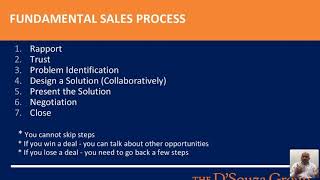
A sales framework where trust accounts for roughly 40% of closing a deal. Once prospects trust you, they share their problems and you design solutions together. Pricing comes from what customers will pay, not your cost estimate.
Chapters
These rules never change. Good market, bad market. In fact, in a bad market, you've got to be really sensitive about these rules. You've got to build rapport. If somebody doesn't like you, they're not going to trust you. Once you have the trust, which is the second piece, now they're going to say, hey, I trust you, you have integrity, you're a nice guy, we get along, you understand me, let me share my problems with you, let me show you my dirty laundry. All business is personal. Nobody is going to talk to you about their problems if they don't like you and they don't trust you, right? This is key. Once they start sharing their problems with you, if they like you and if they trust you, then I suggest— this is the art of the pivot— you collaboratively, right, design a solution that they like. That they will comfortable with, that they say, that's safe enough for me, right? Try to get their input. It's— it could be a survey, right? It could be a phone call. It could be, you know, uh, getting on a Zoom call and designing something for them where they say, I have this problem, and say, maybe we can help, and you'll mastermind it together, right? And then you got to present the solution in a way that they will buy. You can't just arbitrarily pick a model in your head and say this is worth $50,000. It may be worth $80,000. It may be worth $5,000. Your customers will tell you how much they'll pay for it. That's what it's worth, not what you think it's worth, right? And then you need— your negotiation should be very simple. I've got a graphic I'll explain to you. I've got this explained. You negotiate and close. The negotiate and close is 3%, 3% of this entire value chain. The 1, 2, the rapport and trust is 40% of the value chain. Right? I'm explaining to you. I've got a slide just for that. You cannot skip these steps. This is important. If you win a deal, you can actually sell them something else. If you lose a deal, you want to see where you broke down. Did you break down in designing a solution? You just tried to shove something down their throat? Or did you not identify the problem well enough? Or did you not even have trust? So you might have to go back to where you think you need to go back.