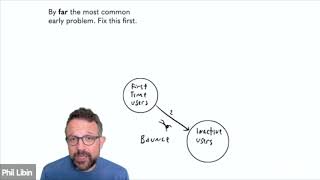
Most startups chase user acquisition numbers while ignoring bounce rate, the share of new users who quit within a month. The speaker found 75-80% of startup products suffer high bounce rates, often from mismatched expectations rather than poor product fit. Evernote discovered this problem too, and fixing bounce before scaling acquisition made their retained users stick around long-term.
Chapters
when should you actually try to get more people here? And this is the first place where many, many startups get it wrong. Many startups try to focus on this right away, right from the beginning, right? Try to get as much hype as possible, try to get as many people as possible moving on the sales and marketing line. But I actually think that's usually a mistake because what's more important is this, is the second line, which is the bounce rate, which is people who go from being first-time users and then in the next month immediately afterwards they're inactive. So they start using the product and then they bounce away. They don't use it anymore. This is the biggest problem of most startup products that I see. I would say 75-80% of the startup products that I look at initially, if they haven't optimized this, they have a very high bounce rate. That means that a very large percentage of the people that they get through the front of the door just stop using it after the first experience or after the first couple of experiences, right? Whatever that first month is. And very often, bounce is actually counted as part of churn or as part of retention. And this is a big mistake. So at the beginning at Evernote, we used to count it like that. We would say, well, we thought we had a retention problem. We thought, well, too many people that used to use it aren't using it anymore. But what we realized when we looked at the numbers, it actually wasn't a retention problem at all. It was a bounce problem. So what we had, the problem was that a lot of people were bouncing. But of the people who stay, they're actually staying around pretty much forever. And the psychology that causes someone to bounce right away is very different from the psychology that causes someone who uses it for a while and then churn. So you've got to look at it separately. Usually, a high bounce rate means that you haven't set the expectations correctly.