What Investors Want in Early-Stage Startups with Tahira Dosani
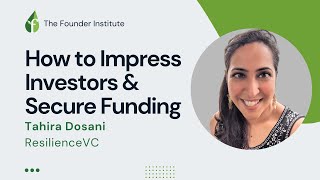
This content was created by Royston G King. This content was uploaded by Royston G King. This is a YouTube Q&A titled "What Investors Want in Early-Stage Startups with Tahira Dosani" (recorded/posted 2024-04-16). It’s a Founder Institute-hosted live/recorded event in English, with Sana (marketing at Founder Institute) moderating and Tahira Dosani (co-founder and general partner of Resilience VC) as the featured speaker. The format is audience-driven Q&A: Tahira answers questions from founders and attendees (Treya, Steve, Troy, Emily, Ibrahim, etc.) on topics including seed vs pre-seed requirements, traction and metrics for pre-revenue startups, evaluating solo founders and teams, regulatory risk in fintech, pitch decks and pitching mistakes, fundraising strategy and investor selection, diversity and gender gaps in VC funding, AI hype risks, liquidation preferences, dilution and equity, channels to find investors, and how hands-on the firm is. Content type: YOUTUBE; hosted by Founder Institute; created_time: 2024-04-16T15:00:38Z.
Chapters
We have a question here from Treya. And she's asking, what is one thing that you wish startups would not do in their early stage?
I mean, this is, you know, I think one thing I often emphasize to early stage founders is focus. It's very easy, especially at the early stages, to try a lot of different things and to test a lot of different things. And that testing is good. There's a lot of value to it, but you can't do everything at the same time. And so making sure that you're really focused on what is the next milestone I'm trying to get to, what is the next thing that I'm trying to prove out, and what do I need to do to get there? And trying to maintain focus at the early stage is not easy, but it's something that I think more and more founders need to really do.
Hello everyone, welcome to today's event. My name is Sana and I'm part of the marketing team at Founder Institute. We are happy to have you all here. Please let us know from where you're joining today. I see people from Germany, Pakistan, Thailand, Iran, Canada, South Africa, Welcome everyone. We are so happy to have you today. So, um, for those of you who don't know Founder Institute, we are the largest pre-seed accelerator. We help startup founders, um, turn their ideas into fundable startups. And we do host these kind of events every week to help you with the needed resources you need for startup launch. Today's event is a bit special. I'm sure all of you are excited about this. We have a lot of registrations for this event, so I'm sure that you have a lot of questions prepared. Uh, today's event, we have a a very special speaker. She is the co-founder and managing partner of Resilience VC, which is an early-stage embedded fintech fund investing in scalable startups. She focuses on investing in supporting fintech and non-financial services businesses that embed payment, credit, insurance, or saving offerings to drive financial resilience for consumers and small businesses. Let's all welcome to the screen Tahira Dosani. Who will be today answering your questions. I hope you have preferred— you have prepared good questions for Tahira today. Uh, I will— uh, hello Tahira, uh, you— to present yourself and the Resilience BC.
Thank you so much, Sana. It's great to be here with all of you. My name is Tahira. I am the co-founder and general partner of a seed stage venture fund called Resilience VC. We invest in— and excuse me, I'm a little under the weather— we invest in seed stage fintech startups and specifically in fintech startups that build financial resilience for their end users. But I've been investing in seed stage venture for about 15 years. And, and so looking forward to engaging with all of you and hearing your questions.
Thank you, Tahira. So let me quickly explain the agenda of the session. It's going to be totally run by you, the audience. You will be asking the questions, and Tahira will be gladly answering those questions.
So if—
please write all the questions in the Q&A section here, and we will put them on the screen. So just before, because you still don't have a lot of questions, we will start by like asking introductory questions to Tahira. So could you, Tahira, give us more details about Resilience VCs? What regions are you focusing on? What kind of startups do you invest in? All those details, please.
Sure. So we invest primarily in the US right now in companies both headquartered in and operating in the US. But previously I've invested in venture globally across Latin America, Africa, and Asia. So I'm quite familiar with the early-stage venture market everywhere. In terms of our focus at Resilience, as I mentioned, we have a dedicated focus on fintech. And within the fintech space, we like embedded fintech models where the fintech product is embedded in another product, service, channel, or value chain where the customers are already engaging or transacting. We think that that creates meaningful value in terms of distribution, data delivery, and trust that really drives ultimately revenue, usage, loyalty, retention, and ultimately profitability.
Great. Thanks, Sayur. We have a couple of good questions here. So let's start with a generic one here. The question says, what do you look out for in pre-seed venture?
Yeah. So, you know, my fund invests at the seed stage, and because these terms are used very liberally, let me define what I mean when I say seed. Seed for us is the company has a product live in market and some early customer and revenue traction. So at the seed stage, we won't look at something that is pre-product or pre-revenue. At the pre-seed stage, and again, we don't invest there, but we often start building relationships with founders at the pre-seed stage. And then, you know, um, really get to be, be privy to their growth and their development for 12 to 18 months until they're seed ready. So at the pre-seed stage, the things that get me really interested are one, really understanding the market need and the market opportunity. So is there a clear customer pain point that this product is solving? Is it a large addressable market? So is this a pain point that's felt by many, many customers? And, um, is this a product or service that I believe makes sense to address this pain point? And then finally, is this a team that I think is equipped to deliver on that product or service, right? At the pre-seed stage, Those are the high-level questions I'm asking. I know there's still— it's pre-product market fit. It's often pre-product. So things are going to change. The product itself will evolve. Pricing will evolve. Go-to-market strategy will evolve. But at that stage, what I really have to get sold on is, is this addressing a key customer pain point? And is it a big market? And then do I believe that this team is capable of executing?
Great answer. Thanks, Tahira. We have another question here. It says, how do you evaluate investments, particularly solo founders, traction, and pre-seed funding? Regulatory context or social proof?
Yeah, so, you know, when it comes to solo founders, my view is that, you know, There's pros and cons to both solo founders and co-founders. I've seen companies that really struggle with co-founder dynamics after time, you know, and so it's not certainly not a given that just because there are co-founders that things are going to be better or easier. With a solo founder though, you know, there's often a more of a singularity of vision. And with a solo founder, what becomes really important is the team they've started to build around them, right? Have they been able to hire people who can be good sounding boards for them, who can balance them and their capabilities? So that's one key thing when I'm thinking about a solo founder. Other things I'm looking at at the early stage, You asked, asked about regulatory context, and fintech is certainly a heavily regulated industry. So definitely understanding the regulatory environment for the product as well as upcoming regulations. You know, in the US context, there's multiple bodies that are regulating financial services from the SEC to Treasury Department to the CFPB, the Consumer Finance Protection Bureau. That all have different agendas. And so understanding what upcoming— current regulation and upcoming regulation is certainly is important because as an early-stage investor, I'm willing to take on product risk and execution risk. I don't really want to take on a lot of regulatory risk. So that is something I do have to get comfortable with early on.
Great. We have a more specific question from Steve here. And he says, I am a software engineer and entrepreneur myself, and I offer software services and consulting to startups and angel investors. As an investor, how do you know how to evaluate a tech startup as a VC and how to detect non-viable, non-viable solutions?
Yeah, I mean, so, you know, this is where I think different venture funds have different approaches here. I am a fintech specialist. I've been an operator in fintech previously and an investor in fintech for 15 years. And so that puts me in a position where I can evaluate technology in the fintech space pretty well. I know these product offerings. You know, if it's a credit product, an insurance product, payments product, those are spaces that I know very well. In terms of, you know, detecting a non-viable solution, there's a few things that make something non-viable, right? There's the product itself from a tech perspective that may not be viable. That's, I would say, rarely the case. I'm not investing in a ton of deep tech where the tech itself is often, um, where you have to go super deep into the technology. And I'm typically not investing in hardware where there can be viability issues in the product. Also, I'm investing in software that I can pretty easily test. But there's also questions around viability from a customer perspective. And that's really what I spend the bulk of my due diligence on, right? My due diligence will include talking to a lot of customers, both current customers and non-customers, understanding how they would engage with and use the product, what their pain points are, does this solve them, etc.
Great. Thanks, Tahira. We have— since you mentioned fintech, we have a specific question here from Troy. He says, how do you develop interest in fintech investment?
So for me, my interest came from working as an operator in fintech. I worked in the payment space, building out some of the first mobile wallet, mobile payment solutions in a number of markets. And so that's really what got me interested in that intersection of technology and financial services. And I've been working in that space since. So that was about 20 years ago. And, and I started as an operator, building out, growing and scaling products. And then from there moved into the investing space. So it really came from, from operating perspective for me.
Great.
And, you know, beyond that, I'll just say that I think fintech is particularly interesting because it is an enabler for so many other things. You can't pay for any other product or service without leveraging fintech in some way. You can't borrow to acquire some other product or service, right? And for most people, fintech is not an end goal. It's an enabler. I don't want credit for the sake of having credit. I want a mortgage to buy a house. I want a student loan to go to college. I want insurance to access healthcare, right? These products are enablers and they are what allow us to access, to pay for, to engage with so many other products and services. And so I see fintech as, as really core and is very intersectional.
Good. We have a question here from Treya. And she's asking, what is one thing that you wish startups would not do in their early stage?
I mean, this is, you know, I think one thing I often emphasize to early stage founders is focus. It's very easy, especially at the early stages, to try a lot of different things and to test a lot of different things. And that testing is good. There's a lot of value to it, but you can't do everything at the same time. And so making sure that you're really focused on what is the next milestone I'm trying to get to, what is the next thing that I'm trying to prove out, and what do I need to do to get there? And trying to maintain focus at the early stage is not easy, but it's something that I think more and more founders need to, to really do. Mm-hmm.
Okay. Um, we have here a question, uh, that says, um, how do you evaluate the traction, uh, slash progress of pre-revenue startup? What metrics do you find the most important at this stage?
So, you know, you can have— there's a lot of different incarnations of pre-revenue, right? Pre-revenue can be we have a PowerPoint, we've not launched a product, or it can be we've launched a product in beta that we're not charging for right now because we're trying to get really good customer feedback on it and get the product right. Um, I wouldn't really look at something in the former category. I would look at something in the latter category. And so You know, if, if a product is live and there just isn't revenue yet, it's understanding, well, what's the business model? Is this something that is based on huge network effects that requires getting a large base of engaged users today to monetize them later? Or is this something that's in a beta or pilot phase where we're not charging today, but we're honing the product, which will allow us to then start charging shortly, and depending on, you know, what, which of those it is, you would evaluate it slightly differently. But really what I'm looking for is customer engagement if there isn't monetization.
Great, thank you, Tyra. Let's take a couple questions. There are a couple of questions about pitching and pitch decks, so Uh, let me, let me start with this one from, uh, Joy. Yeah, what's the most common mistake that entrepreneurs make when they pitch for investors, obviously?
So I would say, you know, your first pitch, um, which is often you meet someone at conference, at an event, or in a you know, demo day or something, and you have a minute or two. I'm not looking for the answers to every question, and I certainly don't want to go deep into the technical details of your product at that stage. What you need to convince me of in that very initial pitch, that elevator pitch, is this is a big problem and I offer a really interesting solution. That's what gets you the 30-minute meeting where you can actually then go into much more detail. But if you start with deep technical details of your product, you haven't sold me on the opportunity, and that I think is the first thing you need to do. Um, the other thing that I often see that, you know, I think can be challenging is Yes, you want to present an optimistic view of your business in the pitch deck, but if I feel like you are either unaware of, um, real challenges, or that you are minimizing them, or that you are not being open and honest about them, that's not going to build the foundation for a trusted relationship. So, you know, the other thing I would say is like when you actually have the chance to have that full pitch meeting and go into the detail, certainly talk about the vision and the potential and what's going well, but also be open about the things that aren't, because ultimately you're trying to build a trusted relationship here. I'm not going to invest in someone who I don't think is going to be honest with me. We're talking about a multi-year relationship. Today, the average venture investor founder relationship lasts longer than the average marriage in the US. These are 5, 7-plus-year relationships, right? And so building that trust is really critical.
Yeah, absolutely. There is another question from Choi, which is, I think, related to the first one, and I, I really am personally interested to know the answer here. What is the most memorable pitch, something that you really marked your attention?
Um, that's a great question. Let me think. Yeah, I've heard, you know, thousands of pitches. Um, I mean, I think the, I don't know that there's one specifically that comes to mind, but I will say the ones that tend to be the most compelling to me are the ones that where I hear them talking about the opportunity and I'm like, I wouldn't have thought of it, but of course, of course there's a need there. And that's, you know, when you make me see the insight that I hadn't seen before, all of a sudden you've got my attention and now I'm really listening.
Great. Let's take a question now on the team. Like, there's a question from Ibrahim that says, what gives you confidence about the team in a pre-seed stage and what are your go-to questions to assess the team?
Yeah, so, you know, there isn't a single prototype of a founder or a team that I look for. If there were, right, like a certain kind of founder or team, then we'd have an algorithm do my job. You wouldn't need me as a person. And so it's really about, does this team have the right capabilities to execute on this business? So, you know, I'm a fintech investor. If I'm looking at, say, a lending business, is there someone on the team that has underwriting and credit and risk experience? Because that's really critical. You know, in the tech space, I need to make sure that there's someone who can build the product. Even if you're outsourcing a lot of your engineering team, do you have someone that can make sure that you're building with the right tech stack and the right structure so that it can be scalable over time? So there's certainly an element of like the hard skills and the capabilities on the team. Then there's the element of does this team function effectively as a unit, as a group? And a lot of that's about leadership, but it's also about culture. So that's certainly something that I look at. You know, I want a founder that can ultimately hire people and attract people to the team that come from different backgrounds that are smarter and more capable than the founder is. You know, research shows that diverse teams outperform. And so I don't want a team that's very homogenous. But at the same time, there has to be enough of a common thread for there to be a strong culture. So those are all things that, that matter to me from a team perspective.
Thanks, Taira. Talking also about the team, but here there's a question about the solo founders, and Theo, uh, asking, what do you look for in solo founders? Not all startups have teams.
So, you know, whether it's co-founders or a solo founder, as I mentioned earlier, what's often most critical is the relationship. That I can build with that founder or that founding team. For me, you know, things like, do I believe this founder is resilient? Can they overcome challenges? Because the entrepreneurial path has a lot of those. Is this someone who is open to feedback? Um, can they take feedback and criticism effectively without getting defensive? But also, do they have enough vision and conviction to not be swayed and pulled by every piece of feedback they receive? I mentioned trust and openness earlier. Those are things that are really important to me as well. So a lot of it is about the nature of the relationship that I can build with that founder. And, you know, whether I think that they are someone I want to be working with for many, many years.
Interesting. I have a question I'm assuming you're gonna like here because I'm loving it. So it says like, less than 3% of VC funding goes to female-founded startups. What advice do you have for female founders to overcome some of these barriers to funding? From Emily.
Yeah, it's a great question, Emily, and you know, you're right. Excuse me. Last year, just over 2% of venture dollars went to, um, founding teams that were all female. About 20% went to mixed gender teams, and then 70-some percent went to all male teams, and You know, this dynamic is true from a gender perspective. It's also true from a racial perspective. Um, you know, white entrepreneurs receive far more capital than entrepreneurs of color, and, and there's a number of things that drive this. One, it's who controls the capital, right? This isn't just something that's happening at the founder level. If you look at the investor level, if you look at the $80-some trillion of investment assets in the US, 98.6% of them are managed or controlled by white men, only 1.4% by all women and all people of color. And it's natural for people to want to support people that they feel commonality and connection with. And that, and so that drives these dynamics. And ultimately, if we want to change that, we need to change who the asset owners are and who the asset managers are, because that's what will help this flow of capital come down to a more diverse set of entrepreneurs. At the manager level, there are a number of things that I as a funder look to do to really try and improve diversity within my own pipeline. There are investors that say, you know, we only want founders that come through warm introductions. And to me, that means that I'm missing out on people who aren't already in my network and who don't look like me. And so I— it's really important to me. We have on our website an open forum where you can submit your startup directly into our CRM, and we'll review those every week. Right? We make sure that we are taking introductions and open to submissions from startups everywhere. The other thing that the research shows is that male and female founders, even if they have the same exact pitch, get asked different questions. Women tend to get asked about risk and men about growth. So, you know, as a fund manager, we can standardize our due diligence questionnaires to try and remove some of this implicit bias. So there's certainly things that can be done and that need to be done at the fund manager level. At the entrepreneur level, it's tough, right? I mean, certainly this, this disparity exists, and it is a higher bar. It's unfortunate, but that is the reality. Finding investors who who certainly are more diverse, who are looking to invest actively in a more diverse set of founders can be really helpful. And then building diversity into your own team so that people can, regardless of who they are, find someone on the team that they can connect with can be helpful. But ultimately, you know, you've just got to get out there. And keep pounding the pavement. And yeah, you might have to take twice as many investor meetings to get the money as, you know, one of your male peers. The bar is unfortunately higher, and we all have work to do to change that.
Good, thanks, Tahira, for the answer. We have a question here from Daniel, he says, collaborating closely with VCs, we've observed a recent shift. It appears VCs are increasingly looking for a fairly consistent MRR in the range of $5,000 to $10,000 before considering an investment. Is it also a critical requirement for your firm?
So we don't have a minimum revenue threshold. We do want to see some evidence that customers are willing and able to pay for the product. But, you know, we've invested in companies that are an ARR, not monthly, but annual recurring revenue of $5,000 to $10,000. And we've invested in ones that are an ARR of, you know, $100,000. So it's less about the specific revenue number and it's really more about, you know, what I'm seeing from a customer perspective.
Good. Well, we have a lot of questions here. I'm not sure if you're gonna be able to answer all of these, but okay, so you have a question here from de, I'm not sure, I don't know, I don't want to pronounce the name incorrectly, but I will show it on stage. So it's, what type of risk do you look at, or how do you assess the business risks before investing in pre-revenue startups? It's a good question.
Yeah, Divya, it is a good question. What I would say is that I don't invest pre-revenue, um, I only invest post-revenue, but there's a lot of ways that you can get a sense of customer interest pre-revenue, right? Is there a customer waitlist? Is there— and what does that waitlist look like? Is it just people that have given you their email address or have they done more to demonstrate their interest? Right. What have they done to assess customer willingness to pay or ability to pay? So, you know, I think it's— if the— if there isn't revenue, then it's about, well, what are the proxies? What are the things that are going to get an investor comfortable that that revenue will come. Do you have an incredibly engaged and passionate user base that has indicated that this product creates a lot of value for them? Do you have a really high net promoter score, right? Those are the kinds of things that can be indicative of, um, likelihood of revenue, strong revenue traction, even if that revenue hasn't hit the books yet.
Good. We have a question from Liat here. He's asking, where should we even start to find VCs or investors? Looks like we don't— if you don't have great networking, it might be extremely hard.
It can be, and I think, you know, that's part of why I was saying earlier, one of the things that's important to me is that we're accessible even to people who don't have strong networks, right? That it's open on our website, you can submit. And I think more and more venture funds are doing this. But there's, there, you know, within your market, within your field, there should be good resources. Certainly accelerators and incubators can be really helpful. Programs like Founder Institute can certainly help connect you. They'll have mentors, they'll have folks that come talk to you that could be good venture resources. Often there will be like venture associations within the country. So, you know, we have like NVCA, the National Venture Capital Association in the US. You can look at their member lists. You know, I— there's certainly a lot of startups that come through me through known channels and networks, and there's a lot that come to me because they just cold outreach to me, and I'm as open to those as I am to anyone else. So it takes work, it takes effort, it takes hustle, but you can find them, you can reach out to them.
Cool. We do have a question here. Um, let me just— there are a lot of good questions. It's— I hope we can manage to to read them all. Um, just a second. Okay, here a question from Nick. He's asking, what is the top 3 questions you should ask to a startup founder to decide if it is worth to invest for or not?
So what I would say is, you know, ultimately, at a high level, the top 3 questions are: what's the market opportunity? Why is this the best product to address that market opportunity? And why are you the best team to do it, right? At an incredibly high level. But ultimately, you have to get into a lot more depth than that to actually make that investment decision. Due diligence takes time, and it's about really getting deep into the product, into the market, to the customer, to understand whether this has the potential to be a scalable, you know, ideally billion-dollar business over time. And it's where you get to build that relationship. And establish that rapport with the founder. And so it's not something that happens overnight. And I don't think an investment decision can be distilled down to a few questions.
Great answer. We have a question, interesting one from Pico here. He's asking, why do VCs search for revenue in startups from the start when companies like Facebook prefer to grow users before starting to look for revenues?
Yeah, so I think the market has shifted, right? Um, 15 years ago there were a lot of businesses that really were looking to build really large user bases, and there was a strong network effect within their users, right? Um, and, and social media, um, businesses are great examples of that. I have Facebook, Instagram, Twitter, um, all of these, right? Snap. All of these businesses focused on how do we build a large base of engaged users, and then we'll figure out monetization later. And some of them, like Facebook, Meta, were successful in monetizing. Many others weren't. And so You know, we're now at a different stage in the market where there is a lot more focus on getting the unit economics right from early on, where in many sectors, not all, it's not sufficient to say, I'm going to get users now and figure out how to monetize them later, because many, many businesses have failed to do that. And it's more about, can I— can each incremental user that I bring on be profitable? Can I make these unit economics work at scale? And that, that be— that, that has become a more important question, especially in the market today, because we've seen so many companies that have failed to monetize, and we've seen market caps go down and and valuations go down where those companies didn't figure it out. And so investors are no longer willing to take that risk. Cool.
We talked earlier about pitching. We have another question here from Kush. It says, what do you look for in a pitch deck? What is the most valuable valuable part of a pitch deck that would compel you to invest in the company?
I'm really looking for the pitch deck to clearly tell me what's the market opportunity, what is this product or service that's a solution to that, how is that product or service going to be going to go to market? What are the economics of that product or service, the unit economics ideally? And then what's going to enable this company to scale it effectively? So that can be a look at the competitive landscape, things like that. But those are really— it's not one magic slide. It's the story as a whole. All has to be there to get my interest and for me to want to go deep.
Okay, thanks. Tahira, we have a question here about AI startups. He is from Daniel. He's asking, what challenges do you see in today's hyper-hyped AI SaaS market from an investor point of view?
Yeah, you know, I look, I think generative AI has the power, the potential to be transformative in a lot of spaces. I also think it comes with a fair set of risks. I think what we're seeing with AI today is very much what we saw with crypto a few years ago, right? There's going to be a lot of interest, the market's going to get hyped up, then there's going to be a correction. And, you know, whether it's a crypto model or an AI business, I think for me it still comes back to this fundamental that I mentioned earlier. A lot of times with these tech-driven models, we see a tech solution looking for a problem. I have this really great LLM that I've built that I want to apply here instead of Here's the market opportunity, here's the customer pain point, and here's why this AI tool is the best solution for it. And I, I'm very skeptical of a lot of the models that are tech, that are a tech solution looking for a problem rather than the other way around. I think being customer-centric is really critical regardless of the technology.
Great. Um, we have a question here from Mamesa. She's asking, what are some of the key things that founders should assess to consider to know if they are choosing the right investors, uh, to grow with?
Yeah. Um, I mean, I mentioned some of the things that matter to me and a founder and with that relationship. And I would encourage all of you as founders to do the same, right? What are the values and where do you want that values alignment with your investors? Everyone's money is the same color. You know, it's, it's who do you want to be your first phone call when things get tough? Who do you want to be there with you through the ups and downs of this? Who do you trust? Who do you think is going to be able to add value? And it's not— and you have to evaluate every single investor, but then you also have to make sure that your investors as a group bring a diverse set of skills, right? You don't want everyone that's a lifetime investor and no one that's been a founder. You want maybe one investor that's been an operator or a founder previously. And can get really deep with you on certain elements of operations. You certainly want some that have really strong VC networks and help— can help you get that next round of capital. You want some that might be plugged into the local ecosystem to help you get talent and customers, and others that are global investors that can be signals to a broader market, right? So it's, it's about the value that each one can add, and then ensuring that across the breadth of them, you have everything covered that you need.
Thanks, Tahira. We have a question for you or your firm, Tahira. It says, how involved do you typically like to be in the companies you invest in? And what value do you aim to bring beyond capital?
Thanks, Ari. It's a good question. For us at Resilience VC, we are pretty hands-on as an investor. Both my co-founder and I come from operating backgrounds in fintech and financial services. So, you know, we, we really love getting to work closely with founders on their biggest challenges. And it's part of our model. We aren't investing in a portfolio of hundreds of companies. We're looking at a much smaller, much more concentrated portfolio, which allows us to be hands-on with those companies. And work closely with them. So, you know, it's— that's a big part of our approach. It's what works for us. It's certainly not what works for every investor, but for us, it's a big part of how we think about our investing.
Thanks, Tahira. We have questions from James here. He's asked— he's saying, I plan to get my first funding through the NSF. If this funding requires some sort of proof that is commercializable and confirmed market interest, how would going through this process affect my ability to engage with the VC after?
Yeah, so, you know, taking money from government agencies is Can have pros and cons. Certainly if you can especially tap into non-dilutive capital, into grants and things like that through governments, it can be really compelling. It can make a lot of sense to do that. If you are taking equity, if you're giving up equity for capital from government agencies, You know, understanding the implications of having them on a cap table, understanding their limitations. A lot of times, especially in the US, they can't do straight equity and it ends up being debt, which, you know, has a number of other considerations, especially at the early stage. It also varies a lot sector to sector, right? There's certain sectors, aerospace and defense, for example, where you have a lot of government funders that are much more active in the space, and it's much more normal in those spaces to have government agencies providing that capital, but it may not be in other sectors.
Thanks, Tahira. I have a question here from— I'm sorry with the names, I'm so bad with pronunciation, but he's asking, when leading a deal, how do you effectively balance liquidation preferences considering the interests of other co-investors?
Yeah, so, you know, I think liquidation preferences can be really predatory, especially when they're above 1x. I really don't like seeing those, especially at the early stage. A lot of times founders agree to liquidation preferences to get higher valuations. And I think that that can be really short-sighted. I, I will typically seek like a 1x preferred non-participating, but I get very wary of investors who are looking for high liquidation preferences early on. It can just be incredibly predatory towards founders and management.
Good, thanks, Tyra. We have here, yeah, question from Fabienne, sorry, she's asking, is it typically uncommon to fund ventures in the idea research stage, like if funding is needed to make the prototype and tech?
I think it's, it depends again a little bit on the sector. In biotech, you often do see things in the research stage get funded because they do need a lot more capital to actually get beyond that research stage. Um, but in other sectors, um, that's, that's much less common. Sometimes you'll see like a friends and family round or an angel round coming in at that idea stage, but you typically won't see a lot of institutional capital at that stage.
Yeah, let's take this question. What are the key considerations in deciding whether to sell or keep scaling a company? What should be considered before deciding?
And again, you know, so much of this depends on the specific context of the business. But, you know, broadly, ultimately an exit decision, whether it's for a founder or for an investor, has— there's market considerations, there's business considerations, and there's, especially for a founder, personal considerations. So, you know, you, if you're looking at the business, there's Well, what's the trajectory of the business itself? Is it continuing to scale? Is that growth plateauing? Is it struggling, right? Those, you know, that's definitely going to affect that decision. What about the market? Is the market growing? Is there continued interest and opportunity? What's the competitive landscape like? Are a number of new entrants entering the market, which means it's going to get much harder to grow affordably, you know, all of those things can matter. And then, you know, if you're a founder thinking about this, there's, well, is this what you want to continue spending your time on, right? And those personal considerations matter. For investors, there's also often questions of where in the fund life you are, how the rest of your portfolio is performing. Those things may also factor into that decision.
Great, thanks, Zahira. We have a question from Martin. He's asking, he's saying, people say that VCs usually apply pressure on founders in order to accelerate timings because they need to prove returns to their LPs. Any thoughts on this?
Um, look, I think that there's In the venture space, right, your venture investors are equity holders in your business, which aligns incentives in a lot of ways because they only do well if the business does well. However, there's also potential areas of misalignment. A venture investor is going to have a number of companies in their portfolios. As a founder, you're only working on one business. So if your business is struggling a little bit, your venture investor might say, hey, we're going to write that off and focus on our winners, right? You also can see situations where for the venture investor, they're looking for a certain level of growth that may or may not make the most sense for what you're trying to do. So venture funding is not for everyone and is not for every business. And sometimes it, it can come with, you know, growth expectations, um, and, and a pressure to accelerate growth in a way that doesn't make sense. And in that case, you shouldn't seek venture capital. There's other sources of growth capital out there and funding out there that are not venture money.
Let's just do the next question from Jamie. Is asking, when do you know the best time for startup to go for investment?
Um, well, it depends on the startup and what you're trying to do. And, you know, oftentimes it's driven by, well, we need money, right? We need money to hire, to pay our teams, to put into marketing. And that's when we have to go out to the market. But you certainly want to do that from a place of strength. And so being at a place where you have achieved certain milestones, whether that's product, revenue, customers, whatever it may be, can then put you in a stronger position. But typically it's driven by, by need for capital.
So if, for example, this question is asked by an early-stage founder, and let's suppose that this founder has the ability to bootstrap his startup.
And I mean, look, if, if so, there are times when it makes sense to bootstrap as long as you can, and there's times when it makes sense to get in venture capital early. If it's a, if it's a model where, or a market where first mover advantage counts for a lot, then raising money to be able to be that first mover and be first to market may be your best bet. If it's one where actually having your competitors educate the market is better for you, then, you know, it— so it's going to be so dependent on the specifics of the business and the market and the company situation.
I have a question here from Lenny. She's asking, how do you know if it's a good deal? Intuition or 20% of the profit? Should you give their stakes? She's, she's asking, how do you know? The question is, how do you know if it's a good deal?
Yeah. Um, I assume you're asking that from the founder perspective. And you know, what I would say is equity is expensive. Right? Like you're giving up a meaningful percentage of your business for this money. And so the question is, what does that money allow you to do? Does it allow you to grow more? So say you're giving up 20% of your business for this capital. Does this money allow you to grow such that your 80% of a bigger business is more than your 100% of that smaller business, right? That's ultimately the calculus that you have to do.
Good, great answer. Uh, we have a question from Yael. He's asking, how much detail about our product should we disclose to investors during our pitch meetings, and what trade-offs do we need to consider between transparency and protecting, protecting our trade secrets? So the—
there are bad actors, you know. I've certainly heard stories and I've certainly seen cases, but the majority of venture investors are going to respect your IP and your confidentiality. This is a relationship and reputation business. And if an investor gets known as one who's gonna share IP with others from pitch meetings, no one's going to want to pitch to them, no one's going to want to do business with them. And so ultimately, I think you tend to be in a stronger position if you're able to share more and be more open. But, you know, that said, before you take a meeting, make sure you do your research and you understand if there are reputational risks or concerns with that investor.
Good. We have, uh, let's wrap up with a couple of questions before we end up the session. Um, Let me just— okay, so we have here a question from Murat asking, how much equity do you give in the first round?
I mean, again, this is going to depend very much on the specifics, but generally we take a view of like standard roughly 20% dilution per round.
And can you, uh, is this negotiable with the investors?
Certainly, right? Everything's negotiable, but there's just going to be trade-offs. Um, you know, if you're— if you want to give up, um, if you want to take less dilution, you know, the business has to be performing well for them to be comfortable with that. There have— there you may end up giving up on certain other terms.
Cool. We have a question here from Peter. He's asking, what methods or platforms do you use to find your startups, startups you want to invest in?
There's a lot of different channels. I mean, I, you know, I'll meet them at events and conferences. I will get referrals from co-investors. We have relationships with a number of incubators and accelerators that refer companies to us. Um, we get a lot of direct inbound from founders. We do thought leadership, writing, publishing, speaking, where then founders come find us. So lots of different ways.
So for your, for the, your, the, your, the case of your firm, do you look for, uh, I, I'm sure that both, uh, work. You look for investors and investors come to you. Which is, which is more, uh, of frequent? Do you go and look for the startups or startups come and, uh, ask for the, um, we, I mean, we see, we see both.
I would say it's, it's a really good mix. We get hundreds of startups reaching out to us, you know, and, and we're very open to doing deals from cold outreach from founders. And we get a lot coming, you know, from others. And then sometimes we'll see a company and we may reach out to them. I would say we probably get more inbound than we do outbound though.
Great. Can you mention some of the companies or startups you invest invested in that are, that marked your memory or very proud of?
Our portfolio is, is on our website for, for resilience. But in the past, I've invested in a number of companies. Some of my favorites are Self Financial, Confio, iFinance. So a number of really great models. One of the companies I'd invested in a previous fund, Pula, in, in Africa, just raised their Series B. So, you know, it's great to get to see, having been in this space for as long as I have, companies that continue to grow and scale.
Great. Let's take one last question from Ahmad because we are about to close this session. There is the networking lounge that is open for as long as you stay. So you can— Tahira, I don't know if you can dedicate a few minutes to the networking lounge, or you have a few minutes, but not too long, unfortunately. Great, no worries. So please stay after the session to talk to Tahira. So let's take this last question from Ahmad. He's asking, post a research idea, is it best to showcase traction through building a waiting list or building an MVP? I have heard both pieces of advice at the point of research area that I'd love to get your opinion on best steps going forward.
I have a pretty strong view that it's an MVP. I don't put a lot of weight in a waiting list. You can collect a list of email addresses pretty easily. People don't really know what it is if they haven't had a chance to interact with it. So building an MVP and having even a much smaller set of customers actually engaging with that, to me, is much more valuable.
Great. Thank you, Tahira. Thank you everyone for your questions. Thank you, Tahira, for all your answers. That was a pretty responsive session. Session. Um, please stay for the networking lounge, and if you like, I know that we didn't answer all the questions, but we have a lot of AMA sessions coming up on the upcoming weeks. So, uh, keep an eye on our website, you will have all those events there. We, we will host every time a new investor to answer your questions. Thank you everyone, um, and, uh, have a good day.










