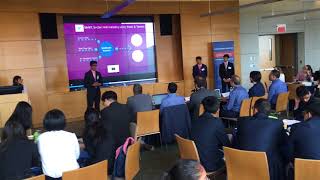
The video records a high‑school investment team’s pitch to client Mr. Jack Abraham, structured as a six‑course “menu” of investment decisions. The team—Monty (CIO, Chantilly HS), Sue Chen (CTO, Thomas Jefferson HS), Sid (Security Selection Manager, Thomas Jefferson HS), and Susan (Client Portfolio Manager, Laney HS)—first introduce themselves and profile the client using behavioral‑finance tools, including a proprietary risk‑profiling app (Wrist) and a Twitter‑scrape. They adopt a goals‑based philosophy, confirming Abraham’s aspirational objectives and his risk‑averse stance. Asset allocation is set at 90 % equities, 10 % cash. Sector and industry choices are driven by a custom AI/NLP engine called SAINT, which generates sentiment scores from news and Twitter data. Stock selection follows a three‑pronged framework: (1) Buffett‑style value screens (ROE, ROA, margins, economic moat), (2) technical analysis (20‑, 50‑, 100‑day moving averages), and (3) an inverse‑volatility weighting scheme. The team’s flagship pick is Lockheed Martin, justified by sector fit, geopolitical tailwinds, and low volatility during crisis periods. ESG considerations are highlighted, noting Lockheed’s anti‑corruption and gender‑equality policies. Performance results show the portfolio outperformed the S&P 500 and the class average, though the team notes transaction‑cost impacts. Finally, the team discusses “progress”: they have taught financial‑literacy courses to over 50 k students and surveyed 81 investment professionals, extending their risk model internationally (e.g., a partner school in Russia). The presentation concludes by emphasizing the blend of AI and Buffett‑style value investing to deliver a balanced, client‑centric portfolio.
Chapters
We are the all you can eat buffet team and this is our Investment menu for Mr. Jack Abraham. Our menu consists of the six Ps of investing and we like to think of them as a well balanced six course meal for one very satisfied client. Our first course is people. So let's meet the team. We represent three high schools from Fairfax County, Virginia, two families and one comprehensive strategy. I'm Monty, Chief and Chief Investment officer from Chantilly High School.
I'm Sue Chen, Chief Technology Officer from Thomas Jefferson High School for Science and Technology. I'm Sid.
I'm a security selection manager also from Thomas Jefferson High School.
And I'm Susan, client portfolio manager and dog builder from Laney High School. So to start it off, we use some cutting edge technology in the behavioral finance world for helping establish our portfolio. We sought the advice from the founders and pioneers in the behavioral finance. These amazing professors helped us along the way, especially in determining Mr. Jack Abraham's client. So our recipes for success was to make sure we know our client really, really well. Mr. Abraham is a 32 year old entrepreneur originally from Fairfax 9 regime where all of us, coincidentally, Mr. Abraham goes to my Langley Python. That's the keys. We did a deep Twitter scrub and created Mr. Abraham's portfolio accordingly. Mr. Abraham is interested in and has invested in tech, healthcare and aerospace. Mr. Abraham, like me, is a doggo. He made his first company and named it after his dog Milo, which he later sold for $75 million. His company of course, not his dog. The next course is philosophy. We chose goals based investment plan to make sure that we know exactly what we're doing with Mr. Jack Abraham's money. So I directly contacted Mr. Abraham as part of my chief or client portfolio management. I assessed that through this email that he sent me that he had achieved all his regular goals such as going to college and buying a home, and that he was more interested in his aspirational goals such as founding a charity or as he says here, having capital to do more interesting projects within the future. Next, we use Wrist style to assess his wrist biases. Wrist Style is our proprietary risk profiling model published in the Journal of Personal Finance and now available for free on the App Store. Once again, instead of just guessing, I sent this profile out to Mr. Jack Abraham and had him respond. So, contrary to the popular belief that Mr. Abraham is young and risky, we actually found out that Mr. Abraham is risk averse.
As part of my job, I had to bring together the two parts of our investment plan. One, our new proprietary artificial intelligence algorithm with two the old value based Buffet approach. This ensured our well balanced portfolio to help achieve our clients goals. To understand how this works, let's move on to our next course process we determined Mr. Abraham's asset allocation and after this Chichat worked on sector and industry selection while Sid worked on stock selection. Because Mr. Abraham is wealthy, young and moderately risk averse, we determined his asset allocation to be 90% in stocks and 10% in cash. The different colors here represent the various sector choices such at one stock.
After ascertaining asset allocation, our next step was to determine sector and industry selection. The way we did this was by creating our own proprietary artificial intelligence natural language processing algorithm called saint where CINCT stands for Sector and Industry Selection using Artificial Intelligence on News and Twitter Data the way we did this was by creating a neural network that built off of past experiences to predict future short term changes in the sector market. By using historic data coupled with real time news data as well as scrubbing a Twitter feed including that of Mr. Abraham. Shown here is a short snippet of our code actually running. Our code has been back tested through numerous tests and has actually been published in the Journal of Computational Economics. Our code finally produces a sanescore which represents and reflects the quantity of positive sentiment data surrounding this specific sector within Twitter feeds or news data and provides a recommendation to us, the investor, of whether we should or should not invest in a particular sector. The majority of our portfolio is made up of the sectors shown in this Apple word here. Notice that these sectors are generally considered defensive and tie in with Sid's aforementioned work showcasing that Mr. Abraham is risk averse when it comes to lawsuits. Also notice the correlation
and the connection
between the sectors we invested in and the interest of Mr. Mr. Abraham in the healthcare, industrials and infotech. Lastly, we rebalanced our portfolio monthly to account for changing market conditions. Our industry selection was based off the exact same algorithm we used for sector selection and the majority holdings of our industry are shown in this Apple Word cloud as well.
We then went through all the stocks available on the watch list and picked one to three stocks per industry using a three pronged approach. So first, the valuation screen which we derive from Warren Buffett's approach to investing. So we looked at some financials that Mr. Buffett looks at such as return on equity and return on assets and use the standard return cutoffs that he uses of 15 and 5%. We also looked at operating and profit margin to get a fuller picture of a company's valuation. Finally, again going back to Mr. Buffett we used economic moat to determine if the company had an advantage over its competitors. Next, we also know that the market tends to move away from value time to time. So we overlaid a technical analysis. So what we did here was we used three standard technical indicators, the 20 day, 50 day and 100 day moving averages to see where stocks momentum takes them over different periods of time. Finally, once again knowing that Mr. Abraham is actually moderately risk averse, we implemented an inverse volatility winning scheme where lower weighting is given to the higher volatility assets in the portfolio and vice versa. So for example here we provided in our biotechnology industry picks has actually higher volatility than the other two companies and so as a result it's giving the lowest weight. Our fourth course is now the pick and our pick was Lockheed Martin. We picked Lockheed Martin based on Mr. Abraham's interest market conditions and his economic mode. For example, its key product, the F35 Lightning and Sikorsky helicopter are basically unmatched in the industry. So let's take a look at the top down approach. So again we went through sector selection, the Twitter swap and then we also looked at the market conditions where President Trump's increase in defense spending and rising geopolitical tensions in China, Iran, Russia and Syria to name a few, will definitely help towards Lockheed Martin's potential growth. We also spoke with Mr. Belsher, managing director at auction. So now we look at our Von Hooking approach which is evaluation and technical analysis. So let's take a look at. So we looked at several different criteria and saw that Lockheed Martin actually placed first or second in most of these major categories amongst these. Now knowing that again that Mr. Abraham is risk averse, we want to focus on capital appreciation for his aspirational goals. A good case study here is that last summer when North Korea placed an imminent nuclear the S and P went down whereas Lockheed Martin went up. This is very similar to the recent in the Syrian crisis where the same thing happened. So what this tells us is that Lockheed Martin is a relatively low ride and is a great entry against geopolitical risk.
Before picking, it was also very important to us that our company was socially responsible. Lockheed Martin has moral values consistent with our client. They embrace anti corruption and they promote gender equality and they also use latest technology to fight terrorism.
For our fifth course performance, our favorite, our dessert. We love to feast our eyes on how diverse our portfolio is. In hindsight, if we were to change something, we would run our state model a little less frequently to account for the high transaction fees every time we ran the same. Overall, we're very satisfied with how we turned out. We were above the S and P average and the class average.
Sweet. Our sixth and final course, like icing on the cake, was progress. Throughout this competition, we as a team learned a lot about financial literacy, but realized that financial illiteracy is a global problem that affects many different people. To solve this, we started locally at our schools. We taught financial literacy courses in our school psychology and economics classes. And our school's own economics club and investment club uses our proprietary risk model to make students more aware of their inherent risk biases. Today, over 50, 348 students have taken our survey.
Also, 81 investment professionals have taken our survey. And finally, as Mr. Dimitri talked about in the beginning of this entire competition, he said that financial illiteracy is a global problem. And so I actually got the opportunity to visit our partner school in Russia, Gosudarsky this spring and I presented the Rift House model to them and they loved it. And finally, if anyone here is anyone would like to take our 2 minute RIRZC survey at whenever, please let us know. So to wrap it up, we use AI and Mr. Buffett's approach to come up with a well balanced, healthy and enriching six course investment menu for our client, Mr. Jack Abraham.