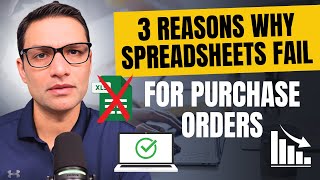
Sachin Sharma, founder of ProCare Desk, explains why spreadsheets fail for purchase orders once you hit 100+ per month: manual updates create stale data, multiple copies kill a single source of truth, and no receipt tracking forces AP to chase vendors. A dedicated system with automated matching and mobile receipt capture fixes all three.
Chapters
If you're using spreadsheets for tracking your purchase orders and that's not working anymore for you, you're not alone. In this video I'm going to talk about three reasons why spreadsheets don't work for tracking purchase orders, especially if you are tracking more than 100 purchase orders a month and what to do instead of tracking them on a spreadsheet and stay till the end where I'll share you know, the long term impact of these manual processes on your fulfillment cycle or on your customers. If, if you're joining me for the first time, welcome. My name is Sachin Sharma. I'm the founder of ProCare Desk where we help companies like yours to automate purchasing nap processes. So let's jump right in. Number one reason why it doesn't work, a spreadsheet doesn't work for tracking the purchase order is the constant manual updates. If you think about a purchase order life cycle, right, it's not one and done. A purchase order is issued, you might have to reissue it, you might have to change the price, items are back, updated and so on. Now these are constant updates that somebody has to make in the spreadsheet to keep it I would say updated. And you're probably one step away when somebody forgets to do this and now your data is out of date, you have no confidence on the spreadsheet and you land up backing back to calling people or sending emails and so on. So that is one of the reason is that it works at some time but, but then it stops working because you know, people either don't update it on time or they forget to update once and then just data is completely out of it. Number two is there's no single version of Truth with spreadsheets. So if you are using Google spreadsheet, maybe still you have an online version. But we see a lot of times people have their own version on their desktop, they're updating, then they forget to put it back in the central repository from where they pull and now all of a sudden you have three variations of data and think about, you know, the effort that is required to now consolidate all that into the single version. We see this very often where people will just make copies to just say oh let me do a local update and then I'll update it back and they never do. So that's number two. Number three is there is no tracking of delivery receipts. So what I mean by that, if you think about your AP team, when they receive an invoice from a vendor, they have to make sure that this is the correct invoice that you have received the product. It matches what's on the purchase order. These are the standard best practices every accounting team follows. Now if you do not have the receipts or the physical copy of the receipt that the vendor sent you, you have no way for the AP team to go check that out. And that means they have to call you, they have to get a copy from you, you have to go scan it. It's a lot of work. So what? It's not only the AP team that is following people for getting invoices approved. You also have to as a person who ordered the product, you also have to get involved to provide all the details and that slows down the whole operations. And think about if you're doing 10 purchase orders a month, fine. But when you do 100, 500,000, this process doesn't scale. So that's number three. So those are the three areas. Now let's talk about the bonus tip I was talking about in the impact on fulfillment. What do I mean by that? Now let's talk about what we say. Second degree consequences, right? So the first degree consequence of a spreadsheet is you don't have a central way to track all the information is updated, but what is it it's doing to your end process? So what I mean by that is let's say you're a construction company and you're tracking the materials that you're ordering for to fulfill the job for the customer. Now the information is incorrect. That means you can't schedule the work for the client and the work gets delayed. Of course you get paid late. That leads to lower customer satisfaction. They might not call you for another job as an example. So those are the second degree consequences from a fulfillment standpoint. And as a company, you should be thinking about this as okay, if I'm using spreadsheets for tracking purchase orders, yes, it is causing me manual work, yes, it is, you know, causing me lower productivity. But what is the impact on the customer? And 90% of the cases when we talk to people, they have no clue. They don't link these two things together. For them, these are two distinct processes. And I would argue that this is one single process. So if you are struggling with spreadsheets, here are three reasons why. One is you have a constant need to manual updates. Number two is there's no single version of the truth. Number three is there's no way to track receipts, hence cause problems for your AP team. So here's what to do next. So if you are dealing with, I would say more than 100 purchase orders a month. Implement a purchase order system that allows you to do three things. Number one is a central place for tracking the purchase orders so you are not manually doing the updates. It should allow for automated updates, collaboration with the vendors, tracking the status of delivery, tracking the shipment status. All that in one system without your team kind of going and manually updating it. Right. So that's number one. Number two is a process to track the delivery of the product. So a central place where you can easily go take a picture from your phone of the receipt, good receipt, note, and so on, rather than scanning and sending it to somebody and so on. Right. So that's number two. Number three is the matching process, so matching the invoice with the purchase order and receipt. So your accounting team is not spending a lot of time trying to do this manually and chasing people for missing documents. This can be done within the system itself and the system automatically points out exceptions, so your team can then go figure out exceptions rather than trying to chase people for missing receipts. Now, if you like this video, go and hit subscribe button so you get notified when we release a video like this. And thanks for joining me today and I'll see you in the next video.