Gumroad + Flexile Q3 2023 Public Board Meeting
In this public board meeting, CEO Sahil Lavingia walks the audience through Gumroad’s Q3 2023 performance, recent product launches, and the roadmap for both Gumroad and Flexile. He shares financial highlights – $41 M creator earnings, $2.245 M net income and a trajectory toward $10 M net income – and explains how a newly shipped feature generated $1.6 M GMV in its first month, projecting $3 M of net income over ten years. The meeting showcases Gumroad’s new content editor, product sections, custom domains, upsells, faster email delivery, and a demo of the upcoming bundles feature. The “ABC” roadmap (Abandoned‑cart emails, Bundles, Collaborations) and a longer‑term website‑builder vision are outlined. Flexile’s admin UI improvements, on‑demand invoice payments, and a novel equity‑for‑cash compensation model (options at a $100 M valuation, dividend payouts) are demonstrated, with a live invoice approval flow. A testimonial from freelancer Tony Dinh highlights Flexile’s time‑saving impact. The discussion touches on competition (Deal, Remote), the philosophy that cash‑flow positivity equals product‑market fit, plans for a DIY‑PO Series D dividend raise, and an AI‑assisted customer‑support tool. Throughout, Sahil emphasizes profitability, founder‑aligned incentives, and building free, value‑driven features for creators.
Chapters
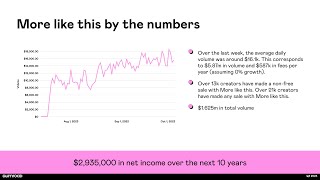
Board meetings are in the news recently. People are curious what happens in these. Welcome everybody. This is a Q3 2023 board meeting. If you haven't been to a board meeting before, welcome. We talk about what we shipped, the numbers, and what we're up to next. We're gonna do that for two products that we have. Gumroad.com is an e-commerce website that we built to help people sell stuff on the internet. eBooks, courses, Procreate brushes, all sorts of Digital Content started in 2011 and we have a product called Flexile to help pay freelancers cash equity and dividends. Q3 of 2020 was awesome. $41 million in creator earnings, $2.245 million in net income, annualized $9.8 or so million. We might break $10 million in net income this year. It's going to be close. This is what the financials tend to look like when I see them from our accounting firm. Our CFO, Steven, sends this to me and I thought it'd be cool to highlight what If you're running a business, you generally get, you can pause and take a look. This is the retained net income to the company. The purple should be net income per month. You can see that we started the company and we have this exponential up into the bottom right. When most startups, when you hire a bunch of people faster and faster, you don't grow the net income of the company. That's not the goal. You're just trying to grow as fast as possible, which is how the entire economy has been operating in a sense, being super focused on growth at all costs without going bankrupt. Since January, in about 10 months, we've almost reversed all of that burn. Hopefully that line keeps going and you'll see net retained earnings go positive. The significance of this is that we'll pay taxes because if you don't have net retained earnings, you don't have to pay taxes. So the US government will get a check from Gumroad in 2024, which is very exciting. The other metrics that we have, creator earnings per month, is the GMV of the marketplace. The revenue that we make on that, the gross profit we make on that. What did we ship? The most exciting thing that we shipped is more like this, which Connor over there worked on. You could see this in the bottom left. This has been a very successful feature for us. So I thought I would highlight it pretty numerically. This launched in July and it's done $1.6 million in GMV for the platform, about $16,000 a day. And it continues to go up and to the right. I'll tie this back when we start talking about Flexile and equity and dividends, but I think this feature alone will do about $3 million in net income to the bottom line of the business. This is a $3 million feature. This is not all of Conor's credit because there's all this work that leads up to this, but it's a really good example of the reason why software is worth investing in. It compounds. You're making an investment that returns over a very long period of time, $2.9 million in net income over the next 10 years. Features like this don't come around all the time. Once in a while, really nice to find one of these. We also shipped a really nice content editor. Gumroad for about 10 years was a place where you would sell files. It's not super compelling if you're trying to sell a class. Something like this is a lot more compelling. You can format the video, have the downloadables in a grouping, add context as you go instead of dumping 5 MP3s. For selling an album or a, a premium audio podcast. You can explain what the files are going to be. You can link to a Discord people can join. You can have pages on the left now. It allows for a lot more things that you want to sell. And then product sections. Now you can have product sections on your profile. Before you have this grid of all the things you were selling, and now you can have sections, categorize your products. You can now have a custom domain associated with a Gumroad product that you're selling. You can do upsells, so you can replace a variant of a product with a higher variant of a product in the middle of checkout. We send emails about 15 times faster. I want to email 200,000 newsletter subscribers. It would take 4, 5, 6, 7 hours. Now it gets done in a minute or two. All your emails are delivered. If you're trying to do a sale or you're trying to alert everyone to show up to a board meeting at a specific time, it's nice to be able to send emails really fast. What's next? There's the ABC. The most important 3 features that we're working on. I know creators have been asking for a while. We will do our best to ship these in the next few months. Abandoned cart emails, set up a trigger so that if someone starts buying a product from you, enters in their email, but doesn't complete their purchase, you'll be able to send them an email and say, hey, you didn't finish this. And you can customize it so you can have a different one per product. We're also working on product bundles. If you want to sell your products for a single discounted price, you'll be able to do that. And collaborations, you'll be able to create a product and split the revenue automatically with another creator on the platform. Ideally, all of these features come together and lead to a lot more revenue for Gumroad creators. The website builder, our north star where Gumroad ends up going over time, is to take the content editors and product sections and say, what if you were able to customize your entire Gumroad profile? It would look like this. You could have different kinds of product sections. You could have text, you could have marketing, you could do about pages, blog posts. You could feature your core Gumroad products right in line. Gumroad should be a place to host your website. Every other website builder I've seen charges a monthly fee. All these things charge $10 a month. I don't think you should pay money to have a website on the internet with a domain. This is all going to be completely free and it's all subsidized by the fact that we make 10% anytime you sell a digital product. We can give all of these features away for free.
Bundles. Hello everyone. I'm Connor. I'm an engineer at Gumroad. I'm going to show you a feature we've been working on called bundles. Here you see, I have two products. They're both. Programming books and I wanna bundle them together into a bundle that has a discounted price. Just go to new product and we're gonna have a new type called bundle. I'll just call this book bundle and I'm gonna price it at $85. And here I am on the, the bundle creation page. It looks just like the normal product page. I'll just give it a quick description on the content tab where you normally put in your product's content, like how Sahil was just showing you with our new content editor. Instead, we have a product selector here. I'm gonna add both of my books. You can see my C book actually has two versions, so I can select the version I want to be included in the bundle. So I have a version with the book and a version with the book and some code snippets. So I'm gonna put the fancier version in my bundle. I'm gonna save my changes and I'll go ahead and publish it. And that's really all it takes to make a bundle. It, it works just like any other Gumroad product. I show you the process of buying it. I'm logged into a Gumroad account here. I'm going to add this bundle to my cart and I'll go ahead and buy it just like a normal Gumroad product. And once I bought it, it redirects me to my library and you can see both of the products are in my library and I can go ahead and open them up and access them just like I would have been able to if I bought them individually. So that's what bundles looks like. We're hoping to have it out by the end of the year and we hope that people will use it to sell a lot of products. Thanks. Send it back to Sahil.
That's Gumroad. Time to talk about Flexile.
Hi guys, I'm Helen. I have been working a lot on Flexile recently, making some improvements to the company admin side of invoicing. I'll show you a couple of things on a staging app and then we will pay Connor some money, which I'm sure he's very excited about. Yes. So we've changed what you see when you first go to the invoices page to just the things that need your attention, either to approve an invoice or to pay. And we also have some additional information about the actual status of those, of those invoices. So for example, we have a few invoices here that are awaiting a final approval since this company requires 2 approvals before paying an invoice. And then we have this one here that's fully approved and it should be paid on schedule on December 7th. And then the second big thing that we have just shipped is the ability to pay an invoice on demand. Previously you'd have this set monthly date where all your invoices would be paid, and that's the way Gumroad always did it. So that's why we built it. But in onboarding our first few customers, they for sure wanted to be able to pay things on demand as they came in. So we've just shipped that. It allows you to pay invoices immediately. So you can see this one here has sufficient other invoice, other approvals that I can pay it immediately. So let me approve some of these. And pay the one that is able to be paid and hit Approve/Pay Selected. And we can see that we'll be approving 2 invoices and paying this one invoice that is able to be paid because it has other approvals. So let's do that. And now they have gone away and should be in our history tab or approved tab for the ones that we just approved. Now let's have Connor submit an invoice and we can pay him in real time. All right, there it is. Hooray. All right, so now I'm gonna have Sahil approve this invoice. Awesome. Great.
Done. Let me just review the work.
Oh yes. Make sure that he's not trying to pull a fast one.
What? You didn't say what you did.
All right, fine.
Okay, great. Sahil has approved. Great. So now I can go pay this. Let me do that. Clever. Okay, let's pay him $150. All right, so now keep checking your email and you should get a notification you've been paid. Momentarily. We hope that this feature will enable people to really use this in more flexible ways. We're always trying to be flexible. So if you're trying to pay invoices, talk to us, sign up.
All we do is we talk to customers, they tell us what they don't like, and then we fix them. Same with Gumroad, same with Flexile. And this was a big thing that our customers wanted. You have a contractor who wants to get paid out once a week. I would love to move to a world in which people can choose to get paid daily. Big news, we have our first repeat customer. In Tony Dinh. Very exciting. I asked him, do you want to come to this board meeting live? He said, it's 6:00 AM where I live, but I'll give you a testimonial, which is Flexile is great and it saves me tons of time. He has a great blog post that he wrote called My Solopreneur Story: $0 to $45K a Month. He talks about the journey of scaling his business from indie hacker, and now he manages a team of freelancers. He's a great example of the kind of person that we want Flexile to enable someone who can be independent, but scale up. I don't think that these need to be mutually exclusive. This is Flexile's chart. We crossed $100 in MRR. And just because Gumroad's at $20 million in revenue doesn't mean that $100 in MRR is any less awesome because getting to product-market fit is very difficult. It is so hard. It's also a lot of fun and we're headed in the right direction. One of the things I don't like about the bootstrapping ecosystem is that the founders own 100% of the business. They often talk a really good game, but when the business sells for $11 billion, the founders made— right? And that's fine. At the end of the day, people entered into a voluntary contract, but I imagine there's a better way without having to sign up for venture capital, IPO or bust. We've come up with what I think is a pretty novel approach, and I'd love to tell you about it. What we've done is figured out a way for every freelancer who works on Gumroad to choose how much equity they want to earn in Gumroad on an hourly basis. You can say, I want $200 an hour in cash. But if you say, hey, I actually want 50% of my comp in equity in Gumroad, cuz I'm shipping this feature that's gonna generate a lot of net income. I want to earn part of that for myself. We should allow you to do that. So you can say, hey, I want to take 50% of my hourly rate in equity, and that $100 an hour you get in equity in Gumroad. The way that works is you get options issued at the last valuation of the company, $100 million, and we give you the exercise price of these options in cash, and then you can choose to exercise them. And if you choose to exercise them, that money comes back to the company and you start earning dividends. The simple way to think about it is for every dollar you trade in cash upfront, You get 37 cents back and about 10 cents a year. Given a $100 million valuation, we're doing about $10 million in net income. So it'll take you about 5 to 6 years to make back your investment. And then indefinitely you are getting 10 cents a year for that dollar that you gave up. And the goal is over time, the equity, the cap table composition of the company changes all the time. At a $100 million valuation, about 1% of the business is changing hands and going to the people who run the business. You could see in this OpenAI thing, the employees— companies don't ship things, people ship things. Companies pay people to ship things. I think this is like a cool, clever way to trade cash and equity. We allow up to 80% of your comp you can take in equity. I think this is going to be pretty cool. Imagine you have a friend who you really want to help, who's busy working at some company, and you don't want to pay them their hourly rate, but they're really good. What if you could attract them to the company and say, hey, Sorry, I'm not willing to pay you $500 an hour in cash, but I am willing to pay you $100 an hour in cash and $400 an hour in equity. All of a sudden, that's great for them. They're long-term aligned. Every single owner, including the person who just made that trade, gets more money because the cash flow of the business is now improved. And so you have this virtuous cycle. As more people are aligned and making this decision, the business improves in the best possible way. I'm super, super excited about this. I think all companies should consider, for example, when they issue options, giving them the exercise price in cash. Otherwise you're just getting, let's say $500,000 in options. Is that $500,000? What's the exercise price? If the exercise price is $400,000, it's only $100,000, but only if you have $400,000 to exercise. I do think you could start to see this becoming more popular. Imagine someone like Tony who might not have the cash balance of, of a company like Gumroad, hasn't been around long. But still wants to build these long-term relationships should be able to do that. And I think that might be it for the board meeting. Does anyone have questions? Any news on H.AI from the last board meeting? Honestly, it wasn't good enough. It didn't meet the caliber of what we wanted to show off today. It's an AI customer support tool. Currently we use it to draft responses, but it's soon going to take over all of the customer support that we do. The goal is to get customer support tickets down. If you send us an email, I want it to be 15 minutes or less. The way you do that is you make the AI generate all the answers and workflows required to answer the tickets, and then you have humans in the loop answering all the tickets. I don't believe you will automate humans outta the loop. Does Gumroad plan to raise money in the future? Yeah, we do plan to DIYPO Series D, Series Dividend, which is if people are excited about this, look, the goal is not for Gumroad to IPO. The goal is to continue generating cash flow. With Gumroad, with Flexa, with other companies that, that we start or invest in. If you want a chunk of that cash flow, you'll be able to invest in it. We'll probably do it at 150 pre-money valuation. So about 50% more than the crowdfunding round. Collabs.
December, possibly, probably January is what I would say to that in terms of release.
It seems Sahil Lavingia maybe hasn't been growing as fast as you wanted. If that's the case, What do you think's behind that? And you've had, like, how do you think about your go-to-market strategy?
So I would say the biggest reason is Deal and Remote are the established players. Most people are like, oh, I'll just use Deal. Those companies have established themselves. That's why I'd rather double down on the indie hacker. If you're an indie hacker, I want Flexile to be the best. Like, the other thing is just time showing people the value of using Flexile. Next update, when we have the split live and we say, hey, we saved $200,000, $300,000 this quarter. Founders are going to be like, hey, could I, could I do that? Can I do that with Deal? It goes back to solving our own problem, being okay with that too. We're profitable. We're not selling VCs on Flexile. We don't have to raise money. I just want to build what we think is the right piece of software for us and then find other companies like us. 5% interest rates will catch up to a lot of people over the next several years. And eventually if you're sitting on an asset that's not really generating cash, You've just been treading water for the last little while. You might say, hey, we should actually try to get profitable, but it's very hard to do that by switching to Deal or switching SaaS providers. Maybe we should have a super lean, mean team of customer support, some designers, some engineers. We should pay them hourly. They can scale up and down as the work is needed. They can trade their comp for equity. They get dividends. I'm positioning Flexile to sell these founders in 5 years. Summar took 12 years to get to what I felt was undeniable product market fit. Product market fit is a psyop of the tech industry. Why do you need the word product market fit? Just say profitable. Just say cash flow positive. If you're cash flow positive, you have product market fit. Customers use your product, pay you more than you paid your vendors. If you don't, obviously there's some nuance there, which is why all these terms get introduced. So it might take a little while. And the public board meetings, one way to show people that the, the, the thought process, getting to product market fit is all— I'm very grateful to people like Tony. Right? Because they have to give us feedback and they have to say, hey, Sahil, this is not working for me. And I'm like, we gotta fix, we gotta fix this. And we ship that and that'll be, sorry for collaborations getting a little delayed. Like we had to fix that. People say like, remote work, how do you motivate people? It's like, just add customers to your Slack. If you have a customer in your Slack, that's like having a boss in the office.
I have to, when you started Gumroad, did you have a thing that you wanted to do websites at some point? And then the second follow-up question is the competition before the websites different than the competition after, meaning now you're in the WordPress WooCommerce space?
It seems like there's basically two businesses on the internet. One is website builders and one is email marketing services. It feels like that's it. That's all the internet is, websites and emails. So I just looked at Gumroad and I was like, okay, we gotta get into these. This is the market. This is what people use the internet for. And if we should support more and more of that stuff, we will be doing even more stuff on the email marketing side as well. And we'll see how it ends up working out. Go after portfolio creators on the website builder side, email newsletter services on the other side. A lot of these services, they're like AOL. They get you to sign up and then you just forget about them and it feels like they're capturing value, but not actually creating that much value. And then on the other hand, you have email newsletter services who often charge per the size of your list. You might pay $200 a month even though you haven't made any money. I have all these friends who are very optimistic, but if you look at their cash flow, they've lost a lot more money than they've made. I think it's good to be optimistic, but I would like if we only made money when you made money. That's philosophically why I'm excited about this. Will it actually work? Statistically, no. Statistically, most experiments don't work. Just like Gumroad was likely not to work, but the fact that Gumroad works, honestly, gives me a lot of confidence, probably too much confidence in making more bets. Tony says it saves him time, right? We got a ways to go, but we have time. Thanks everybody for tuning in.










