How to come up with good business ideas - Lesson 1
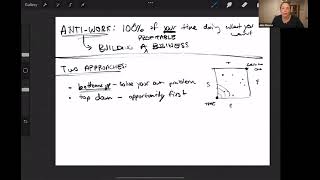
Sahil Lavingia walks through how to find and test business ideas, using oil painting as a concrete example. He breaks down what makes a good idea: fast MVP, 10x impact, B2B potential, personal interest, and organic growth. The homework is to generate 20-25 ideas and write a memo for each using the problem-solution-market template.
Chapters
24/7.
Really?
This?
No, not at all.
It's not very relaxing, I don't think.
This is what happens when you lose a penny. Can you imagine? Just like, it just— I can just see a Charlie Chaplin skit right now.
Does anybody play instrument?
An instrument?
I know some people were saying in the introductions that they play instruments. Hello everyone!
Who plays an instrument? Feel free to unmute and, uh, Bass and drum. Key back. Okay. Maybe the music is too loud.
Yeah, who does play an instrument? We could have our own band.
No one play? I played clarinet when I was in school.
I played flute very badly.
Very, very badly. I feel— you wish you played a different instrument? Like, if you went backward?
Like, yes, because all the girls played flute or clarinet, and I wish that I had played, um, a brass instrument like the trumpet, something loud.
So we can start a really, really bad band.
Oh, that— really bad bands are the best kind.
Did you know that every band starts out as a really bad band? It's the only way to start unless you're like a, I don't know, a fork of another band or something maybe, or you come together with some soloists.
Yeah. Well, we have 34. We'll give everyone one more minute. How was your weekend? Anyone do anything exciting?
Feel free to unmute. There's not that many people, so we can definitely—
You should— you can unmute and speak. We're not—
we won't bite.
I brought a bunch of my clothes from my wardrobe to a thrift store to just donate, just to be more of a minimalist in my own wardrobe.
Awesome. I love doing that. I do that like every 3 months and I don't feel like I buy that much stuff, but every time I do it, I'm like, holy crap, stuff just accumulates. Like, I feel like I just—
So now what are you down to? Do you have a uniform?
Um, no. I mean, I have like 5 outfits. I have 3, 2 pants that I alternate between. So I'm that, like, that, you know, the Barack Obama thing. He wears two suits. It's blue or gray, I think. So I'm like, I'm that on pants, at least.
And what about you, Julie? What are you down to now that you've donated all of your stuff? I'm down to enough stuff that will fit into a carry-on luggage.
So all of my stuff. No way, really?
Yeah, for clothes. Yeah. Wow.
Wow. That's pretty impressive.
Hey, you're winning. You're winning today on minimalism. Okay. Maybe we should go ahead and get started. 9:04.
Awesome. Yes, let's do it. Let's get started. So let me quickly share my screen and just go really, really quickly recap kind of the overview, cuz there may be some people who are watching this for the first time. So let me share my screen and just go through how we're gonna spend the next 6 weeks of the class. So this week, the first week, is about coming up with good business ideas. Then we're going to take those business ideas, and we're going to take at least one of them each and write a memo, and write a really, really awesome memo, just the kind of memos that I assemble to get feedback on my own ideas, and to raise money, and to do all of these sorts of things. Then we'll design stuff in Figma. I'm going to teach everyone how to design stuff. This is how I got my start. And then we're gonna build stuff. We're gonna build an MVP. We're gonna go through kind of like what the no-code version of that might look like, what the code version of that might look like. We're all going to deploy if we don't, haven't already done so, our own websites to the internet with our own domains, which is gonna be awesome. And then we're gonna talk about sales. You know, obviously if you wanna build a business, which is the goal here, after you build a product, you need to sell that product. And then finally, we'll go through kind of everything else, which I've kind of used the word growth, but effectively growing your team via recruiting, via growing your company. Basically, I'm going to do a pretty intense deep dive. You'll basically see every single thing that we do at Gumroad around quarterly planning, recruiting. I'll go through our P&L, our accounting, our crowdfunding filing with the SEC. I'll go through Notion, how we use Notion, how we use Slack, how we use GitHub, like literally basically everything. And then obviously like the vast majority of the content is not here, uh, because the vast majority of the content is either going to be peer-based or it's going to be you asking me questions, um, and figuring this thing out because obviously there's like 70 words on here. Um, and I thought what would be really fun is to actually use Procreate. So I don't know if people are familiar with Procreate. Who's familiar with Procreate? Procreate is an awesome app. Oh wow, that's like half or more. So I'm gonna, I'm gonna share my screen again, but this time I'm gonna share my screen using AirPlay. Actually, no, what am I gonna do? I'm gonna share my screen using my iPad cuz that doesn't work and then I'm going to be knighted by Julie so that my iPad will show up as the main view.
I'm going to jump in and just say something quickly about—
please do—
anyone who was not here last Thursday, just a quick overview of the course. I just posted the course Notion in, uh, in the chat, and it'll also be in Slack. But just to get a sense of every week, the workshops are Monday, 6 to 8 Pacific time for 6 weeks in a row. Then we have 3 peer mentor groups that happen, one on Tuesday at 11 AM PST, one on Thursday at 6 PM PST, and one on Friday at 6 PM PST. And I'll post all of that in the Slack. But we've sort of added to that. We're adding to the course Notion as we go. So I added an alumni mentor group page at the bottom that has a link to all of the calendars and a link to the mentor group Slack channels. And then office hours on Friday, yes, and Sahil Lavingia is going to post a Calendly link for the office hours every Wednesday, so you can look for that in Slack. So there, just, I'm trying to answer all of the questions that I got today and over the weekend about Logistics, scheduling. You should have gotten 6 email invites for the workshop, and if you didn't, just send me a message in Slack and we'll work it out. But we're trying to post things in multiple locations, so you'll never be looking for the Zoom link or the time or anything that you need. But I'm on my computer a lot, so just send me messages back.
Awesome. Yeah, we're gonna try a bunch of stuff as we do every time. We're gonna try a bunch of new things. Uh, and then a few things are gonna really, really, really work and then we'll double down on those things. And that is kind of one of, definitely one of the themes of, I feel like a lot of what I say over and over again, try a bunch of stuff. Some things work, double down on those things, small bets, um, et cetera. But, uh, yeah, let's get, let's get started and we'll see. This is kind of an experiment. I haven't like done anything like this before, but like, this is how I think through my ideas. Like I like being able to do freeform instead of just like type in this list of slides and text and all these sorts of things. And it also means that I have the chat open, the— so please use it. But Julie will help as well. Awesome. So yeah, let's get started. So this week, actually before this week, let me set the goal. The goal for the whole course, I think the right framing is kind of what we talked about on Thursday, but it's kind kind of this idea called anti-work, right? And I really like this. I like picking up, picking up on like what the zeitgeist is kind of already talking about. Another theme that we'll get into in a second, but anti-work basically is, you know, something like 100% of the time, your time doing what you want. That is kind of like the broad goal, right? That's, I think, what everyone wants. Um, and hopefully we'll get there. The way that our approach to actually getting to this goal, um, is by building a business, right? Uh, and so our approach to this is building a business. So that is kind of the 6 weeks or so that we're spending here. And obviously if you want to be able to do this, You need a profitable business, uh, because it needs to exist for a long period of time, and there's only one way to do that, which is to be profitable. Um, and yeah, so that's kind of the focus of the course, and this week is going to be on the first part of that, which is coming up with the idea itself. And there's two ways, uh, to come up with ideas. There's sort of two approaches. I mean, there's, there's many approaches. We'll go through a gazillion of them today. Uh, but there's, there's, there's kind of two, I think, real framings of this approach. Uh, the first approach to approach— also, I want to flex my drawing abilities at some point. There's two approaches. What are the two approaches? Well, there is my approach, which I kind of consider like bottoms up, the bottom So, and another way to say this, very commonly said, is solve your own problem, right? This is kind of the approach that we will generally be taking. But I want to give credit and talk a lot about the other way, the other sort of sets of approaches, because this is not like sort of my way is the right way. So the other approach is kind of the opposite, right? So instead of bottoms up, it's sort of like top down. Pod. I also flipped that top down. And another way to kind of, I think about this, cuz this is really, I think the framing that, that sort of side uses is kind of opportunity or market first. And this kind of works nicely in a, in like a framing way because if you kind of, you know, the bottom is obviously at the bottom, top is at the top. You kind of start with your own problem over here and you kind of finish with the market opportunity over here. This is kind of like, let's say right here is kind of like Zero to One, Zero to One, which is a great book. I highly recommend everyone read it. And then maybe here is kind of like TME or Rework. And of course there's kind of, most ideas fall, right? Something like that. So it's everything kind of is in the gray area. But just to be super kind of clear that like, we're really, really focused on kind of this bottoms-up approach. And why is that? There's a bunch of reasons. The core reason is that this is about the minimalist entrepreneur. And if the goal is 100% of your time, like notice that the goal is not to build a profitable business, right? The goal is 100% of your time doing whatever the hell you want, I think owning a business is a great way to do that. There are probably other approaches. Certainly if you go to the anti-work subreddit, there are many other approaches to getting to this place. But the goal is 100% of your time, which often means that you're going to start many, many businesses. I was just listening to a podcast or a YouTube video with Naval. I love finding, going '86, '87, finding the oldest content possible from people that I like and respect and getting a sense of what did they think when they weren't as famous? And I learned that AngelList was 13 years into his career. He started AngelList when he was 36, and he had dozens and dozens of ideas. I'm pretty similar. It's in the book, but I had a bunch of ideas before Gumroad. Some of them even worked, most did not. And my guess is everybody has these ideas, and we'll use Elon actually as an example in a second. You're going to have a lot of ideas.
Uh, the truth is a good time to ask people who has started a business before, or how many businesses have you started before? Uh, you can type into the chat or you can unmute for a second.
I'm in the middle of founding my first startup.
Only one? Okay, you're in the first one. Okay, good. Oh, look, here we go. Started.
I'm gonna ask a clarifying question as well, which is, yes. Like, are, what, what do people, when they hear that, this is like a meta question. What do they, what are they hearing when you say started a business before? Like, how do you define starting a business? Because that also may change, right? Like, is that I incorporated a C corporation in the state of Delaware, or is it I had an idea, I tried it, made a sale, maybe didn't, failed. If you wanna chime in on what, even the people who have already answered, like, how are you thinking about, I'm very curious, like how even people frame in their heads, what, what building a business, what a business even is. Sorry to get meta, but this is my show. I'm thinking of almost anything as a business from when I was a little kid and I used to clean houses for people or babysit and I'd set up my little schedule and go out and try to get clients. Awesome. Does anyone disagree? Does anyone kind of— did anyone— or not disagree, but like just in there kind of think about it like, oh no, I have to really— like, for example, the person who said, uh, you're building your first startup. Yeah. Is that your first business endeavor ever, or like do you kind of weight startup more in your head and that's why it's your first one? No, I've been a freelance illustrator for 20 years. Oh my gosh. Wow. Amazing. Peter. So this is my first business, business, not creative freelancer. But when you're freelancing, were you self-employed? Yes, of course. So you were self-employed. So you kind of had a business or like sole proprietorship, but this is a startup. So when you say startup, what do you mean by startup more than freelance business? Obviously startup business. Like, how do you differentiate those two? Right now, I had an idea. I wrote an MVP document. And, uh, I made a team and we built the MVP basically. We, and we are ready to launch in, I think, about 2 weeks. Oh, awesome. Awesome. Cool. And do you have certain expectations for kind of the startup in terms of growth, or is it just like, we'll see what happens? It's basically the idea was something that I needed myself and that I could not find out there. So I decided to build it myself. So solve your own problem. My only expectation for it is it for actually to work and for other artists to start using it. All right. That's good. That's good. Okay. Okay. So I see, I think, I do think this does remind me of, or this does bring up something where a lot of people, the way that they define business is, or that they have started a business is when they have a co-founder or in your case, like a team. I think a team really changes things. Having one other person really defines a business in many people, but I prefer the first person who spoke— sorry, I have a lot of things open— because I really want to make sure that everyone feels like they can do this and that they can start a business and that they should actually start many, many, many, many things. And the way that I think of it is like jumping off a cliff. Everyone says that all the time, like starting a business, like jumping off a cliff and make building the airplane on the way down. Like what a terrible way to like get people excited about entrepreneurship. Like it's, you know, I like to like lower the height of the cliff. Like let's like make it as simple as possible. So everyone should feel like they can start a business in this 6 weeks. Like actually ideally much, much faster than that. I would argue to Peter's point, freelance is like an amazing way to start. And we'll get into that later. Daniel Fasolo has like a really good Good way to think about it, but freelance, I think, teaches you so much about being a business owner, cuz you are actually kind of a business owner. It's kind of a, yeah, it's kind of, you sign up to be an entrepreneur without maybe realizing it even. Awesome. So yeah, so why this approach? Well, one is I mentioned like, this is about you. The way we maximize your chance of success is by taking many shots on goal and inherently like these sort of top-down approaches. There's just not that many of them. The example that I often use is the iPhone. The iPhone is obviously one of these massive opportunities, though Apple also discovered it organically from the iPod, et cetera. But the iPhone, let's draw an iPhone. They keep changing the design. So now this one has a notch at the top and goes all the way to the bottom. So this is the iPhone. And how many companies are kind of this top-down? Like, I'm going to say Apple, right? Apple. Like, when I look at this, I think of an Apple iPhone, but there's like 10, or there's 6,000 businesses, I believe, businesses that help make this iPhone a thing, built this. Actually, that I bet is just including the actual things on the phone. It probably doesn't include, for example, all the restaurants that served the people who worked at these companies. So my point being that for every one of these top-down massive businesses, the kind of things that Peter Thiel is interested in, the Facebooks of the world, there are tens of thousands, if not hundreds of thousands of these businesses that will all solve this problem for you. And so there are so many of these out there. Like, I kind of believe that there may even be more than one per human because the more problems you solve, the more problems there will become. Like, I kind of believe there's like just an unlimited amount of these. And so that's like a really, really big reason for it. And of course, if you're someone like a Peter Thiel or maybe even like me, I get to invest in a lot of startups, I like when people take big shots on gold, because I don't mind if there's a bunch of zeros, as long as there's 100. But everybody else really wishes that there was an average, except for the one person right at the top. Actually, even if you see this, using Apple as an example, or the iPhone as an example, this power law happens even at this level, because you have Apple, obviously up here. I don't know what they're worth. $2 trillion or something like that, $1 trillion, some stupid T. Then you have TSMC, which is the manufacturing company in Taiwan that makes all the semiconductor chips, which is scary, but it is what it is. I think they're worth half roughly. And then who knows, maybe you can put Instagram. Instagram's probably worth $500 billion or something, if you include that on the thing. Blah, blah, blah, blah, blah. So this thing plays out everywhere. You can't help it. I just find that I'd much rather I don't know, focus on the sort of bottoms up, like I don't need to think about building this sort of thing. All I need is a business that makes me $100 grand a year, and then I have all the time in the world to do whatever the hell I want. And so that is kind of, that's kind of why we take the approach. It's a multi-iteration game. It's a very long-term game and we should, you know, we should kind of treat it like that. Julie, any questions that I should answer? Is anyone confused. Any questions? Feel free to chime, chime in the chat or just unmute and ask. Does that make sense?
Any questions? Um, no questions.
No questions.
I'm very curious. I'm, I'm very— I'm excited to get to the what, uh, I'm excited to get to the what businesses do you wish you had start— wish you started or wish you ran question.
Awesome. Okay, so let's do that in one sec. I want to give one other example which is Elon, Elon Musk. And the reason I like to give him as an example is one, I do actually think he does a lot of the minimalist entrepreneur things, even though people probably don't consider him one, but his trajectory as an entrepreneur, I believe, fits very nicely into this framework. And so for example, his first company, I'm sure he had other companies before this, he had a company called Zip2. 2, and people can look this up if they're not familiar, but he started a company, kind of a very software, like super simple, easy to start software business. I think it's basically sold like mapping software to like newspapers have maps on their websites or something, some newspaper website or something like that. So he started this company called Zip2 with his brother in Canada, I think. And then he started another company. Called X, which became PayPal, had some like weird merger thing happen, and then became kind of a co-founder of PayPal. And then the kind of the famous story is that he made like $170 million off that. And then that kind of spun into SpaceX, Tesla, and SolarCity, I think was the other one. But the cool thing here is like Zip2, if you kind of graph this out, Zip2 was kind of like his thing. This kind of got him to Andy where he could kind of do whatever he wanted. That kind of created this PayPal X thing, and then obviously Tesla and SpaceX, and who knows what's going to happen. So over time, you can kind of make bigger bets yourself and you can kind of take the Peter Thielian zero to one sort of thing, but turns out if you have unlimited time and capital and you've built trust and you have an audience and these sort of being able to take these moonshot bets actually becomes easier and easier over time. So my thinking is actually maybe if I really want to like eat my cake and have it too, that like the best approach to the zero to one mentality, to the top-down opportunity-first sort of approach is actually my approach anyway. So I get to eat my cake and have it too. So anyway, that's just what I wanted to say. And Julie, yeah, let's ask that and I'm going to write them down because I can do that when it's not Google Slides.
So my question is, uh, what businesses— sort of on the pathway to defining like what a minimalist business is, I'd love to hear what businesses people wish they had founded or wish that they ran.
Yeah, what are your favorite domain names?
Oh.
What was the domain name? Also just buying domain names in general.
Oh, interesting.
You wish that was your dream business? I wish I had just learned about it way earlier. So my challenge to you would be to find, find someone who did so you can visualize like what that business actually— what that looks like.
Loom, Calendly.
Go ahead. Yeah, I can add one. There was a— it's kind of shut down now, but the founder of Groupon started this company called Detour a few years back. I don't know if anybody used it. It was like a virtual walking tour app. Yeah, it was like my favorite app of all time. And then they got bought by Bose and shut down, which made me really sad. And there's no alternative that exists. It's like it was a beautiful business and really great at storytelling and learning. And so, yeah. OK, so that's my follow-up question. Which is what, why, why these businesses?
I just wanted to give people a chance to— oh yeah, sorry. Oh, Wordle. That's my, that's my dream business. I wish that I had come up with Wordle.
Wordle. That guy's a, he's a, he's a, he's a many, you know, if you could, he actually has a bunch of these too. Like Wordle was not his first game. Um, he had two at least that I know of before. Um, so yeah, common, common theme. Um, okay. So why—
I think about like why the things that attract us that are important. Detour, Catan, Figma.
No one wrote Procreate, so sad.
Substack.
Okay. Now I need to know why. So why— okay. Detour was answered, which was Storytelling. What else? What else was cool about it? Why do you want— why would you— it got people out of the house. It taught them something new at their own convenience. Taught something new. Awesome. What else? Who said Figma? Why Figma?
I said Figma and I'm a designer. I think just before design tools were so expensive. You know, that prevented people from like buying Photoshop or Sketch, but Figma, it's like free for 2 people. So it just makes it so much more— design tools way more accessible. And the fact that it like allows for collaboration, so multiple people can be in the file, and is really good for the remote world. So it fosters like collaboration amongst like everyone in this remote world, and especially along designers, PMs, developers, execs to all be in the design file, whereas before it wasn't really as possible to have that collaboration. Yeah, and also I think the fact that it's end-to-end, so as a designer, the process is way more streamlined versus like different parts of the design process, like going to a different tool, like for prototyping perhaps. Or for doing a task flow.
I do love, I do love Figma, which we obviously will spend a week, a week on it. Awesome. We could do this for a long time, but I'm talking too much, I think. So I'm gonna move on and I'm gonna move on to all of, all of the different ways that we can come up with with ideas. And so obviously solve your own problem is not enough. This is like a good framing for what, you know, I basically, the, what I want you to do is I'm gonna come up with my own framework and different ways that I think about this. And I want people to look at these companies and figure out, okay, this is how, you know, like basically start to visualize, okay, how can I come up with, for example, other companies that also teach something new that are, that also make something like Figma, I think is a phenomenal example of this. Cuz I really believe that there is this sort of thing that has happened in which you can take some expensive piece of one-off software, move it to the cloud, give it to everybody for free, make it way more collaborative, more stakeholders. You can take that and probably apply it to many, many, many things. Splice is kind of doing this with music. There are a bunch of startups doing this with video. Canva kind of does this, but for a different kind of thing. So I often think about it like, You know, let's say you had some sort of dimension and like Figma's over here and there's like two dimensions here, right? Like there's that whatever you defined as like, okay, collaboration, like this is the collaboration line. Right. But then there are, this is like the vertical line, let's say. And so like Figma's here, right? Because it intersects like collaboration. Operation and like designers, right? I'm gonna make a note to myself cause I wanna talk about something in a second, but designers. And then you could like imagine like, well, there's probably like, this whole thing is businesses, right? So there's probably like every, you know, every, you can almost intersect this with so many different, like lawyers, I think really lawyers really need something like this. Like it drives me insane how they work. Writing this book, I can tell you, man, like there's a lot, a lot of need for collaborative, collaborative, collaborative software. Yeah. Okay. So let me go through my frameworks. These, these are kind of like the ones that I think about. The one sort of most old school one is called economic utility, right? So this is kind of the thing that you learn in high school, probably. Shout out the 4 types of economic utility. If you took economics in high school or college, what are the 4 types of economic utility? What are the 4 types? Or type it in. There's, there's at least one of them is written on the, uh, on this Procreate slide. Come on, everyone, everyone's gonna have to drink a couple beers or something. Yash, you got it. Form, time, place, possession. I can wake up my wife, she's a doctor in economics. No, that's cheating. Form, time, place, possession. Form, utility. OK, so Yash, can you unmute and explain one of them? It's been a while, but I think the one that resonates most with me is time utility. So ways to give people back their time, ways that reward people along the curves of demand or supply. Apply in terms of giving that asset back to them. And that's kind of the trend for the other 4, but just in different places or other 3. Yeah. It's there. Yeah. There definitely, there's kind of a lot of overlap. So you said, okay, so time, which I, yeah, basically save people time. You can't really give people time, people time, but say saving people time, basically. Another way of saying this is make it faster. Faster, right? Place. Who wants to do place? What does place mean? Place utility. What is the faster equivalent of this box? So retail store. Lakshmi, what'd you say? Retail store. Shopping stores. But why? Why? Like, what— you're correct, you're correct in that that is an example of a, of a, of a business that provides place utility. But specifically, what is place utility? Like, what is the property of that store that you value? Is it the branding? Uh, why place? Yeah, it's mostly a like central repository where I could get everything over there. Like, I don't need to know Yeah. Okay. So central, central, I'm gonna put central repository here.
The way— And Matt's suggesting we give examples of some of these companies if we can. Is that what you mean?
Oh yes. Yeah, we can do, we get, let's do examples. This is gonna get crazy. Yeah. This is gonna be an insane slide, but we'll do all of that. So yeah, let me do examples, but first let's do these. So I'm gonna, the word I'm gonna use is closer, effectively closer, right? Like central is kind of a way of saying that central, you're basically saying close to where other things are. But closer to you is kind of like, you know, if you're looking at this and you're like, what drives me utility? Closer, right? Form is the hardest one. So I'm gonna skip that and then, or I'll fill it in myself. And then possession, who wants to do possession? Possession should be relatively easy. Easy. iPhone. iPhone. It's on here. iPhone is an example of one. Okay, let me write that down. iPhone, retail store. AirPods. AirPods. Yeah, so basically accessibility is the answer here. The reason— it's the fact that you can possess it at all. Is what brings a utility, because there are many things that you literally cannot possess. Sid says, "Remove middlemen." That is definitely— Yes, this is homework for the book. Good catch. Yes. Basically, things that you were not previously even allowed to do, only half the population could do it, and now the whole population can do it. That is a huge amount. Of value. And the network effects fit into that and all these other sorts of things. And then form utility, I'll fill in myself, which is basically, I mean, it's kind of, but basically I've never found the right, like, unfortunately there isn't like a word for this, but basically more useful is kind of like what I say. And if you notice, I don't know if anyone saw my Synthetic Wombs tweet, which went more viral than I wished it did. This is what I said. I said, you know, basically we should make having kids. And then what I said was faster, cheaper, simpler. This is where that comes from. It's like the framework that I use to create new ideas and come up with, uh, business, business ideas. Um, and the bi— the biggest businesses do all of these, right? Uh, so like, I don't know what the, what's the most valuable company in the world. Is it Amazon? Maybe. What does Amazon do, right? They save people time. They make things closer to them. They literally have these distribution facilities that they've built. They don't really do form, though they kind of do now with Amazon Basics. They build their own products, they make their own products. And possession utility. And possession actually is really clear with something like an Amazon Web Services, where they really do allow me to possess, to effectively own my own servers and create a lot of value by doing that. And so this is my framework. This is what I use 80% of the time. And a really easy way to come up with ideas is to say, what is really freaking expensive that shouldn't be? It doesn't make sense. Everyone probably has examples in their life of like, why did that cost so much? It might be some interfacing with the government. It might be, I don't know, some product. It might be some food. It might be whatever, but there are so many things. Really, the most obvious one of this for me is if you do anything in crypto, gas fees. Obviously, gas fees are going to go down over time. That is a multi-trillion-dollar opportunity. The amount of demand to get into crypto is massively regulated by how expensive it is to get in. So if you make crypto— by the way, all the haters on crypto, You will get rid of all the haters. You will turn them all into lovers if you solve these problems. If you fix time, if you make it fast— I mean, this is what people are trying to do. Make it fast, make it cheap, make it free, ideally. Change its form so that people can even understand what the hell is going on, and then give it to everybody. The accessibility, the possession utility is built in from the start. So I use this framework all the time. It's like, this thing costs $50, I could use this piece of software that, you know, they're doing it manually. I can automate it and I can charge $25. That's a business, right? And so you can constantly kind of do this where similar kind of exercise I do is I kind of find a business that's over here and I'm like, can I move it this way, right? Can I move it this way in time? Can I make it faster? Can I make it cheaper? You know, can I move it over here? You know, sometimes something as simple as, hey, no one in this city has eaten this awesome food. That I love, right? I'm gonna open a restaurant. Like that is place utility, right?
And form utility. How many of these criteria does a business need to meet for you to think about starting it?
Just one, to be honest. Just one is plenty. It's plenty because most businesses, most business ideas, honestly, I hear them and I'm like, you have not solved any of them. Like, it's surprising to me. I'll get pitched an idea and I'm like, you actually haven't really solved a problem. This is like a, and sometimes you're like, really? Like every problem fits in this? I got a lot of crap because one time I tweeted, "There's only 3 ways to make money." This is another way to look at this framework, only 3 ways to make money. What are the 3, only 3 ways to make money? Someone said glue, which I assume is not the answer to this question. Kind of bundling would be some. Glue, I guess. Okay, well, I already said one, which is save time. Save people time. Time. Save people money, number 2. And there's one left, and there's only one new word in it. Is anyone gonna say— oh, someone got it— make. It's like Wordle. This is like Wordle money, literally. Like, and, and everyone's like, oh no, there's like other businesses that like don't do these 3 things. And I'm like, first of all, sure, uh, there are a lot of bad businesses, uh, but I guarantee you if you go to like the S&P 500 or you go to your local store, you go to like 99.9% of the businesses you support that you patronize, like go on, go Open your credit card statement. Uh, I guarantee you that like these businesses are doing these things. Um, the other thing that maybe like isn't addressed here is they make you happy, right? Like there's sort of a whole set of businesses that just like make you happy. I'm not focused on those businesses. I'm focused on like the thousands of businesses that are supplying to Apple sort of businesses, uh, things that are obviously in business because they save time or make money or save money. Um, the reason is this is far more objective. On the left, right? Happiness. It's like no one agrees on like the best artist, the best food, the best restaurant. These are all very, very soft, abstract things. These things over here, like if you can save someone $100, like that's a number. Um, it's so much easier to build a business like this and it makes your whole life easier. Like sales becomes a lot easier cuz you're like, I will save you. My value prop is 7 minutes. How do you sell a restaurant? The food's amazing. It's like, what the— like, that's super hard. That's super hard. Um, so anyway, yeah.
Okay, Sid, you want to unmute and ask your question quickly?
Uh, yeah, I like the framework. I'm just curious, um, rather than a binary solution, you're giving more time, they're giving more, uh, how much— if you give it like a few minutes extra, that's not adequate. So how much marginal utility, like when would it make sense to, you know, there's some overhead in starting a business. So when does it make sense to say, okay, you're doing 10 times better, or like, is there some ballpark criteria? Yeah. I mean, that's a really good question. And yeah, you're basically trying to figure out like, yeah, what's the activation energy, right? Like when is it really worth it? Both in the sense of you maybe starting the business, but then too, like on the other side, like you can't really say, hey, this is like 1% better. Right. Like that's a lot of work, a lot of risk to try a new product and, you know, blah, blah, blah. So, you know, there's, there's a couple of ways to think about it. One is like this obvious 10x better. I don't know if you've ever heard this framing before, but basically make something that's 10 times better. The reason being that people will only switch, like everyone has inertia on what they're doing, right? Like they already have solved their problem somehow. Right. The only way you get them to kind of like say, actually, I'm gonna do something different, right? Is like when there's a big, like a big reason for that, right? It's like easier to say, hey, like I'm gonna do this crazy trip, go to France, than like, hey, can you like, you know, grab coffee with me tomorrow sort of thing, right? Like, and so 10X is kind of the simple heuristic. The reason it's 10X is because we have 10 fingers, right? Like literally totally arbitrary. So, but what I like about it is that it's just like, it has to be a lot. It has to be significant. And maybe that is something I do incorporate in this when I sort of use this framing is— oops, use this framing is I like— I want to figure out what is the biggest differential there is. Right. And so another question was basically like from last time was like, how do you— if you have a lot of ideas, like which one do you pick? Right. And I kind of think about it like, well, what is the 10x? If I have an 8x and a 15x, go for the 15x. Try to create as much value per person as possible. I think it's going to vastly increase the ability for your business to succeed. Like Paul Graham says, it's much better to have 10 people love your product and 50 people hate it than 70 people kind of think it's okay, it's fine, whatever. Not a big deal. And so you really want to over-index on those kinds of people. And that actually brings me to my second thing, which is I said Figma was kind of for designers. I think what's really important to help answer that is you have to think about who is this going to be a 10x for? Because you build a product, for some people it's nothing. They don't care for it. And so starting with the right people, like Y Combinator has that great thing, make something people want, it's pretty awesome. People want. And this is maybe kind of where I start to get more counterintuitive. Like they've really, I would say they really focused on the something. They kind of have like this very like builder engineer mentality to it. I really think you should focus on people. Like you should really, you know, in the book I call this start with community, basically start with people, like start with who, who, and we'll do an exercise about who, but start with the who and then I think it's a lot easier to come up with a lot of these other problems. The last exercise I want to do, there's two exercises I want to do. I want to do one more thing before I go into our last final thing that's going to be actually coming up with a bunch of business ideas is I want to come up with trends. I think one thing that's really important is you need to ride a wave. I think it's very difficult. Part of selling is just hard. You kind of want to search for market pull, which I I just use riding a wave as kind of the metaphor. You can't surf in a lake. You kind of have to go to where things are already happening. And so I just want to really quickly go through a bunch of trends. I would love if people just wrote a bunch down in the chat, and I'll write up a bunch of these. I'll start with a bunch of trends. Offline to online is something I often think a lot about. Again, these will all map back to economic utility. They should. Either because going online saves time or makes something closer, more convenient or cheaper. But generally, this is one level of abstraction lower. Desktop to cloud is a great one. That created a ton of opportunity. And ultimately, by the way, the way you come up with business ideas is just bashing. It's a bunch of atoms coming together. So I just will throw all these at you and hopefully Things will start to, to work. Solo player to multiplayer, single player to collaborative. Yep. That's a good one. So that's kind of like that Figma one. Figma's also kind of this desktop to cloud and kind of offline online. If you, if you, you know, for like wireframing, for example. Single to collaborative is a good one.
I like gated to open also.
Ooh, that's a good one.
Domestic to global, user to self-service. Agency to freelancer creator. Uh, they're going so fast now. Hold on. Uh, client and designer to collaborators, centralized to decentralized.
No-code counts. Oh, manual to automated, manual to automate. Oh, I love this one. Honestly, if I could pick one and just say, just literally just 'Zoom in on this one' is probably what I would do. Like, I'm gonna star this. Um, 'Agency to product' is a good one too, actually. There's a lot, there's, there's a lot. Um, like, I would, I would put like 'plant-based' is another one, to be honest. You know, like, 'meat to plant' is definitely kind of a trend. It seems like 'manual to automated' also applies to 'agency to product' and a lot others. Yeah, definitely. Um, you know, like the— in the book I say process to product, start with process, right? This is kind of that, right? Like all of the— it's basically— and this is a— yeah, this is often something I think about. Like when I, when I, when I think about, okay, how do I map economic utility applied to a business that already exists, it often is basically doing this, right? Which is taking a business that already exists and being like, wow, this is so badly run or could be so much better done and just making it better. And you don't have to say, oh, we're going to take this coffee shop and make a freaking Starbucks or Cometeer or something crazy like that. But you can say, hey, we're going to use a bunch of software and we're going to make this awesome. I think, for example, a lot of the cloud kitchen businesses do this where they're like, oh, wow, Now everyone's just ordering on DoorDash. Like, you can build probably a 10x better sort of like fried chicken restaurant if you're just focused on that specific kind of thing. You could use a packaging that keeps the wings crispy or whatever, right? Like, you can really make that experience better. You can automate tons of stuff. Uh, you can kind of create these checklist manifestos, you know, like all these friend, you know, franchise basically. You can, you can like think like a franchise even though you may only be operating one or two. And the way a franchise thinks is they basically take all of the rote repetitive behavior, type it up, codify it. Uh, and then the last step is kind of the full automation step, right? Which would be basically just like robots. Like you just, if it's, if you can digitize it, easy to automate. If you can't eventually, you know, Optimus Subprime or something like that. Um, audience to community is definitely another trend. Um, but like I would make a list of all these trends and like, you know, you, you almost like think of like the way I think about a business is like, it basically is an arrow. And you want it to intersect as many possible things as possible, right? So if it intersects like time utility and place utility and offline to online and manual to automated and collaborative, like you'll start to be, that's how you get to the 10x better, right? Like very few things are 10x better, obviously. Like you, you, you know, things don't disappear and are just like so much better than what came before. They're, they kind of, you know, get 10% boost from this trend, 10% over here, 10% over here, 10%. And like Figma becomes 10 times better. Than Photoshop, um, all, you know, all over all of these kind of like small compounding, compounding things.
So, so far that's 3 things. So looking at, uh, traditional economic utility as—
yes, I have more.
Yeah. Oh, you have more? Okay, so let's just, let's just— because we had a couple—
I know, we're like 50 minutes in.
I'm like, I know, we had a couple really great like framework questions, um, in the first session, so I just want to like stop for a second before you—
Yeah, I'll do some more quickly.
Yeah, no, it's like, so traditional economic utility, uh, is it 10x better than what exists? And is it— can I ride a trend? Yeah, let me write what we have so far.
Yes, let me, let me write them all down so it's nicely available. Start with people, like, that's kind of like a really broad one, but just people in your life. Yeah, economic utility was another one. I would say like 10x better is kind of its own one because it's such an easy, simple framing of like what sucks. I often do this with like my bank account or Gumroad's P&L statement, which is I just look at literally what are— what am I or the company paying for? And what is the worst thing? What is the worst thing in December 2021 that we paid for? Oh wow, we spent $4,000 on Amex. What a shitty company. And since then, since I went through this exercise in 2015, 2016, when I was like, wow, what are all the crappy things we pay for? And then now since then, Brax, Ramp, Stripe Corporate Card, boom, all these startups. So there's so many opportunities if you can just look at Yeah, this kind of bank P&L sort of thing, just literally going to your credit card, what do you spend money on? What's there? I also do this with Google and Twitter. What questions do people ask? If you go through your search history, one, you'll realize how many times you use Google. I'm always shocked by how many times I Google stuff. It's bonkers. But you'll see all the stuff that you need help with all the time. And if you think about the save people time, if you're doing content, there are a few people who are doing content, courses, books, things like that. A lot of that is this, which is it took 5 hours for me to figure this thing out and I'm going to write a blog post that's going to get you that answer in 10 minutes, or a YouTube video or something like that. Even when I had the idea for Gumroad, the reason I built Gumroad was because I wanted to sell this pencil icon that I spent 4 years or 4 hours designing, and I felt like someone could learn it in 15 minutes if they had the pencil icon. So the pencil icon's utility was time utility really, but then Gumroad's utility was form utility or possession utility. So there's layers to it. Every marketplace is going to have multiple layers. Another one I think about, this is a new one, is what— and then actually I'm going to use the trend because there was a trend which was the domestic to global. So I'm just gonna say local to global cuz it's slightly more rhythmic. But this one is, is, is one I've started thinking a lot about recently, which is just like, what is literally, like, what does your region locally produce? And I've just been fascinated. I got a little bit into wine. I'm like, oh wow, it's kind of crazy. Like you cannot compete because like your geography really matters on certain things. And I noticed that like every place has things. So I often think about that too. Like the internet is connecting everyone. So all of a sudden your customers are global. But you locally can— your region is the best place in the world that produces X. So for example, I live near Portland in Beaverton, Oregon. We have the best shoe company and we have the best chip company outside of TSMC. We have Intel and we have Nike. And so think about what is in your region. Obviously, The common things that will come to mind are going to be the sort of food products, right? Generally, but like literally like think about what businesses have started. Like if you're, you know, if you're a Seattle, like Whole Foods started in Seattle, right? For example, like why, like what about that confluence of things? I like thinking about that, that kind of thing. These are all kind of just kind of filters just to help you sort of get more specific. You don't really need any of these, but these are These are kind of fun to sort of think about. Yeah, Volvo, Volvo cars. What else? Another one is just this broad concept of being early. I really felt this when I tweeted about synthetic wombs because I thought it was kind of obvious that at some point we would have these things, 50, 100 years from now sort of thing. And it was not. It just really made me realize early is really important. What are you early on? What do you know is the future that you're one of the first 5 million people on it? Obviously, crypto is probably something that comes up in people's heads. That's too easy, so skip that one. I remember I got my first Apple laptop, was an iBook G4. I was early. I was one of the first iOS developers. What are you early? What interest? And generally it's your interests, your natural curiosity. It's like, what are you already kind of toying with on the weekends? Like, what are you reading about that, you know, like start trying to pay more attention there. Like, what are you, if you imagine, like, I like to think of it like kind of a beachhead or something like that, right? Like you're here somewhere and like, it looks like, oh wow, I'm so late. Everyone in the world already, everyone already has This, but it's like, no, it's because you're only looking that way. You don't see all these people. And really one that I often think about is just startup equity. Startup equity, everyone knows what it is here. A bunch of people have some. You can angel invest, you can do whatever you want, you can own Republic, you own crypto probably. Almost nobody does. Almost nobody does. So that's pretty obvious to me that yeah, 10 years from now, 20 years from now, everybody will. That's another one. This is another way of saying it. What will everyone do at some point in the future? What will be at 100%? For example, the internet. My guess is the internet will be at some point 100%. Everybody basically will have access to the internet. Currently not true.
I'm going to get Lakshmi to unmute and ask your question.
Yeah, hi. Thanks, Julie. So I have two questions. So don't I need to choose a domain or idea which resonates with my existing background? Like, okay, I have an idea, but I don't have full background to work on it in future. Uh, will that impact me down the line after I choose my idea? Um, it does, and we'll get into it. I think we'll do the checklist. Julie, if you can— if you remind me to do that checklist, um, we'll do it after the The who, what exercise. So yeah, I think it does matter, but honestly, I don't think it matters that much. Um, the beauty of building a business, like if you imagine like using this graph, um, any business you start, you're going to be over here, right? Uh, and most people are going to be over here and very few people, as I mentioned, want to be here. Like nobody really wants to be here. I noticed this because the bigger Gumroad got, the the easier it got to hire, which made no sense to me because I'm like, you're getting less equity, it's less fun. But no, it turns out people want other people, you want to risk mitigate. And so basically my point being, it doesn't really matter because if you're the one who's willing to start and you make some progress, your business makes it over here, still might die, but you've made some progress, you've removed some boulders out of the way, you've done a lot of the hard work, people will, will want to help you. Like, they will start to join your journey because you already have this momentum, and they're happy to help you kind of accelerate it until you're to the moon, right? Got it. So, so I wouldn't worry too much about it, honestly. Um, it's certainly a nice— like, if you want to use it as a filter, right? Like, there's, there's all of these ideas all over, and if you're willing to say, like, I'm only going to focus on ideas that are in this box And you can ignore all this stuff. Great. Right. I think that's totally awesome because ultimately you only need one, right? You don't need 50 businesses, right? Uh, you only need one. Uh, so I do think sometimes it is nice, like, and sometimes I'll like, I'll do that. Like one other exercise I like to do is the domain one, which I talk about in the book, cuz Peter does this where he just like buys domains and then he's like, what can I build with this? Right. Um, which I know is not what you meant when you said domain. You probably meant more of your experience domain, but like, that's, it's kind of fun to just come up with like a really intense filter and it will, you know, the best book I've read on this subject is called Thinking Fast and Slow. But basically he says like the more specific, the more constrained, the more ideas you have, which is kind of weird cuz you, you'd think it's limiting, but it's actually freeing in a way. It's kinda like the, you know, the 140 characters on Twitter, right? That sort of thing. So let me go through, through these real quick and then we'll start with the fun exercise. And we'll see if any of this works, right? Very important. So yeah, domain, I mentioned that. And then toe stubs is another one, which is, I also talk about in the book, but basically this is the solve your own problem one. This is just about your observational ability. This is just about being able to see what's already happening in front of you. I guarantee you, you walk around your life and there are problems everywhere. They're constantly like, "Oh, I wish I could do this." The problem is so many— I think there's just an expectation that it is the way it is for a reason. There's some reason it's like this. It was like this, some cost or regulatory, whatever. And that just seems to happen all the time. And so you just have to start to use this stuff, use economic utility as ways to start to train your observational ability to start to see these opportunities. Like when I started painting, I started like, just the world became more interesting to me because it's like, oh, that could be a painting. That could be a painting. That could be painting. You start to train your eyeball. Um, and so I would say that's the other thing, by the way, like don't wait for the perfect idea. Like give yourself 10 minutes and then go with the best idea of that 10-minute period and start building it because the act of building it will start to teach you Oh, that wasn't that good of an idea for this reason or that reason. Right. And as we talked about on Thursday, ideas are not worthless. Ideas are very, very, very, very valuable. So yeah. Awesome. I think that is everything I really wanted to— Oh yeah. The, the other thing, another one is old versus new. This kind of goes with the trend one. Old versus new is basically old human need. Old problem, new solution, new technology. Humans have always needed to eat, but there's better, awesome, cheaper, faster ways to eat today, right? Um, humans have always wanted things showing up to their door. There are better, faster, cheaper ways for that to happen. Humans kind of want the same stuff. We've kind of always wanted the same stuff. Um, but if you can find a new technology, you can literally go through all of the things humans have always wanted and be like, hey, This new technology makes that cheaper, makes that faster, makes— I can now have that closer to me that I couldn't do before. So I often kind of use this old versus new as another kind of framing. And I think those are it. And, and, and I guess maybe my last point would be that most of this work is going to be wasted. Like, you are going to build stuff that will not work. You will be, you will have a lot of bad ideas. I think it's really important to measure yourself based on like how much effort you put into it, not your success, not your output necessarily. 99% of your work will be wasted. Just like 99% of everything I do is basically pointless. But the only way to get to that 1% is through that 99%, right? Like that's the only way. So unfortunately, even if it is, you know, is it a waste? Is it not? How do you even define that? I don't know. But yeah, anyway, do we want to give people like a break before we do the exercise?
I think so. We have one question before, and maybe we'll take a 5-minute break or 3-minute break. Nikat, you want to unmute and ask your question? Hi. So I just wanted to ask, how important is the domain name? I've only read a little bit of the beginning of the Minimalist Entrepreneur and I know it really mentions that, but what are some creative workarounds if you don't have the domain name that you want?
Oh, that one. Yeah. Yeah. It's a good question. Honestly, I don't think it matters a lot. I think it can matter and certainly certain kinds of businesses, it matters more so. I think that, for example, the example in the book, Peter, he bought vidaliaonions.com and he said that was awesome. Because one, it came with the business idea for free. Like, it's kind of obvious what you would build there. But then two, um, he, like, he could email someone and if it, if that email came from like peter@vidalions.com, like they'd respond, right? Like immediately they would respond. And if you think about it, like a domain is like the first opportunity you have to kind of say something, right? Um, like it's text, it's kind of literally if you cold email someone, like that's kind of the first thing that that they're going to see. And if it is like food.com, that's probably gonna— they're gonna be like, hmm, that's interesting, right? So I do think it does matter. I wouldn't let it stop you. My company's called gumroad.com, didn't stop me. But I do think if you can spend like $1,000 or depending on how you think about it, I do think it can be worth it, but I don't think it's like the end of the world. And I always use examples like Google, Yahoo, Facebook. I mean, like those sound normal now to our brains, but like, those are not normal. Like Google, Yahoo, like, are you joking? Google's a $2 trillion company or something like that. That's insane to me. So I think you just— success will mean, you know, like everyone gets used to the name, right? After— so I don't think it supremely matters. But I do think it's worth thinking a lot about. I do have some— I know this is not part of this, but the way that I often think about domains, the way I come up with names, there's two, and then there's two words. So there's puns. I just try to come up with puns. So if I'm working on, I don't know, something to do with the future work or payments or this, right? For example, Stripe is kind of a pun, right? It's the credit card stripe. Right. Two words, Gumroad, Facebook, Dropbox. The reason I like this, one, it works on the radio, which obviously doesn't really matter anymore, but like podcasts, like you can just say it to someone in person. It's easy to remember gumroad.com, right? If I said it's like wooah, then they'd be like, oh, how do you spell wooah? Right. So I like the, I don't like, I like the fact that people just have to remember the linkage. Um, but the best is the, is puns. Like I, I love puns. I think if you can find a good pun, um, double meaning, triple meaning pun, um, like Vimeo is one of my favorites. Um, can someone tell me what is cool about Vimeo? The name Vimeo. Two things that have to, you have to, let's see. Can anyone come up with one of those? Oh, there's 3 things. Oh, I came— there's a new one. So me, it's like YouTube, but then me, yo, me is better than you. So that's me. Another one said play on video, which is also true. Right. So that's one, that's two. And there's one more, which is pretty awesome, which is it is an anagram of movie. How sick is that? Like, come on. That might be the best name of any company of all time. Amazing, right? Like once you realize that, like game over, that's your company name, right? Amazing. So well done Vimeo. So anyway, yeah, so sorry, that was kind of a tangent, but domains, they don't matter too much, I would say, but they're a lot of fun, you know? And again, like if it gets you excited, like whatever gets you to start to make progress on your business, like if it's that, like for example, I bought antiwork.com. I have no idea what the hell I'm gonna do with it. If anyone has business ideas, maybe we can try that here. But I just like the fact that I own antiwork.com and like it might inspire me. Like I'm gonna spend a lot of my time thinking about like, what can I build on this thing? Right. So sometimes it's like a nice hack to get me outta bed metaphorically. Any other questions, Julie?
I'm looking at the chat. Yeah, that's it. Awesome. I mean, I'm, I'm so excited. I would love to hear great, uh, if people hang, we'll take it.
Yeah. How about if I'm sure people do have trivia on this kind of stuff. So if people have trivia on anything I say, by the way, put in the chat because I love reading about this kind of stuff after the fact, people can read it in the fact, in the moment. Um, yeah.
Yeah. I wanna take a 3-minute break, come back at, uh, 10:10 or whatever, 10, wherever you are.
Awesome. And just to give people a preview of what we're gonna do, we're gonna do this exercise that's from the book, Start with Community. And we're gonna try to apply as many of these things that we just talked about. And then we're gonna do breakouts and, and give everyone a chance to kind of like make those ideas better and stronger. And then maybe at the end, as a preview of the next time, we can like kind of workshop the ideas and see if we can like riff and make 'em better as a group and, and come up, see if we can, how many kind of really good ones that we can, we can come up with, which is the true test, right? Like 2 hours into it, are we actually able to do this? Like in a— which is, by the way, one last point. Sorry, I talk a lot. I know. Actually, I forgot my point. So let's take a break and let's see if I remember in 3 minutes. That was the most professorial thing I think I've ever done.
Great. So we'll be back at 10:10.
Monoku is a good name. I do like that name. Like if you asked me to spell it, I'd get it right.
Well, now that I looked at everyone's email address, I want to know why, uh, there's Chris at Always August. I'm really curious.
Yeah, it's always cool, right?
You know, I, I want to go through the email addresses and say why that domain. Yeah, there's a bunch of fun Yeah, because now I know, now I know everyone's email address.
So it's like a bumper sticker, your email, you know, it's like your, yeah. Uh, uh, yes, hold on. I want—
will you ask your question again about the first email? Don't leave the meeting.
Yeah, I was just gonna ask what was the first What was the first email address you ever had? What was the first email address I ever had? It might be— it might have been raketitanmcburl. Uh, it might— hmm. Oh, honestly, I was the— I was such a boring kid. My— literally think my email was sahil_lavingia@hotmail.com, actually.
Um, Hotmail.
Hámeo.
Yeah, hámeo.
Hámeo is a pun as well. Oh, could you let me in, by the way?
I left the— Oh, you left? Oh, okay. Yes, I can let you in. What is single— okay, single line haiku. Okay, so Natalia, you answered my question. It's a single line haiku, extremely hard to make and extremely beautiful to read. I don't think I understand what that means.
Extremely hard to make, extremely beautiful to read. A single line haiku?
Um, well, do you know what a haiku is? Yes, it's a 13-line poem. Yes, well, well, in English, in English it's a 3-line poem. Well, uh, I'm like, it's a 13-line poem. Long time ago, uh, yeah, someone in the United States decided to make a single line haiku, and that's called monoku. Oh, I mean 13 syllables instead of one. Oh, I see. Oh, oh, oh, now I understand.
Okay. 13 syllables in one line. Is there any other constraint, like a number of words as well, or no? Like 3?
It's funny how many of these things refer to children's programs because like you were talking about the name I was using on Discord, which is, which is Gem, and I'm totally dating myself. There was a cartoon when I was growing up with— yes, thank you, Alex, I appreciate it. Um, and that's why I always use the David Bowie emoji because of that cartoon, and it's a very horrible theme song, which I will not sing, but you can look up on your own time.
I love Roly Poly Ollie. Roly Poly Ollie. Good times.
Since I typed, I went through all the emails. Tell me, is Chris from Always August here? What is Always August?
Hey, yeah, I just got back. Um, yes, I manage— I own and operate an agency called August. Uh, we couldn't get august.com. I live in Toronto where it's very cold and we always wish, you know, that it was August. So at August, it is always August.
Oh, there you go.
And the alliteration is nice. Um, yeah, nice. Over here, August is the hottest time of year, so it's horrible. Yeah, I mean, I'm in Toronto, July is hot. February is very cold and August is like nice. Born in August. That's kind of like the, what does your region locally produce thing? Like it, it kind of hints at something, you know, like always August. Must be in a place that's— you want it to be August more often. Why may that be? Hmm. Like Gumroad, even like why Gumroad? Like, well, I grew up in Singapore where gum is not allowed. So maybe that factored into the prominence of gum in my brain.
A blank page lab.
That's interesting. In Singapore, it is always August. It's literally, you know, Singapore is always August for sure. Right now I can tell you what the temperature is. It's 27 degrees Celsius, up to maybe 32 degrees Celsius. Yeah, yeah, yeah. No matter what time of day or what day of year.
Okay, you ready? We'll get started again.
Awesome. So let me share my screen and we can do this awesome exercise and we'll see how it goes. Oh yeah, one, one thing I wanted to say is this, basically, I really believe this is I know it sounds kind of weird because like execution is much harder than coming up with ideas to build stuff, building stuff's certainly not easy, but I really think, especially in a format like this where you're like forced to come up with ideas, like that's hard. Like if you're like, hey, design this app based on this idea, I can do it immediately. I can do all the other stuff. Like I feel like is much more deterministic, right? In the sense of like, I kind of know what I'm gonna get out of an hour or two doing something. This is like kind of the hardest. So I really believe that like this is the hardest week of the, of the, of the lecture. It only gets easier from here, or of the, of the course, in my, in my view. So anyway, let's, let's do this one. If you've done, if you've read the book or you've kind of done that, you're familiar with this. But basically, this is kind of like the way, this is like the mental model that I use. Which is kind of a combination of a lot of the stuff that we've already talked about. And it is start with community.
You mean to be sharing the screen?
Am I not sharing it?
Nope.
I think I am. I think you might have to highlight my iPad or no, am I not? Oh no, maybe I'm not. Okay. One second. I'm sorry, everybody. I thought I was, but share content screen. Start broadcast in 3, 2, 1. All right. There you go. Cool. If you wanna see pictures of my cat, let me know. Okay. Who, who is the first one? Pretty simple. Who are we solving for? Again, start with people, start with community. Then I say basically, what do they do? Like, what are the kinds of things that they do? Kind of like activities. And then what problems do they have with those activities? Problems. And to do solution, solution. And this is kind of a double because there's the product solution and then there's like the business model solution, which are always the same. So let me just note that and then we can kind of explore that. And often what I find is like, let's focus on product, often overlaying the business kind of makes everything feel a lot more real in the context of coming up with business ideas instead of just ideas, business. We'll do that at the very end. Awesome. So I'm gonna start with some, and I would love to hear Some other ones as well, but I already mentioned anti-work, so I'm gonna put anti-work and more specifically the community I'm gonna reference here is gonna be the anti-work subreddit as a group of people. Another one I often like to think about is like fine art painters, cuz that's a lot of who I hang out with for fun. This is often like a list of people who you enjoy hanging out with or that you have a hobby in common with or something like that. Another one of, you know, kind of obvious one would be like remote founders or something like that. Like who follows you on Twitter? Like who are your people, et cetera. I would love to hear, have a couple more of these. What you have the Gum Twitter handle? Hmm. We almost rebranded to Gum, by the way, Gumroad. Anyway, sorry, distracted. I would love more rock climbers. Rock climbing is a good one. Writers. What do you say? Sorry. Uh, writers, people, writers, and aspiring digital nomads. Let's start. We can start with this. This is a good list.
I'm going to say the opposite of aspiring digital nomads and say moms.
Moms. Well, I have, I have the thing for you.
Oh no.
It starts with synthetic and ends with wounds, et cetera. Just kidding.
Awesome. Medicine practitioners.
Plant medicine. Oh no, I'm running out of space. Let me delete. Amazing thing you can do with digital.
One thing I love about plant medicine practitioners is how specific it is.
Yeah, that's a good one.
Yeah. One thing we've talked about that hasn't come up today is how Very, very specific communities can be a great place to start.
Yeah. And I'm gonna, I'm gonna, yeah. Push on that a little bit. Right. Like Figma did not just start with like designers, you know, like they started out with very specific, like UI/UX, which is much, much, much more, you know, graphic design, for example, is like 90% of designers identify as graphic designers. Like that is the primary sort of design, or, and then probably illustration is probably second, which is kind of similar, marketing ads, et cetera. Like a lot of that, I actually like UI/UX product design is like not a massive industry in terms of number of people, but that's what they focused on. And so it's really important to be specific. And that's like one of those things that I like, don't, you're right. I don't have a slide for, and we'll talk, we'll talk like, especially the memo chapter. So I'm just gonna look, list some keywords here and we can go through them maybe at the end. As we start thinking about how to like make our ideas better and better, which is really about that, that, that next week we'll get into that. But yeah, like for example, writers, like the, literally when you said writers, what I thought of was like people who write tweet storms. Why? Because it's bit more specific, but it's also new. It's also kind of new, right? It's this new, and it's not like a new technology, but it's like this new format, community, medium, consumer behavior thing. Something's happening there. I don't know exactly what, but certainly there's like some weird dynamic happening there. And so I would kind of like, if I were you, I would probably say Threadwriters, right? As like a much, obviously you don't have to do this or agree with me or anything like that, but I find that, yeah, plant medicine practitioners would be much better than medicine practitioners, better than practitioners, better than humans. Right? Like all of these are a subset of humans, right? Not very useful to say humans. So getting, you know, fine art painters is more specific than painters, right? I would say even like fine art might be too broad. You could say oil, oil painters or something like that, or people who wanna do portrait painting, right? Or some specific thing like that. So let's pick one of these. I'm gonna just pick plant-based practitioners. Even though I'm not super familiar with that one, so maybe that's a risk actually. Yeah, let's not do that. Let's do one I'm familiar with first. And then we'll do one that I'm not familiar with if we have time. Yeah, so let's do, let's do Fine Art Painters. And this, this is the way it's gonna work is I'm gonna draw another thing and I'm just gonna do this cuz we're gonna need this whole thing per category. And then I'll hide and show the different layers if we want to do, if we have time for another one. So awesome. What activities does the fine art painter do? Let's list some. If you're not familiar with what fine art painters do, I will start to list some in one— by chance. They do what? Live? I think they buy paint. Buy paints. Yes, they do buy paints. They do buy paints. But then there's oil paint, acrylic paint, spray paint. There's a lot of paint, so I'm going to say oil paints. Let's change this to oil, make, make it easier. Boom, oil paints only. We're not going to do anything else. What else do they do? They clean up a lot. Oh, the people already know. Clean up after painting. I have, I have no idea what the hell you could do here to build a business, but that's awesome. That's totally fine because we're going to write everything down. If you have, if you want to write something down, you're like, that's not a good idea. I'm not gonna write it down. Write it down anyway. Just write it down. Every, everything you think, try to, try to get it out there. That's really important. This is like the vomit draft of business. Like you're putting all of your ideas out there. You can always delete stuff. You can always throw stuff away. But yeah, you, you wanna start broadly. Sorry. Figure out colors is another one. Figure out colors. This is a, is, is actually a really good one. It's one I've thought a lot about. Research paints. I've also done this a lot.
Janet, what does underpainting mean? The underpainting is the sketch that you do before you do oil painting to see what you're gonna— what are you gonna come up with. Thank you very much.
Actually, Janet is the painter. The underpainting, yeah, that's a You guys will see that I'm the person— like, one or two—
I'll ask all the questions that you, that you think, I don't want to ask that.
Oh, display their art in a gallery is a good one. Display their art.
Oh, paint related. I think social, like sort of Canva for painters.
Oh, social. Oh, figure out what objects to paint. One of the most important ones in oil painting is look at other classics. Yes, yes. Do, uh, like master copies and studies. Exactly. That's, that's, that's the way to learn old painting.
Oh, Sid wrote, deal with rejection.
Oh yeah, see, it gets more abstract. I'll tell you a quick story about the Pinterest logo. The Pinterest logo, which is a beautiful P, the way it was designed was the designers— two designers got super baked And then just— I know, uh, drove, uh, drew hundreds of P's. And their rule was they would never draw— they were never allowed to draw the same P twice. Uh, and guess what? After 100 P's, it gets really hard. But you keep doing it, you keep doing it. And that's kind of the point here, is you keep doing this and you keep doing this and you keep doing this. And like, for example, the deal with rejection, I don't think would have been your first or second or third or fourth, but there might be something there, and it might cross-section with other communities and other verticals and other this and that. But deal with rejection is certainly a problem. And then that kind of is like kind of the save people time thing almost. It's like, let me save you a bunch of time dealing with, you know, like let me teach you this skill or let me help you get over this thing. You know, imposter syndrome. Really, really real things. Awesome. So that, I think that's a good start. We can certainly add more and people can keep typing them in, in their— oh, preserve the painting. I think that's a really actually interesting one as well. Wow, you're like— so many business ideas are already coming. Transport the art, replace brushes. Oh yeah, I can show you some of my brushes. Oil painting restoration. Yeah, so I mean, at least to me, like, before I was familiar with the fine art industry, I thought that they would paint. Like, it was like my conception of what they did, but this is like dozens of things already. Like, imagine like every single small community that like has this many things, like hundreds of things that they— it's cr— and obviously you all know this because if you're in a specific hobby, you kind of know all those sorts of things. But I find that like, it's kind of like if you look at something far in the distance, like you look at some building far in the distance, you're like, oh, that's the building, right? And it gets closer and then it's actually like, no, it has this like cool thing, whatever. And then you get really close and you're like, oh, actually there are all these windows and this and that, like, right? Like I, I just think it's, it's helpful to realize like, oh wow, there's really a lot of, a lot there. Um, awesome. And obviously, like, you know, there are many businesses at each one of these, um, these things. Okay, so what problems do they have? The second one, what problems do they have with those activities? Like, what problems do they face? Again, like, think about some of those frameworks like economic utility. Um, what are the kinds of problems that they're having As they do these things and you've kind of, some of, some of you are clever. So you've embedded the problem within the activity, like clean up painting. Really? That's kind of cheating in my opinion. Really what you're saying is the activity is painting maybe. And then what problem do they have is like cleanup, right?
I think, I don't think Amy's here, but I think that there's something about the figuring out colors that intersects with Amy's thing last week about figuring out the nail colors. Based on palette. Like if there's an old master painting that has a certain palette, pulling those colors out.
Yeah. There's a, there's one of the first apps I ever built. Cause I was trying to solve my own problems as a designer is I built like a color palette manager on my phone to track up color palettes. And when I still to this day, and we'll do this in the Figma design thing, but like I still do this where like every time I have a new idea, I go to colorlovers.com. And I just like scroll palettes and I find like the, the palette that like feels like the right palette for this brand or thing. So like, it's actually kind of interesting, like how often that's come up. There's like definitely something pretty interesting and compelling there. Like I could even pair some of these ideas together like this, like this sort of research paints, figure out colors and buy. I could almost imagine all of these coming together. Right? Like, oh, that's another framework I forgot about, which is bundling and unbundling, right? Like you either make money bundling or unbundling, right? Like you could potentially bundle these things together and I could imagine— I'm getting so far ahead of myself. What am I doing? Sorry, everybody.
Well, I also, I'm so curious.
This is what happens. This is what starts happening.
You know, there are a couple people who have said, I know that we're not supposed to skip to solution, but I'm, I'm But there are a couple people who have said scared to show work, and I'm really curious what people think the solution, the business solution, is to scared to show work. Ben mentioned that, I think Peter mentioned that.
I'd be really interested. I think there's almost like a mentorship issue and almost like a psychologist, because all of this, like, people People feel inferior to other artists and they are afraid to show their art because there's always someone out there that is better than them. Yeah. And I think the business model there would be coaching. Yeah, definitely. I mean, there's so many opportunities. I mean, like, what does college do, right? Like, I think a huge function— this is, by the way, another trend— is like institution to individual, I would say, is another trend. And so imagine all the institutions, take their market cap, that is the market cap of what will replace them. And so take Art Center College of Design or whatever it's called in LA, which charges $60,000, $70,000 an art student per year and say, that's all moving to Gumroad, to YouTube, to Patreon. That's where our That's where our valuations come from, is we're taking bits and pieces of all these other things. And so yeah, it's like, if we want to solve the problem that the university is solving, then we have to figure this out. We have to figure out like, okay, well, university isn't just about teaching you skills, obviously, right? It's about community, it's about networking, it's about all of these other things. So yeah, I think that's— yeah, pricing. Like, how do you learn how to price? If you go on YouTube, like, this is like like the top creators in all these verticals, this is kind of what they're doing. They're kind of making a list of all the activities and then they're teaching you how to deal with them. Uh, they're making a list of all the problems. They're like, this is how you build an audience. Like we'll get into this a lot in the last week, and you can read chapter 6 in the book if you want a preview, but it's just constantly, it's kind of doing this except it's not solving the problem by building a business to solve the problem. It's like creating content. To solve the problem, kind of. Obviously they should use the business if they really want the problem solved, but you can kind of help them along the way. Right.
So maybe we should give everyone a second to do this activity for their own.
Oh yeah.
Their own idea. And then we can come back and call on some people and, and just do that. How about I'm gonna continue? Like we're, we're our own community. Yes, you finish, but then we can be our own.
Yes. Everyone should pick their own. Sorry, you go.
No, no, because it was interesting because the solution that people came up to, came up with for feeling nervous about presenting their work as community.
So I love Oliver's idea too, which is blind dating. That's so, there's something that's pretty, there's a lot of good stuff here. Awesome. I'm going to continue. I'll stop talking and You can watch or you can do your pick, pick your own community, pick your own community. If you want to do something really hard, rock climbers, because honestly I have no idea. Um, this, this really applies to my current startup actually. Can I pick this or— yeah, no, you can, you can pick it. No, there's no cheating here. The great thing in business, there— I learned this quote— there's, there's, there's, there are no rules, only laws. So there's no such thing as cheating in business, uh, for better or worse. Um, you can break the law, but, um, there's no cheating. I'm sorry, I had a quick question if that's okay. Sure, yeah. By the way, if anyone's listening to this wants to focus, just mute. You want— so yeah, I'm sorry. So you had this idea of anti-work subreddit and then you started working on activities. I often kind of think about, like, self-evaluate myself thinking that I may have a startup idea, so the activities I'm going to write down, they're very biased towards that idea that's already set in my head. So how do you do kind of a sense check to yourself saying that, no, I'm, I'm working on activities which normal human beings do and not tailored towards the startup idea I already have in my head? Yeah. Does it make sense? I mean, to be honest, what I would say, just build what you have in your head. If it's like, if it's capturing your attention, like just build it. And like, honestly, I, the reason I, the reason I, and I, I love memos and we'll talk about this more, but I love memos because it, it sometimes gets the idea, like literally gets the idea outta my head onto something. And then I can like, work on it and I work on it and work on it. And then that's sometimes what I need to stop thinking about the idea so then I can go work on better ideas. But it wasn't good enough for a business, but in the idea form, it was so good and interesting to me that I couldn't stop thinking about it. And only once I wrote it down as a memo, I was like, oh, that's not actually that good of an idea, or that's not that interesting to me. But it kind of, it's kind of like, you know, when you like, I don't know, like the idea of something is more attractive than the thing itself. Right. So I don't know if that's helpful, but sometimes I kind of will just, I sometimes it's just good to listen. Like if that's what you're interested in, like then that's what you're interested in. But like you can, you know, you can always set up like weird constraints for yourself. Like for example, like every single thing has to start with the letter C. Like you're only allowed to come up with businesses that start with the letter C. You do that 26 times, you'll have every— you'll have no constraints. You'll have every letter, but you'll come up with a million more ideas, right? Because if you, for example, if I'm like, I don't know, name a bunch of colors, you might think of some obvious ones like red, green, blue, yellow, and then you just freeze and you stop thinking of any. You're just like, you named all the, all the obvious ones, right? But if I say only name Like cool colors that remind you of the ocean, then you're gonna be like ultramarine blue, you know, like aqua, like these colors, like aren't really even colors. They're, they're, they are colors because we have them. So we've run out of the obvious names and we actually do have these colors out there. There is an ultramarine blue, et cetera. But like, you know, you don't, you don't really know until you know, right. In a way. So I often find that like, Some of these constraints are just, they're kind of stupid on purpose, you know? But then they work. So then are they stupid? I don't know. Like Twitter's 140 characters was kind of stupid cuz based on like the SMS text thing, right? It's kind of arbitrary. And now it's 280, which is like 2x the arbitrary, but it worked, right? Like it, it kind of ended up working. So sometimes like these kind of weird constraints. Sometimes like technology, this is kind of like another way of thinking about the new technology piece is like, what are the constraints of this new technology? Like maybe that opens up the door to, to something else. All right. Okay. Let me, let me, let me do some of these. Thanks, Sahil. Finding is one that often I feel like some of these are saying that, which specifically is like locations. Community comes up a lot. Finding a good match.
And Renetta mentioned startup costs for people learning to paint. I think that's it.
Startup costs. Yeah, it's just freaking expensive. Yeah, especially if we are narrowing down to oil paints. Oh, turns out oil and dirt and the combination is expensive and pain to clean up. Oil painting is the worst.
Waste disposal methods, that's interesting.
Oh, that's kind of cleanup. I'm going to put that under cleanup, but, um, That does cut, uh, you must paint. Yeah, I know.
I guess I do.
It's awesome. Ventilation, especially if you oil paint. Oh yeah, it can get very unhealthy. I'm going to broadly say like health. Like, this is probably one, like, you could probably take health and probably apply it to a bunch of other communities. Right. Because like a lot of these communities have some health, like for example, like if, uh, like my wife, she's into like a, she does 3D modeling. So she has like, you know, carpal tunnel syndrome sort of issues, right? RSI stuff. Transporting it and shipping it and sending it. Yeah.
There's so, there's so much, uh, transportation, sending and shipping.
Like one exercise I didn't have time to mention, uh, was like basically take a product, like for example a t-shirt, and just like try to trace it back to— like try to go back as far as you can. Like this shirt like came over here and then was over there and then went over here, and then it was over here and it was made over there, and it's actually the combination of like this material from over there, and then this is actually from this plant over there. It's crazy. Um, and every, every piece of clothing I believe is made by hand still. Like, I don't, I think effectively all clothing, like sewing is still like manual basically. Is what I heard. So basically like all of these, everything we're wearing right now is like made by humans. Like it's, it's honestly insane. Like you wear a $10 shirt. You're like, this is great. This is amazing. Like both amazing and crazy and scary and all these stuff. That's very emotional to think about a t-shirt and its past. But I often think about that because at all of these steps, like, you know, you mentioned like for painting, it's like distribution, transportation. Security, preservation, like these are, you know, oil painting is actually good because it forces you to really, it makes that stuff front and center, but it's actually a problem with everything. Like every good has those kinds of constraints that kind of need to get solved and need to be made faster, cheaper, better, safer, et cetera. Pretty interesting. Distribution. Obviously, make a living is like they need to do, which is, I guess, kind of this one. This is kind of more startup costs, but yeah, same kind of thing. Time, because oil paint needs to dry. Yeah, they need to— let's say wait. They need to wait. And you need to learn how to manage working on multiple paintings at the same time. So I have one drying, work on one. Oh yeah, like I'm gonna— okay, I'm running out of space. Let me delete my— I'm gonna put, uh, like just productivity as one task because that's another one that probably comes up a lot. To cycle back to the— to the— to some trivia, a lot of painters in the past died from lead poisoning in oil paint, like Van Gogh, Goya. Gauguin, the old— had suffered from lead poisoning. Have you, uh, listened to this podcast called S-Town? Nope. Really good. Um, it's like, I think Serial is like, you know, the mega famous like viral podcast, and this is like, I kind of think it's like kind of number 2. Um, but like lead poisoning comes up, I think, in that one, or mercury, or like some, some sort of aspect of that. But it's like Yeah, it's crazy. Like, I mean, lead, I've seen lead, what was it called? Lead white, lead, lead white is, I guess it's called lead white. Yeah. Yeah. Cuz now we use titanium, I guess for most, like by default, I guess titanium is, is what we use. I guess there's other like zinc and stuff, but titanium is kind of probably the number one. But yeah, this guy, I like was painting at this like workshop and this guy like had a, he was living out of his truck. And he's like, check this out, I'm making my own lead white paint. And it was literally like these like tubes that he was like making lead. And he's like, you can make lead paint, you're allowed to make it, but you can't like in the US, I don't think you can even buy lead paint anymore, which is sad. 'Cause I guess if you wanna make paintings like Van Gogh, you know, like back in, you know, those kinds of paintings, you really wanted to master copy them. You'd probably— you probably want lead paint, but it was— it looked pretty cool. I love paint. I love looking at oil paints. John Singer Sargent is probably my favorite painter, though apparently I paint more like a Sorolla, for whatever that's worth. Can't help it, you know, everyone has a style, everyone has a fingerprint. It's kind of inevitable. Awesome. Julie, should we get started again? Sure. Awesome. Yeah, so let's, let's come up with, uh, with actual solutions. Like, we have the problems. Like, the whole sort of, you know, point here is to actually come up with business ideas. Um, so like, let's see how many of these we can actually come up with. Like, does this stuff actually work? Um, we can come up with existing businesses that will probably be easier Um, but we can certainly come up with new ones. I know we came up with, um, with some already. Um, like for example, this one, right? This bundled up buying of oil paints, figuring out colors, researching paints, like to, you know, and even more, right? Cuz you have like learning and productivity and, and, and all these other things. Like I really think like there is a huge opportunity for something there. Um, let me call it like the on-ramp to oil painting or something like that. Like, I can imagine a kit where you just order a kit and you get, you know, a set, right? Like, you get like a little canvas. Like, the amount of things you even need to oil paint, it's kind of crazy. You need canvas, you have your brushes, you have your paints, you might need some thinner. Um, that might be all that you need to start. You probably need some paper towels. So maybe you like buy a kit, it comes with like white, literally yellow, red, and blue. And then you do that for a month and then like month 2 comes around and maybe you get some, you know, you get some famous painting that everyone knows, like some Monet or some Van Gogh. And then you make this, you learn about how to mix colors in this very limited palette. And then month 2 comes around, you get 3 paintings. And maybe you get, you know, a bunch more, you know, 3 canvases in the mail with 1 extra color. Now you have a warm blue. What? You can have warm blues? Crazy. And then, you know, like, and then month 3, you have like a— now you have a warm red and a cool red. And boom, like, you know, 6 months in, you know, you've kind of learned how to paint like, you know, the masters, right? At least on a— you have all the tools now. Now it's just like practice., right, to become amazing. So I definitely think there's a business idea there for sure.
We didn't talk about X for Y today, but Maya, do you want to unmute and say your idea, please? Hi, my camera doesn't work, but my sister is a painter and I always go down to her workshop and literally do my graphic design and just watch her do her thing, and it's so productive the time that I'm just like looking at an artist do something.
So I would definitely pay for this service. I love it, and we'll do a lot more X for Ys, uh, next week.
Yeah, that's a good one. Rent the runway for the— rent the runway for oil painters. So you could get the brushes, borrow the brushes, send them back, buy them if you want.
Yeah. Rent the Runway is a good one. Rent. How do you, how is it written normally? I don't know.
Something like that.
Someone said Preserve. That one spoke to me quite a bit. Because I make oil paintings and I even wanna buy some to be honest, but I'm like, I don't wanna actually own, like, I wanna own them like in my name, but like, I don't need them in my house specifically. So I would totally, you know, like there was like, I don't know if you saw like a Tenet, right? Like the, Those art ports, uh, like the art ports. And then this— oh, our art ports is a good one because this goes perfectly to accessibility, like possession utility, like just not a thing that exists for normal people. Like, you— I assume, like, I can't just, like, do this, right? Um, Airbnb for oil paints. Um, yeah, like, there's, there's, there's definitely, like, how do you, you know, how do you— 10x better is often can just be cheaper. 10x more accessible to 10x more people. To those people, it's a million times better because they couldn't before, now they can. And so yeah, definitely this democratized Artport, I think that's a massive free port. That's a massive opportunity, especially with what's happening in crypto and NFTs. That's a big one. So let me add Artport, Freeport, whatever it's called. By the way, another reason those businesses are doing so well is because they're parked in places that are international tax whatever laws, right? Save people money, right? That's another one. Uh, Artport, Freeport. Yes, digitally preserve. I guess NFTs kind of solve that problem in some, some degree for some, some people, for sure. Bob Ross, great business. Yeah. Uh, one thing I'll say about Twitch for oil painters as well is when you go specific, one, everyone's gonna— every painter is going to use your thing. If you're like, "Oh, we're for everybody," then you're for nobody, unless you're Coke. Maybe you can say that 100 years from now, you can be like, "Oh, we're for everybody," everyone believes you. But in the beginning, you have to be specific, you have to be the best for— and the best way to be the best is to be the only. If you're like, "We're literally the only streaming service for oil painters," and because services like Bailey and Mux exist, you can actually build this old versus new. There's technology to make this kind of stuff easier to build. You could build actually in 2022, a verticalized streaming service like in 2018, you probably wouldn't even have been able to do without a team of engineers and this and that. And so that is definitely one for sure that I think is good. And the other thing I want to say is you can actually build a much better product because if you're like, "Oh, I'm only for painters," cool, then what do painters need that all these other gamers don't need? Or even gaming, the reason Twitch is even a thing, Twitch is a vertical. They took gaming. The reason they took— Twitch is even a thing is because Justin's like, "I don't want gaming. Gaming is stupid. I don't want gaming on my video streaming platform. So we're going to spin it out and do it." And it turns out that thing is even bigger than the original thing. Crazy. So yeah, Twitch is actually a really good example, I think, of this kind of gamer problem for a community. OpenSea. Nice one, Julie. OpenSea is 100% this in many ways. Different ways. We talked about community, we talked about distribution, display art, social. And this is still early. I would argue there's almost no social on OpenSea. There's a website called ArtStation, which is kind of like they basically took Instagram and were like, we're going to build Instagram just for artists, but it's still pretty basic. I think you could do a lot more. So that's one for sure. What else? There's a lot of physical things, right? Like there's a lot of, like you can make better paints, better brushes, better easel. Like there's a company called Strada, which is mentioned in the book. The Strada easel, this guy had an easel, a friend of mine, it broke while he was camping or hiking. And he's like, I need to build a better easel cuz I literally like my painting trips down. So he built a better easel. Now it's doing great. Right. And so there's just so much. I mean, I even just look around my desk and there's these key lights that die way too quickly. There's stuff all over the place. So hopefully people start to feel like there's not a dearth of business ideas. You can have a lot of these and you can do it in a way that's deterministic. There's at least one business that I could spend 6 months working I'm working on here, you know, and not that you should, like, you may not be interested in oil painters as a group of people to solve for, but, but I am. So, so it works. Definitely. Like, I think a lot of this stuff around location is really interesting. Like, there's a website called iOverlander, which is an app where you can find places to camp your RV. Like, I used it when I went car camping. You can just basically, it's like community crowd— crowdsource is another huge I should have written this one down here too. Crowdsourcing. If you like, one of the big things the internet does is it allows you to crowdsource instead of expert source. Uh, so there's a lot, you know, Yelp, what is Yelp? Crowdsourcing. What is AngelList? Crowdsourcing. Like, so, so that's another one that I would, I would kind of recommend. Um, but like, so on a location, you know, give me all the cool barns, like the dilapidated barns within 20 minutes. 20-minute drive from me. Like, I would pay $10 a month, $20 a month for that. Seriously. Yeah, exactly. So there's, there's, it's like unlimited amounts of, and the fun thing about this is like the solution, if you are struggling, is to just like do more cool stuff, right? Like start oil painting, start contributing to subreddits, like start rock climbing, start, you know, like just start things. Adam from Tailwind UI, he said, If you don't have business ideas, start a business, any business. Because you start a business, you go through the process of starting a business, you're gonna be like, that sucks, this sucks, I cannot believe I have to do that. I have to fax this. I had to fax something the other day. Like, what? Every time I send a PDF— this is another one, this is another one I love to use— I just literally just call it PDF. That's my idea, PDF. Anytime I see a PDF, I'm like, there's a business there. PDFs are stupid. They don't need to exist anymore. They don't need to exist. Anytime— and by the way, there's a PDF as part of this course, which is a good example of something that doesn't need to exist. So I always— anytime you have to download a file, sign it, and then upload it again, there's just so many, so many things that could be made faster, cheaper, better, simpler, more accessible over and over and over again. Planar Painting by Virtual Stream. Again, if you can do this at a high quality, I would pay. It doesn't exist right now. This is the other mind-boggling thing is you'd think this stuff would exist, but the reason it doesn't is because building business is not easy. It's hard. And so there's just like, the bottleneck is not like, is really just the amount of people who want to start businesses. I even see this as investing in startups. I'm like, the bottleneck is people who want to start businesses. And do, it's like that seems to be where— like the bottleneck is not like there's not enough investors, there's that like we do need more of those people too, but we really need people starting companies. So yeah. Awesome. We have 9 minutes left. Anything, Julie, that we should really, really, really cover? We didn't really cover the business aspect of these, um, which is basically pretty simple, which is, you know, basically how do you charge money, right? Um, so let me break that out into a new slide and we'll, we'll, we'll do, again, this is like kind of a memo thing. It gets more into like the nuance, but I often find it again as kind of like a nice constraint on business idea generation. So I'm gonna add this. Um, but like what, yeah, basically how do you make money? How do you actually charge? Right. Um, so there's a few ways. One is products, right? You can have like digital products, you can have physical products. And one, one fun thing, by the way, as you— as I write these down, like, think of this, you know, think of these ideas that we have come up with and been like, what is the marketplace take rate model for this? What is the digital product business here? What is the course? What is the SaaS? What is the events? Like, Apply the, you know, and you'll, you'll come up with even more ideas, I think, doing it that way. Right. So anyway, products generally, you know, one-off sort of sales, right? Um, so this would be like Adobe, right? Or, or a brush or something like that. Then there's services, right? Products and services. Um, which, you know, I would put in like courses. I'd put like consulting, I put freelance. These are all like, I think freelance is an amazing one, to be honest, because you start freelancing, which is kind of how I started my career. And then you automate. You're just like, what am I doing for every client over and over again? Automate, build a service agency, build a product, sell the product. Boom. Right? Like that's Basecamp, that's MailChimp. Like that's literally what they did. Right. Um, both mentioned in the book, I believe. Um, so that definitely works. Um, or a restaurant. I would, I would kind of put under this generally, I don't recommend restaurants cuz they have a high failure rate, but my, my guess is they're actually less, uh, less high failure rate than you would think.
I'm sorry, I'm just gonna, I'm gonna inject my personal experience as the child.
Sure, do it.
As the child of a commercial baker, don't start a restaurant.
Oh, you know the numbers.
I know the numbers. Don't start a restaurant.
Okay. No restaurants. They're not, there's not a— Nick Kokonas from Millennial is like, oh, anyone can start a restaurant. It's easy.
No.
Everything turns to gold.
I'm like, yeah, but you have Grant, Sid has one question, and then I have a question about what people need to do this week in order to be ready for next Monday. Sid, will you ask your question?
Yeah, I'm just curious, how do you actually choose between multiple reasonably good ideas? Do you have some mental heuristics which guide you? Yeah. Yeah, let's see. So let me say which— I, I, there's a, there's a bunch of answers. So yeah. So heuristics is a good, I like that framing actually. Mm-hmm. Because I don't have to pick one. So which idea, what heuristics do I use? One heuristic I use honestly is like, what can I build the fastest? Like what can I get to an MVP to like selling in front of, you know, to somebody? So fastest. By the way, I do this in my daily life. Like I do, I do my to-do list is ordered, not in terms of priority, in terms of how fast to how slow. And I just do the fastest thing. The reason is cuz I just, I believe the faster I can do stuff, the more I do, like the more I feel like I just give myself permission to be more aggressive and stuff I find. So anyway, sometimes the fastest, the other thing I said sort of previously was like the 10x thing, right? Like if you have one idea that's like 10x and one idea that's like, you know, 3x or something. Like, I would generally try to pick the one that has like more impact per person, probably, because I think you'll have a much easier time getting the product-market fit. Getting, you know, for example, if some— someone believes that your product has the chance to make it 10x better, they're going to actually take time to help you make it. But if you're going to improve their life 10%, you like— it'll— you can build the same kind of business if you— you just have to help more people, right? But like, each person is going to care a lot less, and so you're not going to— it's kind of You never get to that scale. So I find that generally I would do that. I would probably, especially if you don't have a business that's working exactly and you're still on your first one, I would say B2B over B2C. So for folks who don't know, basically this is going back to the iPhone. This is the iPhone. And this is like all the 10,000 other businesses, right? Like if you think about it, like basically all these businesses are kind of selling to Apple and then Apple is the one selling to us. This is not exactly perfect, right? But like there are many, many more B2B businesses. You just don't see them because you see the iPhone, right? So I think it's, that's, you know, if you have a bunch of B2C, B2B, generally B2B is a little bit easier. Like it's very, if you're like, hey, Gumroad spends $600 on this, I could, you know, You'll have to spend $60 on this. Really much easier sell. So that's one thing I would say. And then what else? Also, yeah, just what's interesting. I would just follow your interest. What's more fun? I think that's another one that's important. Maybe there's someone you really wanna work with and they may be more interested in one or the other. So there's a bunch of different ways to kind of think about it.
I'm reminding you about the checklist.
Yes. And then finally we have a checklist. Wait, let me write this one down. Who do you want to? Yeah. Cause I, I do find I like, sometimes I'll, I'll like, I don't know if I'm like, I'll ping someone I really like and just try to be like, try to riff with them on like what they wanna work on. Just kind of a fun, kind of fun thing to do. By the way, that's a good exercise for next week as well. Is to just like find somebody and just like help them come up with that. Like, you know, sometimes it's like, I don't have any designers here, but like, have you ever tried designing your own personal website? It's like the most brutal experience on earth, but then you like, a client asks and you're like, here's 50 different website designs for you. You know? It's like, it's like too hot. It's like too close to home. Right. So sometimes it's like, you can't help, like you can't do this exercise for your own business. It's like too high stakes. But if you like help someone else, it's like super easy, you know, like this exercise probably would've been harder, honestly, if I was just doing it myself. But like the sort of, I'm like not paying attention to that part of my brain right now, you know, in a way, the worst.com is a good domain. But yeah. So, so, so yeah. And then yeah, let's do the checklist. Let's do the checklist. So do we have it? Uh, Julie, do we have it?
Yes, I mean, I have it.
I feel like I probably have it memorized. So this is the ultimate checklist, which is once you have your ideas, you're going to realize they all suck and you're going to do it again. No, just kidding. But what is the checklist? First one, which is, will they pay for it, right? Is that one of them?
Uh, yes, that is the— well, it is one of them. Is there—
what is that specifically? Let me write down what it actually is.
Is there a clear path to profitability by selling the product and service to customers? Also known as, will someone pay for it?
Yeah, I'm gonna say path to profitability, and I would just say soon. This is kind of the minimalist thing, you know, like once you get to profitability, you can take as many shots on goal as you want. So I would say soon is kind of key here, but yeah, path to profitability, unit economics, are people willing to pay? This is kind of like a way to do the— sorry, to do the B2B to B2C thing. Another thing is consumers are just less likely to pay often. Businesses are much more likely to pay and have much more money. A different way would be to say rich people over poor people. Obviously not in any real way, but in terms of ability to pay for a product or service, you may want to target some kinds of people over other kinds of people. For example, the iPhone first came out, it was stupidly expensive, no one could buy it. It's actually weirdly more expensive now, but everyone has one. I don't know exactly what happened there. I think phones just got so much more powerful that they just sort of deflationary technology. But yeah, I think Yeah, anyway, um, path to profitability, right? Will, will there be— will people pay for it? Um, another one, and this is, uh, this is something that I use often, which is, will it grow organically? Basically, will it grow by people using the product inherently? Why is this so important? This is the one that will probably, like, a lot of the ideas like, oh, this doesn't meet anymore. Again, it doesn't have to be But I often, I often use this. So, will it grow organically? And the reason it's so important is because if it does grow organically when people use it, then you can focus on getting people to use the product, and then them using the product is going to get more people to use the product, right? So, example, Gumroad. Gumroad, to use Gumroad, you have to tell your audience about it, which means that for every single person we sign up to Gumroad, they are inherently gonna sign up more people to Gumroad, which creates this like nice snowball or kind of like compounding thing, right? Where we just have to focus on this part, just getting people from 0 to 1, getting people from 0 to 1, and then they do the rest, right? Um, but imagine if they didn't, imagine if there was no organic growth. Then you have a sales team, you have all, it's like you're constantly trying to make this thing move. Again, there are many great businesses that do not do this, but I find for myself personally, it's important for me to find an angle. And this is just often a fun exercise that you can take your business idea and say, how can I make it grow organically? Instagram, before they launched, had these beautiful filters and like they were so opinionated about them that people would share them and like it became a brand even without Instagram having an app. Like, so there's, there's sort of clever ways to kind of do that. Okay. This is kind of a, I know we're going a little over, sorry. I swore we'd have enough time for everything, but we never will. It turns out. This one is basically, what was that? What was mentioned earlier? Which was basically like, what skills do I need? Like, or do I need, like, I think Luck may ask, right? Like, is that a requirement? It's not. But I do think, you know, you should have the right skill sets to at least build the MVP, right? So basically just basically, can I build it? Maybe I being the dominant or the most important thing here. Like, I just like building stuff myself. I like learning. I don't like, you know, one reason that I picked building a business as the way to get free and anti-work is because There are no gatekeepers. You're selling to a market. You don't have to ask some university for permission or some association for a specific document. What I love about entrepreneurship is you can just build a product and sell it, and there's no body, regulatory body you have to really appease or anything like that. So similarly here, I like to find things that I can build myself. Obviously, I like building stuff with other people too, but I want to be in control because then it's in my destiny sort of thing. And then the most important thing is, will I love it? And this is not it like today, but this is, you know, this is kind of like, will you, will you marry me sort of thing. Right. Like, but like 10 years from now, by the way, I've been working on Gumroad for 11 years. So I can say this. There are parts I don't love to be honest. But there are parts I do love. And so that's important cuz ultimately if all these things do work out, then you're stuck with your business, which, you know, I have friends who are running businesses that they hate, like genuinely hate. So, you know, important to, important to keep in mind. So anyway, I think we're outta time. I know we went a little bit over. I think we did a pretty good job though. I think this format kind of works, but I would love everybody's feedback on it. So we can, uh, we can, we can, and, and, and starting next week we're going to do a lot more, especially because people will have stuff. Um, a lot more of the second half will be on like Q&A, like actually working on your, on your problems together.
Um, so what should people do this week to be ready for next week?
Yes, so you should probably, I would say, read let's say the first 3 chapters of The Minimalist Entrepreneur, or I would probably just listen to the audiobook. By the way, if anyone in this class hasn't Bought it. Just, I'll put a PDF in Slack for free. So any, anyone can have it for free and browse it really quickly as well. Don't tell Penguin. And what else? And then come up with, do the exercise, like pick one community, pick two, like come up with as many business ideas as possible, like 15, 20, 25. I would say 25 is probably a good number. You only need one, but I do think it's helpful to kind of, you know, kind of get the bad ideas out of the way, you know, in a way. And then what else? I would say that's a pretty good start. If you want to start, if you're pretty convinced, you're like, this is my best idea, you want to strengthen your ideas, you want to have varieties of your ideas, like just— oh, sorry, I'll unshare my screen. How do I do that? Zoom, unshare.
I think another place is the playbook. I posted a link in the chat to the playbook. It's also on the course Notion. Uh, though the whole first section of it is really about generating business ideas. In addition to the frameworks Sahil showed about who, what do they do, uh, what are their problems and how to—
We're covering a lot more in this cohort than you. Yeah, this, this is like 2 to 3 weeks worth of content. I mean, let me, let me, let me show you. And yeah, people drop this record anyway, right? So let me show you an example of, you know, a reach goal. Like if you do all the ideas and everything like that and you still have time would be to, would be to write a memo. You know, kind of just basically we'll do this next time, but like, if you want to kind of get a head start and like have some sort of something to start with. I'm gonna link, I just linked something in here so people can see it. I won't share it cuz I don't wanna ruin it for any spoiler alert for anybody for next time. It's not that it's a secret, but I'll share it in the chat so people can see it live. But this is a memo that I wrote for a product that we're working on internally at Gumroad. This is literally, it's funny cuz I wrote the first version of this like in 2017 or 2018 before Deal, before Remote.com, before COVID and all of these other things. So this is— you can kind of take this and maybe make a version of this much shorter, much smaller for your— for one of your business ideas, your best one probably. But this is a lot of what we'll do next time is like, we'll kind of go through like kind of how I often use this framing of problem, solution, market. I use different ways of doing it sometimes, like I use GTM, MVP, whatever. So we'll go through a bunch of those.
Those.
So that's kind of a preview of the kind of the next step of, and I think if you, I don't know how public it is. Let me make the Flexile thing public too. It is public. So you should be able to, if you click through, you'll see other stuff there too. So you can get a preview of more stuff if you want, but that should be a good start. I think, I think that's plenty coming up with a bunch of business ideas and seeing if you can turn one of them into a memo. I think, and read a couple chapters. It's a pretty good amount of stuff. And then I'll try to do a better job of like, if as I see things, I'll post them in the Slack. So it'll be kind of like ad hoc, you know, kind of things that I, if I see things that are topical as I waste time on the internet, as we all do.
Awesome.
Great.
Thank you everyone.
Awesome. I'm gonna go have a glass of wine. So hopefully some people will join me, unless you're in India or something, then don't do that. All right, see y'all. Good night. Bye.










