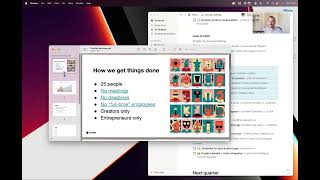
Sahil Lavingia walks through Gumroad's flexible work model: 20-35 hours per week, no meetings, no deadlines, hourly-based equity tied to revenue. He introduces Flexile, a tool that bundles contracts, invoicing, time-tracking, and payments to help remote teams run on this model at scale.
Chapters
So I just wanted to give everyone kind of an update on how we work at Gumroad. We have a new product coming out called Flexile in Q4 of 2022, and I thought it would be a good, kind of a good time to just give an update on some of the things that we learned working the way that we work. Gumroad works a little differently than a lot of other companies. I wrote an article about this that I published, I believe, in January of 2021. Called No Meetings, No Deadlines, No Full-Time Employees. At the time we had 25 people, no full-time employees. Everyone was just kind of working on Gumroad as if it were kind of like an open source project like Rails or something like that, except everyone was getting paid to do it. And the article resonated, you know, 250,000 people ended up reading it. And I just wanted to kind of highlight some of the changes that we've made since, a lot has kind of happened since January of 2021. We're now in July of 2022. First thing I'll just call out, this is the chart from the article, is that a lot of these changes are, they're not, they're sort of reactive, right? Like these are often, what is the line? Invention is the, you know, necessity is the mother of invention or something like that, right? Where you were generally, I think these are really good changes to make, but you generally only make them when you're kind of in dire straits. And I think, this sort of impending recession that everyone is worried about, I think will potentially be sort of a macro environment that forces a lot of other companies to have to make changes like this. You can kind of see here that like our operating expenses, this is kind of when we were like venture-backed in 2015, you know, spending, you know, peaked at about $400,000 a month in burn. Weren't able to raise any more money. And so we had to kind of do a big round of layoffs. But the, you know, the nice thing about building software is that it compounds over time. It's gets automated, et cetera. And so you can kind of see creator earnings over time, like basically continue to grow. I mean, there was almost no significant sort of statistical change here. And I think that's just important to come to terms with. I think that's one of the big sort of secrets that I think we have is that we understand that a lot of work is kind of BS, to be honest, and we just try to avoid having the work being done at all. Which I've, I've sort of thoughts about politically what that might mean long, longer term, like how sustainable is that? But maybe, maybe for another day. Anyways, updates. Let's give some updates. And by the way, if people have questions, just ask them in the chat and I'll, I'll kind of go through, I'll give demos of how we use Figma, Notion, GitHub, and, and, and Slack, and then give a demo of Flexcel. So some updates in the article I mentioned that basically people can work as little or as much as they want. And we basically learned that there is a range that is most productive. I think people generally thrive in this, in a sort of team format, kind of like, I think of Gumroad like a sports team almost more than like a company. And to perform, you need to put in the time, right? I think people who are just purely optimizing for working as little as possible, which is great. I mean, great that they can go do that. But in terms of sort of being able to create value for Gumroad, being able to kind of chip in on a weekly basis is pretty key. And what we've found happens is when people kind of do 10, 5 hours a week, even though they can be phenomenal people, is that they never get the work that's most important to do, right? Because the most important work you want someone to be able to work on in a relatively like, you know, 24, 48-hour kind of timeframe, right? And so generally the work just that you get to work on is just less exciting. And so we've decided that 20 to 35 hours a week is a good range for folks who work at Gumroad. And I think 20 is a good floor because it's basically half of what people would consider full-time. So that's pretty significant. I mean, an extra 20 hours a week is a lot. I mean, that's a huge amount of time. And so I think we'll stick with a floor of 20 going forward. We've also added some light quarterly cadence. So as I mentioned before, Gumroad was kind of an open source project except you got paid to work on it. It's a little bit more than that now. I think the biggest sort of change that we made is we raised a crowdfunding round in March of 2021. And as part of that, it's like, look, we want to build a growing business that not only creates value, that's still sort of key to the mission, create value for creators, but also captures some of it for our stakeholders, of which now, you know, thousands of creators are those, right? And so we have this kind of dual duty, I think, to serve creators, which means there's more pressure, as I mentioned, like this is a sports team, right? Like I wanna be the best, I wanna create really great products. And so that having a light quarterly cadence, and I can just show you kind of briefly like what that really looks like at Gumroad. It is pretty light. We basically have this internal roadmap, which is a mirror of our public roadmap. So you might have seen our public roadmap. And the only reason we have really two different ones is just for, like, you know, user privacy and like, we don't want to accidentally, like, leak something or something like that. But you can kind of see publicly what we're working on. And internally, it's just a little bit more fleshed out where you can see, like, you know, basically this quarter, like, what we're working on this quarter and then next quarter. And I only try to forecast like a quarter or two ahead of time, maybe, maybe, you know, like You can kind of see like our long-term vision for Gumroad is kind of this sort of Notion-inspired website builder, basically just adding more and more customizability to Gumroad over time so people can build more and more, you know, pages and sections and categories and all sorts of things like that. And this is it. I mean, this is like basically you join Gumroad and boom, now you know, you know, like what we're working on. You don't even need to join. It's great. And so that's basically it. And then every sort of at the end of every cycle, Um, similar to how Basecamp or 37signals does Shape Up, we sort of spend the last 2 kind of doing postmortems, you know, cleaning up things like that. And then I sort of really spend a lot of that time figuring out, well, what are we gonna work on next? Right? And, and this kind of happens over time. It's not like, you know, all happens over, over 2 to 4 weeks. And so generally it's a lot of just like taking stuff that we've sort of been chatting about in Slack and Notion and different places and just really kind of like creating, a document that kind of goes through all of it, right? And tries to kind of categorize them into different sections, uh, and, and, and things like that just to create more narrative structure, which is helpful when you work at a company, even small like Gumroad. It's nice to know like, this is what I'm working on. This is kind of how it fits into the, the bigger picture. Uh, a couple other changes. We don't have an anti-overtime rate anymore. So part of the, the, the post was that basically up until 20 hours a week, You would get paid, you know, your full rate, right? Let's say it's $100 an hour. You get paid $100 an hour up until 20 hours a week. And then if you wanted to work 35 or more hours a week, you would be able to do that. You would just get, you would just get, was it 20 or I get, I get, I forget what the number was, but basically above that amount, um, you would work at a 50% discount. So it's an anti-overtime rate. Uh, and I actually like the idea still. Like, I think it's an interesting idea. There are two things. There are two reasons we got rid of it. One was that sometimes we just needed people to work more, right? And so it was kind of this incentive and it made sense pre-raising the money, but when we wanted to work faster, there was no real— like our incentives didn't allow for that very easily and actually created this weird thing where I just felt like the incentives weren't aligned in order to— if Gumroad is awesome and people want choose to want to work more, I think they should be able to do that. And this system kind of was inflexible in this way. And then the other thing is that, actually, no, that's basically it, is that I think it just created this kind of weird paternalism where I'm saying, oh, 20 hours is the right number of hours to work. I don't know what the right number of hours is, probably different for everybody. And so I'd rather just like let people, you know, kind of make that, make that on their, their own decision on that. And people choose 20, 35, like people, you know, people, some people wanna work more. And, and that's, that's, that's great. And then this is probably the biggest change that we made. I, I don't know if we even had it at the time. I think we, we like kind of had it planned, but I didn't wanna talk about it until we'd kind of done it and made sure it works. But basically we do this thing, Gumroad where we just give everyone equity, but we do it by the hour. And so on a sort of the simplest way to sort of actually what's happening is we say, hey, if you build, let's say in 2021, you build $100 grand, right? Currently, or like according to the blog post, you get paid $100 grand, right? Cool, simple, easy, works. But I want people to be incentivized to make the company successful. If Gumroad ever sells or goes public or whatever, I will do pretty well, and I want to make sure that everyone else does pretty well too. And this is controversial because a lot of people, when I talk to people, they don't want equity. This is sort of a San Francisco, we really like equity. You might have friends who've done well because of it, but the vast majority of people are not that excited about equity in a startup that they may not see a return on for several years. So there's this kind of interesting thing where I don't want people to think of it like cash because it's not cash, but it's also not a lottery ticket. Gumroad is $12 million in revenue. I hope that it'll be something someday. And so our solution is basically to consider it kind of like a bonus. And so the way that we do it is we say, okay, you build $100 grand in 2021, we'll take 10% of that, so $10,000, and basically just issue you 100% vested grant of stock options. So you get effectively $10,000 in Gumroad stock based on the last valuation, which in this case was $100 million in March of 2021. And we think this is a pretty good middle ground where it's not a lottery ticket. It is worth something, but it's a bonus. And so people should still join Gumroad for the cash. I think it should make sense as a direct arrangement, and then there's this nice added thing. And the hope is that over time, if we decide, hey, we want to be a little bit more like a startup, we can just— let's say Gumroad starts growing fast and that people want that, then we'll just say it's 50%. So you get $100,000 plus $50,000. And so I think there's ways to experiment with this non-binary binary nature of startup equity in a way that people haven't really done before. There are some downsides. It's, it's not easy because mostly because of like laws that, that make it a little tricky. But pretty excited about this because it's something that I like a lot. It's something we do now. And as part of Flexile, we wanna build it right into the product. And so anyone using Flexile to issue their contractors payments, will soon be able to also be able to kind of issue this kind of 10% bonus or whatever, you know, equity program they wanna set up. We should make it really easy for them, for them to do that. So that, those are the updates. Now I wanna talk and just kind of give a tour. I've done these tours before, but I find that it's helpful to just kind of do them again because things, things change. And so there's sort of 4 tools that we use to, to work on Gumroad. Basically the first 3 are pretty common. Between every startup now, right? Most startups use Figma for design, Slack for communications internally, and GitHub, uh, for code. So that's not too different. Um, though I will show you kind of how we use, we use Figma. Um, and then Notion is really, I, I would say like our kind of unique selling point where we like, we really like use Notion, uh, in a pretty sort of customizable, unique to us way that I think allows us to work in this async way super well with like basically no meetings. That's still true from this. No, you know, that no meetings, I guess, you know, deadlines we kind of have with the quarterly thing, but still no full-time employees and still no, no, no meetings. Or we do, you know, like one a quarter, like an all kind of an all hands. But yeah, let me, let me go through them. So let me show you what Figma, what Figma looks like. Actually the be— the best thing to do would actually be to show you FlexOps, right? Because that's, that's actually the newest thing. So let, let me show you that. So this is what Flexile looks like. Like when we work on Flexile, this is basically the document in Notion. And it's almost like, you know, this is kind of like a mini, you know, like the first Pokémon evolution of like Gumroad's Notion, right? Where everything is like in one page instead of having like a dedicated icebox, like it all lives in one, you know, in, in this table. And so it's a pretty good place to see kind of like what working on Gumroad actually, you know, would look like. And at an earlier stage, Gumroad's obviously a little older, so you can kind of see I wrote this memo a long time ago, and so this kind of explains the problem, the solution. I have a course on YouTube you can check out if you're curious about like how I put these, these sort of memos together. But this kind of aligns everyone about like why, like why are we actually building this thing? Like what's the problem that we're solving? This is, you know, kind of just the high-level description. There's some, there's some user research and some customer feedback. We have our help center that we'll, we'll use for the product Notion. And then we have a roadmap. So similar to, you know, the Gumroad roadmap that, that I showed. So, you know, in Q3 our goal is to get the third-party customer product market fit. So we already use Flexile internally at Gumroad. It works, solves our problem, and the goal is to get to, oh, this is what I'm doing now. Awesome. Oh, I wanna get feedback from y'all. So cool. Good reminder. And then, you know, our big, our big milestone next is to basically onboard that first customer. I mean, ultimately that's sort of binary, like do we have product market fit or not? And that is pretty easy to define as like, do people want to give us money and then do they continue to give us money month over month for this product that we've built, right? Like, should be pretty simple. And if you can't measure your product market fit in a number like revenue, then you probably don't have it. And so this is, you know, it just keeps us accountable. You know, there's some due dates. These are kind of pretty optional, but, you know, you can kind of see by basically by the end of the quarter, we want to kind of do all these things, allow people to get onboarded and then I go through and I will go through and sort of type in a bunch of notes in these sort of subtasks, right? And these, these have been fleshed out better actually by, by, by engineers. And so you can kind of see our pipeline, but generally I start by having these super light, you know, Notion mocks. Like for example, contracts, you know, it would, it would probably be, have been just like, you know, This, right? Documents page, you know, in the nav, being able to download them, like just functionally what's necessary for this feature to actually work. And then I pass it on to a designer and then a designer will take it and make it awesome, basically. I mean, this is like, in my opinion, where a lot of the magic happens. And so Figma is where we take those, those sort of rough notion scopes and then design them. And we've gone through tons of, I mean, insane amounts of iteration. We can go through like tons of different things. And I kind of liken it to listening to a song where you like listen to a Justin Bieber song and you're like, this is really boring and simple. Why did it take so long? It's cuz you don't see all the, all the work that went into it. So you're not seeing a lot of the work that went into kind of what we're shipping and what we consider an MVP. But we basically go in and we kind of take those Figma mocks or the, that Notion scope and then do it in, you know, turn it into Figma. And then we go back and forth on this like a gazillion times. Until we have something that we feel is really great. And then we start, oh, and then once we align on Figma, then the designer goes through or the engineer goes through, looks at Figma, re-adds it all back into Notion. So there's this kind of like Notion, which is super light to Figma, which is like, this is the pixels, like this is, you know, and then once we kind of agree, we kind of take those pixels and turn it back into words in Notion. And that at that point, those, the pixels and Figma and the Notion scope should kind of, that should be the point in which they agree, right? Everyone agrees like, okay, cool. We know where we're building. And by ideally, if we do this all by the sort of second week of the quarter. And so if you kind of recall, if we go back to our internal roadmap, you know, the first two weeks we're kind of doing this, right? We're refining our scopes in Figma and Notion, things that we don't refine well enough, or I feel we don't have the time. I just say we're not doing it. We'll do it next quarter or never. And then that's it, right? At that point, you are basically just shipping and the engineers, you know, the designers will live in Figma and Notion. The engineers will live in GitHub and Notion and Figma and things just get shipped. And it's actually, yeah, it's like pretty, it's pretty simple. And so basically every day I go in and I check this stuff and I, you know, I just make sure everything is up to date and I just, We just, we just keep going. So the next thing we're shipping, for example, for, for Flexile, just to give you an example, Notion just added this nice feature. So you can see our, you know, Figma that will link to the appropriate place in Figma. So it's super easy for the design, for the engineer to kind of go and start building the thing. You know, the, the GitHub pull request is linked here. And so you can see that happening. You, you know, these are all pulled from from Notion. So you can see all the, all the stuff that, why are we doing it? We need this feature. Can't really build this thing without ending contracts in some fashion. Screenshots so people can take a look. We also deploy these things to staging so people can try, you know, can mess around, et cetera. So yeah, I mean, this stuff is probably relatively familiar to you, but that just get, kind of gives you a sense of, of, of how we build stuff. And so this is kind of my view, you know, this is like, you can kind of see like these are the pages that I look at, like day to day. And let me talk a little bit about onboarding because this is a problem that Flexile saw. So I'll kind of talk about how we do onboarding currently, and then I'll talk about how sort of we plan to, plan to solve this with, with Flexile. So I showed you Figma. Oh yeah, Slack. I guess I can show you Slack's pretty basic. These are the rooms that I pay attention to. Design, Flexile, obviously product, which is kind of Gumroad product., and then the engineering log and Flexile logs. But basically like, you know, pretty minimal. Like I feel like you don't need a lot to run it, to run a company. You should be able to kind of have a high level view of, of what's happening and, and, and stay up to date and, and, and everything should be dandy. So that's Slack, GitHub, pretty, pretty boring. And then Notion. Uh, so yeah, let me, let me add someone to, to, uh, to Gumroad. Like let's say CEO of a company, you know, CEO of Gumroad. I wanna add like a new person to the company. They just joined. I wanna add them, right? So how do I do that? Pretty simple. I basically just add them. I go in here and I click add members, and then they go in and they hit new, they add themselves, and these instructions are right in the wiki, or sorry, they'll, they'll, they'll get added to home. This is like kind of their first page. And boom, they'll have this instruction, create a new card for yourself and people, and then follow those instructions. So let's go do that. Let's go to people. Let's say Sahil Lavingia is joining, you know, I can link it to myself and then I just hit, I'm a new engineer, let's say. So a new product team person. My, I'm, you know, I'm, I'm in a trial, trial period. And then boom, these are already done because I already added myself. Generally add people to Slack, Notion, GitHub, and, and Buildkite. Figma self-serve, you just click this link and you can add yourself. And then boom, you have your to-do list of all the things you need to do, how to get paid, you know, all, all of that stuff. Even, you know, some, some recommended tasks that you can work on first. You know, what, what, what we actually wanna see from you during the trial period. You know, generally engineers at Gumroad go through sort of a 4 to 6 week trial period. And then afterwards, you know, if things go well,, you know, the other stuff that you get added to, right? And so super, super self-serve, super simple. Like all I had to do was take their email and add it to Notion, add it to GitHub, add it to Slack, add it to Buildkite if they're an engineer, and then I'm done. I mean, it literally takes like 3 minutes to, to add a new person. And part of that is cuz we just put a ton of work into these public resources that everyone can read, our private resources. So if you join and you get stuck, you know, you're an engineer, you can go in here and you can just figure this stuff out. Right? This is, this is kind of the recommended workflow. If you get stuck, blah, blah, blah, blah, blah. Like the goal is that there's just like, you shouldn't have to talk to a human being to, to, to, to get your work done. Any question that you have an answer, any question that you have, you know, should be answered with a, with a doc. And then Slack is deleted every 90 days. So basically we can talk in Slack, we can discuss in Slack, but generally anything that we want to persist, we put in Notion. Notion is kind of like the universal truth. For Gumroad. And then besides, you know, besides onboarding people through Notion, we also have to do all the legal stuff, right? And so we use bill.com for invoicing and payments. So we set them up with a bill.com account, which is like this pretty old enterprisey kind of company that is actually not really for contractor payments. It's more for B2B stuff, but we use it for that. We use HelloSign for all the contracts. We got the contracts made by our law firm, Cooley, which was not cheap. And then Notion already mentioned is kind of what we actually use to kind of like glue these things together. And so basically what I want to do is, or what I, what we did was I want to take all of these tools and put them into one thing, right? So instead of using Bill.com and HelloSign and manual contracts, we want to have all of this, you know, as part of FlexOps, right? And so that is sort of the pitch. And you can kind of see over time. And this is another thing we do, by the way, in Figma is we kind of divide these things into, you know, our MVP, which was our Q, sort of Q2. We're working on Q3 right now, and then Q4 will be our public launch. And so you can kind of see sort of feature by feature, right? What, for example, invoice rejection wasn't part of the MVP, but you know, was part of White Glove. And so you can kind of see all the things that we're working on, like the, you know, time tracking, onboarding, invoicing. A huge one is contracts. So let me actually just show you what that looks like cuz it's pretty cool. We also have a lot of prototypes that we build in Figma. Do, do, do. Where is the contracts? Oh yeah, here's onboarding. This is all built out actually. Oh yeah. So, so we're adding contracts. So currently we, we don't have contracts in our, our staging environment, which I'll show you. So You can see I'm not making up the fact that we have this product. Basically, this is how it works is we'll add this new tab and so you'll have the contracts all in line and you'll just sign and agree and see all the terms and all of that stuff. And the cool thing here is that you get contracts in every single country that we support. And so if you're, let's say Indonesia and you're working for Gumroad, I believe, is it Indonesia? I think it might be Indonesia that requires all contracts to be in English and a local language or was it Argentina? One of those two countries. Basically lots of countries have their own policies and if you use Flexile, we'll pay Kooli, we'll pay our law firm and we'll do all the work. And then when you onboard somebody, you can just onboard them. You can just say they're from here, we're paying them $100 an hour. We want to give them a 10% bonus in equity and then boom, you're ready. They're kind of onboarded. And let me show you what that— Oh yeah, here's what it looks like. So this is not yet built, this specific part, but let's say you onboard someone, you type in their email. Let me show you actually what it looks like so we can kind of compare. So this is the contractor view. Let me open the company view. So this is kind of what it looks like. You can kind of compare the, the view looks like this. So what's the difference? Let's see. You can kind of tell there's some differences. Yeah, like we're making this full screen cuz we need to add this consulting agreement, right? So right now it's just one line, their email, their role, how many hours a week on average are they gonna do and their rate, right? And then when, when do they start? You can add more people. It works. MVP works. But we, we want to add contracts, we want to add this new feature. And so this is what it'll look like in the future. So yeah, most people by the time they use Flexile won't even see this view, right? Even though I think it's pretty good, it looks like, you know, it works and does its job. It'll look something like this. Awesome. And then what does it look like from a contractor view? We also have that built out. So this is me logged in as a contractor right now. And so I can submit a new invoice, right? Just type in the invoice ID, just like, you know, if you're familiar with Harvest or something like that, you can go in and say, you know, work on Flexile. You know, I did 10 hours, right? For $1,000. You know, you upload a PDF of the invoice. Currently we're migrating off of bill.com, so we still require PDF invoices. But in the future, what's gonna be awesome, I think, I'm, I'm excited about this, but I do think this is one of the big bets that we're making is we're gonna build all of the time tracking stuff actually within Flexile itself. And so people can just go straight to Flexile, they can start time tracking, and, you know, all, all within the UI. And when they're done, they just hit finalize invoice and then boom, they're taken to that other screen, which is somewhere hiding here, right? They're taken to this screen. All of this stuff is like filled out for them. Boom, boom, boom. And then they just hit submit now, right? And then it shows up in my queue and I just hit approve and then boom, they're done, right? And so we've done time tracking, invoicing, payments, compliance, We don't have tax stuff done yet, but you know, we'll have that done by the end of the year. And so basically like the hope is that Flexile takes Gumroad, basically takes this article that I wrote that 250,000 people read and we're like, oh, this is cool. But like, that's weird and crazy and you know, requires me watching a bunch of YouTube videos to figure out how you do all this stuff. And we want to kind of take all of these insights package them up, put them into a product, and then get, you know, lots of other people to use it. Because ultimately, like the way that Gumroad works and what I'd love to call it is a flexible company and a flexible company, you know, no, no, no meetings, no deadlines, no full-time employees. Like all of that kind of stuff is great and it makes Gumroad like a very appealing place to work for many people. But we only have so many slots. And my hope is that we can have thousands of flexible companies, not just like 5 or 10. But I think, you know, part of having thousands of flexible companies is you need the stack, right? You need the ability for people to build these things really, really, really easily. For example, let's say I have a venture fund, right, that I invest in startups out of, and I want to hire someone for $50 an hour to do some work. Now I have to like Google, like find some random contract on the internet, hope it It works, like edit it, you know, like turn into a PDF, like sign it in preview. Like it's just, it's a total cluster. And my hope is that if we can build something really great that works really great for flexible companies that can be as small as 0 people basically, and as large as Gumroad and hopefully larger over time, that it could be pretty cool. And that the vision for flexible work gets more and more clear and is more and more attainable for for more and more people. So yeah, hopefully that was helpful. There are, there are some action items for everybody listening, either live or if you check this out on YouTube. I would love your feedback on time tracking, contracts, building all of this kind of stuff in line. How do you think about it? Do you want time tracking in line? Do you not? Contracts, do you want to use your own? Are you okay using ours? Ours are definitely awesome. But some people might have their own. So if you have FUD, if you have fear, uncertainty, or doubts, if you have concerns about, you know, things that would get you excited to use Flexile, not excited to use Flexile, things that you definitely need, things that you don't think we should build ever, things that you hate about products you currently use, please let me know. I will share a link to this Notion doc so people can kind of peruse it and, and check out Figma and, and, and give us feedback. Uh, we're building this product kind of like halfway in the open where I'm trying not to tweet about it, but I do want as much feedback and I basically want to only tweet about it when we have product market fit, when we have revenues, when the product is sustainable as a sort of a, a reward, right? For doing the hard work. Uh, because having a, a viral launch product hunt tweet, whatever, that's, we can do. Um, But I wanna, I wanna get to product market fit. I wanna get to profitability and do all of this stuff first. And hopefully we can do that by the, by the end of the year. And certainly with your help, it would be, it would be easier and I would feel more confident. So anyway, thanks everybody for listening in and catch you later.










