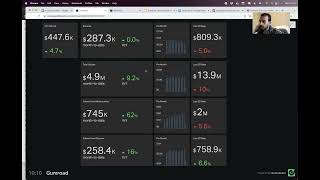
Sahil Lavingia outlines Gumroad's rebrand and "Zero to One" mission to help creators earn their first dollar. The roadmap includes courses, memberships, and communities, plus a redesigned checkout. The company raised $5 million through Regulation Crowdfunding and is tracking metrics like daily volume, GMV, and revenue per support ticket.
Chapters
I thought I'd do things a little bit differently this time. Normally, we do this kind of traditional board meeting format, which I think makes sense given that's kind of what I'm most comfortable with, what I'm used to, and also kind of what most people do. But I wanted to do something different. We like doing things a little bit differently. Thank you. New haircut. Cut my hair. Pandemic's over for me, at least emotionally at this point. And yeah, so I thought it'd be fun to just like screen share. And so I'll use the old deck as kind of like a format for the new deck or kind of the, you know, kind of the agenda, I guess, for today. But I'll try not to, like, I'll just use it and then, you know, that way you'll actually see like what I look at. And that's kind of my main goal for— I have two goals for 2022. One is to be even more transparent, to show people more about the way that, like, how I actually work and what do I actually do and, you know, as a CEO, as an investor, all of these sorts of things. And then my other goal is to create more equity owners in companies. Obviously, the Gumroad round was an example of that in 2021, but I want to spend a lot of my time this year with the fund, with the Scout Program, with a bunch of other stuff, trying to get more people on cap tables of companies. So anyway, that's kind of the framing that I would look at, sort of evaluate, am I doing the right thing? Yeah, so this is the board meeting from sort of a year ago where I started with the story. We can kind of skip this part given that people already know this, but effectively Gumroad started out 10 years ago, has kind of built up into kind of this e-commerce solution for independent content creators of all sorts. And this is kind of what it looked like a year ago, and this is what it's going to look like very shortly. So we've been rebranding the entire website the logo, like basically everything from the ground up. We started this project not too long after the fundraise itself, probably like April, May timeframe, and sort of launched the first version, the first batch of updates to our logo and color scheme and everything like that on Black Friday, actually, November 26th, I think it was. And we're rolling out the rest of the stuff and everything about Gumroad is changing, like including even like purchases, like, It's all, it's all here. One nice thing about rebranding everything is you get everything to, to live in one place. So if you look at products and you scroll down, you can see, um, the new, uh, purchase flow. And what we're currently working on internally is, you know, we currently have this form, which, or, or this look, right? When you buy a product, you get a bunch of files. Um, we're gonna make this super customizable. So it's gonna look a lot more like Notion where you can customize this stuff. You can of course upload files and do the stuff you've been able to do before, but you'll be able to do that within an interface. Where you can have text, headers, lists, all of that kind of stuff. I think it's going to be really important for the next phase of Gumroad. So this was the big thing that we got done. We also got a bunch of other stuff done, which people can check out. If you go to our roadmap at roadmap.gumroad.com, it should redirect you here. But this shows you what we communicate publicly about what we're working on. And so you can see all the stuff that we got done last year. We got quite a lot of stuff done. We ship a lot, a lot of this is sort of small incremental features to just make Gumroad UX better for our existing users, for people getting started. And this quarter, this upcoming quarter, we're really, really focused on this new objective called Zero to One, right? So this is kind of a riff on Peter Thiel's mnemonic, right? Go from zero to one. That's where kind of the value is most created. And we kind of took that and riffed on it and said, we wanna help creators go from $0 to $1. And so our next sort of OKRs for the next quarter are really gonna be focused on this sort of agenda item. What does this actually mean? It means currently if you go to gumroad.com, you're creating digital products. Like what even is that? When we started, we had kind of had to use this like vague word 'cause it wasn't really defined. Even creator wasn't really defined. Now it is. And so we're sort of saying, you come to Gumroad and you say, I wanna create a course or an ebook or an audiobook or a membership or a community or all of these sorts of things. And we'll support these natively. If you create a community, we can actually show you features that are relevant to you instead of all of the other features that Gumroad, you know, sort of has, right? Instead of having a single product. And so that's a pretty big, big change. We're also gonna include that into our discovery. Our discovery UX is pretty simple. You have these categories, you can see the top selling in each category, et cetera, and scroll down. And we wanna make this a lot better. We think this can change should be a lot more like Amazon where you have categories, subcategories. It's a lot easier to say like, I just want, you know, I wanna buy an ebook about creative writing or something like that, right? Where do you go in this? You can kind of find it, books and writing, but I think it's not formatted the right way. And so it's a twofold problem where it's creators, it's kind of confusing and arbitrary. Then it also means that the discover UX ends up being also kind of confusing and arbitrary. And so I think switching to this mode is gonna help help a lot with, with, with that. Um, it'll also be easier for us to kind of do data analytics to be like, well, what are people actually creating? What do people actually want? Um, and, and yeah, so you can kind of go in here and see all the stuff that we're working on, but the sort of overall thesis is basically from $0 to $1. That's the most impact that we can have on a creator's journey is helping them get there. That's kind of the aha moment. That's the, you know, the first comment on the WordPress blog, right? That's our version of that. And so everything we're trying to do, you know, redoing the checkout experience, bringing back add to cart, moving discount pages, discount codes away from product edit into its own page, redoing onboarding. A lot of this stuff is going to be where our time is spent. And so this is an internal document, which is we use OKRs, or we are starting to use OKRs again. And people can kind of read up about those sorts of things in these two books and things that I link. And I'll put this link actually in the chat. So people can see it. Um, but I won't share it too, too publicly. Um, but at least people in the chat can tune in and, and, and, and see what I'm talking about here. Um, so I mentioned the rebrand. The rebrand is our big project. It's a huge document. We're making good progress here. Um, this is, we're gonna write a post about this, so you'll kind of get a deep dive on how we actually like made this happen. Um, we're adding a bunch of KPIs to, to our main gecko board dashboard. Um, so I already shared the brief metrics, but I'll kind of share the metrics that I look at day to day. So this is kind of like the, the high level. And so this is what I look at, um, 24-hour volume, revenue, um, month to date, and volume month to date. These are— this is kind of like the most important, right? These two. Um, and this is basically how much revenue we've done so far today, uh, to date in the month. So for the first, uh, sort of 10 days of January, uh, and then volume.. And then this is year over year, right? So effectively comparing to the same amount of days in January of last year and the same amount of days January last year, et cetera. And so it's just a really easy way for me to see like, are we growing and how fast? And then over time we're adding more dimensionality to this. I don't think you have to get super complicated even as a company grows. I think it's actually good to kind of keep things simple in one place. We can see our volume for memberships, for example, is up 62% year over year. So we definitely want to continue to invest in this sort of thing. Discovery is another big focus for us, as I've talked about already. And so having effectively the way that I think about it is that there should be one number that every single person at the company cares about. It's a different number depending on your job, and then your goal should be to increase that number, right? Or decrease that number, depending on what that number is. And that's it. It should be really, really, really simple. And I think OKRs are the best formulation of doing that. And I think as a team grows and you want alignment, I think it's really important to, to have this so you can kind of see, and then, and this changes, right? So like one thing I'm not a big believer in is like these massive dashboards that track everything. Uh, things change, things are more important, less important over time. So for example, volume for mobile, that's not something we're super actively working on anymore. Cuz we kind of did all the improvements that we think we can make on that experience. Um, and so we should probably just get rid of this, right? You should constantly be getting rid of stuff. Like that's a good chunk of what I do and I'll do the day in the life of a CEO kind of at the end of this. But that's kind of, that's most of what I do actually is basically just saying no, saying we shouldn't be working on that. I feel like that's almost all of what I do on, especially around December, January 2022 goals kind of timeframe. But anyway, you can see, so complete rebrand is our kind of number one OKR, then improve our metrics tracking, not the metrics themselves. So we're gonna add SEO, GMV driven by SEO to it. We're gonna add creators who made $1. So just like we have, and this is going to become a key metric for us. So just like we have revenue and this kind of monthly, we'll list like how many creators did we go, you know, do we help go from 0 to 1 in December, in January, in February, etc. And that's going to be a pretty key metric that we're going to start tracking. And then dollars processed per support ticket, I think, is the single metric I'll be using to kind of monitor the efficiency of our kind of support, which should be getting more and more efficient over time, hopefully as we get economies of scale. And so tracking how much a GMV is actually being processed, you know, you could write like track creator earnings per support ticket. And this is just to align them really. I think that's all we really need to do and then we should be good on that one. This is just an image to remind people what's going to change about Gumroad. The 0 to 1 push I mentioned, all of the stuff that we're kind of doing. There's obviously more stuff that gets done, right? There's bugs, there's tech debt. I really try to keep this page, like you can, it almost fits within a page, um, super light. Like it should be, you know, it, it was like 3 or 4 times longer, like 2 weeks ago. And I just was like, we don't need this. We don't need this. Um, let's keep it really, really high level. Um, and so the 0 to 1 push I mentioned, uh, the new product types, which you can see here. You know, all of these things will, will kind of appear. We've kind of thought through all of this stuff and we'll be adding them, uh, in the backend. Um, those will appear in the per product settings. And so people will be able to easily see, okay, this is an ebook, um, about this topic. Um, we'll update Discover Search to, to, to kind of, you know, include that. So this, this discoverability should improve and then we should update the navigation finally to kind of include all this kind of stuff. And so that's, you know, that's that. This is kind of the download page version of that, which is, let me see how much of this is designed. Let's see what's here. It's a lot of talk here. Yeah, you can see all the conversation that kind of goes into this and how we break things down. But yeah, here's a kind of, you know, here's like an old mock of that page. You know, obviously it's very different now. So by the time engineers get to this, it'll be kind of cleaned up for them. But you know, this is kind of an example of what that might look like, right? If you say, Obviously this hasn't incorporated the redesign, but if you say, hey, this is a course that I'm creating, you know, then we might want to show lessons and modules and have automations related to, you know, adding people automatically to Slack per cohort, removing them, Discord, et cetera. And so that's kind of an example of what that will eventually look like, that we do have to pare this down probably by Friday. Our goal is to kind of get to an MVP of what we want to ship by the end of the quarter. I mentioned moving the discount pages to a different page. Profile edit is super convoluted on Gumroad right now. That's gonna simplify. We're basically, the way it works today, I know this is getting very nitty-gritty, but this is literally like what running Gumroad is like, what we actually do. Let me see if I can find it. Yeah, so product edit or what was I looking at? Oh yeah, profile edit. Yeah, sorry. So yeah, you can see that we, we moved to this version, right? Where you update the product on the left and then all of the changes happen, propagate on the right. And we felt like this was the best approach to kind of WYSIWYG. Before we had a WYSIWYG approach where there was one form, but it wasn't perfectly like what you would see. And WYSIWYG isn't honestly the best for stuff like this because you, you kind of want to edit in a UI that's built for editing, like editing like a preorder release date is kind of annoying if it was like in this view, you know, where would that actually be? And so we decided to do this and we're basically applying the exact same sort of metaphor, um, visual metaphor to profile. So right now profiles are edited like this where you have this like tab bar at the top. I think we took this from like Tumblr or something like that. Um, and you can, you, you click these and it opens these like popovers, which is kind of janky. Um, right. And it, the nice thing about this is it allows us for this kind of full screen approach instead of that, like, you know, that divider. Um, but the divider's important, so we'll keep this. Obviously you can always go to your profile and see it. Fully, but we're going to switch profile to be actually in a kind of in settings, I believe. And it's going to be more like this kind of this split view. So I'm excited about that because I think it's just going to make it a lot simpler to actually edit and update your profile. And we have a big vision, kind of a big vision for profile editing and customization over time. And I think this is kind of a prerequisite step to getting there so that hopefully Q2 our focus will be on customization. Um, block-based kind of Notion-esque editing, taking that stuff I talked about on the download page and actually bringing them into the profile, profile page. And then other stuff like, you know, improving the onboarding with a new homepage state, collecting sales tax, cropping, you know, unslash, pulling images in, just stuff like that to make onboarding easier and easier and easier. And then we have a bunch of other stuff around marketing, uh, mostly focused around two KPIs, Discover GMV and SEO GMV. Again, really simple. 2 numbers that should go up over time. And then support internal, which effectively has kind of 2, 2 things this quarter, which is, you know, increase the number of dollars processed per support ticket, as I already mentioned. And then, and then kind of engineering sort of backend, right? Like trying to make it faster to actually work on Gumroad and a bunch of tasks there. And then you can see we just started using this in Q4. You can kind of see what we got done, what we didn't get done, um, in, in, uh, in Q4 of last year. And this is like super— I think everyone should do this if you don't already. It's super helpful to say, well, what did we not get done? Like, we thought that these things were important, but we didn't get something done. Why? Right? I think it's super healthy to have those kinds of conversations. For example, I decided, like, after looking at the community stuff that we, we did, um, in Q Q3 and Q4 primarily, that we just weren't seeing the returns. And like, so we're getting rid of the community. It just isn't working. And the way that I think about it is like every creator who signs up for Gumroad has to like understand everything about Gumroad, which is like, that's like adding a new item to like the McDonald's menu, right? Where you have to train every single franchise now that like how to make a milkshake and figure out all the supply chain issues and like what happens if it breaks and this and that. And every new person you hire has to learn this and every new customer has to look, you know, like all these menus have, like there's just so much that goes into, to like training a new user of anything. And so I think it's like really important to say, okay, we tried like 10 experiments and 3 of them worked and let's just double down on those 3 and get rid of those 10 and try another 3. And so we'll do 6 things this year and out of the new 3, like 1 will work or 2 will work or maybe all 3 will work or none of them will work. I just think it's really important. Like failure is, kind of failure is like defined as failure to not fail, right? Like, it better work. It's— that's a better way to define failure, I think, than like not doing things. So anyway, let me, let me see what questions people have before I jump to the slides again and see, see what people are, um, asking. Do you have a question that I think will naturally come up? Is best-selling on Discover based on ratings or revenue? It's based on revenue, uh, and specifically number of sales. Um, so the same, same way that Amazon kind of does it, which is highlights number of sales. And revenue is a combination of a few things, but, but I believe the sort of highest exponent part of the algorithm would be number, number of sales. Awesome. So yeah, that's kind of a preview of all this stuff and how we think about, you know, actually shipping stuff at Gumroad. Um, literally like what I look at. I also have this metrics dashboard. This is like what I use to generate the graphs. I'll put this into the, uh, the chat as well. So yeah, what I do is basically since the beginning of the company, every month gets a super— oh, that's kind of fun to see— gets a super, you know, super simple, again, super simple. This is like the— this is not the entire company. There's always fractal patterns, right? You can go into these things and they get more complicated. But at a high level, you know, for example, in the month of— and this is because we haven't gotten our exact December financials back, so I don't know exactly the COGS and expenses yet, so that's why this is still gray. But let's do November, it's a little bit easier. So we processed $16.9 million, that's creator earnings. Our revenue used to actually compose of two parts. We're simplifying this. As I mentioned, simplification, really important. We used to have a premium service offering that was making us $80,000 a month, We just got rid of that and we just said we're just graduating it into the sort of standard Gumroad so that there's a single fee and that just fee kind of changes over time as you make more sales, that goes down. And so, you know, soon this basically can net to zero and we'll probably do that pretty soon. So that's why we have two columns. You know, at some point these will all kind of be zero and I can kind of actually probably assume zero is probably what I should be doing because these are projections. So we can assume it'll be a little higher than that because there's still a few people who've kind of been grandfathered into the old plan. But anyway, so yeah, anyway, revenue that effectively these things will be equal over time. GMV, this is just helpful for me a little bit. If February has 28 days, some days have, some months have 31. So I have this there. COGS, which is effectively what we spend, which is hosting, payment processing, fraud, risk, and that might be it actually. That's it to run a marketplace business. You need to accept payments, you need to pay people out, that's payments. You have some fraud and you have hosting to operate the website. You have other fees, Amazon, et cetera. I guess Amazon would be hosting, but Slack is probably a better example where it doesn't correlate with running gumroad.com and that all goes into expenses. So you can see basically in the month of November, we had $350,000 of fixed expenses, which is kind of engineers, primarily engineers, designers, HR, et cetera. And that means we had a net profit of negative $85,000. So we lost, we burned basically $86,000. This is, again, this is like super simple and we made money most of the quarters. One reason we raised money is so we could grow the team faster than we can afford. So we're still doing great. I think we're still up for the year. So not a cause to worry, but yeah, it looks like we're up $663,000 for the year. And this was also because we did the big rebrand. We had a bunch of people help out. So this should go down pretty aggressively, pretty quickly in December and January, et cetera. So anyway, that folds up into these numbers. And so I do it kind of per year and per month. So you can see the per month here since the beginning of the company. And then revenue per month here. And so you can see kind of the pricing, the pricing bet was like kind of a scary one, to be honest, which we talked, we mentioned here, but was really important. Like I really felt like it was just better. Like our pricing, it just makes more sense. It's the right thing to do. And it looks like this where it starts at 9% and it goes down at 2.9%, which is effectively what you'd be paying Stripe, which I think in the short term is going to lower the GMV that we do. Or sorry, lower the revenue that we do, but hopefully increase the GMV over time. And then we can have value-added services for creators that will effectively make it great for everybody, sort of positive sum over the coming years. That's not going to happen immediately. So that's what we saw where earnings continues to grow, revenue has dropped a little bit, but I think that's okay. And then this is abstracted out over, blended on a yearly basis. And then I track year over year and year over year for both revenue and volume, which is basically what you saw on the Geco board, those green numbers. But this is what I look at. And then sometimes I do cohort analysis every once in a while to see where the GMV is coming from. Obviously 2020 was crazy because of COVID and it has peaked and it normally generally stabilizes at around 80% of the peak. And you could see this on a cohort basis, all these other cohorts have a similar behavior. So you can kind of gauge, um, you know, kind of the cohorts over, you know, kind of LTV, I guess, um, pretty easily based on that. So that's metrics and 2021, uh, stuff. I talked about what we're shipping in the future. Um, what else? Uh, does anyone have questions? Any, any, any stuff that people want to, uh, ask? Lucas has a question. Sounds like pretty healthy financials. Are there any talks about going public? And let me stop sharing my screen. Are there any talks about going public? I don't know if you're even allowed to say if there are any talks about going public. I think that's one of the rules of having talks about going public. Yes, I would love to go public at some point. I don't want to sell the business and there's only really two ways to get liquidity and And one is selling the business and the other is going public, which is effectively kind of quote unquote selling a percentage of your business to the public markets. We kind of went public in a sense, and March 15th, we raised $5 million from 7,300 people. I want to do the exact same thing again. So let me share a link on how to participate in that. I will share more and more details about that, but there's more information in the link that I just pasted in the chat. And if you're watching this on YouTube and you want to know more, just DM me on Twitter @shl. And again, I'll share more as we head towards March 15th, 2022, which is when we'll be raising another chunk of cash. But yes, basically the way that I'm thinking about it is that eventually Gumroad will be a public company. It'll be liquid just like any other public company. What does that actually look like? Generally, you cannot really go public unless you're worth $1 billion. It costs around $250,000 a year to be a public company and stay a public company and become a public company. It's not easy, Web3, crypto, all that kind of stuff, people can talk about how that solves all these problems, which is true in some sense on a tech basis, but not on a really regulatory basis. So for Gumroad to go public, that is the plan. And I'm talking, I met with the New York Stock Exchange, I'm having a lot of these kinds of conversations. The plan in the short term is to basically continue to use Reg CF, et cetera, to raise these batches of financing at marked-up valuations. So we did this Last round was $5 million at $100. This next round will be $5 million at between $185 to $225 million based on how the next couple months go for us. I'll pick a number, but it'll be assume around $200 million valuation pre-money. And then we'll just hopefully as part of that, people who participate in the last round, they want to sell a proportion instead of buy, I'm trying to see if I can facilitate something like that. So it's almost like liquidity, except it's like one event per year instead of 24/7 or whatever the stock markets allow. So yeah, that's kind of how I'm thinking about it. So hopefully that answers your question. Awesome. George says, do you use a third party for SEO or keep it in-house? We do it in-house. Yeah, third party, we worked with a third party on the rebrand, But generally I'm not a huge— I think like so much of doing stuff is like learning about how to do stuff. Right. And I think when you outsource that, you're not getting the learning enough. So I try to do as much stuff in-house as possible though, you know, like a logo redesign every 10 years, something like that. You're probably not gonna have like the people within the company, right. With the expertise on how to do that. So that's kind of why we do that for that. Uh, Ken asks, what is the current state of competition for Gumroad? How much attention do you— to comp— oh, basically, do you spend to competing ideas and companies? Um, I do spend time in the sense of like passively, right? Because I'm on the internet, so I'll see stuff all the time, and people DM me, you know, about competitors and other things frequently. Um, but honestly, not much. Like, I think the way to think about it is We have creators and then maybe we have sort of adjacent creators, right? Creators adjacent to our current creators who don't use Gumroad but may. What problems do they have? Can we help them? And effectively the way we think about it is like, can we help them make more money? Can we help them save money? Can we help them save time and stress, right? If we can do those things with some feature or something like that, we'll consider that. Hardik asks, uh, will there be a $1,000 limit like last time? So last time, uh, we raised, uh, $5 million and we had a maximum check size of $1,000 to allow as many people as possible to participate. There will probably be a limit. It will probably be higher. Um, my guess is the limit will be $5,000 to $10,000, and that limit will also kind of go up over time, hopefully, as we can, we can raise more sums of capital. There is a possibility that we can use a different kind of regulation to raise more money, let's say $10 million, and then we could have a different cap. So if there's truly demand for that, then I would love to make that happen. So fill out that form and I'll do that. Yes, you can invest. Also, the minimum will be, I think last time was like $10 or $100. I think it was $100. So that will remain the minimum. So if you want to put in $100 or whatever, that's totally fine. You can do it from anywhere in the world. You don't have to be an accredited investor, all that kind of stuff. I'm not sure exactly the format of the next round. It'll either be another Crowdsafe or it'll be an equity round. So I'm not sure which one it will be. Who are our main competitors? That's a good question. Patreon on the membership side, I guess maybe Substack. Do I think, yeah. What else? Teachable on the course side, if we get into that. Yeah, that's about it. There's a bunch. I mean, there's so many that launch every day, but the truth is like the building of the product's not that hard. I mean, it's hard certainly, but becoming like the default in people's minds is really, really hard, right? Like the kind of marketing around it of like when I wanna sell an ebook, Oh, should I, what should I use? Oh yeah. Gumroad. Getting that position kind of SEO in someone's brain, right? Like search, like that's, that's, that's, that's, I think the, the, the most valuable thing you can do. Dan asks, what are you using the money from the $5 million raise for? Just like we did last time, which is basically just growing the team slightly, having a war chest just in case. One-off things like, you know, we'll probably invest some amount of money in like exploring how to go public sooner rather than later. But mostly just growing the team and trying to improve the product and run more experiments. I've also thought a little bit about, this is kind of like Plan Z or Plan X, which is like turning Gumroad into, I'm having, I don't know, I get bored, I have ideas. Currently, I can't really work on too many things because I'm working on Gumroad. So I've explored turning Gumroad into kind of almost like an incubator of my own ideas and raising money on that sort of premise. But I don't want to make false promises. I don't want to raise speculatively. But if there's interest in that, again, DM me. DMs are open. I'm spending the next month or two having a lot of these conversations, figuring out what would be best for Gumroad, for me, for our creators, for Gumroad investors, et cetera. So yeah. Did the crowdfunding round— Jono asked, did the crowdfunding round act as a marketing event that helped increase Creator acquisition or some other metric like revenue? Was it impactful? It definitely was impactful in two ways, I will say. One, definitely marketing. Like I think a lot of people saw that crowdfunding round. I think, I don't know what the number was, but you know, in the millions of people, most of them are not, you know, creators on Gumroad today. So, you know, you can kind of debate like the value of something like that, but I do think it was pretty valuable. The one super valuable thing that I've seen from it is recruiting. Recruiting is like the hardest thing that most startups have to do. And recruiting has been drastically easier because every time I need to hire like engineers or designers, I just put it into an email list with 7,000 people who are invested in the success of the company, many of whom are designers, engineers, or may know some. And so that has been like ridiculously helpful. So yeah, the other thing, by the way, I'll mention about the incubator idea that I had is that I would love to be able to do more crowdfunding rounds and like Gumroad can do one a year basically. And so if I can, and I've tried to convince other founders to do it and some have, like Mercury, I helped do their WeFunder one, but one hack was like, well, maybe I can just start more companies and then spin them out and crowdfund those rounds. So anyway, I'm definitely in an exploratory mode right now. Again, as I mentioned in the beginning of the call, how do I create more equity owners and how do I be more transparent about what I do day to day? Those are my two goals for 2022. Kenneth asks, what user acquisition channels are you primarily focusing on for growth? Great question. Uh, 100% organic basically right now. Um, we've thought, we've tried some paid stuff. It's never really worked. We're open to it. Um, we might, I think the right approach probably for 2022 in terms of a new experiment would be to have a sales team again, which we haven't had in like 7 years and hire like one awesome single person and try that experiment out and try like sort of manual sales. Sort of one secret of the creator economy is that a lot of the companies, the way that they grow is by convincing creators with emails and calls and things like that to use their products and explain to them. And these things don't just get organically adopted all the time. So that's an experiment that we might do. Amanda asks, "I invested in the last round. How do we know ROI and tracking that?" Yeah, I mean, I think the simple thing to do, and this is what I do personally, and I can't— not financial advice, etc., not investing advice, but what I do, because I have to price the company, is I look at public market comps and private market comps because I have access to some of that data. But I basically say, "Okay, what are similar companies?" For example, Shopify is probably the closest US, I guess they're not US, but large mega-scale mainstream company that comps similarly to us. I look at their revenue, I look at their P/E ratio, these things, and then I look at what the market pays for private companies. So right now, for example, I can say that generally the benchmark for public traded companies is around 20x multiples, super simplified. And so that means if you're doing $10 million in revenue, you're worth around $200 million. That's kind of at the low end. It can go up to 70, 80. And last year, at the end of last year, it was up to 100. A lot of Series As right now are done at 100x revenue multiples. So if you're at $1 million in revenue, you're at $100 million in valuation. And so I just kind of imagine a scatter plot of different metrics and dimensions, and Gumroad is one of these dots, and there are all these other companies. And luckily, because I'm in the industry, I can kind of I have more sort of visibility into where the dots are. And so I kind of just say Gumroad seems to be roughly here. And honestly, like, my goal is not to get like an amazing deal. If I wanted to get an amazing deal, what I would do is I would pitch a bunch of VCs and I would make them compete with each other. Um, that's not my goal. My goal is to pick a fair price, something I think is fair, offer it to everybody, and then people can decide if they want to participate or not. Um, Eric asks, what percentage of goods sold on Gumroad are digital versus physical? 80 to 90% digital, maybe actually 95% probably digital. Good question, because it is kind of existential for us. Like, why do we even support physical if it's so tiny? Should we just focus exclusively on digital? We've thought a lot about that. For now, we like having physical 'cause there are a lot of our creators who like wanna sell a t-shirt every once in a while. But yeah, definitely kind of a question. What's your thinking around NFTs? I have thoughts, like everybody has thoughts. I tweet my pithy hot takes on it. I own a bunch of NFTs, but it's probably not a fit for Gumroad right now, honestly. I think, again, it's not really what our creators and our adjacent creators want from us and need, but eventually I think they might be interested in that. So we're always open to it and we'll do it. I'm not personally opposed. So I'm not the blocker here personally. How are you planning to grow in international markets? Basically, currently everything runs on USD rails at Gumroad. At some point in the next couple years, we'll probably allow just kind of Airbnb-esque where you can price things in different currencies. Kind of the simple, I think that's the number one thing that we can do to make that happen. Uh, Matteo asks, will you just raise through CF? Yeah, basically the plan is to raise through regulation crowdfunding and then eventually IPO. That's at least how I'm currently thinking about it, um, today. Um, and I will likely be using Republic again, uh, for that. Yeah, so Republic, by the way, congrats to Republic. They're now republic.com instead of republic.co. So that is a huge— that's awesome. "Will music be supported more in future?" Yeah, that's a good question. Honestly, I think Bandcamp's better at music than we are. So I don't think we'll sort of focus on music, though obviously people, you use it for that and it works. Lucas asks, "Do you think the biggest creators in Gumroad are also the biggest evangelists?" Yeah, that is the number one. I mean, when I say organic word of mouth growth, the reason that happens is because the biggest creators on Gumroad tell other people. They kind of have to, right? Because you can't really not tell people about Gumroad by, you know, when you sell something on Gumroad. But then hopefully the people that like it go above and beyond and say, hey, you know, I use Gumroad, it's awesome. One thing that we haven't scoped out in Q1, but we will, though hopefully it might fall to Q2 actually, is a referral program. So just like, you know, you can sign up for Amazon as an affiliate to Amazon, um, you'll be allowed to, uh, to do the same thing, uh, with Gumroad. Um, it's complicated, there's a lot of legal complexity, but basically you'll say, you know, we'll do something like if you, you know, refer any sales to Gumroad, uh, using Discover, like you'll get 5% of all GMV or 10% or something, something like that. So I think that's how we'll start to explore Making our creators more evangelists of the brand. So let me see. That looks like all the questions. Let me see what other things I want to cover. I'll cover the metrics. I covered 2021. I covered the 2022 roadmap. What else do I want to— I covered all the questions, covered the fundraise. I'll send an email recap with a bunch of the links if people miss them. Um, if you're watching this on YouTube, you're gonna have to DM me on, uh, @shl on Twitter for now.










