Q2 2024 Public Board Meeting
In this public board meeting, Sahil Lavingia, founder and CEO of Gumroad, walks the audience through the company’s origin, current financial performance, product portfolio, and strategic vision. He recounts the original pencil‑drawing anecdote that sparked Gumroad in 2011, then presents Q1 2024 metrics (US$42 M GMV, US$5.6 M revenue, US$2.3 M net income) and explains why owner earnings and dividend payouts are the core valuation lens. Lavingia details recent product upgrades – a new rich‑text content editor, written reviews, wishlists, product bundles, and a marketplace‑building data engine – and announces upcoming service‑type offerings (Coffee, Commissions, Calls) plus a tipping screen. He introduces two sister products: Flexile, a payroll/equity‑cap‑table tool that lets contributors choose cash vs equity splits and may enable dividend voting; and Helper, an AI‑powered customer‑support platform with pre‑filled drafts, automated workflows, and Gmail integration, demonstrated live. The talk also covers company culture (no formal internships, part‑time hiring), the cash‑flow‑first business philosophy, comparisons to creator‑economy leaders, and a Q&A where Lavingia defends his decision not to raise new capital, outlines dividend policy rationale, and discusses cost structure and equity‑splitting as a cost‑control lever. The meeting ends with a preview of a forthcoming product (code‑named “I”) and an invitation for audience feedback.
Chapters
Where's my mom?
So I was visiting him in Mountain View when he was at Pinterest, and that was the first time I was seeing him after he had left home. I was seeing him after he had joined Pinterest, first of all.
Yes.
So I was, of course, very nervous. And then, as usual, he's busy working. I don't know what, always working 24/7. And I'm like, what are you doing? And he's, look at this pencil, Mom, and I'm gonna Oh, this pencil, the yellow pencil, then I'm going to draw this pencil. So I'm like, okay, he's gonna draw it on the paper because he was a very good drawer as a kid as well. And I'm like, okay, fine, one of his things that he's doing. And then he finished drawing, and then it was so perfect. And he's like, what do I do with this? And I'm like, what are you going to do with this? You think somebody will buy this? And I could understand what he was saying, and I'm like, buy a pencil? And picture of a pencil. So I think he just took that idea and he must have researched, and then he told me that there's no marketplace if I want to sell this as a digital good. There is no marketplace for this. And I'm like, are you sure? And he's like, yeah, I looked, I can't. But what if I build this over the weekend? I build a website and let me try to sell my pencil. I made a list of 10 names, and of course I had to go on GoDaddy and see this.
That's a requirement, by the way, the .com.
Yeah, he told me only .com and no two words that have to come together as Yeah, two words to come together. So he had those.
Because basically I was inspired. I was like, I think I was ripping off Dropbox. I was like, oh, I don't know, GitHub, Dropbox. I was like, okay, I want something.
So I tried and I thought it was difficult and Gumroad was one of them. What does it mean? And I'm like, I don't know, like a road and then Gumroad, profits that stick, like that kind of a motto in your mind if you want to use it. And he's okay, fine, I'll buy it and then I'll see what to do. And that's how it started.
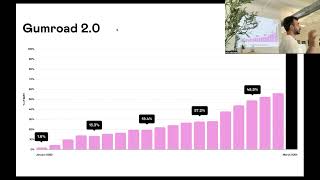
That was 13 years ago. April of 2011, April 4th is when I launched Gumroad. I think April 1st was when I had the— when I think we had that, like, when I had the manic episode, basically, of, oh my gosh, like, why isn't there a way to sell digital icons on the internet really easily to an audience I already had? That's how things start. Let me just answer a couple questions that came in and then we can start with the formal agenda. Are you planning to open the investing in Gumroad again? I would love to, but honestly, I can't find a good reason to do it. If someone can convince me to raise money, I would still love to figure out how to do it. But the truth is we made $8.9 million last year. So what would an extra, like the money is already flowing the other way. So I'm stuck on this point. One other question. Someone says, I want to be an intern at Gumroad. You offer internships? We don't offer internships. We will pay you the same. We would pay anyone else. And you can choose to quit in 3 months if you want, and you can choose to stay and do that. We don't offer formal internships. You can get all the value of an internship, which is you can move to New York, you can work here for 3 months, you can work 20 hours a week, 35 hours a week. So that's possible. Awesome. Let's start. Gumroad has 3 products now. Gumroad is our original product, which we shipped in 2011. It's the one that makes us all the money. It allows us to build all the other cool stuff. Flexile Helper is another. Both of these ideas I had In about 2016, 2017, when I was running Gumroad by myself and doing all the customer support once a week and trying to keep the site up and looking at the P&L, which I was trying to conserve, that's why I was doing everything myself. So I looked at the P&L, I was like, okay, we're spending money on customer support, we're spending money on managing all these engineers, all the accounting associated with that. These are two products that I think we build up the right way, we can scale Gumroad infinitely. With an army of part-time people. Q1 of 2024. So we did $42 million in GMV. We did $5.6 million in revenue. COGS was $1.75 million. The number that matters the most is we did $2.3 million in net income. So if you compare the quarter of last year with the quarter of this year, we grew. Most, most important things. Net income is basically cash flow. It's like how much money the owners made. Warren Buffett will say this is owner earnings. And so you would base all your valuation modeling or whatever off owner earnings, not GMB, not revenue. We're now running this business that generates cash flow and we want to measure the thing that matters the most. We also shipped a lot of stuff for Gumroad, written reviews, abandoned cart workflows, section types, profile pages, wishlists, collaborations, recommendations, and a whole new content editor, audio player on mobile. Written reviews and wishlists are huge for us. We have over 100,000 reviews already. About 4,000 to 5,000 products a day are added to wishlists. And these allow us to spin up our marketplace. Gumroad was not about that for the first 10, 12 years. It was about helping people sell directly to their audiences, which is really great, but you're capped on the audience of your customers. It's hard to induce demand further. Amazon, Netflix, those are the winning creator economy companies. And why? Because they're able to induce demand. They're able to build something better than any one creator would've been able to build. Spotify, also a good example. Written reviews and wishlists allows us to get the data that we need to make the marketplace really interesting without having to build a marketplace, because no one's gonna visit the marketplace if there's nothing there. And then we're gonna walk backwards into, to a marketplace. If you go to Gumroad.com now, that it is a place where you can actually go find products. But it's gonna take a lot of work to train people to say, okay, I can open up the Gumroad app and buy, if I wanna learn React, the Gumroad app is like the best way to go. The beauty of Gumroad is we just have so much traffic. We have so many people that buy products, that sell products, a lot of free downloadable things. We've just been around for 13 years. That's a huge advantage that most people don't have. If you're interested in working on Gumroad, you can go to jobs.gumroad.com. If any of these features are things that you think you can, you can build. These are all built with Rails, React. Please, please hit us up. As I mentioned, capital is not the bottleneck. Knowledge and creativity is, and humans do all of that for now. The biggest change we made in Q1 was our content editor. So our content editor, if you remember Gumroad in the beginning, I wanted to sell the digital pencil icons. You'd go to Gumroad, you'd drag and drop your file, and then you would get a link, you'd share it out, you'd buy it, and then they get to download the thing. People are not downloading as much stuff these days. There's no up and downing. What do you, there's no floppy disk icons. They're all gone. No one even knows what a floppy disk is. And we wanted to correct this. I think Notion did a really good job of figuring out like what's the right way of building these like relatively structured consumption experiences. And so that's what we did. We first started shipping in January 2022. I think this is a good growth moment for me. I used to just like ship new features or delete stuff and everyone would get mad at me. But this time, this was a fundamental change. So we made it a beta, we made it opt-in, we made sure that we had 50% of GMV going through this new thing, basically not having an existential crisis where everyone freaked out and left. We just kept shipping features until no one complained anymore. And then we turned it on for 100%. This is what it looks like. You can have rich text, you can still do all the file uploading that you could do before, but now it exists within the content editor. The really cool thing about this is you now have the ability to do all of this stuff in, on the marketing side too. So it started out as a place to make your experiences more interesting once someone has bought your product, but 90% of Gumroad is trying to get someone to buy the product in the first place. So we're gonna take all of this, give it to you on your actual Gumroad profile. And not just your profile, by the way, but soon even on your product page, you could imagine if you were able to add a section above the product So you could have sales marketing copy, you could have a subscribe in the bottom. All of a sudden, every Gumroad product page can now do more than just be a product, which I'm very excited about. And we've done so much of this hard work already. So the last mile of adding a subscribe block to the bottom of your Gumroad product page is super easy. Very excited about this. And I thought it'd be fun to do a demo. Hello, Maya.
Hello, Sahil.
How's it going?
It's going great.
Thank you.
How about you?
I'm doing all right. Just stressing a lot, but trying not to show it at all.
Hello, everyone. I'm Maya. I've been with Gumroad for 3 years and 5 days now. So happy anniversary.
Oh, nice. Congrats.
Awesome.
Here's to another 10, right?
Yes. Let's go.
So let me share my screen so we can show you what you've just seen in the video in the real world. I'm just going to build a quick website on Gumroad. So This is what you'll see now when you make a new Gumroad profile. It's going to be a nicer blank slate than it used to be before. If you're a new creator and you've never done anything on your page, this is what people who come to your page are going to see. The subscribe page to get you started and get people who are interested in you, give them a chance to follow you. These here are new. You can just decide to add any kind of section you want. Let's just add a product section before, because that's what we used to have before. You can see there's a new page now and we can just add some products to, to make it pretty much what it was like before. And also what it was like before is there was a second page for posts. This was products. And so we can, with very little effort, create the sections just to keep things the way that you had it before. But now you have the choice to do more. For instance, the bio appears pretty limited. So how about I add a rich text section where I can just type in a blurb, for instance, that is totally not generated by ChatGPT. Here, basically just, you know, a bit about me as a person. I'm a Twitch streamer. I'm a developer for Gumroad. I'm, I like to cook. So you can put whatever you want here. You can format it however you want to. It's basically similar to what you've, what you would be used to if you've ever made a product description before, you can put pretty much anything into this. You can put a button in here too. So let's just make this a button to a certain YouTube video, and we can add a subscribe shit section below. And if you would like to highlight a certain product, you can do that too. Just select the product of your choice here. For instance, support me. This is pretty close to what Sahil Lavingia mentioned before with being able to add sections above and below products. This is like a product page now directly on your profile. The whole point is to give you as many options as you want, your profile, your content, your products in exactly the way you might want to. So you're no longer constricted by what we built for you, but we're giving you the tools to build it yourself basically in a way that's simple and easy to do for you and you can add as many pages as you want to. You can add as many sections as you want to. And at the end of the day, it's your playground, your world. So you can do what you want with it and show us what you do with it. We're going to keep adding new sections to this. If there's anything you want to do with this where you feel like you're currently limited, let us know. We're building this for you.
You should be able to run your blog on this, your portfolio on this, whatever. If you want a home on the internet, you can connect a custom domain. And it's all free. The beauty of Gumroad is that we make money by charging 10% on all product transactions. We don't want to make money by charging $10 a month for a website. I see a lot of, a lot of my friends who are non-technical spend like $20 a month for a really basic website. And that just seems insane to me. That's $240 a year. So it's something that Gumroad can offer the world, the internet, the metaverse, and I'm very excited about it. And I love the idea that it's very opinionated. It's not going to be edit HTML CSS because I think 99% of people don't want that. What's awesome about Notion is that you can drag and drop 6 PNGs, you move them around a little bit, it works when it goes on mobile, it works. It's always gonna look nice. And that's why people use Gumroad. We make a lot of decisions on, on, on your behalf. One of the reasons we want to be really standardized is it helps with the marketplace aspect of Gumroad. All the products should look similar. It'll increase conversion. I think of the marketplace as Main Street, and then all of these creators will be able to build their websites off of it. And we can take all this traffic and give it to people. Browsing Gumroad should be like walking down the road. It should not just be selling products, but posts, essays, portfolios, uh, even selling services. We also shipped product bundles last quarter. It requires work to set up. There are $10,000 a day go through it. But we can automate this for you. Bundles doesn't actually require you to create any more content. If you have 3 products that you've sold for $10 each, you could create a new bundle product and sell it for $15. And so we've assumed these defaults and generated this ready-made bundles for you email. And it did really well. This single email, it's so far to date at about $120,000 in GMV. And Gumroad's business model, if you think about that slide a while back, you can do the math and figure out how much GMV leads to how much net income. And it's roughly about 5%. And so you can project that this feature, this has generated about $6,000 in net income for the business. And that's pretty awesome because I don't think it cost us $6,000 to build. If you think about maybe 20 hours, $200 an hour, $4,000. So we've already made 150% ROI on this investment. And that's why software is awesome. You build once and you get the value in perpetuity. This is $120K in GMV. It's been about 3 months. A year from now it'll be $300,000, $400,000. 30 years from now, this email will still be being sent to any new creator who joins Gumroad and they sell 2 products. They'll get an email saying, hey, we made some bundles for you. And the flywheel will just keep on spinning and spinning. Services. So we have 3 services product types that are, we're gonna launch, which all start with the letter C, Coffee, Commissions, and Calls. These are all services. Gumroad started as selling digital products, especially with high interest rates, people aren't buying as many digital products anymore. So I think services are going to be a really big, a big way for creators to make money. Ko-fi is tipping, which will be purpose-built for that. Commissions will allow you to take a deposit, half of the payment upfront. I can use custom fields to collect some information from you upfront, and then I can finish the work and deliver it to you. All using Gumroad, all built into Gumroad. And that way, if there's like a dispute or a chargeback, like all of that data and information is automatically used to fight and the flywheel continues to spin. Calls is also simple. People use Calendly and then they have a Gumroad link or a Stripe payment link and all of these components that all talk to each other. And the beauty of Gumroad is that we do everything. If you commit to Gumroad as the thing you're using to sell stuff online, All of these things will like work really cleanly together. They'll all show up in mobile app discovery and they'll all work really nicely with all of our email marketing features. So I'm very excited about these 3 things that are coming up soon in the next 3 months, hopefully, which should make creators more money. I also had this idea recently to combine a little bit of what I was saying about automation of product creation and helping creators make more money without them having to put in a lot of work. And coffee, and we're gonna have a tipping screen on Gumroad. So you love tipping screens. Everyone loves tipping screens. Everyone loves American-style tipping culture. Gumroad is an American company. We're a Delaware-based C corp. So we are going to export some American culture and we're gonna add a tipping screen to Gumroad. Every single creator who creates a coffee product, that coffee product will basically automatically be added to all carts on Gumroad, and you will have to remove the coffee product if you want to continue. The reason I wanted to build this is I was traveling to San Francisco and I was getting a coffee at Dunkin' Donuts at the gate at JFK. And there was someone in front of me who had this crazy complex order and she didn't have enough money on her card. So she stepped aside, transferred some money. The person after her paid for his thing, and then she came back and the cash register was like, oh, you're back. And then she like filled in the order again. She had stored this order in her head somewhere. It's just amazing. I was like, oh, that's pretty cool. That's worth 20%. So I paid and I was like super excited to tip and there was no tipping screen. There was no way for me to voluntarily give this person money. And I was really mad. I was like, fuck Dunkin' Donuts or fuck JFK, or I don't know who to fuck. But someone is, I realized Gumroad doesn't allow that either. If you want to give a creator additional money, there's pay what you want. There's certain features, but it's, it's not forced upon you. It's not opt out. And the truth is like people choose to buy things on Gumroad. They don't buy food on Gumroad. They don't pay for their rent on Gumroad. These are non-essential services. And these are people choosing to spend some of their disposable income. And so my feeling is that tipping is going to do really well on Gumroad and we're going to publish all of the data behind it. We're gonna tell you which countries tip, which countries don't tip. I don't have access to the data yet, but we're gonna learn, we're gonna publish that data. Some people say Indians don't tip. We'll see. We'll see. There's a billion of us, a small word for a big group. I'm super excited. If it works, I would love to see tipping screens all over the internet and take credit for some of that. I think Gumroad inspired some cool payment UI designs on the web, and maybe they'll copy tipping. We'll see. Creators like to make stuff. They're not often thinking financially, they're not financially minded. This is why tipping works so well. It's actually amazing for small businesses because small businesses aren't gonna do it themselves. Starbucks will do it, McDonald's will do it, but the small businesses won't. They'll say it's not good for the customer and then they'll die and there'll be a Starbucks there. So that's my bias for better or worse. That's Gumroad. Let's move on to our second product, Flexile. Flexile is this product we've been building to help founders pay people in equity and dividends. It didn't start out that way. It just started out as a way for me to pay our freelancers. We had this team of 20+ hourly folks. Everyone bills different hours. Everyone was sending me like a PDF that they used Pages or Microsoft Word, or they wrote a thing and then they took a photo and Stephen is like, hey, this needs to have your country. We wanted to standardize and make it easy. We now have roles, so you can now use Flexile to hire people, applicant tracking system, really easy. Basic thing, but it's really nice to not use another tool to do this. Similar to Gumroad, we're going to do everything for founders, roles, tax reporting, cap table management. If you set up the cap table, you can have an option pool. People can choose their equity split and all of this stuff is automated. Not really, actually, unfortunately, 2023 tax forms are not automated. Raul does a lot of manual labor to make this thing happen, but to the user, it feels automated. Which is what matters most. And the equity split thing is really cool too. We allow people now to choose their equity split. This allows us to pay people a higher upfront cash hourly rate. So now we pay $125 to $200 an hour, but of that you choose your equity split. So if you want 0%, that's fine. If you're like, Sahil's weird, I just want to get paid cash. That's fine. If you live in an expensive city or you're trying to buy a house or whatever it may be, But if you feel like you're getting paid $200 an hour, but you only need $100 an hour and you want to make a bet on the company and our future cash flow, we also want to make that really easy to do. And so this is the equity split that people have currently chosen. The average is about 18.3%, which is roughly what I think it should be. It should be about 20%. Some people should be more because they want to take the risk. But the, at the end of the day, there's one problem we'll never be able to solve. Investing in Gumroad is an insanely undiversified bet. If I jump out that window, that's not great for the Gumroad share price. It's going to crash just like I did. Even if you have the most amazing business, it makes sense to put it in an index, put it in some real estate, buy some land, things like this, bonds, gold. Gold has outperformed the S&P 500 in the last like 20 years, by the way. Everyone thinks the S&P 500 is crazy. It's up 300%. Gold's up 400%. I didn't buy any gold. Just actually, no, this ring is up. Maybe that's why they do it. It's an investment. I never thought of that. Interesting store of value. And Flexile's been working. It works. People use it. I, I was at a CEO summit the, the other week and Jensen Huang from NVIDIA was there. And there was this one thing he said offhand. He was like, getting people to buy a product repeatedly is really hard. And the entire room of very successful CEOs, like, Just all, it was like raw, like a standing applaud. And it is true. It's really hard to get someone to buy anything repeatedly. That's why most people have jobs because so few people have succeeded at that and have the cash flow in order to employ people. It's really hard to get this to happen. And I'm very excited that it has happened for Flexile. There's about 10 people who are now repeat customers of the product and the customers are growing as well. So we have this nice up into the right growth. That would be really nice if I were raising a seed round, but I'm not. These numbers are super tiny and they're still very basic features that we don't currently have. And so I'm very appreciative to all the people who have decided to pay $64,000 worth of invoices in April of 2024. You have to go to Flexile and sign up and give us access to your bank account. And we can just pull funds whenever we want and then deal with all your taxes for you and things like that. It's a big, it's a big commitment, similar to the commitment creators have made to sell on Gumroad. And so I'm very excited about that. And this is only going to get better as we have more and more features. And so those are our two cash flowing products. Before I talk about the third product, I wanted to briefly cover 2023's in a very short thing. It's funny, like quarterly board meetings, like everyone does this quarterly thing. It's just set by the, I guess, going public and quarterly filings and things like that are required. But no one thinks in quarters. That makes no sense. Q4 has Christmas in it and Q1 has nothing in it. But we all just cargo cult what Google and Facebook do. By the way, they both do dividends. Just saying. I think it's healthier to look at on a yearly cadence, but that's a long time. 2023, we did $8.911 million in net income. Of that, we're going to dividend out $5.346 million, 60% of that. And to give you a comparison, what are some other things you could invest in that generate returns? The S&P 500 is at about a 25— it's actually higher than this now, but it's about a 25 P/E ratio. It means if you invest $100 in the S&P 500 and just the profits of those companies, it'll take 25 years to make back your money. 25 years. So why does anyone do this? It's because these companies are growing. Most public companies do issue a dividend, it's about the dividend of 1.35%. So it'd take about 80 years to pay that back. The 1-year Treasury is a way better deal. Why have things crashed? If you've experienced a crash of something you've invested in, like Shopify stock has gone down by $20 billion this week. Why is that? 5 years ago, the 1-year Treasury was returning 0%. Now it's returning about 5%. The P/E ratio of a 1-year treasury would be about 21.7. So therefore, unless you expect growth from these companies, all of your money should be going into this. These are the sort of the two probably most common sort of investment strategies for most people. If you take this and you say, okay, Gumroad, we raise money at $100 million, makes the math really simple. What is the return? 8.91%. So the annual, the, the PE ratio would be about 11, way better, but obviously way less diversified. And we're also not raising $100 million at a $100 million valuation today. If we did, if we just took the math and said, okay, what if we were doing that? What if we just took the S&P 500 multiple, 25 times this number is roughly what Gumroad would be worth if we went public today, right? So you just take $8.911 million. Times it by 24.79 and you get something like $100 and maybe $200 million, something like that, about $200 million. So that's what it would be if it were fully liquid and inflated by all of these retail investors who want to buy. And that drives the stock price up. That's why you go public. I've never met a CEO who enjoys being public. The reason you go public is because your stock price goes up. It's the way you maximize your stock price and you pay up for that. You pay up for that. I think this is like a nice sort of like framing of Gumroad and like what we're really competing against is now a cash flowing business. Annual return of 5.3%. Almost no one can beat this. This is like the US government right here. This is backed by a military. We don't got that. That's some of the context for how I think about growing this thing. And hopefully we can do better and better. In the last 12 months, by the way, we're now 3 months into, into 2024. We're at about $9.3 million in trailing 12. So we've done better. We found ways to save money on Amazon and payments. There's room to improve on the efficiency. And we also have a new product. We have a new product that we're going to demo. This is Helper. Helper is a customer support AI tool that we shipped last quarter. It started out with a very simple idea, which is no one should start with a blank text box. You should always have a pre-filled draft and you could always delete it and type your own thing. Every escalator turns into a staircase. That's what we're trying to do with Helper. You can use it as a customer support chat, but we can use AI to help turn your staircase into an escalator more and more. So we shipped this last quarter and we shipped a bunch more features since then. We shipped bad replies, pin replies. You can now see who's viewing a thread. You can search stuff, you can escalate things to Slack, all relatively simple features, but built for our use case, trying to achieve the vision I had for running Gumroad in 2017, which is a super verticalized stack where all of the people who work at Gumroad are using software built by Gumroad in order to do their jobs because that's what we can control. We can't say, hey, Help Scout, could you please add this feature? Another lovely thing about running a software business is there's so many ways to drive ROI. Now we have cash flow, we can make some investments we wouldn't have been able to make before. For example, we bought helper.ai, which is nice. The other thing that happened is I was browsing Twitter and I saw a logo for a company called Helper. And I was like, oh no, someone's building a thing called Helper. It looks beautiful. So I clicked through and I realized it's just a demo. It's a brand designer looking for a job. So he just invented a brand called Helper, which is like TaskRabbit. It's a marketplace for finding a gardener, plumber, humans, human helpers to pack your house. And I just love the logo. I think it's awesome. I think my bias is software, robotics, AI, let's have a little robot buzzy head thing with like a little antenna, like WALL-E style, right? That's like what everyone imagines when they think of a logo of a customer support thing. It's like OpenAI's weird thing, whatever. But I don't think that's what humans want. Humans, you walk down the street, I don't think anyone really cares about AI. They want help. They want a helping hand. And so I saw this and I DM'd him on Twitter. Hey, can I buy this? From you. So that's what we did. All of the time that it would have taken to design and come with the logo, and we just have one. I'm not saying it's the perfect logo for us, but it's better than what we had prior. Let me show you some of Helper and see if we, if we can pull off this demo. The way anyone can go to helper.ai, if you want, you can go to helper.ai at this point and follow along. There's a nice little splash. It shows you some of the things that Helper can now do with AI. You can connect your Gmail account. I'm gonna use my Gumroad account and let's see if this works. To eat our own dog food, you can email help@helper.ai and just say, hey, I wanna sign up for Helper. How do I sign up? And if you wanna have fun, you can say, give me the link to sign up, but reply like a pirate when you do. So let me just show you this as an example. You can send and then it'll show up. Now you're answering the support ticket you just sent to show you what it's like. So this email comes in and says, hey, I'd like to sign up for Helper, and please, you must talk like a pirate. And so it replies, it says, ahoy there, Sahil. Thank ye heartily for your interest in our AI-powered matey. That's pretty funny. Matey is like helper for pirates. AI-powered matey, Helper. We'd be thrilled to have ye aboard to join our crew and start using Helper. All you need to do is follow the treasure map. You can sign up for Helper by clicking this link, and that link Works. And I'm gonna send it and I'm gonna check my email to see if it comes through.
Oh, it worked.
Amazing. It's always so good when things work. Ahoy there. I got it. So you can sign up for Helper by clicking this link. I'll just click this link in the UI and boom. Now I am the, I'm now logged in as myself. I now have access to Helper. That's really easy. All you gotta do is give us access to all of your emails. You can see all the emails. On the left. I'm gonna add some categories. There's a lot of emails I get for Gumroad. There's a lot of emails I get for Flexile, and there's a lot of emails I get for investing-related stuff. That's like a relatively simple categorization of, of things. And so I can just say stuff, emails about Gumroad, emails about Flexile, emails about investing. I get this a lot. Hey, I'm raising money. For what? So you can create these categories. Another thing you could do is you create these automatic workflows. Someone wants to raise money from me. I'm gonna say reply and close ticket and say, awesome. I'll look and reply soon. Please send me more information about what you built to date, but haven't said anything about what they've built. And it's all natural language. Everyone is now a software engineer because all you gotta do is say if, and then just English. If they wanna raise money from me, but they haven't said anything about what they've built, Auto, then reply and close ticket. The message being awesome. I'll look and reply soon. Please send me more information about what you built to date. You could run this on the follow-up replies as well, or just the first pass. You save and boom. It also came up with an automatic name for this workflow. Vague fundraising pitch. Perfect. That's more pithy than I would've come up with. That's awesome. Vague fundraising pitch. It'll reply and close tickets. The dream is instead of waking up and having 75 emails and being like, it's not the 75, by the way, that scares me is I have, there's one email in there that matters and I don't know. I want, I just wanna open my inbox and say, I just wanna deal with people who wanna work at Gumroad right now. I just wanna deal with people who Gumroad-related queries or Flexile. Flexile is always number one for me. I always wanna do the Flexile stuff first. And now we have a way to do that. Let's refresh and see if this has worked.
Oh, it worked.
Pretty cool. I can reopen the ticket if I want. I can also pin the reply. You can pin it and then automatically that reply will feed into future replies. All this, this is built for people who have a lot of customer support queries. We use this at Gumroad to do about half of our customer support, but it's gonna be like Gumroad and Flexile for solopreneurs, this weird middle ground between the individual and the business. But again, just trying to solve our own problem and get better and better at doing that. This is our response time. It also helps that we hired someone in Australia to help us out when we're sleeping. You send us an email and you get an answer in 24 hours. If you just draw this line here, it's like mostly below that. Now the average is about 5 to 8-ish hours. Let's say you want to launch a product on Gumroad and you can launch it in 8 hours instead of 24 hours. That's pretty nice. It should be able to take actions. It should be able to refund purchases for you. It should be able to queue up like draft actions and then you just Complete them. That should help a lot. That's it. Gumroad, Flexile, Helper. We have another product coming soon. Starts with an I. We're just making our way down the alphabet. It's the, it's, it has my favorite name and the coolest domain. I'll say it's 4letter.com. Starts with an I. So if anyone guesses it, I'll buy you something. Let's do some Q&A. Any questions? Feedback? Is it integrated with Gmail or can I forward emails to— You currently, you connect your Gmail account because that's how we use Gumroad, but maybe one day you'll be able to connect to other things. Everyone has like their own flow they already use. Imagine if you could CC help@helper.com and say, hey, CCing my helper, they'll refund the purchase for you. And then helper can just refund and all of a sudden you don't even have to log into Gumroad and imagine all of that time saved. The beauty of running Gumroad to a large degree is that Gumroad is just a larger version of what creators have to deal with. So if you go back to the very beginning, ideally Gumroad creators will use Flexile and Helper. If they embrace using Helper and Flexile, all of a sudden they can just focus on making stuff, building their audience and distribution, and just have to pay taxes. I read this book about Google, I think called In the Plex, about why is Google such an amazing business. And the reason is And by the way, like the Google is an insane company. They will hire someone who's a genius and make them do ad sales. Imagine you're a dentist shop and you want your dentist, Google in one phone call, like that ready-made bundles thing in one phone call, they can help you get set up with AdWords and the right keywords. So I've always been inspired by that idea that Google can get you to integrate AdWords and then you never have to think about Google ever again, ever. It's set and forget. Oh, if we can get people to add AdSense to their blog and then just mail them a check every 90 days, they could die and we'll still make money. Gumroad wasn't like that. Gumroad, there's some support. Customer support is a huge thing. You sell a thing, you now have to do customer support. So I'm excited to see how these things work together. And it's pretty fun. Sorry, Helen had a question then. I'm sorry.
How do you think about, what are the factors that go into deciding how much of a percentage you want to issue?
So I read this book, The Intelligent Investor, which is published in 1949, I think. And Warren Buffett recommends like great book on investing, best book ever, whatever. And in the book it explains that interest rates used to be much higher than they were. And also dividend payout rates used to be much higher than they are now. They're very tiny now, mostly because of ZIRP and stock-based compensation being a tax deductible expense. But back in the 1940s, the dividend payout ratio was 90%. 90%. Partly that was because their taxes were much lower back then. So you could dividend out 90%. The whole point of a business was to generate cash flow and then return that capital back to investors. So it was virtually 100%. Now it's 10 to 30%. It is very low. I was like, okay, where are interest rates going? They're probably going to about 5 to 7%, which I think I was pretty spot on about, which is not, by the way, not that hard to predict. You just have to not listen to VCs. Listen to Warren Buffett. He'll tell you he's been around the block for a long time. And there was a single sentence that said the standard dividend payout ratio of 60%, nice round number. And it felt okay if Warren Buffett is saying this is the best book on investing and this book is saying this is used to be the standard. That's where I think the world is going. So I had to pick, I couldn't just say, hey, I, 60%, I had to justify it. So I said, hey, I read this book. It says 60%. None of us were alive back then, but if you guys think it's fine, we'll do 60%. If it's too much or too low, we can always adjust it in the future. If tax rates change or whatnot. One of the things I would love to build into Flexile is voting. We have the cap table on Flexile. We should just ask and say, how much should we dividend? 60%, 80%, 40%? And maybe that ends up, we don't have to listen to them luckily, but I'm the board. Quick question on the number you shared earlier. So a lot of your COGS remain fairly flat, but do you expect that to increase going forward by hiring more or investing in more business? Yeah, my goal is to try to keep the cash flow roughly the same. So as the company does better, we can hire more. COGS will stay pretty consistent. I think the biggest room for improve on that is equity splitting. If you look at the sort of P&L of the company, like last month we spent over $400 grand on people. Elon saw this P&L at Twitter, he bought it, and what did he do? He said, okay, the number one cost is people, so we'll just fire 80% of the people. 80% of the P&L is gone. Another way you could have a similar outcome on your P&L is shift to equity. Shift. If everyone chose 80% in equity, you have the same P&L. Not that you should force that on anyone, but I like the idea of letting people choose. And if the markets are doing their thing, people should tend to choose like the right amount. And for example, up to date, about $178,000, uh, has been invested in Gumroad by the team by deferring their— by swapping cash for equity or so. And so that you can look at, you can just go back to that S&P 500 multiple and say, how much equity, how much enterprise value is that? By the end of the year, it's about $700K saved. $700K times 25 is, what is that? I don't know, $18 million, something like that. Yeah, that's, but there's no way for that to be reflected in the stock price. There's no fun little chart that goes up and down. So you just have to just be content with getting that stock price showing up in your dividend over a long period of time instead of showing up as a big number. Sell. That's the other thing. I want people to buy to hold. I don't want anyone to buy Gumroad stock to sell. Obviously, there will be opportunities to do that, and that will happen, and I will want to buy a house too. Generally, I want to try to find people who are, like, excited about working on something for a long period of time. Any other questions, comments, concerns, fears, uncertainties, doubts, jingles? Someone say something.
Oh, all right.
We're done. Thanks everyone for tuning in, and I'll catch you all in 3 months.










