222 Scott Savage Fearless Speaking in This New World
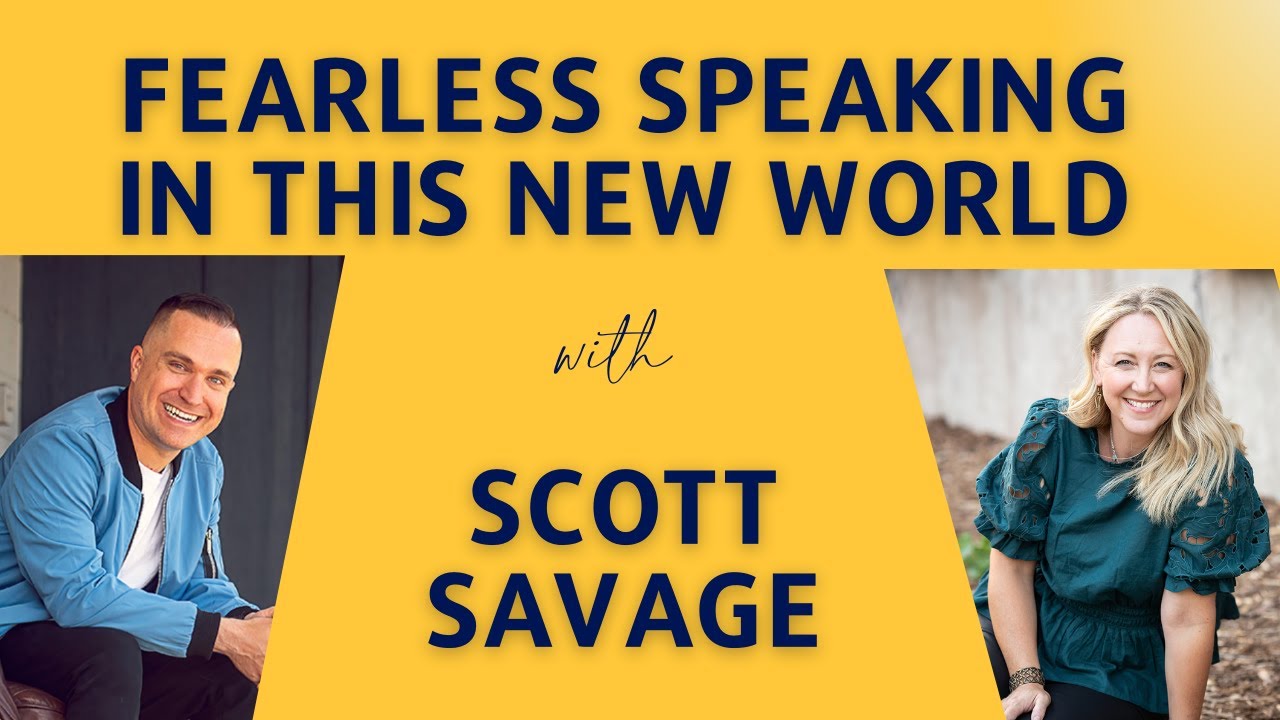
In this interview, host Sally Koering Zimney (Sally Z) talks with speaker and coach Scott Savage about the rapid shift to online speaking during the early COVID‑19 era. Scott shares how his live‑stream audience grew from about 200 to over 1,000 viewers, the technical glitches that came with that surge, and the mental adjustments required to speak to a camera instead of a live room. They discuss the importance of imagining the audience as avatars, making content urgent by aligning it with listeners’ current hierarchy of needs, and listening to social‑media signals before a talk. A major focus is Scott’s transformation from relying on notes on an iPad to speaking without notes, the fear and freedom that entailed, and the broader theme of “hiding” versus authentic presence. Both speakers emphasize self‑trust, risk‑taking, and vulnerability, sharing personal stories about phone‑fasts, counseling, and the emotional toll of the pandemic. The conversation ends with a “This Moved Me” segment where Scott cites a video of doctors singing “Imagine,” Michael Hyatt’s leadership insights, and Brad Montague’s new book “Be a Better Grownup,” reflecting on hope, creativity, and the role of speakers as caregivers during a historic moment.
Chapters
Hey movers, it's Sally Z with Be Moved. Let's go create some talks that will move this world. We're gonna talk with amazing speakers, share tips, tricks, resources, and we are going to be moved so that our audience can be moved. This moved me. What is moving I cannot wait to hear how you're doing.
Oh my gosh. Well, my, you know, my wife is working today. She had to go into court. So I have my kids watching Star Wars in front of me. So hopefully my mic will not pick up Episode 1: The Phantom Menace.
So, you know, even if it does, It's like, this is the world that we are living in right now.
Yeah, it's wild.
It's unreal, surreal, unreal, bizarre. These are all the words I've been using. So wild. How's the transition been for you into doing your services online?
Well, so we've been live streaming for 6 years.
Okay.
So, um, and typically we have about, we've been running about 200 people watching us online a week, maybe 2, maybe 225.
Wow.
And then, and, and now we've gone from that to like everybody online. And so that's been like 1,000 or 1,100 people watching online. Wow.
That's awesome.
So we've had, we've had some some tech glitches the first week. You know, our hosting company wasn't prepared to, you know, 5x, you know, our, our traffic, right? Um, but, uh, but we kind of made it through. Um, and we have a great team that's kind of figuring out a lot of the behind-the-scenes stuff. And, um, and yeah, I'm getting used to speaking to an empty room. So that's—
well, that, that's kind of where I want to start. Okay, because I'm getting a lot of, um, just people reaching out to me and saying, how do I do this via video? I mean, literally taking a conference keynote, or in your world, a sermon, and you're, um, you know, whatever, you're, you're having to pretend like there's an audience full of people there. Are you trying to Tell me about what that's like for you, and then I have some follow-up questions.
So it feels like speaking to an arena. Have you ever spoken in a really, really huge venue, like an arena?
Yeah, I mean, there was like 6,000 people. That's a lot.
Yeah, so it feels like that where you have a massive stage, you have a huge dark room, and you're trying to overextend yourself and your energy so that you connect with people. And so I felt way more exhausted than normal after last Monday. I think it's because I was trying so hard to project, to help my body language and everything go through the camera. And I think I was even more engaged than normal. And so that's a little bit of what it feels like. You know, we had some people in the room the first week we were just streaming 2 Sundays ago, but once we hit the 10, no more than 10, like the room was basically empty. Yeah. And they turned off my microphone because it helped with the acoustics for people online. So like, I wasn't hearing myself in the PA anymore. I just was hearing myself talking normally. So that was an adjustment too. Yeah. But I've gotten some great feedback, people saying, hey, you're not any different online than you are in person. And so that's been really, really encouraging. So I think it's just going, okay, speaking to the camera, um, and instead of the room and thinking still, like in the process of development, like, who are my, um, who are my types I'm speaking to? You know, whether it's a, um, uh, what's the term? Um, an avatar or like an actual person. I can imagine this message is for this person who's dealing with this. And this and this, and I'm trying to help them go from here to here. And so I think all those kind of things are really important because those people are now having to be in your imagination.
Totally. Yeah. Yeah. That was a big thing I've been talking with people about is it's an imaginative exercise. The connection that you are making is, is even more important than before, but it's really such a powerful exercise for our imagination because we have to be so clear in our minds who we are talking to. So when you're looking in that camera, you can imagine them, see them, you know, as much as possible. So it's interesting that you, you're thinking about different people as you go along, or these like different avatars, different, um, caricatures of people, because without that, I think it can feel, we sort of, it's like unanchored, you know? Floats out there instead of searing into the audience so they can feel it, you know?
And I have the unique privilege, 'cause I'm speaking to roughly the same people every week, that often I'm thinking about people who are, end up being in the room, and so typically it'd be like, okay, I see that person, I know what they're going through, and I'm writing and speaking with that in mind. Now it's like, I know they're in their living room, you know, or in their car. And so now it's going, okay, how do I imagine them? And then, you know, we saw probably, you know, a 20% increase in people watching us online versus our total before. So we know we're connecting with more people. Listening to social media, listening to people I'm talking to, polling the team and going, okay, where are people struggling right now? What are the pain points? And how do we make sure that what we're saying, the application of what we're teaching is super relevant right there? So that's been really cool to kind of morph what we were doing, not changing our approach in terms of what we were going to cover, but making sure the application points and then the on-ramp into the message is super relevant to where they're living in the middle of this.
Totally. So, well, it's interesting because you, you're like a little case study in one of the episodes that, well, it will have already come out by the time this comes out, but that's coming out tomorrow, um, of the current week that we are talking right now. Uh, the time warp of recording and then publishing these things is funny, but the episode that's coming out tomorrow is about adjusting our content so that we are speaking to the context of now. That we don't, you don't have to scrap the planned content that you had. You know, you don't have to create a whole new set of messages necessarily, but your why at the beginning has to be so acutely relevant to their experience now? Because if it's not, they're not listening and they don't see why. I mean, have you ever heard me talk about Nick Morgan? Who I heard, he's a speaker coach out in, I think, Massachusetts. And I've heard him speak before and he talks about this really awesome idea that every person shows up in the room with a hierarchy of needs.
Yeah. Oh yes, I remember this guy.
Yeah. Okay. So if we cannot speak to, if we cannot make what we are talking about more urgent than their most pressing need, they're not, they're not going to take it in at the time, which makes so much sense, but it's such a challenge for us. I just want to say, I think one of the things I'm seeing and I'm hearing from you and I'm hearing from other speakers is this What is happening in this is it's forcing us to get really clear about the urgency and the need for what it is that we're talking about. And so I think it's just refining people's purpose in a really powerful way that I think is good.
Yeah. I mean, I, and again, I told my people again and again, like you see obstacle right now, but there is, opportunity in the middle of it, you know? And so people still have the same needs that we've been speaking to, but you have to be able to understand how those needs fit in their overall reality that they're trying to make sense of.
Yeah.
And you need to make sure that you're not speaking as somebody who is perceived as like above what's happening right now, immune to it, and you speak in a way that you're being as authentic as possible in it. And so this, this past weekend, you know, I talked, um, I was talking through just the emotional kind of unrest of right now and talking about the need for, um, health and wholeness. And, and I talked about the fact that my counselor and I had met and I was not navigating this well. And I knew it wasn't, but I didn't know what to do. And so he and I had come up with an idea that I would do like a 24-hour phone break, like a fast from my phone. And so I said, "Break from my phone." And I thought that I had a phone problem, but I didn't. It was deeper. It wasn't that I had a phone problem. It was that my phone problem was kind of covering over the fact that I felt very out of control.
Yeah.
And I felt very insecure right now. And I was on my phone all the time because staying on my phone helped me feel more in control, helped me feel more secure. And so I shared transparently and said it was, you know, you would go, Scott, you couldn't give up your phone for 24 hours. And I'm like, yeah, it was really hard. And so just sharing transparently about that kind of gave it like, hey, Scott's navigating through this. He's struggling with this emotionally. He had to talk to his counselor about this. And then I was able then to speak to, here's some places I think I see people struggling, and here's some ways we can go forward. And I just think like leaning into that authenticity, sharing your own struggle in the midst of all this, whatever your topic is, kind of humanizes you, and it makes sure that you don't step above people as the person who has all the answers, and you go like expert mode. You gotta be really human in this moment, and stay in an empathetic place.
Yeah. Yeah, yeah, it's, it's a funny thing, uh, as, as people who, if we're out front, we are leading, right? And so you want to lead with some sense of wisdom and like experience and yes, here, here's what I've learned, here's the, the best path. And yet we are going through this at the same time, so it's not like one of those those experiences that is a scar for us, that we're like, here's what I did.
Mm-hmm.
And then it happened. No, this is new for every human on the earth right now. We've never been through this before. And so, um, I think navigating that is really important to, to show up with compassion for ourselves and, and to be so empathetic to our audience. Like, I think that's where it has to start is this really strong sense of, I'm feeling with you and here's my feeling.
Well, if we're going to be in this online space, I think that the benefit, again, the opportunity is it is so easy to listen to your audience before you speak right now. Go through your Twitter feed, go through your Instagram feed, go through your Facebook feed, see what people are posting. See what the pain points are, see where the emotion is. And then when you begin to speak online to the camera, make sure that you are speaking with that in mind. Because it's not always gonna be, and it depends on where you're presenting, you know, some opportunities are there for you to interact and do Q&A or, you know, be interactive. But if you're presenting kind of a packaged talk, you're not in the moment gonna be able to listen. It's really gonna be about you speaking. And so it's gonna be incumbent upon you to have listened really well as you've put together that content and prepared yourself so that you're postured where even though you're speaking, people feel like they're being heard by what you're saying. And so that is gonna be the connection point that this person has listened to me well before I even, before they started talking, and even in the listening, they're speaking to the elephant in the room, they're speaking to that pain point that I have, Oh my gosh, I just was talking to my wife about that. Oh my gosh, I was just talking to my team about that. And by speaking to those things, you're opening up that sense of connection and that credibility there.
I love your giggly kids.
Yeah, we're really big fans of Star Wars in the house. So we just kind of cycle through all the movies over and over again. So they've been champs, you know.
I know. My kids too. I'm like, this is— hard for them too, and they're being absolute troopers. Their resilience is truly inspiring for me because they're just— we're just all making it work.
We're trying to give each other a lot of grace, and we need a lot every day.
So yeah. Oh my gosh, totally. Um, what you just said, Scott, I feel like is one of those like mind-blowing aha things that we sort of know, but that this situation is crystallizing. And how, what a great strategy and insight for everybody listening right now, which is to not just do your homework about your audience, but you're listening so that what you have to offer resonates and is what people need right now. So I just think that's huge. That's great. So we initially, when I was like, let's do this again, Scott, because we've connected a lot and you're awesome. And we got to actually hang out in Nashville at the Story Gathering and you've been on my show and I'm just like all the Scott Savage fan that you can be.
It's a mutual feeling for sure.
Well, when I did my little launch, when we launched Be Moved and I brought you on screen like this, it was just like the highlight of my week. Oh. Because you talked about big shifts that you had made in your speaking. And that is what Be Moved is about. I mean, that's part of the reason why I changed the name of my company is because I feel like in order for us to move our audiences, we as the speakers, have to be moved from one place to another place. Like, they mirror each other, otherwise the big things aren't really happening. And so, um, that was why we initially wanted to talk, but I could not just jump right into that. We've just got to set context. Yeah, for now. And, and you've got some really important insight around how to bring your voice out into the world in this virtual context we're living in right now. But let's set that aside for a minute because I do want to hear about this transition that, that you've made after speaking for 15 years. Something shifted for you. So can you talk about that a little bit, what that, what that transformation was for you and what it what it felt like.
I started feeling restless. I felt restless like I was— it just started as a restlessness at first. I just felt unsettled. And I wasn't sure, okay, so do I need to go back to the drawing board and change how I approach writing a talk? Do I need to change the length of time I speak? Do I need to change I kind of put everything on the table. Around that same time, we connected when you first were starting your coaching and you really challenged me that I was hiding. That was strong language for me, but that's why you're a great coach is that you don't pull punches. You're like, "I feel like you're really attached to your iPad and you're really attached to this kind of bar table kind of thing." The first step was— kind of getting a different table so there was less of a gap between me and my people. And then it was okay getting out of my notes. And so that took some time, but then around the same time, I had somebody else that I follow who talked about how do you go from preaching with notes to without notes. And I know for some people that kind of give a keynote again and again and again, there is sometimes repetition that you get more comfortable. But in my world, I'm delivering 40-minute keynotes a year. And so sometimes I'm not finishing writing until Thursday or Friday, and I've got 48 hours to then get up and give it. And so I was like, how do I have that mastered enough to be giving that, you know, notes? And so, without notes. And so, but what the guy gave insight about is he said, hey, It's less about memorizing your talk and it's more about understanding it. And so that was so key for me 'cause I was trying to get every precise point correct as opposed to understanding the journey I wanted to bring people on. And so, you know, your coaching to kind of change my approach just in terms of how we staged it, and then his approach to say, hey, make sure you understand it. And then, you know, me beginning to kind of experiment and noticing the immediate sense of connection I had more with— I moved the barrier, the table to the side, got a smaller table, and all of a sudden I felt more connected and I was getting more feedback. And then I gave it a shot one day and I said, okay, I'm just gonna leave my iPad over there and I'm not gonna open it, I'm gonna leave the COVID on it. And so if I get stuck, I will go over and get it. And then I did like 3 weeks with no notes. And, you know, a little bit longer. And sometimes, sometimes I would say things that weren't as polished, but I just saw like a 2 or 3x level of connection difference by leaving the iPad aside. And I think what people began to tell me, and I would have never thought about this, but they said, when you're not reading off your iPad, I believe you more.
Mm-hmm. Totally.
But these are my words. Like, I mean, I'm reading the words I wrote on the iPad. They go, but when you're looking at me, and you're speaking it to me and you're not looking off your notes, you are so much more believable and I connect with you so much more. And I was like, okay. So then like the fourth week I totally flubbed. I lost my place. I got confused. And so I just said, guys, I'm sorry. I'm gonna get my iPad out, figure out where I am. I got some laughs. People just ran with me. And then once I kind of failed, you know, quote unquote, and had that moment, I realized, okay, I can live through that. I just kept going. And so now it's been probably 12 to 18 months of speaking without notes and the level of engagement, the level of confidence I have, and my willingness to step out and say things that I knew I needed to say, but I was like, well, it's not in my notes, or I needed to say, but I was scared of, or stories, or I feel like I am so much more fearless in my speaking.
Yeah.
And you would think speaking without notes would be fear-inducing, and it was initially, 100%. I mean, it was terrifying.
Yeah.
But once I got over that hump, I was like, you know what, I'm just going to show up and I've got, you know, I may have 75 slides on my cue screen in the back. And I have my remote, I'm gonna keep going through it, but I am just gonna get up and I'm gonna be fully authentic. I'm gonna say what I need to say, and if in the moment it comes to me, I'm just gonna follow it. And it's been kind of, I wouldn't say it's been a Copernican revolution in terms of my speaking, but it's been, if I went back and I watched some videos a couple months ago from when I first, I've been where I am about 4 years, and so they're about 4-year-old, and I was like, It's almost like a different person speaking, uh, from then and now. I mean, it's just radically different.
Yeah, no, I, I— that process and that transformation, you said a few words there that I think capture it. Um, it, it starts with a willingness, and because it's a risk, um, and I love that you baby stepped into it in some way. You just were like, my iPad's right over there, And if I need it, and there are moments that you did, and you go back and you, you can check in with that. People understand that. I mean, they understand what you're doing up there. One time I just remember giving a client permission, like, if you lose your spot, you can always just say, give me just a second, I'm going to check my notes. Like, no, they would rather you do that and fumble and sort of search for it and panic and, you know, the blood rushes to your head and everybody's uncomfortable than handling it. If you can handle it, you can move through those moments. But the, the, the fearless willingness to potentially fall on your face and do it anyway, there's something about that that makes our message not just more believable, but the process of our willingness to stand up and say that on our own two feet makes it live in us differently.
Absolutely.
I don't know, the hiding, the hiding thing is, it's not just that it gets in the way of audience connection, but there's something internal too. Would you agree?
Yeah, I think that, and I think that for me, hiding was my iPad and my table. But hiding may look different for you as a speaker, you know, in a unique way. And I think we are all tempted to hide in the art and the work that we do and to pursue a safer, more comfortable path. And sometimes, Sometimes the longer you've been doing it, you would think the more fearless you would be, but you actually might be just really well experienced at doing the comfortable, safe hiding thing. Yeah. And I think sometimes the longer you've been doing it, the more tempting it is to hide because you're so experienced.
Totally.
And so you have to keep climbing the ladder and keep figuring, okay, so what is hiding now? Maybe if you've been speaking for a long time, I've been doing it 15 years, maybe 10 years ago hiding was X, but now 10 years later hiding is Y. And continue to say, okay, if I'm going to show up and be my full authentic fearless self in a way that shows up and engages my audience, but for myself, is the next progression, then what is hiding? And so that's where for me, I think I'm, you know, I kind of have a sense of what my next thing is gonna be in terms of hiding, but this was certainly the mountain I had to climb here to get to the place where I could be note-free and just trust myself and engage. And it's been, if you're somebody who wrestles with these things, your iPad, a table, your notes, I just would encourage you, figure out how to make 1% progress every time you speak, Yeah. If you need to piecemeal it down, piecemeal it down, but you know, what's on the other side of it is definitely worth the work. Yeah.
And I, so a few things, cause I think, um, when you're talking about self-trust, that is absolutely what we're trying to move towards is a willingness to risk because, you know, you can, you can handle whatever happens. Um, most of us have a little more time to practice moving to self-trust. But you're literally practicing in your performances, like, because that's, that's your time to get up on your feet. I mean, I'm in awe. I'm in awe of how much pastors speak. I just think it's amazing. So that is the first thing. The second thing is, I thought you'd appreciate this. My fourth grader, my daughter who's in fourth grade, they invited parents to come in and do these little mini courses. And so I had done one when my oldest was in 4th grade. I did a mini course on public speaking and it was fine, but everybody took it really seriously and it just wasn't any fun. And I was like, okay, I gotta, I gotta change this up a little bit. So this time I did sort of improv and performance and I kept it really loose. And it's interesting when you have the challenge of trying to teach young people these core concepts. What does a 4th grader need to understand about the risk of stepping out front and performing? And so one of the key things I talked about was a sense of freedom. That was the best word I could come up with was freedom. I want you to feel free in the moment. I want you to— it was like, I wanted to move past risk and risk-taking because it's just like, how does a 4th grader understand risk? But freedom and like full expression and fun and joy and just the sense of fullness, they totally got that. And that's the one that they all talk about and remember. Like when I see them around at school, not anymore, but when I would see them around the community, they'd be like, "I'm practicing being free." I'm like, "Yay!" I think what you hit on is that some of these battles that we face as speakers they're two things.
They're universally human.
Yeah.
And they started much earlier than we remember.
Yeah.
I mean, I think there's a lot of us that don't remember what it was like to be 9. Yeah. But I think some of the feelings that we feel now at 19, 29, 39, 49 as public speakers, those are experiences we started feeling in a very different sandbox but as a 9-year-old. And so recognizing that these are just lifelong things that we're going to be working through. And it may be the same issue we wrestled with at 9, but we're going around at a different level.
Yeah.
But some of these are going to be the things that are just always with us. We're always going to be struggling with these. And sometimes different size stages or different mediums are going to bring them out in different ways, but just paying attention. And giving yourself grace too. This is just part of the human experience.
Yeah.
And something in public like speaking makes it just more intense. Um, and, uh, I think it's a gift though, cause I get it. So I get to work on this in a way that maybe somebody else doesn't. And so it means I get to be, you know, more and more of who I was made to be.
So I, I totally agree with you. I think it's a really fabulous playground of self-development. And so rewarding, I think. I find it. I like helping other people in their journeys too, but I gotta walk the talk too. Okay, Scott, so let's do our This Moved Me moments. I haven't done this with you in a while. So I'm throwing this at you. I didn't ask you to prep one. Knowing you, I'm sure that you are attuned to something that has moved you recently. So throw it at me. What has moved you?
Oh, so I would say two things recently. One, and I'm not sure if you shared this, but it was a video. I think I first saw it on Sheryl Sandberg's page. And she was with, since she's with Facebook, or was with Facebook. And it was the two doctors, like playing piano and singing songs together. And they serve in emergency medicine. And they were, I think they were singing Imagine by John Lennon. But they had like a number, they had like a number of songs they had sung recently. And just the awareness that we need some sort of outlet to unpack the emotions that are laid in within the work that we do. And I think that all of us in this season are trying to make sense of how do I do my craft, how do I do my work in a rapidly changing context? And that in and of itself is more than a full-time job.
Yeah.
But at the same time, how do I do that in a way while I'm also caring for myself.
Yeah.
Because I don't just do the work as a robot, I do it as a human. And so I have to take care of myself so that I can keep doing that work. And that simple 58-second clip of Imagine for me was a reminder that those people who— I pulled a 12-hour shift in a hospital trying to make sense of PPEs and COVID and masks and supplies and ventilators. They're finding a way to care for themselves and unpack that emotion. I thought it was just an inspiring thing that, you know, reminded me that I need to find my own outlets to be able to keep doing this work well.
Totally. Staying grounded, staying compassionate, and staying in touch with this, you know, the— I feel like the creative arts right now, and I'm using that term really, really broadly, is is like spirit and soul food right now in a really, really important way because it's so easy to feel disconnected from all of that. So love, love, thank you. That's awesome.
Can I share one other thing?
Yeah.
I think I would also say, and I've seen this, so I work with a guy named Michael Hyatt, he's a business coach and leadership coach. And, He's kind of pivoted his content this season and he led a book publishing company through the recession. And so he's talking about the things he learned through that. And just watching the people in our cohort, how hungry they are for what we're sharing. I would just, what inspires me is people who are feeding people right now because I think we often think that, okay, do they care what I'm saying? Do they care what I'm teaching? Do they care about what I'm doing? And right now, can they even afford to pay me for it right now? Nobody's making money, but people are hungry for hope. People are hungry for help. And the people that I see who are pushing through all of the kind of internal battles to get up and speak in this setting, you know, talking to a camera, uh, hopefully keeping their message going. I would just encourage you, what inspires me is that you're recognizing that people are hungry. And they're looking for you to feed them. And when you go out there and you stand up and you do what you do, even if you've never done a Zoom before, even if you've never had a camera before, even if you've never done any of this before, and you're willing to get up and show up and do the work and try to help people, you know, even in your stumbles, that's inspiring. Because people are so, so, so hungry right now. Yeah, for some hope.
Yep. I think this is an incredibly potent time and needed time for people to step up and use their voice in a way that serves their audience. And, and if we can do all these things that you're talking about, Scott, of like really listen to where people are at and let that drive what it is that we are sharing and doing and offering that is, um, I, I just feel like that's soul work, like we just said. So cool. Yeah, I've been following Michael's stuff, but honestly, in the last few weeks, I have— I'm back engaged with him in a way that I haven't been in a long time, partly because I'm like, needed, needed, needed.
Absolutely.
Yeah, huge. Okay, my This Moved Me moment.
Yeah, tell me.
Came in the mail today and I was like, oh my gosh, it's perfect because I'm talking to Scott today. I got this from Brad Montague.
Brad.
Yep, so his book, is this backwards for you?
I can read it. As a member of the Society for Better Grownups, I do solemnly pinky promise to grow and help others grow, laugh and help others laugh, and especially fly and help others fly. Oh, that's so cool.
Yeah, so it's part of his launch campaign. He just launched his book, "Be a Better Grownup." And here we are, all these parents, home with their kids all the time. And it is really our chance to help shape our kids' lives in a really profound way. And not just our kids, but all kids, like the community kids. The country's kids, the world's kids, like, it really is a call for all of us to be better grown-ups. And Brad's one of those people that I'm like, gosh, what is Brad Montague doing with his kids today? What can I do to help make my kids' days a little bit brighter? I would say I'm like 50/50. 50% of the time I'm like, hey! And then the other half the time I'm like, So it's, but it's one of those things I'm like, vision, focusing on what I could do, move towards. But I think we have a real opportunity to shape our kids' experience in this so that we're gonna be talking about, this is historical. We are creating history as we are living it. And so what is the story that our kids are gonna be telling about this time? You know, it's gonna be, "I got to watch Star Wars movies all the time!" They did do a lot of homework this morning, so this is a reward, they've worked. Yeah.
They've worked really hard.
Oh, totally, I mean, and hey, if you told me they were watching Star Wars movies all day, I'd be like, "I get it, I get it, you gotta do what you gotta do." I just love— That would be a beautiful story for them, you know? So I don't really have the answers. I just want to be a better grown-up.
Well, and that's where, again, like, I just go like, you know, Brad had no idea that his book was going to launch in the middle of this.
Right.
And I'm sure, because Brad's human like us, he's sweating it. Oh my gosh, am I going to sell any books? Amazon's not shipping books right now. Do people want, you know, light, wonder-filled, you know, like, is this gonna— but like, who Brad has been for years is exactly who we need right now.
Totally.
We need the truth wrapped in a package that is filled with imagination and wonder and love and hope. And so it's like, what better time for Brad to be a voice and for be introducing a book like this? 'Cause none of us know what we're doing. We're just making it up as we go.
We truly are. We truly are. I agree. This is so great. Scott, I know you have to run, but I just want to say thank you once again for your connection and your time and your wisdom. There's like some good wisdom bombs in this one. This is really good.
Well, I love what you do, Sally. You are— I can't tell my speaking journey without Sally. And so I'm so grateful for the investment you've made in me and the thousands of people that I get to touch when I step on a stage. And so I'm grateful for this new season with Be Moved, and I'm excited for how I'll continue to be a better voice and speaker and human because you're in my life. So thanks for the work.
That means the world. World to me. Really, truly, thank you, Scott. Um, all right, we will talk soon. Uh, I'll let you know.
More from Sally







Speaking My Story: The Talk That Changed Everything (Sally Z's Epilogue) | Speaking Story


The Walk-'n'-Talk and the Stumble-Through: Two Rehearsal Methods That Actually Work | Ch. 39