MoversLIVE: Embracing an 80% Mindset
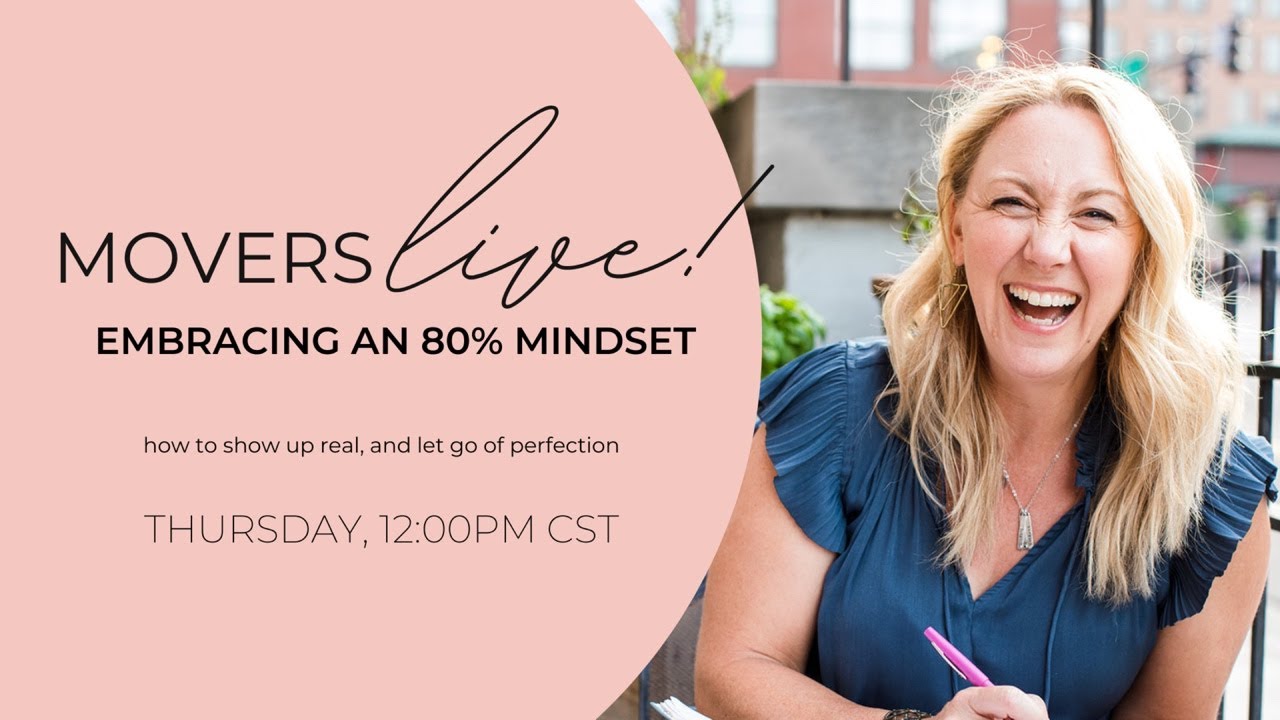
In this live stream, Sally (the host of MoversLIVE) introduces the "80% mindset" for public speaking, arguing that 80 % of effective speaking is mental. She explains that speakers should aim for a "ready‑enough" state rather than waiting for perfection, adopt "good fear" as a motivating risk‑taking force, and reject the belief that perfection enhances connection. Sally illustrates these ideas with a personal anecdote about a coughing fit during a keynote in Albuquerque, showing how embracing imperfection can deepen audience rapport. She also promotes the practical tools she uses (Ecamm Live) and announces an upcoming free virtual event, Story Impact, on February 16, which will provide further training, workshops, and coaching to help speakers leverage their stories. The session blends instructional advice, personal storytelling, and promotional information, encouraging listeners to take action, show up authentically, and move their audiences.
Chapters
Hello, hello, hello everybody! Welcome to Unmovers Live! Yes! So excited! That you are all here. Welcome. Every Thursday, with some exceptions, but I go live many Thursdays at this time to give you and inject a little insight, tips, tricks, answer questions to help take you to the next level in a really simple, easy way. So if you are here right now, say hello in the comments. I'm doing something fun and new this time. I'm not just going live in my Facebook group. So hello, if you are in my Facebook group, I'm also going live into other places that I don't normally go live into, but we are experimenting a little bit. We are going live into my YouTube channel as well. Hello, YouTube. And we are also going live into LinkedIn. I'm so jazzed about this. Um, I use Ecamm Live, as you can see here with the like little logo right here and some graphics. There's all kinds of things that you can do if you are somebody who goes live often or live streams. Um, I use Ecamm because it's a really fantastic tool. So here we are going live through Ecamm. If you want to know more about Ecamm, I have a link that you can grab for— I think it's a 15-day free trial for Ecamm. So let me know in the comments. I'll reach out to you and send that link. I'm pretty sure it's bemoved.com/ecamm. E-C-A-M-M. So there it is. There's the link if you want it. But here we are today. We are talking about this concept right here, the 80% mindset, because speaking is really 80% about what's going on in our mind. That number is high, and people are like, really? Don't you teach the skills of speaking, Sally? Isn't that what it's really all about? And of course we need some basic skills if we want to impact our audience. Yes, all about it. But also, just because you have the skills of speaking doesn't mean that you are moving your audience. And that is our goal as movers here in the universe of Be Moved. We are about moving our audience, and that requires us to show up at a slightly different level. Okay. It doesn't mean that we aren't going to do things well and we aren't going to focus on making sure that we are being pros and we are effective in what we do. Yes, skills are kind of the, the core minimum, but at the same time, I bet we can all think of somebody who has been powerful and moving and impactful who didn't have all of this skills we think you need to do that. I can think of people right now off the top of my head— poets, performers, TEDx speakers, conference speakers who are incredible but not your typical perfect polished skilled speaker. So the mindset is actually what helps you show up and connect. The mindset is what helps you show up and do something powerful and moving. We have to prepare ourselves a little bit differently if we want to be, in my words, a mover. And I hope all of you are all about wanting to be a mover. That is what this is all about. And so what I want to share with you in this very short live that we're going to be doing together, a few ideas for how you can achieve an 80% mindset. What I mean by that is we are, uh, going to get into the right frame of mind so that imposter syndrome doesn't keep us from actually Showing up. And that sounds so no duh, it sounds so simple, but truthfully, I talk with people all the time. Speakers come to me all the time. They want to be taken more seriously as a speaker. They want more opportunities. They want the bigger stages, and they aren't doing the very simple work— still difficult, still challenging— of just showing up and being seen. And what is in their way has nothing to do with their skills. It has nothing to do with their capabilities. It has to do with their mindset. So we're going to embrace what we call an 80% mindset. That idea of allowing ourselves to be in the right space and frame of mind to do something powerful. Are you with me? I know you are. Okay, so the first idea I want to share with you is something that, uh, it's a mantra. I want you to just borrow it. I want you to take it and take it with you. So the next time you are going out front, I want you, uh, saying this to yourself: it's not about being ready, okay? Because we're never really ready. We are ready enough. What What does ready enough mean for you? If you can let go of being ready, whatever that means in your mind, because typically when we think I'm not ready yet, it's because it's not perfect yet. We don't feel like we are all the way there. We're just like, huh, I still want to mess with this, or the slides aren't exactly right, or, um, I don't know what I want to do exactly with that moment. Okay, we're never going to get to exactly ready. And if we wait until we are ready, we are holding back from taking any action at all. So we want to get to a place where we're more like ready enough. It's ready enough, right? The truth is, even if you are ready, you're going to show up in the moment and you don't know what's going to happen. So last week I was in Albuquerque doing a keynote, which was so fun. I loved it. Amazing group. I was speaking with the Cru Network there, uh, and at their leadership summit, they bring their leaders together from all across the world. And, uh, as I am up there, I'm feeling a little tickle in my throat. Now, if you've ever been to Albuquerque, It is obviously, they've, you know, it's in New Mexico, so they've got really like Mexico-inspired food and it's just got a little bit more kick on the daily than I'm necessarily used to. And I had had a little bit of soup at lunch and I had been recovering from a cold, so I had just a lot of, it was very sensitive. Throat was very sensitive. And so I got into a little bit of a coughing jag even before I went up on stage. And I was like, oh no, I'm just going to— it's like, mm-hmm, now my throat needs soothing. So I'm drinking all the tea. Well, my ready enough had to be ready enough at go time. Okay. And if I waited till I was ready, guess what? The audience was like, ready or not, here we go, the show must go on. And so up I went up on stage and yes, I did get into two, count them, two coughing fits up on stage. Luckily they had water right there, it was fine. It became sort of a joke actually for everybody in the room. It was like, wow, well, you're talking about authenticity, way to be real, Sally. I was like, yep. Here I am being real. Now, in order for me to be ready enough for that moment, okay, I wanted to know I've got water right there. I wanted to know that I could trust myself to handle it, whatever happens, whatever goes wrong. But the ready enough mindset is what gets you to take action. It's go time. You've gotta just get out there and give it a go. If we let being ready be the bar, some of us will not take action soon enough. I want you to take more action. So we're going for ready enough. Makes sense? Not about being ready. It's about being ready enough. And that might mean it's not gonna be perfect. More on that later. All right, the second mindset I want you keeping in mind, along with we're getting to ready enough and then we're going, is I want you to embrace what I call good fear. Okay, good fear is the kind of fear that, um, gets you to take a risk that is good for you. Okay, simply put, there's there's some risks out there that's like, ooh, that's maybe not good for you, okay? But good fear, right? Good fear helps us grow. Good fear— neither of them protect us from failure, neither of them protect us from rejection, okay? And fear, that is fear's goal. Fear's goal is to protect you, okay? And truthfully, if we just listen to fear all the time, we would never do anything. We would never get to the place where we're like, it's good enough, it's ready enough, let's go. Because if fear's in the driver's seat, they would rather have you do nothing. Fear would rather have you stay home, stay safe, take no risks. Okay, but we have to discern for ourselves, is this a good risk for me to take? Am I gonna let fear Am I going to drive on this one, or am I going to say, fear, get in the back seat, as Elizabeth Gilbert talks about? And instead, we are going to full speed ahead with good fear. I think we know, we know what is a good risk to take. Sometimes it's hard to distinguish, but I want you to start thinking of it that way. Is this— can I let good fear drive? Can I let good fear be— reorient myself towards good fear? What I call— how do I put it sometimes? I can't remember. Where are my speakers? If you're here, you would know. Sometimes, what do I say? Oh, we're going to let risk be our compass. Okay. Now that's super powerful and helpful when we are trying to embrace good fear. Sometimes we don't want risk to be our compass. When I'm talking to my teenagers as they're heading out as new drivers, I don't want risk to be their compass. Okay. But for us as adults orienting ourselves towards good fear, we want risk to be our compass. Like what could happen? What if we might still face rejection? We might still fail. We might look foolish. But is the experience worthwhile regardless? That is good fear. That's what we're moving towards. Okay, now the last mindset I want to share with you is a classic. I don't know if I can call it a Sallyism, but I say it all the time. We're going to call it a Sally Zism, perhaps. And that is that perfection kills connection. I talk about this all the time. If perfection is the goal, not only does that make it really difficult for you to start and to start taking action and to put yourself out there, um, it is going to keep you from having the impact that you really want to have. We often, believe, and we're sort of grown up in the professional world to believe that our credibility is based on how perfectly we show up and how perfectly we do something. I have to battle this for myself too. Okay. Just to be really clear, there's a lot of times where I am protecting myself from being seen as a full human, but I have to work through that because I know that ultimately perfection is not my goal. Perfection gets in the way of my goal, which is to connect. I want you and I to feel connected. And the way that we do that is by showing up as our full human selves. So here we are, we are being our full human selves. We are letting go of perfection as the goal, because honestly, perfect speakers are kind of uninspiring. Okay. There's no magic in perfect. The magic comes with what we build and create together in this experience, through this experience. That's what we're going for. So we're not going for ready. We're stopping at ready enough. And taking action. We are embracing and really distinguishing for ourselves good fear and letting good fear drive us, not letting fear hold us back and keep us safe because there is no safe. There is no safe if we want to take action and have a big impact and move our audience. Now we are orienting ourselves towards good fear, and we are not going to let perfection keep us from showing up and doing anything. We're going to shift, we're going to take perfection off the goal list. Okay, it's not about erasing all of your humanness, erasing all of the filler words, taking away your mannerisms, That's not what it's about. It's about making sure that who you are is channeled so that you can connect with your audience. And that might mean you've got some filler words. It might mean you screw up on stage. It might mean you have a coughing fit and you have to take a moment while 400 people watch. While you collect yourself, soothe your throat so that you can continue again. That is real because that is what is happening. You get to be you. You get to bring your full human self up into that power position with you. That's what makes it so, so powerful and so, so beautiful. Okay. I honestly don't give a crap if you do it perfectly. I— if you wait until you are ready and it is perfect and you've got it all down and you are, uh, you— it is like absolutely clear in your head, it's going to go like this, this, this, this, this, and this, you're going to show up in the moment and not be connected to what's really happening in the room. So we're going to get ourselves to about 80% ready. It's part of the reason why we call it an 80% mindset. 80% of speaking is in your mind, and we're just gonna stop chasing the 80 to 100% sort of perfection. We're gonna stop chasing that, okay? I don't think that really exists until you are in the moment, and once you are in the moment, you might find the magic that takes you from 80 to 100. But you won't know until you get there. So we've got to get you there. Yes. Yes. I hope that makes sense. I hope this was helpful for you. We are going to be doing this more over the next few weeks. This is all in advance of our Story Impact event. I am so jazzed about it. Jazzed. The Story Impact event is February 16th.— it is Thursday, February 16th. You do not want to miss this, my friends, and you can sign up. It is free. It's a half-day virtual event. I've brought in some amazing speakers. They are going to delight you. We're going to have some great conversations. It's a really powerful combination of— you're going to get the inspiration, but we're also going to give you some time to actually put pen to paper and do a little workshopping so that you can start to really leverage the power of your story and have a greater impact with your speaking. But it really starts with some of the foundational work that we're gonna be doing together. So you can join us, let me get the link up there, at bmove.com/storyimpact. So this is the link that will sign you up. Again, it's free registration. Piece of cake. It's from 8 AM to 12 PM Central Time. I promise I will get you done at noon. Um, and we've got all kinds of fun things planned for that time in between. If you cannot make it, if that date doesn't work, or you've got some meetings in the middle of it, you can always purchase the VIP pack, which includes recordings of the event and, um, some other goodies as well, including a strategy session with me and a group coaching session as well. So that's kind of a no duh. All the details are at bmoove.com/storyimpact, and I'll see you on the 16th, if not before. Bye everybody. Hope you have a great rest of the day. So glad that you were here. Reach out if you have questions, just hop them in the comments or, um, Uh, send me a message. I'll get back to you. Have a great one. Bye-bye.
More from Sally







Speaking My Story: The Talk That Changed Everything (Sally Z's Epilogue) | Speaking Story


The Walk-'n'-Talk and the Stumble-Through: Two Rehearsal Methods That Actually Work | Ch. 39