Permission Slip Podcast - LIVE! Episode 2: #showupanyway
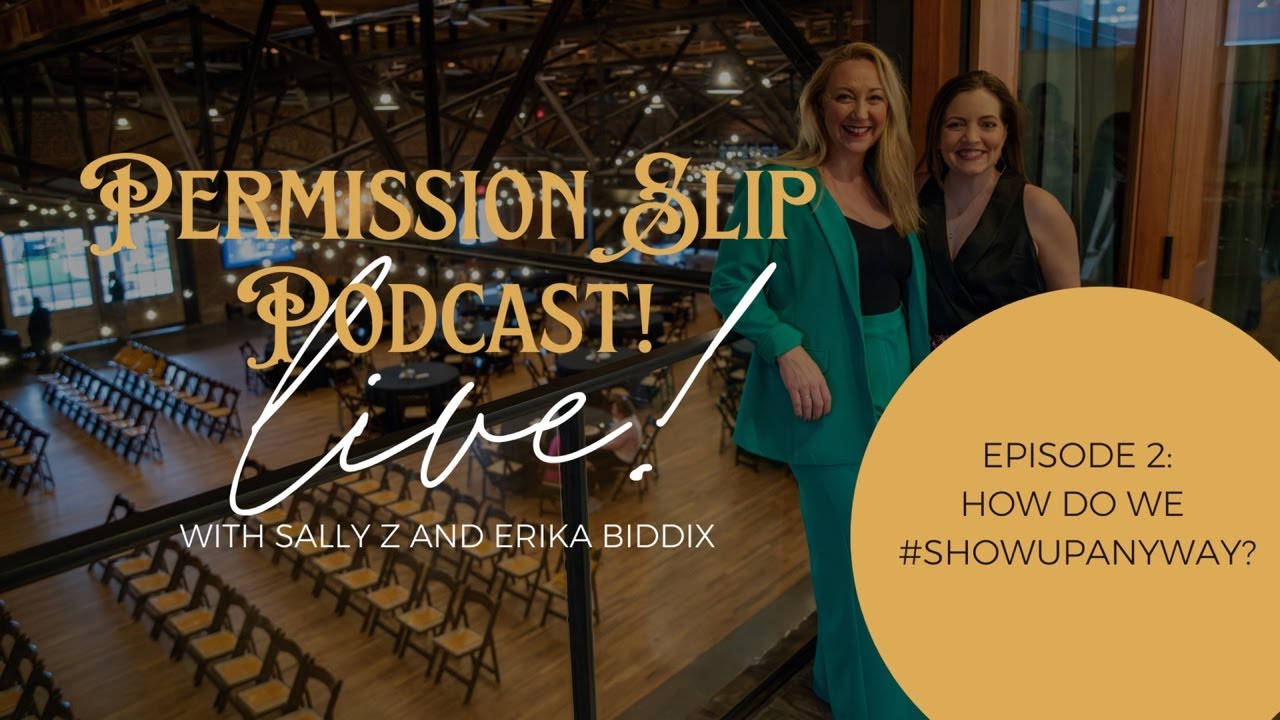
In this live‑streamed episode of the Permission Slip Podcast, hosts Sally Koering Zimney and Erica celebrate the launch of Sally’s new book while unpacking the central theme of “showing up anyway.” The conversation weaves personal anecdotes, entrepreneurial insights, and practical tools. They discuss how the pandemic reshaped social‑media presence, the importance of community, and the recurring obstacles of vulnerability, imposter syndrome, perfectionism, and gender‑based expectations that keep entrepreneurs from stepping into the spotlight. Sally shares her experience of writing permission slips for herself—ranging from a cold‑plunge ritual to delegating stressful tasks—to illustrate how small, intentional permissions can overcome resistance. Erica contributes her background in event planning, emphasizing that showing up despite unfinished to‑do lists is a habit. The hosts reference their recent Permission Slip Conference, announce a free “Show Up Anyway” challenge (available at bemoved.com/showupanyway), and invite listeners to share their own permission‑slip moments. Throughout, they stress that mistakes are gifts, that authenticity normalizes struggle, and that consistent showing up builds purpose and service for their audience.
Chapters
Hello, hello!
Oh my gosh, Erica, we're doing it! We are doing it!
We think, we think we're live.
Uh, you know, I just— here's the thing, right? Entrepreneurs, we are figuring out as we go. I love that you're drinking your coffee as we start this. Hello everybody, hello! We think we are live right now in YouTube, on YouTube, in YouTube. I don't know how we say that. We think we are live, um, in Facebook. We think we are live, um, Instagram. Well, I don't know, is it happening in Instagram? Instagram's tricky, it's tricky. I don't see it happening, and there's some learning. We're learning as we go. Last time we did it, I would say, Sally, we are showing up anyway. Oh, that was amazing. Yeah, LinkedIn. I think we're in LinkedIn. Hello, LinkedIn. Ah, this is exciting. It is, Sally.
What's today?
Today is February 13th.
And what is more on your calendar for today, Sally?
It is launch day for my baby book.
Oh, this is so exciting.
It really is. And we It's been a long time coming, Erica. It has been such a long time coming, but we're here.
We made it. Blood, sweat, and tears. For real.
Blood, sweat, and tears. And it's a whole lot of— you already brought it up, but what we wanted to talk about today is the art of showing up anyway. Because I like— it's so essential for us as entrepreneurs. It is essential that we don't let obstacles hold us back because a lot of them are self-imposed.
100%. I do. And I think we have a tendency, especially— I'm just going to blame the pandemic on this, but post-pandemic, we have a real tendency to go inward when things are hard. And what that looks like externally now is you don't show up on your social media, um, you don't talk to your community. When you go inward, it actually appears externally more often than it used to, right? Like, if you used to go quiet, it did— nobody really noticed that you went quiet. But now they're used to seeing you, they're used to interacting with you. So when you go quiet, it's noticeable.
Yeah, that you're there. Yeah, as a, as a speaker and a speaker coach, like, I remember thinking that the pandemic actually— and, and I think I'm going to use this term correctly— it like democratized speaking to some degree. I felt like it, because even the, the highest paid keynote speakers who, who were showing up in arenas typically, who spoke on the biggest of stages, their stage became the exact same stage that we were all using, which was virtual, like Zoom, you know, or all the different ways that we tried to creatively show up. It was like social media was your stage. And so that's when I started launching my programs for speakers, and the timing worked out well in that I said, even if you don't consider yourself a speaker, like, you're on stage. We are on stage all the time. We've got to show up anyway. And it, it is this recurring theme again and again and again. I don't care if you want to be a speaker or not, we have to, we have to show up anyway, because that's how we serve people. That's how the purpose comes to life.
Well, and that's where I think I have, I have benefited for I mean, my whole life from community, but I didn't recognize it until I opened an in-person place, right? Like an in-person coworking space. And then we couldn't be there. So how did I and how did my company show up anyway? Right. And that was, that was the turning point of recognizing that when it comes to community, showing up anyway is, is the important part, right? If it's hard to show up, if you're embarrassed to show up, um, if you feel like you're not, you know, in a way looking wise that you want to show up, um, it just came down to the important part was showing up and being in community because that's what was gonna help all the things, right?
Yeah, yeah, that sense of service drives you. I know in particular, Erica, like, that is A, it's something that you're really good at. It's something that comes naturally to you. You're an Enneagram 2. We're going to just throw in a little Enneagram in there, but you serve people. And so it was like, when you see a need, this is the aggressively helpful part. Am I right?
It is. Yeah.
True story. Yep. Aggressively helpful Erica is like, there are people are in need. I can help, and you get in there and you do, and it's a gift. It's a gift. But that sort of drove you through, that allowed you to show up anyway, to like get through what I sometimes call delays.
Yeah, yeah, yeah, absolutely. So I— what, um, let's talk about— let's, let's link this to your book because that's what I'm doing today.
Today is all about— I know you keep coming back to the books.
I don't care what the topic is, we are circling back. Is your— what was one of the biggest show up anyway moments for you when it came to getting this book into the world? Which I know some days felt like it was just never going to happen.
Yeah, I mean, it's— I was telling somebody yesterday who wants to write a book, um, and she has her own business, and she was asking me about the process, and I said You know, writing the book felt really hard in the moment, but looking back now, I'm kind of like, that was the easy part. Yeah, the hard part is now. The hard part is this— to show up anyway in a launch when you don't know what's going to happen, when you don't know how people are going to respond. The, like, level of vulnerability I feel when I see people walking around with this book, and I'm like I mean, that hasn't happened a ton yet because today's launch day, but there's some advanced copies out there in the world.
People were walking around with the book at the conference.
Yeah, which, which was wild. It was wild. And it, it brings up all of the internal resistance and fears and insecurities. And I mean, I feel like entrepreneurship was sort of created to pull out all of our personal challenges, and we have to tackle them in order to do what we're supposed to do in the world. Like, I, I— and same with speaking. I'm like, oh, nothing's gonna make you feel more like a 7th grader again than speaking and wonder, like, what do I do with my body? Why do I have these hands? Like, you just— it brings it all up. And the same thing every time you do something big and you put it out into the world. It's like, will they like me? What if they don't like it? What if I'm stupid? What if I— turns out I don't know what I'm talking about.
Like, I always say it's akin to standing naked in Times Square. Like, that's the visual that I get to do things that feel super— like, one of those obstacles is vulnerability, right? Like, are you open to letting yourself be vulnerable? And I, yeah. The only other thing I can think of that would make me more vulnerable would be getting on a karaoke stage, and I just don't, I just don't do that. Like, it's a level of vulnerability I'm not there for. I would rather stand naked in Times Square.
That surprises me, Erica. I feel like I've heard you sing. You, I, you're, you're a good singer. You don't think you are, but you are. And I love to karaoke, and I think we need to do that at some point.
Vulnerability is one of the obstacles to showing up anyway. What's another one?
Absolutely. I mean, imposter syndrome.
Yes.
This routine.
Here's to her.
No, no, screw her. Imposter syndrome, we don't need you here. I know you're trying to protect us from risk and failure and vulnerability. I think it all comes down to vulnerability, actually. But the imposter syndrome voice is going to creep up when you're about to do something that you haven't done before that is stretching you. And her voice can be really loud. Uh, and, you know, I, I think we all can think of examples, and unfortunately, I feel like there's a gender gap here. Yeah, absolutely right. The— when we've heard the stats, you probably know them. What are some of the stats around—
let me grab my soapbox one moment.
Yes, get it, Erica!
Again, because when we talk, when we look at it from through a gender lens, um, women have been historically taught I would argue up until probably a generation or two really that we're not meant to take up space. And so, taking up space is the complete antithesis to imposter syndrome, right? So, it's not just that we're even questioning our abilities, our capabilities, but we're also questioning our worthiness to take up space. So it's just like, here's a megaphone, imposter syndrome. Here's a megaphone, imposter syndrome. Here's another megaphone, right? Um, and so to tell imposter syndrome to shut up is a thing. Like, that's a, that's a show up anyway. And then to not only say that, but then to actually go and do the thing too, that's like, you know, that's big.
Yeah, it is big. It, it is big. And there's you know, there's been a conversation lately within my speaking group about faking it till you make it and how, you know, the ultimate goal is basically the same. Like, basically they're like, you're fine, go do it anyway, go do it anyway, show up anyway, kind of impetus there, which I think is valuable. And thing is you're not faking it. Yeah, you're not faking it.
Yeah, you're drawing upon what, what you— yeah, you already— what you know. Now you may be, um, growing as you're making it. You may be learning as you're making it. But there's a big— there is, there's a big difference between faking it and using the skills and the abilities and the worthiness that is inherent to you. I think that's— I hadn't thought about that. Yeah, maybe we should just retire that phrase.
Yeah, I think we should retire it. One of my speakers says, believe it as you brave it. And I was like, oh, that's, that's good. That's really, really good.
Really good. That— well, and I mean, Judy Heller, one of the things she always says that, um, resonates with me, and I think about This phrase probably comes to my mind 2 or 3 times a week is, "No mistakes, only gifts," right? Like, so that goes back to— let me say that again and then pause for a moment. No mistakes, only gifts. So that goes back to learning as you're going, right? Like, sure, you may not get it 100% correct every time, but how boring of a person would you be if you did anyway? Because you wouldn't If you just thought you were perfect all of a sudden, then— actually, I'm going to throw my kid under the bus here. So I have a tennis player, and he's not like this anymore, but when he was younger, he loves the game of tennis. Like, he would sleep with a racket in his hand if we let him. But going to practice, he was like, why am I practicing? I already am doing— I'm already doing the thing, right? And to get him at 10 years old to understand the idea that just because you're good at this thing, you can't be— like, that there is the opportunity to be better, right? He's definitely outgrown that. So props to him. But that was a big lesson in our house.
Huge, right? Huge lessons. And I think one of the challenges, at least for me, has been is I feel like other people have applied, like, I don't want to let anybody down. Like, they admire me now, but if they see what's really going on, if they see, like, whatever I've been showing— oh, my dog might bark. Hopefully she won't, but the doorbell just rang. Thumbs up. Somebody just gave us a thumbs up. You get it. You get it. So, you know, hey, okay, there she goes.
Hey, Bailey. Yes, it is launch day, Bailey. Big news.
Everybody's a little bit like this today. It's fine.
We can hardly hear you.
Right. But we have this fallacy in our heads that that people don't already see our flaws. Like, um, somebody said to me, it comes up with my speakers so much, they'll say, I didn't realize— they'll listen to themselves or watch themselves and be like, oh my gosh, my arms, or oh my gosh, my voice. Like, how do you listen to my voice? I'm like, we, we have been listening to your voice for a long time. We're already— we've already accepted it. We've already accepted that is who you are and how you look and how you sound.
It's—
you're, you're the one who hasn't accepted it yet.
Yeah.
Oh yeah, that's the journey. That's the showing up part. And, uh, the more you do it, the easier it gets.
And I also find the more honest you are about it, the easier it gets.
Um, say more, say more.
I think, um, so I mean, my whole— I hope my family doesn't watch this today because I'm just gonna throw them— we're just gonna go get real deep. Um, I hear more times, more times than I can count, um, although it has stopped recently and I'll tell you why, like, I just wish we had it as together as you and your, you and your husband do. Like, how do you guys do all the, all the things? And I push back on that every time and I say, I hope that is not what I am projecting to you. I, because it's important to me to be transparent about Yeah, you know, the— I'm just gonna use the word difficulties. That may not be kind, but the difficulties of running a household, running a business, having two working parents, having three kids that need to be different places all the time. Um, so I appreciate it and I accept the, you know, the love that's coming at me with it. But I also always push back and say, if I'm not being transparent enough about the difficulties or the obstacles of this, like, I need you to call me on that because it's important to me to put into the, into the world, um, that not everything is perfect. And same as entrepreneurs, man, Sally, nothing really gets my hackles up much more than entrepreneurs who are like, I just wake up in the morning and it's great, and the bluebirds deliver me breakfast, and then a million dollars shows up in my account, and, um, wow, and I launched and it went beautifully, and, uh, And I journal every day. Yeah. Now listen, can you make a million dollars a day? Yes. Do you just wake up and that happens? No. Like, there is a lot of work, there's a lot of learning, there's— so I think that's important that we normalize and we talk out loud, um, about the reality of all the things that we're doing. And in this space, how we're talking here about entrepreneurship so that you're normalizing. Yeah, people are not coming into it with, you know, rose-colored glasses and no understanding of some of what it takes to do the thing. Absolutely. My stack of silverware.
I think that's super, super important because it just, it, it, like you said, it normalizes the challenge that that is just part of it. And it— I hope that it helps people show up anyway. I hope it helps people do it regardless of the stories that we are telling ourselves, the imposter syndrome, the judgment, the perfectionism, the fear, the fear of vulnerability, like all of that that keeps us from really doing what we're supposed to be doing, from serving our people, from really living out our purpose, and just saying it's hard. And that is part of it because that is the thing that changes us to become the people who have a million dollars just swoop in the bank. Like, it doesn't just happen.
I haven't seen that yet.
But with the struggle. Yes, I hear that's what I hear. That's what I understand.
That's okay, though. Another thing that has helped me with that mindset of kind of show up anyway. So I've got decades of meeting planning experience and it doesn't— and I said this to you the night before our conference— it doesn't matter how long the to-do list is, what didn't get done, what you don't yet feel comfortable with, what package did not show up. Like if your event starts Tuesday morning, you're not in charge of that. Like the sun is going to set and the sun is going to rise and it is going to be Tuesday and that event is happening. Regardless of all those other things from the day before, right? So your option is just to not have the event. That's like not really enough, you know, just not show up, right? Or show up anyway despite what is still on the to-do list, despite what package hasn't shown up, etc. So my, uh, professional background has given me a lot of practice in showing up anyway. And I think about that sometimes when I'm, when I'm talking myself into, into overcoming.
Yeah, right, right. That showing up and doing it regardless, like that if mistakes are really gifts and we become by doing, then we— that event, it's, it's literally our only job is to show up and be present and ride the ride. And let what happens happen, which is so scary. It's so scary, but it's also maybe thrilling.
Depends on your level of adrenaline.
Yeah, I like to get to the thrilling place where you're like, this is exciting. I do too. It's scary.
Basically involve my body, like, at a super high place in the air or a lot of speed. So I like adrenaline. Okay, entrepreneurship adrenaline, here for it. Roller coaster, perfect.
Yeah. Okay, so, um, Erica has underlined something I think is really important as people join us and, and start learning about what this conversational podcast is about, that this is, this is the place for two entrepreneurs, two great friends are showing up and just talking about the journey, where, what's going on with us, what's hard, what's working, what isn't working. What we're going to be bringing on lots of guests with us, especially over the next few weeks and months. And this was really all inspired by our conference, the Permission Slip Conference that we did in December. We have some fun announcements about all of that coming up, but we're not going to say anything yet. Not today. Nope. Zip it up, zip it up. But we are just really grateful for the community that came out of that and wanted to keep those— that level of vulnerable, real, honest conversations going. Because it connects us with each other and we don't feel so alone on the journey, and that is so essential.
Yes. Um, so Sally, you get to answer the last question today. Yes, mistakes are gifts. Yes, yes. It just says Facebook user again. We're learning how to—
I know, I know.
Thank you, Facebook user.
Thank you, Facebook user. We're so glad you're here.
Because it's launch day, Sally gets the last question today. Sally, what is the last permission slip you wrote yourself and/or what is the next one ahead of you?
Okay. Okay. So this is a little bit of a silly one, but I think there's maybe something real underneath it. The very last permission slip I just gave myself was this morning when I got up and I was like, I'm going to start my day with a cold plunge. Oh yeah, let's go. Let's do it. And then I got up outside and I was like, it's really cold. I'm gonna first get in the hot tub. That was the permission that I gave myself. Like, I'm gonna sit in the— chill in the hot tub for 10 minutes before I go cold plunge. So that was my most recent permission slip that I wrote. Yours is—
no, I'm going to show you what the underline there is, right? So you talk openly about cold plunging. You talk about it from stage, you talk about it on social media, etc.
Yeah.
In that moment, you could have forced yourself to do it because of the expectations of others, or you could honor what you needed in that moment. That's your permission slip, was honoring what you needed versus what external expectations that you think are there. Because there— nobody's— I don't know of anyone who's keeping track of what days you're cold plunging other than you, but yeah.
Yeah, I, I am grateful for that reframe, Erica. I am, because it did— it actually felt like a win. And every time I do something that, uh, is for me, I actually am like, you know what, Sally, I'm proud of— I'm proud of you. Because for a really long time— and I know you get this, Erica— we are focused on the needs of the people around us. And I thought, okay, I just need this space of comfort and cozy and snuggly before I go do the really hard thing. Uh, and sometimes that's just what we need. Other days it's like, just go do it. You know, it's usually a time restraint actually that says like, you don't have time to hot tub, just get in the cold plunge and do it. But Oh, our Facebook user is Maria Shea.
Hi, Maria!
Oh my gosh, so great to see you.
Um, well, I, I, we think that this will be available for you to watch at other times. So if you are watching this not live, um, or if you're watching it right now, drop in the comments, um, what your most recent permission slip moment was.
We love to hear them. We love to hear them. Um, and what's next, Erica, for you? What is a permission slip that you need to or are going to give yourself coming up?
That's a big— that's a real big question right now. I'm sitting in that question without an answer.
Great. Sometimes the questions, the questions themselves are the important thing. Yeah, love it.
No, I mean, I had one this morning which I think actually probably— so I'm gonna go for it. I was supposed to be at a networking thing this morning, um, but we had this happening and we had I've got another online thing happening later today, um, and I had to decide if it was more— I had to decide who was gonna be the more important part this morning, right? My business and getting to the networking piece, or, um, my person, my me, um, and my stress level. So, um, I emailed, I emailed my ops manager and said it's gonna be a hell of a lot less stress on me if I don't try to make this happen this morning. Um, so that's a permission slip that like I'm photocopying, right? Like permission to like take the personal stress off of me. Um, yeah, so I think that's, that's probably it.
Yeah, that is big, friend. Um, proud of you always for doing that. Good for you. And you, you are— you do so well leaning in to your people, and, and I know that that was not an easy journey to get to, to be like, here, Instead of me helping you, can you help me?
Oh, that's a whole— that's— that could be next week's podcast.
Oh, we should talk about that, how to actually get help, how to actually— all right. The other thing we would love to hear in the comments or DM us, reach out to us, is what are the topics that you would love to hear about? What are the things that you're struggling with or would just love a conversation about? Uh, we would love to hear that and start to expect to see lots of guests coming in. We're going to share some of our speakers from this past year. Uh, we're going to bring them back and have some deep conversations about this world of entrepreneurship and how we can do it well and fully and really leaning into what's really possible.
Yeah, so I just love you. I wish I was there in person to give you a hug.
Thank you. Thank you for being here. Thank you for all your love and support. And, uh, team, if you— I, I do have— we've been talking about showing, showing up anyway. I have a Show Up Anyway free challenge. We talked about it at the Permission Slip Conference a little bit, but if you are listening in and weren't there and you're curious about it, we use social media as the tool to help us get through what's holding us back, right? Because ultimately the fear is often really to be seen and the vulnerability and potential rejection of that. And so we work through a lot of those challenges in the Show Up Anyway Challenge. And I will tell you, I keep getting messages from people who are doing it and they're like, oh my gosh, Sally Koering Zimney, that was, that was really hard and it was good and thank you. Because the consistency of that gets you through the hurdles that might be holding you back from really showing up for your audience and for your people so you can serve them well. So if you want to join in on that, you can grab it at bemoved.com/showupanyway. I should probably have some little text thing, but I don't.
We're figuring it out. All right, cheers, y'all. Go make it a great day. Woo!
And go get my book.
Oh, go buy a book. Okay, go buy a book. Okay, bye!
This is really fun. See you all soon.
More from Sally







Speaking My Story: The Talk That Changed Everything (Sally Z's Epilogue) | Speaking Story


The Walk-'n'-Talk and the Stumble-Through: Two Rehearsal Methods That Actually Work | Ch. 39