Permission To... Accept Yourself (with Brandi Calhoun)
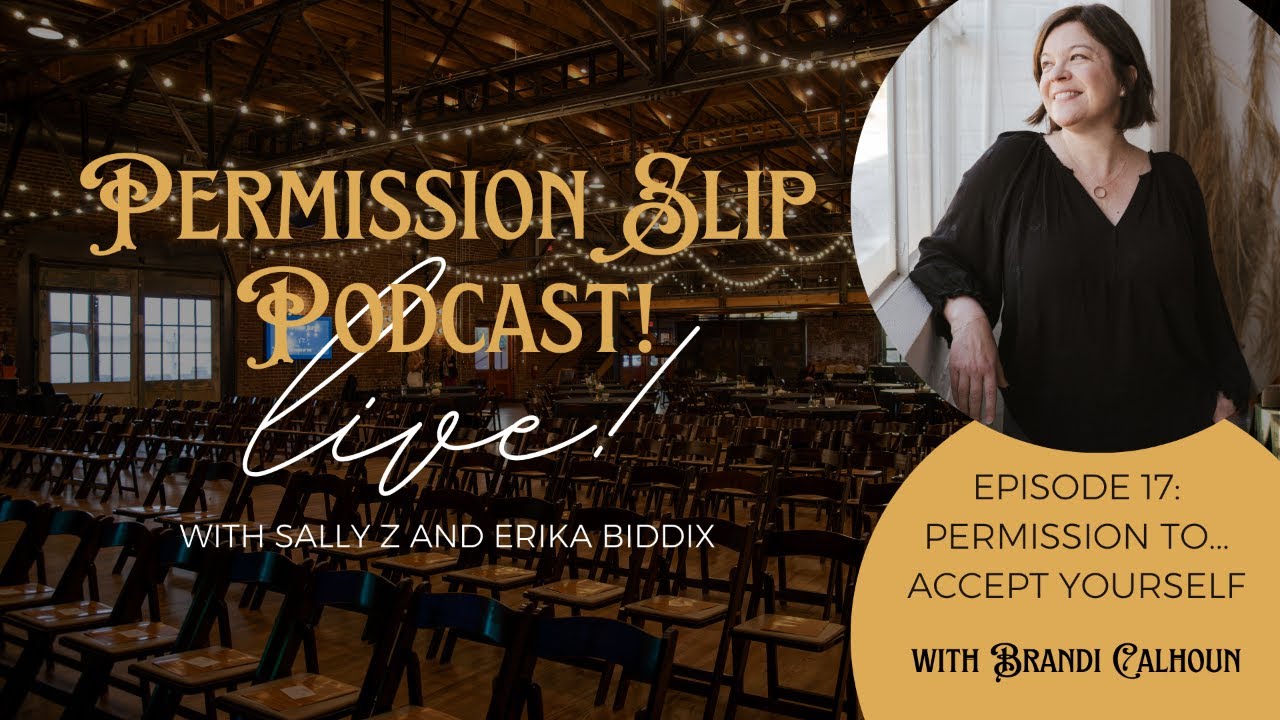
In this conversational interview, host Sally Koering Zimney, co‑host Erica, and guest Brandi Calhoun Diamond explore what it means to give oneself "permission" to be authentic, spiritual, and self‑loving outside of traditional church structures. Brandi introduces herself as a solopreneur minister, founder of Sanctuary Groups, and a doctoral student, sharing her personal journey from full‑time church staff to creating safe, non‑denominational spiritual spaces. The dialogue reflects on the Permission Slip Conference, where Brandi first felt a need for a personal permission slip to overcome imposter syndrome and to find community. They discuss the decline of church attendance, the rise of alternative spiritual sanctuaries, and the importance of belonging. A central theme is the distinction between self‑care (activities) and self‑love (inner affirmation), especially for women. Brandi outlines three concrete "permission slips" she is committing to for the coming year: treating rest as essential, learning to ask for help despite her Enneagram 2 tendency, and "caring without carrying"—offering support without taking on others' burdens. The conversation also introduces a three‑legged stool model (spiritual, social, centered) for healthy giving, and practical exercises like writing positive self‑statements on post‑its. The interview ends with gratitude, a brief dance‑party cue, and an invitation for listeners to consider alternative spiritual communities that welcome those with or without church backgrounds.
Chapters
They say fortune favors the bold. So what are you waiting for? The right time? The right sign? The right guide? The thing is, Movement Maker, you were never meant to follow anyone else. You were destined for something bolder and braver and truer, and you know it. It's time for you to write your own damn permission slip. You have permission to dream big. Not that you need it from us. Fortune favors the bold. So what are you waiting for?
Hello, hello, hello!
Hey, welcome, Brandy! I've got so excited, my chair just like flew out from behind me, so let me grab it.
Thank you, that may be necessary. Thank you, thank you, I love it. It's a great start, Sally.
Oh my gosh, we're so happy to have you here, Brandy Calhoun Diamond.
Thank you. I'm so happy to be here. I've been really looking forward to this. So thank you for having me.
Of course, we are delighted. Yep. Erica, Erica and I. Yeah. Both Erica and I are in a slightly different studio situation today just because that's how things go. So we were spending a few minutes like figuring it out. I'm up at my family's cabin for my dad's 80th. Erica was having— well, Mercury's in retrograde. I don't know if you believe in that stuff.
I actually yesterday said it out loud that like, this has to be happening, and then I saw that it was, and so I felt validated.
My mom likes to say it's in Gatorade.
Well, this one says in the refrigerator.
So Mercury's in the refrigerator again, people. Get ready, get ready to go.
Brandy, before we jump in, can you tell people about yourself? We would love to get you introduced.
Yes, I'd love to. So my name is Brandy Calhoun Diamond, and I've been running a ministry under my own name, Brandy Calhoun Diamond, for the last few years. And I just officially am changing it over early part of this year, but I'm in a slow rollout. I'm a solopreneur minister, and I am the founder of Sanctuary Groups. And so I'm very excited that this is something that was about me and now is bigger than me, which was always the goal. So that's exciting. I live in Atlanta and I'm married to my husband John, and we have two young adult kids who I'm just crazy about. One is my son Taylor. He lives up in New York, and one is my daughter Bailey, who is now in Atlanta for at least a short time, but she just graduated from University of Colorado Boulder. And so we've had had some great last few years getting to go to New York and to Boulder and, um, get to visit with our kids.
So no, send the kids to college places I want to visit.
So smart.
My first takeaway for today.
And it's a good double vibe, right? Like, you go to NYU, totally different feeling than Colorado Boulder.
So yeah, right?
Oh my gosh. So fun. So we first met you, Brandy, at the Permission Slip Conference, right? Uh, which unbelievably I feel like is coming up, or at least maybe just Erica and I are so like thick in it right now. Every day we're texting about it, all the exciting things. So I would love to know, um, like you being there is one thing, but it kicked off into— we've had several connections from then. So just tell us about what that experience was like for you, and then how that has led to some other pieces.
I would love to. So I came to Permission to Slip, I actually heard about it when I was out in Boulder, from Kate Harris. I had done some coaching with Kate and her husband Harris III last spring. And so heard about it from Kate and was so excited she was speaking. And I'm so grateful that I took a chance on that and signed up. And I got the early bird special for this year. So I'm already have my place booked and I'm very ready to—
I'm on the wall!
I'm so excited. Yes. So yeah, it was a great experience. I didn't know anyone else when I was there, but I definitely felt like I needed a permission slip for myself. And the minute that we started the morning, I got to know some other people and it felt like it was meant to be. So I'm really looking forward to coming back next year. I've definitely been telling other friends about it, so hope to have some friends join me as well. It's a great experience. Thank you.
We would love that too, of course, uh, because I think the community piece is so important. So it, it— I know for Erica, community is a pillar around which she builds everything.
Yes.
And so I don't think it's a mistake that you felt that.
Yeah.
And Erica's— that's her magic. I mean, computing is really important to me too, but it's got it Erica, I feel like that's your special magic.
Okay, it's so wonderful and so important. That's so much of what I do as well, and I was really looking for that for myself because being a solopreneur in business, I am very collaborative. I love to be around other people, and I, I enjoy so much what I'm doing right now. I am in love with the life that I'm leading at this moment, but I do get lonely sometimes. And so having other people in that larger community that I know are entrepreneurs themselves, are doing things in other industries that I can talk to. It doesn't have to be in my same field. Really, really important. So I have enjoyed that. It was definitely a draw. So thank you, Erica. I would also say I often quote you because I am also aggressively helpful. Oh, I love that. Yes.
You know, your Instagram will now pop you up about 18 ads.
Yes.
Well done.
So the title of this is Permission to Accept Yourself. So give us an idea of— obviously we met through the conference, so I would love to hear how that plays a part in it. But what did you come into it with and what did you leave with? How did that permission to accept yourself— what has that timeline looked like?
Sure, so I went to Barry College and it— a lot of people don't know where Barry is, but it is in Rome, Georgia, and it's actually a little bit of trivia. It is the largest college campus in the world, has about 27,000 acres. So I loved my time at Barry. I was a communication major with a religion minor. And so a few years later I went on to seminary and did my Master of Divinity there in seminary at the McAfee School at Mercer in Atlanta. And now I'm actually pursuing my doctorate with Fuller Seminary in Pasadena, California. So in the midst of all that, I used to be on a full-time church staff and coming out of COVID there were a variety of reasons, but one, not the whole reason, but one reason being COVID, I knew I needed to make a change. And so I left full-time ministry in June of '21 and wanted to do something different.. And one of the things that was really important to me is finding a space that was safe for people to have a spiritual connection, and that was doing things a little bit differently. Um, we have blamed COVID for a lot of things, but it's my belief that COVID didn't cause these things so much as it brought them up to the surface.
Yeah.
And so with starting something new, and as I mentioned, it used to be just my name, and right now that's still my website. I'm slowly moving over to the other one, I needed to start something that just sort of protected myself at that time. And so I wanted a place that I could be able to put some things together and find a way that other people could join me, and really just an opportunity to connect to spirituality in places that felt safe, where you could ask questions, where you could struggle, where you could deconstruct, where you could say, I don't believe this. And I have found that there aren't a lot of safe places to do that. So coming to Permission Slip last year, for me personally, again, I have been looking for a long time to see, hey, what is it exactly that I do, and where is it going next, and where are those next steps? And in the middle of that, typing a lot, because between my own you know, continued seminary training and working on this last year of my doctorate, as well as leading anywhere from about 8 to 12 small groups at a time that I write curriculum for. I needed a really good outlet, and I needed the permission slip to kind of stop having imposter syndrome. Yeah, it's an easy thing for a lot of people to do when they're in business by themselves, and especially doing something like ministry, because that's different.
Right?
Yeah, like if you want to have a spiritual experience, you, you're supposed to go to your church or your temple, your synagogue. And, um, doing stuff outside of the church feels really important and different and necessary, and I needed a permission slip for that. Last year gave me a lot of confidence and excitement and connections to continue creating that space, not just for myself, but for other people as well.
Beautiful. Okay, so it sounds like what you're saying, and this makes a lot of sense to me, is that in your searching for something deeper and realer, right, we come up against these beliefs or a lot of shoulds. Like, well, if I'm going to do that, it should be this way. I should have this identity. I should have this pedigree. I should look like this, talk like this. Which I feel deeply, especially in the work that I do as well, and I know Erica does too. So it sounds like what helped you is to find places outside of the typical community and connections that you've built, to just step outside that a little bit and recognize that there are a lot of people doing other kinds of work that you connected with and resonated with. Is that Does that resonate with you?
Absolutely. And I'm seeing more and more trends toward that. As I look into research about where the church is moving, there's, there's obviously been a steep decline in church attendance in the last many years. Since 1990, it has really gone down, and it just in the last few years even more. I was just doing some research on this this week. And I think people have a lot of reasons why, particularly in the last couple of years, politically and otherwise. People have felt very disenfranchised. And sometimes it's just a, a bad staffing situation or church politics internally. And so there was a day that I literally sat down and had a big moment of grief because I realized that what I had always hoped for, those spiritual places in my own life, and what I thought that they could be and what they could look like, and, and buying into the hype of that let me say it that way, is a— actually what it was. And so having to sort of realign what spirituality looks like and what it can be, and that it doesn't have to happen within four walls with a steeple, really moved me toward a feeling of working in my community, working with my neighbors, talking about real issues, working alongside people. Makes a huge difference for me.
Yeah, I think, Brandy, I resonate with this so deeply. Um, and this happens— so we actually had an opportunity to do an interview with Brandy, um, for, for her, um, doctorate work. And it's so funny because we came in to have one conversation and then we just like got so deep on everything else. Um, and I'm getting ready to do that here too. Um, I just I think your point about COVID is I accept and validate that. I agree with you 100%. The way I have seen it is that we have historically for several generations now, we have done things within a set of boundaries and a construct that we assumed could not be changed. Right. And then all of a sudden something happened in which the Olympics got canceled and we couldn't go to college football games and things that we just thought would never change suddenly changed. So it sounds to me like you are in that group of people who recognized suddenly, kind of overnight for a lot of us, that things didn't have to be the way they always have, have been, right?
Exactly right. Exactly right. And it's interesting that you say that because at first, and another reason that this was just my name, right, was because I was having trouble explaining, like, what is it I do, you know, really wrapping my head around that. And I've done a lot of work in that area, but one of the common questions that people asked me was, are you a church? And I'm like, no, I'm not a church. I'm not trying to be a church. I don't want to be a church. So just recently, and involving in changing my name of my business, is this. I looked up, like, much to your point, Erica, I looked up what are things that we call spiritual places. And I recognize that, like, if you want to eat food, you go to a restaurant, right? Like, that's where you go. You go to your kitchen. We have limited words, right in line with what you said. When we talk about spirituality, we, we are so limited to a place that you go instead of a way that you live.. And so as I looked through those words, I started to realize, like, I'm not a church, but I hope is that we are providing sanctuary for people. Yeah, a refuge, that it is a place away. And you know, when you think about sanctuary, you may think about a building and a steeple, and you know, here's all the people and that kind of thing. But we also think about an animal sanctuary, or a retreat sanctuary. It's a place that you get away to, and safety is crucial for me in my groups. That is a crucial piece. You can bring your church trauma, you can bring your spiritual questions, whatever you want, but it's creating that life of a space that is new, and we didn't know it could be done a different way. So you're exactly right.
Yeah, I think just the point about what words you're using, right? So You say imposter syndrome, which— I mean, how many times have we used that word? It's like, don't make a drinking game out of it, right? Really, the conversation that's starting to happen now is I see women saying, I'm not an imposter. This feeling that I am feeling is trauma from XYZ, or this is a feeling of fear that I'm having. So the word everyone understands is imposter syndrome. But I'm starting to see use of, let's talk about our feelings, as opposed to just giving it that, that one blanket word too.
Yes.
So Brandy, connect the dots for us. We're talking about some really important things about finding belonging and our own growth and identity and evolution of letting go of the old constructs and, and recognizing we can live life in all kinds of different ways and, and find meaning there. So we named this title Permission to Really Accept and Love Yourself.
Yes.
So help us like connect those dots for us, because of course they're connected, but help us understand that from your perspective.
So one of the things that's become really important to me that I try to teach my groups about, particularly a group that I have upcoming that my doctoral project will be about, and I have taught it before called SALT is one of the first things we do is to ask, you know, what do you want?
What do you want?
And a lot of us just really have trouble even answering that. And so in my own life of like creating a mantra, like a guiding principle, a verse, a poem, whatever it is that you kind of can come back to and guide from, is people used to ask me, particularly when I was working full-time in church ministry, is, how I felt about various controversial issues. And there's so many of them within the church, unfortunately. For me, what I kept coming back to was people would, you know, Pharisee— the Pharisees asked Jesus at one point, like, what is the greatest commandment? And it was really a trick, right? Like, it was set up to be a trick. Like, I'm trying to catch him on something. And Jesus's response was to love God, love other people, and to love yourself. As you love yourself. And so for me, that's like my own personal theological sieve, okay? Is it is estimated that there are about 613 commandments in the Bible. Most of them we don't pay a lot of attention to. People like to pick and choose the things that they talk about. But what it ultimately comes down to is the most important thing is, does this show love to a world bigger than me? Does it show love to other people?? Does it show love to myself? Does it offer dignity? And that answers a lot of questions for me. And so the more I really started to unpack that, what my groups are really focused on is a different way of saying that, which for me is spiritual, social, and centered. We have a connection with spirituality, whatever that looks like for you. Again, it goes back to the shoulds. I'm trying to help people understand that For example, you're supposed to get 10,000 steps a day, right? Okay, well, for you, that might be right. So for Sally Koering Zimney, 10,000 steps may be great. For Erica, she may have just recovered from an injury, and getting 1,000 steps a day is going to be great for her. Or maybe she just hiked Kilimanjaro, and she really needs to get a lot more than that, right? And so what we should be doing is different than being honest with ourselves about what is right for us. And so being spiritual, being connected socially— because we live in an environment right now that it's hard to just have open conversations with people sometimes, we need to get back to that— and being centered. Because the missing part of this three-legged stool is there is already an assumption that you love yourself. And what I have really hit, especially with women in the last few months, is this difference between self-care and self-love. Yeah, we talk about self-care a lot, and normally people talk about that and they're like, oh, I like— I love to get a good bath with Epsom salt, like that is totally a self-care thing for me. But my friend Trisha said at one point, she was like, oh great, now I've got to do something that's like more expensive that I don't have time for, you know, like we've got to go get a massage or something else. And she had such a great point, and I've come back to it so many times, because you can get your nails done, you can have a massage, you can do that all you want, and it doesn't mean that you love yourself. And that's where a lot of women in my work need permission, is to reevaluate that self-care and really liking themselves and not putting themselves last all the time.
Yeah, when I— and this feels like such an essential conversation for women in particular, because it's a lifelong challenge. And I remember when I used to speak to teenagers, we would— we had a whole day about respect, and the first half of the day was about respecting yourself. And we used to say to them, like, can you look in the mirror and say, I like you? I actually— I really like what I see. And of course love what you see. But so often we are, we are brutal. We are harder on ourselves than we are on anybody else.
Yes.
And, and unfortunately, it's really hard to get that voice out of our head as we move on and grow up. And suddenly, just because we're a grown-up woman with a business and a successful— and we've got kids, we're like, yeah, now I like myself. Like, no, this is truly this ongoing— and especially as women. We were just having a conversation in a group in Marco Polo about how our bodies change. Yes, again and again and again. If you have children, your body changes radically in a short amount of time and then a little bit forever, you know. So it's like, how do we stay in a positive relationship, not just with the physical body, but really understanding and deeply loving ourselves. I feel like this is the key, because when you do that— and when I think about the people I work with and the audiences I speak to, it's like, if you have that at the center, actually there's so much that is possible.
So much.
You believe, you believe in yourself in a different way.
Um, Henry Nowen would say that that's The life of the beloved is unless you already understand that you are beloved and valued and treasured, you really can't do that for other people. You just can't, you simply can't do it. And so if we don't start from that oxygen mask on first kind of mentality, and, and I would even take those couple of things, spiritual, social centered, and purposely I don't include service in that because the people in my community are so overserved. And not drinking, although that may be an issue too. But it— they have volunteered for so many things, they are wrung out. And I think if you get those other 3 things right, in whatever way that looks for you, and you have that support around you, then you want to serve, you want to volunteer, you want to give, because it's not then coming from a place of obligation but of desire and of joy. And you're giving the full cup. You're not completely drained. But I think in order to do that, we have to start saying those words of love back to ourselves. And your mental conversation is so important there. I used to run, and I was never very good at it, and I realized one of the reasons I didn't like it is because the entire time I was running, I would talk to myself so mean. Like, why did I get up so early? I'm not even fast. All my friends are passing me. I don't know why I'm doing this. I'm like The chatter was terrible. And I finally realized I would never talk to anybody that I know this way. And so one thing I have also found helpful when I'm asking people like, hey, what do you really like about yourself? And they're struggling is we are also so focused on our looks. Like, you know, I have a big butt or, you know, my eyes are the wrong color, whatever we are worried about. If we can reset that and really ask ourselves some other questions, like maybe today is not the day. Maybe you stood in your closet and you went through 20 outfits and it's not your day to feel really good about the way your body looks. It is still a day that you can say, I'm so glad I play the guitar. I'm a really good friend. I really do like my eyes. I did great on that project I just worked on. It doesn't always have to be about our physical bodies. Yeah, our bodies believe what our mind is telling it.
Because, um, my, my group, we had an exercise the other day where I made us all pull out 8 Post-it notes and we had to write notes about ourselves that we liked. But I was like, I don't want any of this like wishy-washy whatever. I want like, this is— I want you to write like how you would write about your best friend or how you would write about daughter. And I'm keeping them here in front of myself because I know the things, like I know what you're saying, but sometimes we just don't take the time to do that, some, you know, so having these in front, forcing myself to do it while forcing others to do it.
Erica, what does it say? I want you to read it.
Oh, well, there's a lot of them. This says, I'm a support system for hundreds. Yes, I am phenomenal at helping other women. Okay, and this is the last one. I'm not gonna do the rest. No, I'll do one more. The communities I build are important and impactful. Yes, um, I'm the 5th funniest person I know.
I want to know the other 4 names.
My brother, um, and my son. So really, I may be 4th and not—
okay. Okay. That's a good one. That's great.
That's amazing. What a great exercise.
Yes.
Love it.
Good practice.
We all need that. We all need that. Just a reminder, because some days it's sort of like, yeah, some days, nope, I'm not putting that on, but, but I can redirect my focus on the things that actually are really important and that just are. It just is, you know. Beautiful. Okay, well, Brandy, we have just a few minutes left, so what is— time just flies. I cannot believe— I love these conversations. I love digging deep. Thank you for just opening up so beautifully with us and going there. Uh, what is your next big permission slip for yourself that you want to You want to write?
Yes. So I'm really glad that you gave me the opportunity to answer this question because it gave me a little time to think about this. And when I was at Promissions last year, you know, one of the things that I, I think I stood up and said is like, I'm going to finish my doctorate. And I've been really hard at work on that. But it's, it's a lot right now. And I do own my own business. And I'm, I'm, have a busy life. And so this next year is really important to me. And so I am going to focus on 3 things coming up. These are areas where I need permission and reminders. So the first one is to remember that rest is essential, not a reward.
Mm.
It is necessary. It's not a guilty pleasure. It's not even a pleasure necessarily. It is necessary. So that's, that's my first thing. I need to walk away and rest. My second is to ask for help when I need it, because I am a 2 on the Enneagram. And we don't like to ask for help. We never need help. And sometimes when we ask for help, people say no. And then we're like, back to square one. See, I knew it wouldn't work. And so I'm really practicing reaching out to people because I, of course, would help you if I could help you. I'm a 2. I'm a helper. I want to help other people. But I also need to practice asking for help myself. And the last part is, and this is, this is kind of my own little copyright phrase because I came up with this this year. It is an essential practice to me. I have to work on it every day, and that is to care without carrying. Need to care without carrying, right?
Right.
Like, I need a t-shirt because not— what doesn't belong to me is really important. And for me, I always feel like if I'm caring, you know, I've I gotta help and I gotta do all these things. But the truth is really most of us need listening ears more than anything. And that I can compassionately care about you without picking it up and making it all fixed and right for you. Walking along with you, loving you beside you, asking, especially as a 2, asking how I can be helpful to you instead of assuming. Like, hey, how can I be a friend to you right now? What do you need from me? In business situations, like this is a good example, but if someone's complaining to you about a situation, I really have to practice saying, after I'm listening, actively listening, saying, "Is that something that you need me to take action on, or do you just need me to listen to you?" Because both are valid, and sometimes people are asking for different things. So caring without carrying is Those are my 3 big permission slip items.
Yes, I love it. I wrote it down in Sharpie.
That was some like boom wisdom, wisdom from Brandy. That's why you're here, Brandy.
Oh my goodness, thank you for having me.
It's been—
and thank you for letting me interview you for my own doctoral work. It was really such a treasure of time. I enjoyed it, and this as well. Been really looking forward to it.
Oh my gosh, I'm so glad. And if you'd be willing, would you be willing to talk for a minute about what Permission Slip for you, you know, you mentioned some action that came out of that, but we'd just love to hear, and for other people who are thinking about coming, what you found so valuable about the experience last year.
Truly, I think the most number one thing for me was going back to that sense of community and connection. I, it's been interesting. I've been in a few places lately where I was at a conference, at a retreat setting, and I didn't know anyone else. And, and I'm extroverted, and that doesn't really bother me. Sometimes that helps me to have a little bit more time to myself. But being what Parker Palmer calls being alone together is really helpful. That's really helpful. Because I can come, you made me feel welcome, you made me feel like part of the group. I felt like I could speak up, I could ask questions. There were lots of fun people to get to know. But I didn't feel intimidated, like you do sometimes when you go and think, "Gosh, I don't know anybody here. And I don't really feel comfortable, and I think I'm going to take off earlier." I felt welcomed enough to feel confident and happy within that space to ask for and get what I needed while also hopefully offering some of that to other people as well. So that was a beautiful part of what you're doing. You're my people, I can just tell. This is my kind of response.
Well, we feel the same way, Brandy. Thanks for diving in with us and your warm, generous heart. And you know As someone who's not really a church person, I do connect with the idea of spirituality. I used to be a church person, so I'm such a good— I'm such a good person for you and I to connect with.
Yes.
And I just adore you. I adore what you're building, um, and think it's really important and meaningful. And I think you are really talented in the way in which you offer it up and the how I see you bringing spaces and creating spaces for people to gather and find a sense of belonging when maybe they aren't in other places. And that's beautiful.
Well, I'm so glad you said that. And may I respond very quickly to that?
Mm-hmm.
Because one thing I didn't share that is so important to the work that I do is, listen, if you've got a church home and you wanna come be part of one of our groups, either online or in person, that's great. Consider this a supplement. If you don't, for whatever reason, because you've never been part of a church— I didn't grow up in church, so I, I come from a very different mindset. If you had spiritual trauma, if you're just disenfranchised, if you're doing deconstruction, if you just want to be around some other people that can be trusted with your story, we got to agree. Like, pull up to our table. You do not have to have any kind of background in church, and in fact, I'm grateful if you don't, because it gives opportunity to do better than something you— when we're in church.
Yeah, beautiful, beautiful. I think there's some really important bridge building and healing that happens, so necessary around this, that, yeah, uh, I, I think is, is even more important than what we can get at in a live call, you know, like that's happening in the, the meaning and depth of the conversations that we've had over the last several months and that I know we'll continue to have.
Thank you so much. Thank you for having me. It was a joy.
Yay, awesome! Thank you, Brandy. All right, so we always, um, yeah, I mean, we've got to end with a dance party because that's It's kind of how it works here, uh, so FYI, we'll do a little quick dance party and then we'll say goodbye to everybody. Ready?
All right, thanks.
Have an awesome rest— that was very awkward. I'm really sorry. Okay, bye everybody.
Thank you so much.
Bye.
More from Sally







Speaking My Story: The Talk That Changed Everything (Sally Z's Epilogue) | Speaking Story


The Walk-'n'-Talk and the Stumble-Through: Two Rehearsal Methods That Actually Work | Ch. 39