Permission To... Get Over the Overwhelm with ClickUp
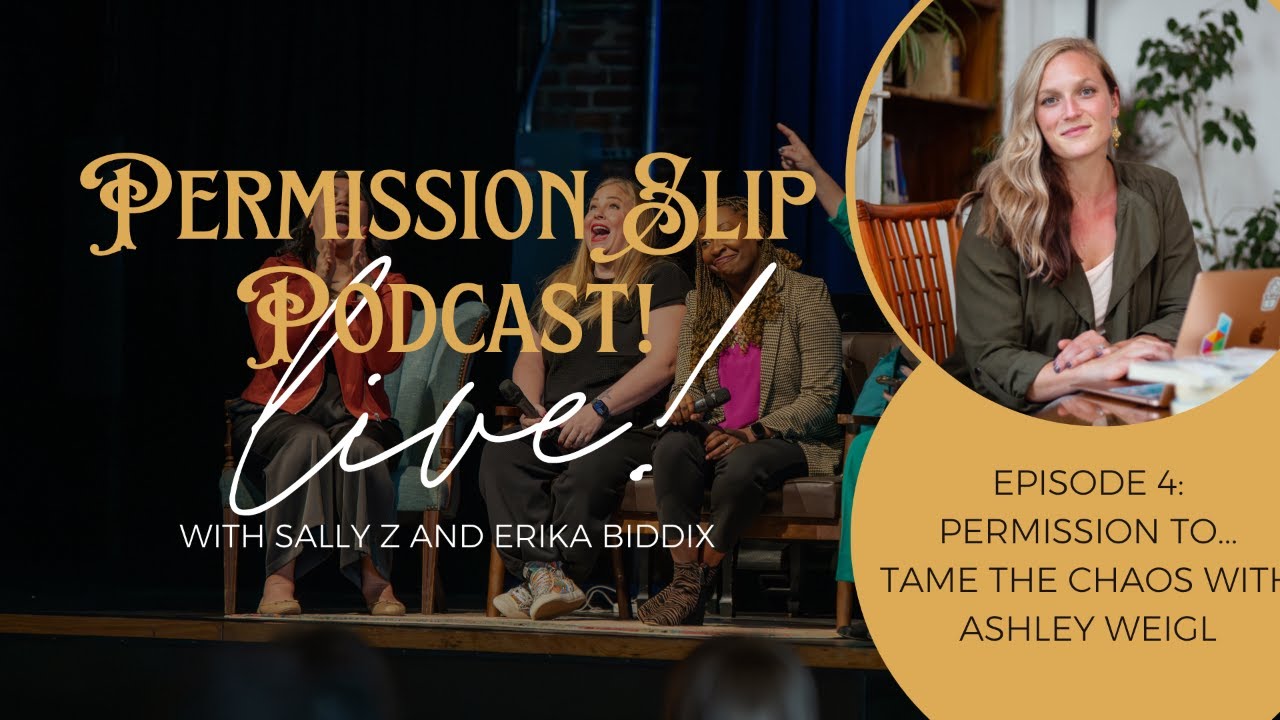
In this live episode of the Permission Slip Podcast, host Sally Koering Zimney welcomes Ashley Weigel, a Certified Online Business Manager and self‑described “chaos coordinator” based in Guatemala. The conversation explores why entrepreneurs often feel overwhelmed when their businesses grow beyond the one‑person show, and how adopting robust yet simple systems can alleviate that pressure. Ashley introduces ClickUp as her preferred project‑management platform, explaining its core purpose, flexibility, and why it stands out among tools like Trello, Asana, and Notion. She shares practical, bite‑size tactics for new users: start simple, grow into the platform, use the “Always Go Home” (A‑G‑H) home view for a daily bird’s‑eye overview, set start dates without due dates to keep tasks visible, and regularly review and re‑date overdue items. Sally and Ashley discuss the emotional side of overdue tasks and the importance of realistic due‑date setting. The episode concludes with Ashley promoting her suite of ClickUp services—including strategy sessions, full builds, coaching, VIP days, and upcoming service retreats in Guatemala—inviting listeners to join a waitlist for the November retreat. Throughout, the hosts emphasize the podcast’s core theme: giving yourself permission to take bold next steps in entrepreneurship.
Chapters
Oh, they say fortune favors the bold, so what are you waiting for? The right time, the right the right sign, the right guide. The thing is, movement maker, you were never meant to follow anyone else. You were destined for something bolder and braver and truer, and you know it. It's time for you to write your own damn permission slip. You have permission to dream big. Not that you need it from us. Fortune favors the bold. So what are you waiting for? We did it! We're here! Ashley, Ashley, welcome Ashley! Hello, hello! Well team, we sort of did it again. We're here at the Permission Slip Podcast. I see you, we are live currently in 4 different places on Facebook, which is pretty awesome. Uh, LinkedIn, YouTube, and not Instagram. Oh, I know, but we're trying, we're trying. I know, I know what I need to do now. I did it halfway right. So as my project manager, Ashley, she was like, just taking notes. Well, welcome, welcome to everyone.
Hello, hello.
This is the Permission Slip podcast, which is a live livestream experience that we do mostly once a week where we get to bring in experts and entrepreneurs much like all of you to talk about the journey and joys of the— this entrepreneurship life that we are living to help give ourselves more permission to do the next big thing. Like, as we are dreaming and living out this adventure of entrepreneurship, what is next? And so that's a really fun place to start and to ask all of you who are watching, whether you're watching live or watching on replay. Of course, the question is, what, what is something that you need to give yourself permission to do? And we are having a series of all kinds of conversations here on the podcast and in all of our communities, which is what, what do you need permission to do? And oh, Shelby's here! We always love to see Shelby. Hi Shelby! Shelby, way to support the live streaming efforts of everyone. P.S., we'll just take a minute and say Shelby has a LinkedIn Live course right now all about StreamYard. Which is what we are using right now. So, um, partly Shelby's probably taking notes for us as well. And feel free to send us notes, Shelby. Feel free, we would gladly take them. Um, and we're just so excited to have all of you here. And today our permission to focus is inspired by my project manager Ashley Weigel. So everyone say hello to Ashley Weigel. Round of applause. Ashley, say hello. Um, Ashley, hi.
Hi.
Where are you coming from? Where are you coming to us from today?
Guatemala.
Guatemala!
What?
That is so cool. I love it. This virtual world is pretty fantastic. And tell us about, like, what got you to Guatemala? Why Guatemala? And then we'll dig into your entrepreneurship story. I—
that part's a little, little longer to get into, but the, the short of it, the short version is, um, while all of our friends were settling down and doing the, the white picket fence life, we wanted something different. And we had some friends that were already living here doing ministry work, and that really called to us. So we came for a visit, and then everything fell into place and we moved here. And that's been over 7 years ago.
Oh my gosh. We were just talking about like, I am living in the Nordic north where we just don't see the sun quite as often as you do down in Guatemala. And, uh, you, you're sun-kissed, glorious sun-kissed. As you know, it's fine. I, at some point, my skin will change color. But right now, it's winter pallor and we love it. Hello, porcelain. Oh, that makes pale sound really nice. I'll take porcelain. Thank you. Put that in my back pocket. So Ashley, today we are talking about the permission to get over the overwhelm with one of your favorite tools. ClickUp. I've become a ClickUp person. Yes, I know. Yes. So how do you— you're a project manager, but really I feel like you kind of do all kinds of different things. That— what does that even mean? And how did you get to be somebody who enjoys taming chaos? What? What? This is not in me. So What's your story, Ashley? How did you get to enjoy taming chaos?
You know, I've thought about this because when I, when I, I actually first became, um, a Certified Online Business Manager, and because the reason I even dove into that is because I realized the description of that role and that person was already who I was. So it wasn't that I came into that role that was already me. And then I realized there was a place for me in the virtual world in that space. So when I started kind of reflecting on what that really meant, like I had, you know, just little memories of things in the past that maybe didn't necessarily apply to the online business world. But, you know, 8-year-old Ashley on a family trip and who does my dad put in the front seat to to read the map but Ashley, right? And that was because he knew that, you know, traffic jams and anything else— this was before even we had MapQuest, you know, and forget GPS— when we had a physical map to read. And he said, map out the best plan. And he didn't trust my brothers that were older than me or another adult in the car. He knew that I would do it because he knew that's how my brain worked. Um, so even like reaching back to kind of the archives of those memories, I realized You know, I'm, I'm that kind of a planner. I'm that kind of a, okay, if this plan doesn't work, here's our backup plan. And that's just in me inherently. And so when I realized, wow, like that's what building systems does for people. And that's, that's how I can come in and actually tame the chaos. I call myself a chaos coordinator. So I love that.
Yeah.
I just realized, you know, I just do that naturally and I don't, I I don't get overwhelmed by that. So if I can just share that quality with others and even teach them a little bit in their beautiful creative minds how to ditch the overwhelm, then I love doing that.
Yeah. Okay. So we just— I just have to say personally, um, you know, part of the reason you and I are working together is because chaos doesn't scare you. And I live in, in a lot of chaos. I'm a great starter of things. I'm not always a great finisher of things. I can't— like, at some point I forget that I've started and I lose track of it. And Ashley's like, whoa, whoa, whoa, whoa, before you move on to that, like, let's see if we can finish— see this all the way through, Sally. See it all the way through. Um, and I'm just so grateful to know that there are people out in the world who have this gift because it isn't mine. And I think that for a lot of entrepreneurs— and please correct me if you haven't found this to be true— but a lot of the entrepreneurs I know, like, we got started doing what we love to do, right? So for me, it's speaking and coaching speakers. Like, I love to curate experiences that help people share their voice more with the world in an authentic and powerful and brave way. That is a very different skill set than running our business, and we've had to learn to do— I've had to learn to do both and have like gotten to the point where I am. And a lot of people have helped me along the way, for sure. I have not done it on my own. Uh, but at some point I, it was like, I can't keep growing. If I want to do really why, what I'm here to do and what is the best use of my gifts, then I ha— I gotta give that up. I gotta let somebody else tame this chaos because I'm not going to grow if I don't. Um, have you found that to be true? Like what's the, what's that? The, you know, the missing piece that a lot of entrepreneurs have as small business owners, you know, where that business side is not— that's not why we got here, you know. That's not why we got into this.
And that, that's the beautiful part. Like, running the business isn't why you got into the business, you know. You got into the business because you have this beautiful thing to share with the world, some way to help somebody else. Yeah. So when it comes to that aspect of running the business, people aren't failing because they're, they're not good at what they're doing. They're failing because that's, that's not why they're, they're in business. Right. And that's not their strong suit. What I've seen with a lot of people is from kind of the beginning stages to the time that it comes to actually scale is that they've been able to kind of do the one man show, one woman show, whatever it is. Um, for so long, but then it gets to a point where you are good at what you do and now you've got referrals and now your marketing plan is really working and now you're getting all of this business and you don't have the systems in place because the systems didn't really matter to begin with.
Mm-hmm.
Um, and so that's kind of why you get into that tough place because, because you are great and you are wonderful. Um, now people wanna work with you, but you're not prepared because the systems and the support to to make the systems run just isn't in place. And so I feel like that's where people kind of get underwater.
Yeah. Yeah. Oh, I feel that. I feel that really deeply. So let's talk about ClickUp for a second because I heard about ClickUp a few years ago. Somebody, um, that I knew was using it and I kind of get attracted to new shiny tools. I'm like, ooh, ooh, cool. And then got in there and was like, why? Why did I do this? This is, it's powerful. It's a powerful tool. So what do you love about ClickUp and why is it kind of your go-to? First of all, maybe tell people what is it and then why you love it.
Okay. ClickUp is in, by definition, a project management tool.
Oh, okay.
So it's not a CRM necessarily. You can use it for a lot of different things, but it is a project management tool, which means there's a place to assign people to task. There's a place to add descriptions and attachments and subtasks with due dates and so on. So it's a way to actually manage projects and manage task and things that are running in your business, right? It's beautiful because you can do one-off kind of task. You can set recurring tasks so things don't get forgotten in the future that you knew you needed to do every quarter, but Let's, let's be real. Like, you got other things going on. You don't remember that. So it's kind of your catch-all for things that you might otherwise forget. So maybe you remember to assign something to a team member, but you don't remember to follow up because now it's disappeared into Neverland. But ClickUp doesn't let that happen because you have accountability with the program. And there's a lot of other project management tools out there. Trello, Asana, Monday, Notion. I mean, a lot of other things. I've worked with a lot of them and ClickUp is still my favorite. And it's, you mentioned it already, ClickUp is very robust, which means you can do so much. You can customize it so much and create so much according to your business, but it can also be as simple as you would want or need it to be. A solopreneur can use ClickUp and that's fine. Um, and they can allow it to grow with their business. So I I love it. It's, it's one of my favorite platforms.
Yeah. Okay. Um, and because it's robust, I think there's a little bit of a learning curve there, uh, which, which is not necessarily a bad thing because, you know, once you learn how to do it, the, um, the how robust it is, it just becomes a really important part of your business and the way that you do it, what you do. But how would you suggest people get started? Like, what are some of the tips and tricks that you suggest for people as they're getting into and figuring out how to really take advantage of this tool?
Keep it simple.
Okay.
Um, yeah, that, that's the biggest thing is getting into the tool doesn't mean that you have to learn every available feature and make it robust right away. You should grow into how robust it is. That doesn't mean that's how you should start. Sally, you've been using it for a little while. You don't know every feature of ClickUp, but that's OK because every week that we're in there together or I'm saying, hey, just use this feature, you're going to continue to learn the features and how you can use it. But I see a mistake a lot of people make is they get in and they try to use all the things. And then, yes, it does become far too overwhelming and something that they will not than use, which defeats the purpose.
Right, right, right, right. Um, that's a really, really great thing to keep in mind. So I'm just going to underline this as you're talking about it. Tip number 1: keep it really simple, grow into the learning. Uh, most importantly, if I'm reading kind of between the lines, it's, it's like, stick with it, use it, actually use it. So start simple so that you're taking full advantage of it. Is that accurate?
Exactly. I do full ClickUp builds for clients. And the thing that I tell them again and again is, listen, I can build this out for you, but if you don't come in and use the thing that we built out, it will not benefit you. So you have to just get in there. You just gotta get in and just start working in it and figure out what your questions are and figure out what your needs are. And if you feel like it's not meeting your needs, ask the question, reach out and say, Hey, how can I do this thing? And then continue to grow with it.
Okay. Okay. So get in there, use it, but keep it simple. Don't try and figure it all out or feel like you have to have it figured out before you can start using it. Okay. What else? What else is helpful?
Within ClickUp?
Yeah. Like, what's, what's another good tip around ClickUp? I, can I tell you the one that's coming to mind?
Yeah.
That you, you told me. Oh, there's an acronym, the Always Go Home.
Yes. Yeah.
A-G-H, Always Go Home. And I was like, that has been so helpful to me because things end up being in lots of different places. So tell us about what does that mean? Always go home.
And this is, this is kind of like a subset of keep it simple. Um, you have your hierarchy all built out and that's really just for the organization. Of where things should live.
Right.
But that doesn't mean you need to dive into every single space and list and folder and everything to see the process of where things are. Basically, when you go into ClickUp every day, there's a little home button. And when you click on that home button, you're going to be able to see what's assigned to you, what's due that day, what's overdue, what's coming up for you. And so it gives you a bit more of the bird's eye view. It keeps your blinders on so that you're not kind of squirreling out on everything else that's living in ClickUp and what all the other team members are doing, especially when you're trying to focus on your task. Now, there are ways to manage your whole team, but you can still see those things at a bird's eye view without having to dive into every list. So that's also another thing that I love is that you've got a very clean view of what's assigned to you and a very clean view of where everything else is with the whole team.
Okay. Okay. That is super. Just that tip alone has been, uh, kind of just a relief because it's let me know, okay, I don't, uh, even when you're assigning something or even I'm building out a project or whatever, things kind of end up in different places. Wherever those to-dos happen, as long as I assign a deadline to it or somebody else assigns a deadline to it for me, it's going to show up on my home when I need it to. So that is like, okay, I don't have to worry about anything else. I just always go home. AGH, Sally Koering Zimney, always go home. It's been a great little tip for me. Um, okay, so A question that, uh, just came in that, um, is, okay, so you end up with a lot of different, um, I don't know, this happens to me. You're going to be like, yes, Sally, this happens to you. But you end up with a lot of tasks. You don't get everything done. I don't get everything done. I'm maybe overly optimistic on what I can get done. That's not a surprise to anyone who knows me. Definitely overly optimistic about what I can get done. So then I end up with a lot of tasks that are overdue, and I stop kind of seeing them. So what do you— how do you— what's your process for clearing out the— just the pile of stuff that ends up kind of sitting in the back room but that still needs to get done? There's probably some important stuff back there that you've stopped seeing. So what's your, what's the best strategy you can offer us in terms of how you start to tackle that so that you can kind of crawl out of the overwhelm?
Yeah. Something to remember is that due dates can be changed. So just because something has landed and you're overdue doesn't mean it has to stay there. Do a review. If, if you are so backed up that you have 300 things that are overdue, um, you know, obviously you don't want to tackle those 300 things today, but make it a goal to, to review 5 of those every day until you get your overdue cleaned out and give them more realistic due dates.
Okay. Yeah.
Another thing I would— another thing that I would say is if it's something that is maybe an ongoing thing or is like something that you just need to work on when you have the time, et cetera. In ClickUp, you can put a start date without a due date, and that will allow it to stay on your due today until you mark it complete. So it won't, it won't collapse down into the overdue. If you actually put the start date with no due date, it's just going to show continually on today as a reminder that it's something that you got to keep working on. So that is like a little trick that I like to do.
Well, and that's important because if you're always going home and you're using that to tell you what to do today, it really does need a start date because otherwise you're only going to see it on your due date. Start dates, uh, show up on your home page. Love it. Okay, awesome. Okay, so you've given us a ton of really good tips. Let's just, let's just review some of them really quickly. Um, so we've got keep it simple, grow into your learning, really allow yourself to get to know the tool. Um, don't feel like you've got to have everything figured out before you do that. Um, always go home, so use your home screen as the go-to place to figure out what you can do each day. So I think that's important to keep in mind because whoever is helping you organize your stuff you want to make sure that they are doing, um, tip number 4. I'm skipping 3 for a moment. Like, put a start date on that so that you can keep the right things in front of you the right time. And then when you start to get overwhelmed, right, you start— those overdues start to pile up. Have a consistent task where you're reviewing them and clearing them out and It's okay to change your due dates. Change your due dates. It's okay. Get a little more realistic with yourself.
You're the one who gave yourself that due date. So it's a— if you've missed it, then reassign, reassign, reassign your due dates.
Oh my gosh. I don't know, without feeling like a failure, which I think is one of the, the hard things about it. I don't know about you, but sometimes I just resist even looking at the overdues because I'm like, oh my gosh, what is hiding in here? What thing is in here that I'm gonna feel bad that I've, you know, ignored for 3 months?
Yes, but it's not going away, so we just have to be realistic with ourselves.
We do. We just have to be realistic with ourselves. Okay. This is why you're good at your job, Ashley, and good for me. So, so grateful for all of the help that you have given to me and my business. And, and what can people like— what— tell us about some of your services and how you help people and how they can engage with you?
Yes, I am a verified ClickUp expert. So I do help people see if ClickUp is the right tool for them. I help them to even do like kind of a general strategy session of their business to see what systems need to be put into place, if ClickUp can fit into that. If someone is already using ClickUp, we can do just a quick consultation call, like if they just have like a pick my brain kind of thing where they just have a couple of questions all the way to a full setup. And in between that, we have ClickUp coaching. We have a ClickUp VIP day, which is for smaller setups. So I do have a whole suite of ClickUp offers and it's really a meet you where you are approach. So, you know, anybody who is interested in using ClickUp or want to use it or feel like they're not using it to the fullest potential, those are, those are the people I love working with because I know that they see the potential that ClickUp has for them too. And I want to help them reach it.
Yeah, yeah, I— the Virgo in me, I just like— look, I love a little organizational tool. Um, I'm just probably not using it to the best of my ability, which is why— which is why you're here and where you come in. We're working on it, we're working on it, we sure are. Uh, and I'm excited about it, I really am, because I know that I cannot truly grow my business until I get that figured out a little bit more. I'm the boss here, I can change the due dates. Yeah, Erica Biddix, let's just say, this is absolutely an Erica Biddix moment where she's like, you are the boss, you can decide that you're not gonna do this thing or you are gonna do this thing. So it's helping me be more of the boss, and that, that sounds like a little thing, but actually I think it's really important. All right. Um, one more thing before we let you go. We like to end all of our episodes with a question, which is, what is the next big thing that you are going to give yourself permission to do?
This might surprise you, but my next big thing is, um, doing, uh, service retreats for business owners here in Guatemala.
I love it.
So that is what is currently in the works.
Oh, I've gotta just— I gotta do this. I gotta do this. Yes, yes, yes, yes! I love that so much. Oh my gosh. Okay, where can we find out more about this? What's the timeline? Give us just a little more info because that is an applause-worthy next permission dream.
I, um, probably by, by tomorrow I will actually have a waitlist, um, page for people to actually sign up for the waitlist. Um, the goal date for our first launch service retreat, we have done a test service retreat actually last March. So our, our launch date for our full-on service retreat is going to be in November of this year.
Oh my gosh. That is amazing. High fives to you. We are cheering you on. Way to give yourself permission to do the next big thing. And what a beautiful experience that you're going to create for people. You're amazing.
I'm stoked.
Totally.
Oh my gosh.
Okay. Keep us updated on that, would you please? Because we want to know and we want to cheer you on. Okay. Big, huge round of applause, everyone, for Ashley. Ashley, thank you for being here. And everyone, thank you for joining us on another Permission Slip Podcast. We love seeing you here. If you are not following, depending on where you are watching this, be sure you follow along, click the follow button and stay with us because every week we are bringing in another guest, some former speakers of the Permission Slip Conference and more really great conversations about how we can give ourselves permission to do the next big thing. Thanks for being here, everybody.
Bye-bye.
They say fortune favors the bold, so what are you waiting for? The right time, the right sign, the right
More from Sally







Speaking My Story: The Talk That Changed Everything (Sally Z's Epilogue) | Speaking Story


The Walk-'n'-Talk and the Stumble-Through: Two Rehearsal Methods That Actually Work | Ch. 39