Permission To... Rest - with Jeanne Hartfield
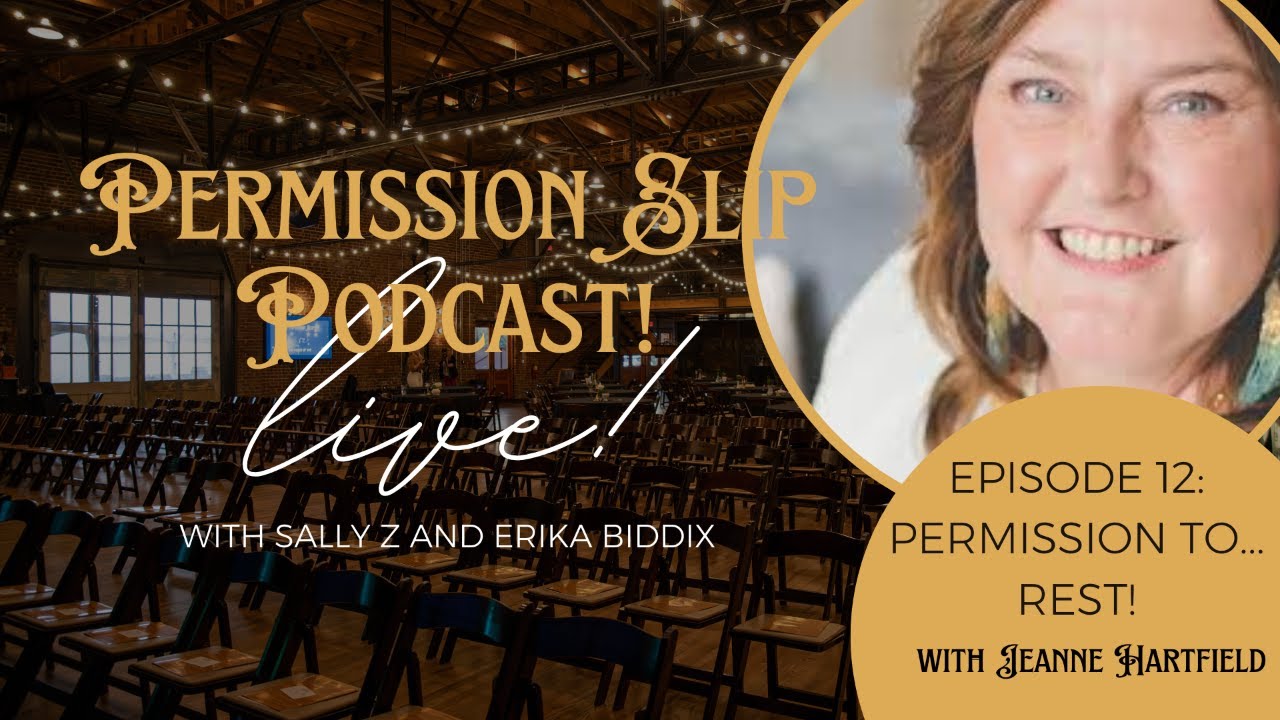
In this informal YouTube interview, host Sally Koering Zimney talks with guest Jeanne Hartfield about the concept of "Permission to Rest" and how women can cultivate a sustainable, replenishing lifestyle. Jeanne shares her personal journey—including her Enneagram 9 personality, pastoral role, and recovery from breast cancer—and explains how intentional noticing of bodily cues, emotional patterns, and life‑giving essentials can guide rest practices. The dialogue explores concrete tools such as brief dance‑party breaks, breathing exercises, reading fiction for joy, gardening, and a custom planner that embeds daily check‑ins and the contemplative Christian Examen. They discuss the "reservoir mindset"—a mental model for maintaining internal resources—and promote upcoming events, a summer Pathway to Rest webinar, and a planner that will soon be for sale. Throughout, the conversation emphasizes granting oneself permission to prioritize rest, redefining productivity, and building community around these practices.
Chapters
They say fortune favors the bold. So what are you waiting for? The right time? The right sign?
The right guide?
The thing is, Movement Maker, you were never meant to follow anyone else. You were destined for something bolder and braver and truer, and you know it. It's time for you to write your own damn permission slip. You have permission to dream big. Not that you need it from us.
Fortune favors the bold.
So what are you waiting for?
Yay!
Yay!
Excuse me. Here we go.
Good to be with Sally. We like to start and end with some dancing, as you know. How are you, Jean Hartman? Yay!
I'm so happy to be with you today. It's always a good day when I get time with Sally.
I feel the same way about you, Jean. And I just have to say, because this is so special to me and says so much about you, I think, the fact that I believe you were our first ticket buyer last year. I was! And I think you were our first ticket buyer this year too. So I feel like that deserves a round of applause and special recognition.
Does that give you a clear message that I'm all in?
It does. It does. And I love that so much. So just selfishly for a moment before we dive in, I'm so curious, like, what— why are you all in? On this? Like, tell me the connection that you feel with this.
Yeah, okay. Well, to be honest, the first year, last year, I'm like, this sounds super cool, and I want to support my friend Sally, and I want to see— I just want to see. Yeah. And then I got there, and it was such an amazing gathering of women, and the speakers were just like, ah, And frankly, some people that I didn't know before, but really spoke a message to me that I needed to hear and to remember. And so then when it came around this year, I'm like, yes, please.
Yes, please.
So everybody get your tickets.
I mean, we'll just get our little ticker going at the bottom. November 5th.
Exactly.
So thank you for allowing this kind of self, self moment before we invite in more of your story and hear more about you. But it honestly means the world to Erica and I. And I think this whole Permission Slip community doesn't commune without people showing up.
Absolutely.
And so it truly means so, so much that You have, and that you're going to again. It's amazing. I love knowing that you're there because you bring a— like, there's a spirit about you that is very unique to you. You're in one of my coaching programs, so we just— we should be clear about that. We live near each other, so that means every once in a while we get to, like, grab lunch or coffee. I think we're due for another one. Absolutely. And so I've personally experienced this, not just at the conference, but I get, I get to eek some Jean Hartfield spirit into me, with me from time to time. You are such a gift. And so let's start by hearing a little bit about you and what you do. And why this— it's an intentional thing, this spirit thing. I mean, it's just in you, but it's also what you do.
Yeah. I've cultivated it over time. Yeah. I was laughing because I was flashing back. Like, you've absolutely seen me where I'm just like my super centered presence and I bring that to others. And you've also seen me in moments where I'm like, ah, I need to give myself permission to show up differently. Yeah. So you've seen the gamut. I think for me, there's no question. I mean, some of, some of my personality is if people know the Enneagram, I'm an Enneagram 9, I'm a peacemaker. But it's really not just that. I have been very intentional, especially over the last— well, I'll say 10 years, right? 10 years ago, I went through breast cancer treatment. And in, and in the aftermath of that treatment, I got really intentional about certain practices that help me live more centered, help me live grounded in what matters most, that help me find perspective, that help me shed, frankly, either lies that I was holding on to about myself or things that just were no longer true and no longer served. And so the more I've done that work, the more I feel like I operate in all contexts out of this deep sense of knowing and confidence and security. And you know what? Frankly, I really like myself and what I bring to the table most of the time. And that's not always been true, but I'm learning to claim it more. I've given myself permission to claim it. And so I think even that sense of, like, I love being in my 50s. Like, each decade, you know, people, people say that each decade gets better, but, but it really comes out of a sense of knowing myself well and, and trusting myself and trusting that I have dear people, including you, who are what my friend Heather Adams calls them, her board of directors. It's the people who pour into her, people pour into me who help me maintain that perspective. Oh, beautiful.
I just like— that is such a beautiful claiming that your strength, confidence, presence, your ability to guide others in leading a life that is grounded, because life is crazy. You've dealt with plenty of your own.
Yes.
And so you've done the work of how to do that. And I know it sounds like a small thing, but it's not a small thing to say, I like myself.
Yeah. Yeah. Well, and I'm thinking, Sally, even as you talk about life can be a lot, there's always things coming at us. I don't do this perfectly, right? Like everybody else, I'm a work in progress. But what I've learned to— I've learned to notice certain patterns, certain internal messages a lot sooner. And I've learned how to, um, how to remember what's not true or what's maybe only true in this moment and not big picture, right? It's Yeah. Like you learn, you learn to navigate those moments where you don't feel calm and centered.
Yeah.
And really you learn to put them in perspective much more quickly.
Okay. So how have you done that? Because I mean, on the outside, and this is true for all of us, it always looks like, oh, we've got it all together. Jean, you walk in the room and you're like, I always say like, You are royalty. You move like royalty. You have like this presence of, um, trust me, I'm in charge and you can trust me. I bring all the wisdom and guidance. Like it's such a powerful presence. It's so beautiful. But how you said, like, I have cultivated it. Can you talk a little bit about what some of those tools are that I know you talk a lot of about with other women? I mean, we named this Permission to Rest, and I have a feeling those things are connected. So what are some hows for us?
Where I would start is, and this is where I start with my clients, this is where I start. So I currently serve as a pastor in a small church, and as we're figuring things out in community, this is where we're starting. We start with noticing. We start with paying attention. So in our lives, it's, we're noticing, okay, how do I feel? We're noticing patterns of emotions or patterns of responses. Uh, we're noticing things that are unexpected or that delight us. Uh, we're noticing frankly, like, what is our, what's my body saying to me? What is like, just a couple of weeks ago, I'd had a really intense few weeks of all just amazing things. And I pushed myself. I made some intentional choices that I was going to push myself, but I got to the end and I was just— I was physically spent. Interestingly, in times past, I would have also been emotionally, spiritually, mentally spent. And it turned out my body was just like, you need to stop. You need to rest. You need to sleep and you need to read, like, a mindless novel that's just purely going to entertain you and take you away. And so when we start to notice, all right, well, what am I seeing? Am I noticing that, um, I'm impatient and things are coming out sideways? Am I noticing that, oh, when I do this, I have an extra spring in my step? I mean, you know, so we start to notice and then we piece together the patterns and that becomes information that we use to guide our choices that we used to be like, oh, okay, I recognize where this is and I know what to do from here, even if I'm feeling really stressed. Right. Right. Right. Go ahead.
Well, I was just going to say yesterday I've just had this very, like, a low vibe week and Uh, which doesn't happen a lot for me, but when it does happen, I feel like it's really kind of just amped up. And I— my friend Jen Whitmer, you know Jen? Yeah, obviously. Yay, Jen! So I think Jen maybe sensed it or something. She, she said, what do you need? Do you need a— do you need a snack? Do you need a nap? Do you need it? You know, she's like a dance party. And I said That is what I need. I need a 30-second dance party. And so I pulled out my little button, my little 30-second dance party button, and I just literally 30 seconds. And I think I had to get out of my thinking, get out of my head and move. And I know we're talking about what you do after you notice, but I needed her prompt for me to even say, what do you need?
Yeah. Well, because we like, honestly, we forget or we think, well, what it is is what it is. And in those moments we forget that we have agency. We have like other tools to draw us in. I mean, Sally, I'll tell you what, last week in my 2 days of just really recovering, at one point my dog Ruby came and kind of pawed at the side of the bed. And I was like, oh, she either wants to go out or she wants up on the bed. So I got up and she kind of ran away from me. I'm like, Ruby. And then I followed her and then she ran away again and she wanted to play. And I'll tell you, once I figured that out, well, I figured it out because I started to laugh. I just couldn't help myself. I started to laugh. So sometimes Sometimes the noticing, Sally, is noticing that, oh, I didn't know I needed that. Like, somebody enters in, in a way, and you feel yourself, you respond, and it's like, oh, okay.
Yeah. And I'm always appreciative because I think one of the things that I'm growing in, and that is a struggle for me, and I think this is true for a lot of Highly driven people, uh, people like achievement focused. I'm an Enneagram 7, but, and some days I'm like, am I a 3? Am I like, cause I'm just big dreams, big goals, go, go, go. That I don't, I ignore the need for the sake of just going and keep going. Like I can keep going.
I can move.
I can trudge through. Hard stuff, which you can do for a while.
And then, you know, and then you can't.
And then you have to cocoon or your body shuts down or you get sick or, you know. Yeah.
But don't you think, you know, I don't think that's just an Enneagram 3 thing or an Enneagram 7, I don't want to miss out thing. I think in some ways we as women are trained to keep going and keep pouring out. Yeah. For, I mean, in our culture to keep pouring out, to be able to do this, to also do this, to do this. And we got to handle this. And, and my husband Andrew and I, we had a, this is Memorial Day weekend coming up and we had a conversation. Do we go to the lake for a few days and just claim some downtime? That would be really great because we've had a really busy stretch of weeks and, um, again, all good things, but it's just been full. Or do we stay home and try to check a bunch of things off the list because we have a goal of kind of getting some things in order before we do our end of school year pool party so that then we can just enjoy the summer, right? We feel the tension of it and it's so easy to say, well, I'm just going to keep going. But what we miss out on, Sally, when we just keep going is we miss out on rest, you know, the downtime that frankly our body, our mind, our spirit needs to be really generative and creative. And we miss out on the replenishment of what actually fills us up. I was talking to someone at a conference recently who's a very high-power, high-capacity professional woman. And she's like, I made a change this year. I went from— anytime I was reading, I was reading business books, self-improvement things. It had to be something that was going to help me be more productive or be more whatever. And she said, I switched this year and I started reading fiction just for the sake of enjoyment. And she said that switch alone has dramatically impacted her creativity and her imagination, her sense of possibility in the work that she's doing and how she's serving clients. Like, she made that correlation, but we forget how the shift in our rhythm and experiment in a way that is really holding space for rest, for replenishment, for joy, for delight, reaps all sorts of benefits beyond the benefit of I'm checking this other thing off my list, or I'm just going to keep going in what I know.
Yeah.
Okay.
So Erica just chimed in and said, same for me. I only read for fun, not for learning, because my brain needs a break.
Well done, Erica.
Well done, Erica. Love it. Yeah, I've decided I've made this switch in— like, I love listening to podcasts, and, and I need the fuel. I need the, the brain fuel sometimes, the inspiration fuel, the strategy fuel even. But if I I cannot go to bed listening to something that requires my brain. That is like all fiction, dreamy. Yep. Romantic— no, what's it called? Romantasy?
Romantasy? Absolutely. Yes, please.
Romantasy.
I'm not going to lie.
Absolutely.
So good.
But we do. Our brain needs a break. So, okay, so we've talked about the noticing. We notice and we've started talking about a few tools. Like finding the things that, um, that delight or bring you joy. What are some other tools that are helpful for us after we've noticed?
Okay, so I think it's really helpful to do some intentional reflection around what I call our life-giving essentials, right? So to have a clear sense of what is it that does replenish our mental, emotional, physical, spiritual reserves and resources? I have a client, for example, who we did some work together at the end of the year. She's a spiritual mentoring client. And so we've had conversations over time. But when I asked her what was most essential going into 2024, She listed 4 things. So she listed time with her boys and her husband, time together as a family. She named taking care of her body, like so feeding well, exercising, moving, everything, working and serving out of more out of her giftedness, and then being intentional about rest and downtime and replenishment. Because she was clear on that, Sally Koering Zimney, it's easier for her to then translate that to, okay, is this showing up in my calendar? Am I blocking out time for this? Am I, am I making these things a priority? Because again, when I, when I'm willing to hold space for, for these things, the the positive impacts just ripple and ripple and ripple.
Yeah, I feel that deeply. Like, just getting clear on— and that is not a strength of mine for sure, because it's sort of a go, go, go situation. And AJ just commented, and I appreciate this so much. I can't stay focused long enough. To read a book anymore. I feel like brain wandering. I feel this deeply. AJ, thank you for commenting, because truly, and sometimes I'm like, is it menopause? Is it that my life is chaotic? Is it that I'm getting Alzheimer's? Is it—
do I have ADHD?
I mean, I literally— as I talk to other women, especially women business owners and entrepreneurs, we feel this, like, pull, pull, pull, pull, pull, pull. Yeah. So how do we work with our brain? What are things we can do specifically with our brain to dial down the chaotic thinking and help us show up with a little more focus to create space for things like reading a book?
You know? Absolutely. Absolutely. Well, first, honestly, I would say maybe reading a book isn't your thing in this season. Yeah, like maybe it's, oh, I probably should be reading a book, but I just don't have it in me to read a book. And my question would be, well, like, what do you have capacity for? What does give you joy? What— like, I, I think it's really important for us to remove, uh, the shoulds in this, that other people's expectations, and And again, really claim what's ours. Again, this is back to the permission concept. I give myself permission to not have those core things be defined what I think it should be or what other people's expectations are. Yeah, but back to your question, Sally Koering Zimney, the simplest practice to start that kind of inner knowing and to calm down is simply breathing. And I don't just mean like, you know, I— if you sit or stand in a way where you feel supported and held, you close your eyes because it just helps again, the focus. You take a deep breath in, you know, deep and slow. You pause for a moment. You release it. And if you do that a few times, what starts to happen is you actually feel, uh, you feel some shifts in your body. You feel your shoulders drop. You feel your heart rate slow. You, you become present to the moment, and in that presence then we can ask the question, a simple question like, what do I really need right now? And I can guarantee you the things that pop into your head, pay attention, pay attention, because those are, uh, those are important clues to what you actually need. Yeah.
Oh my gosh. AJ, I really appreciate it. AJ says, I definitely need more breathing. It sounds so simple, but it is really powerful. And I use it as like a, a pre, when I'm overly anxious, like before a big talk or something, I'm like, ooh, so much breathing. But I love what you're talking about, which is, no, this is a daily practice, a daily check-in to get clear with ourselves about what we need right now. Yeah, maybe it's not reading, and maybe it's not a dance party. Maybe it's—
for some people it might be reading and it might be a dance party, but it might be, uh, going and digging in the dirt in the garden, or it might be, um, I don't know, I'm looking out the window and just seeing nature. It might just simply be going out and going for a walk for 5 minutes.
Yeah.
Yeah. But I think it is also helpful to pay attention to the patterns of like, what are your cues that you are in, like your body, you're feeling like stressed, dysregulated, uncomfortable. So earlier I mentioned, okay, if I'm noticing that I'm impatient and things are coming out sideways, Um, or I'm like super teary and can't find my words, right? Like, okay, I need to just stop for a minute and figure out what's going on. Yeah. Um, but we all have our own cues. It might be when I'm filling up my calendar and I fill up my calendar and I'm not giving my space to rest, to stop and be like, What, why am I uncomfortable with the margin? Or why do I need to, why do I need to fill this up in this moment?
And those are big questions because what we're digging into in those questions are age-old, like long time, probably embedded in us as tiny people.
Yes.
Beliefs that we're trying to untangle because they're no longer serving us. In this, and it's, it's big hard work. So I just want to give a shout out to Jean. One of my favorite things that Jean has created, and I'm just going to pull it out and show it because it's beautiful. Pardon me while I pull it out of my backpack.
Oh, it's a planner.
Jean, Jean made this planner specifically for me, and I love it so much. It's so beautiful. And so, Gina, are these for sale yet?
Soon. Yeah, soon.
So be on the lookout. It's— it is my— I've used all kinds of different planners. I love it so much. It holds everything. Like, I had a brilliant moment the other day, and now I know it's in here. I had a brilliant moment the other day. Listen to me just like pat myself on the back.
Of course you did. Of course you did. And you'll remember what it is because you put it in your— Yes.
It's not like on a random piece of paper somewhere. And part of what is embedded in this are some of the things that Jean's talking about is time and space. I finally— I mean, I'm not super consistent about it yet, but I'm starting to get into the practice of sitting down and thinking and reflecting. And some people are so good at doing that. It's never been something I've been very good at, so I'm working on it and this is helping.
Well, I'm so glad, Sally. But, and here's the thing, um, like, I'm real good at reflecting. I can reflect myself until the end of time and not actually do anything. Okay, so like, we'll come, we're gonna meet in the middle. We'll come and we'll meet in the middle. And so part of what I Part of what I, as I designed the planner, was I wanted to have kind of a rhythm of reflection. So in the contemplative Christian tradition, you know, across the centuries, there's a practice called the Examen, which is just a thoughtful looking back on the recent day or week or however, however much time, and surprise, surprise, noticing what you notice. And so I wanted to build that into the planner, both kind of— we do what we call a weekly reorientation and just a daily check-in because that is part— it's a tool that helps you actually do the noticing and then translate that in a way that helps you integrate it into how you are working and moving day in and day out.
It's so, so good. So just shout out, shout out to Jean. The practices are built into this, and very soon she's going to start selling them. So be on the lookout. Okay, Jean, talk to us about your— I'm sorry, did you want to— you want to—
you go ahead, and then we might be going the same place.
Okay. Well, I wanted to point people to—
okay, good.
You've built a special Pathway to Resting More This Summer. So tell us about this and people can grab it right there at that QR code.
Yes. So the other night I did a webinar that's really about what I call living a reservoir mindset. It's about having a mindset for holding space for what fills us up, what replenishes us. So that, you know, hard things come or it gets really busy or a season, like all of these things, we have the internal resources to respond really thoughtfully and without just pouring ourselves out completely. So we did a summertime version of this. So if you scan that QR code or you go to cultivatingsanctuary.com/summer, /permission. You'll fill out the little form and we'll send the replay to your email and we'll send you the handout, which will guide you through the questions to help you get a sense of the different elements of the Reservoir Mindset, which works for summer and works all year round. You'll also see a little preview of the planner. If you do that, then you'll be on the list as I release it. To get some more information.
Oh my gosh, I love this. I hope everybody grabs it. I, I'm gonna go grab it. I ironically meant to be there the other night, and then it was— oh, it was, it was my oldest's birthday, so everything went haywire, and it was fine. But, uh, this is why I need— I need more Jean in my life.
To help.
Well, and then you can rest.
Yes. And you can spend the time honoring your oldest birthday, which is very important. Like, that's one of— that's an important part of your life. And then you get the replay and you can follow along and still have the joy.
Oh my gosh. Okay. So everybody grab that cultivatingsanctuary.com/permission. And before I let you go, Jean, since you're all in on this permission community, the permission idea, what is the next big permission slip that you are giving yourself?
Permission to really treat my business like a business. Oh, yeah. What does that mean for you? Uh, I, I think I've been treating it like a hobby, like it's something I love, I'll do, I'll give it away. And that's really fun. Like, I love the serving, I love that. And also, I, um, it's valuable and it serves people, and so it should serve my family too. And so to really kind of Permission to own that identity of a competent, more than competent business owner who's serving well through her business.
This is what Erica feels about this. Uh-huh.
Uh-huh.
Exactly. Exactly. Yes. Oh my gosh, Jean. It is so delightful. To have you here. Thank you for being all in with us. Thank you for everything that you bring to the communities that you are in. You are such a wise, powerful, dare I say royal, a royal guide.
She is royally amazing.
It's so good. Okay, Jane, here's how we end this. Just so you know. We dance. All right, we dance and then we'll wrap it up. Are you ready?
Here we go. I'm so ready.
More from Sally







Speaking My Story: The Talk That Changed Everything (Sally Z's Epilogue) | Speaking Story


The Walk-'n'-Talk and the Stumble-Through: Two Rehearsal Methods That Actually Work | Ch. 39