Permission to... Rock Your Systems with Diana Wei Fang
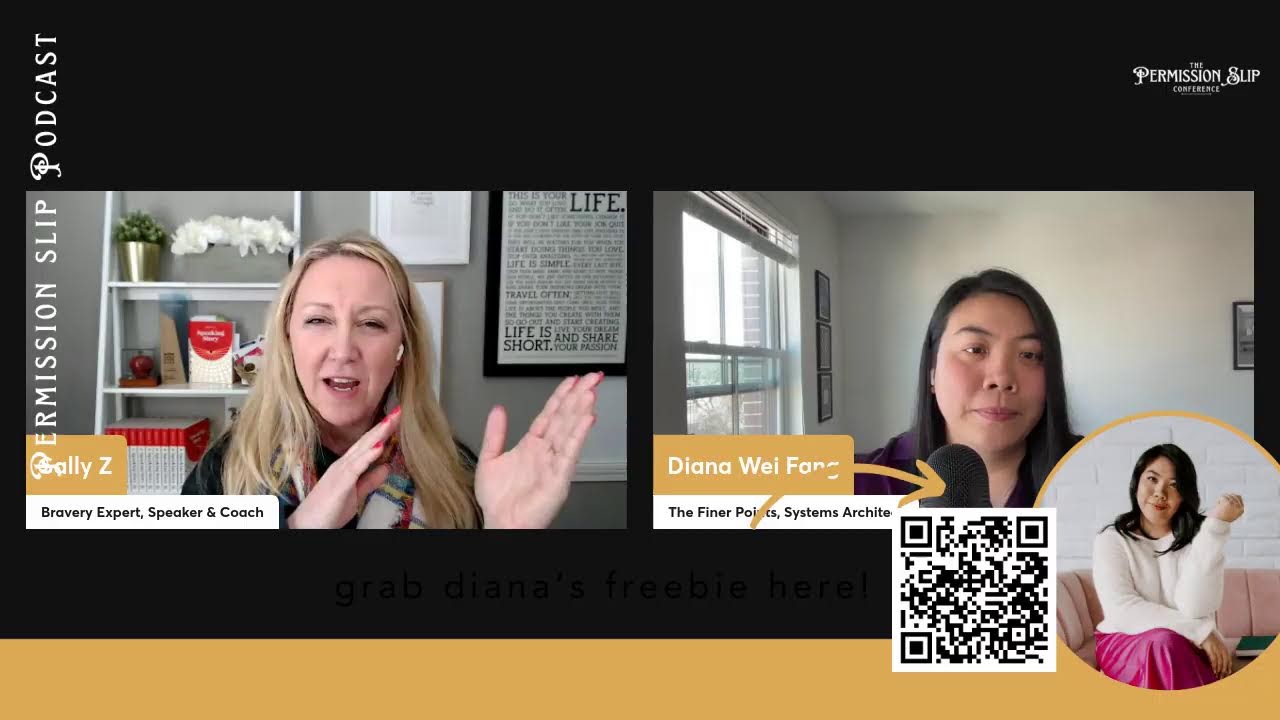
This content was created by Sally Koering Zimney. This content was uploaded by Sally Koering Zimney. This is a YouTube live-stream episode titled "Permission to... Rock Your Systems with Diana Wei Fang" (Permission Slip Podcast) recorded March 1, 2024. The excerpt is an English podcast-style conversation featuring two hosts (labeled SPEAKER A and ERICA) with guest Diana Wei Fang (systems architect). They discuss business systems and operations for small service-based businesses—topics include using StreamYard vs Ecamm, automations (emails, invoices, intake), calendar planning, scaling by handing off tasks, indicators a system needs changing, statistics on conversion/time savings, and a free systems assessment (QR code) to help prioritize improvements. Other participants appear in chat/comments (Shelby, Val, Anna, Ashley) but the primary speakers are the hosts and Diana Wei Fang.
Chapters
They say fortune favors the bold. So what are you waiting for? The right time? The right sign? The right guide? The thing is, Movement Maker, you were never meant to follow anyone else. You were destined for something bolder and braver and truer, and you know it. It's time for you to write your own damn permission slip. You have permission to dream big. Not that you need it from us. Fortune favors the bold. So what are you waiting for?
Yeah, we start with dancing.
We start with dancing.
I was dancing before. I know the drill.
That is, it's kind of what we do. We dance. Yay, the dream team back together. Yes. Ah, Diana Wei Fang, welcome. To the official Permission Slip Podcast. We are live currently in several places. Facebook, Facebook, Facebook.
Is it happening?
It's happening. LinkedIn, YouTube.
So much with the Instagram, but we'll get there.
Yeah, I literally, I was like, I can't do it today because it's just the next layer of learning. We are on a new— we're trying a new streaming software. We are on StreamYard and people, I have been, I'm just going to admit, I've been an Ecamm advocate for years, years, years. And I was like, this came up and many of my speakers use StreamYard. And I like, I hop into other people's podcasts all the time and they're always in StreamYard. And so, uh, I started to see the potential for it. It's very similar. Can I just talk about the major benefit of this? Not like I'm— I don't have a, I don't have a link or blah, blah, blah, but Ecamm allows multiple people to come in and produce. So sometimes if I can't be here, Erica's hosting, she can come in.
StreamYard lets us have—
yeah, what'd I say?
Ecamm.
Oh, sorry. Yeah, no, no, opposite.
Yeah, that's the big difference. Zoom is solely on our machines, but StreamYard, um, we've got team member— we have team members. So Sally's on, I'm on, Anna's on, um, and so we can have a team and a lot of people can utilize it.
So yeah, yeah, go team, go! And here we are, we are here. We brought already just like threw her right in here. Diana's here with us.
Hi. Hi. Thank you so much for having me here. This is day one for you guys?
Um, it's day sort of, I don't know, we've done this a few times. Okay.
But I would say, yeah, we can tell. Let's start over. Hi, welcome to the Permission Slip Podcast. Yay!
I have a feeling I know who this is.
You can't tell.
I bet it's Shelby. Shelby, are you watching us?
Hi!
Hello!
So fun. Oh my gosh. Well, we are really excited to have you here, Diana. Of course, always. I mean, we spend a lot of time via video with each other. We are in a little business group together. Oh, just— it's Shelby.
I love it.
So fun. She is. She is. So Shelby, as you're watching us today, just know we're trying a lot of things. Okay, okay, she's gonna update her settings so we can see that it's her. Um, so we, um, are— of course we spend a lot of time together, but whenever we can, I'd like to— and both Erica and I are like, we are big advocates for the work that you do and the way that you do it because we have personally benefited from it.
Yep.
You have come in and buttoned up our businesses. I will say I could not have launched my book without you, and I really mean that. I really mean that. I— you held my hand through some really tough moments where I was like, I don't know how this is gonna happen, um, and just helped me see it all the way through in really really important ways. Just like, I was like, I can do this because you were just standing right there with me. And that's true with Permission Slip too. Like, you were really truly with us right there the whole time, like holding our hand, bringing us whatever it is that we needed because we were just bleary-eyed. What?
Just eat it. Put it in your mouth and eat. Yeah, except guys, one time— that was my diet—
one time— so like Sally doesn't do lactose well. One time I was like, just eat this smoothie or milkshake, whatever I brought you. So for nutrition, it had like— it was like, like a cup full of dairy, guys.
It was a giant, giant cup of dairy, and I was like That was really good.
Other than feeding us, though, making sure we were fed, what do you do, Diana? We can tell what you do, but you say what you do.
Oh, well, thanks. I think, honestly, I'm a systems architect. That's the official title. But what I get to do is, as Sally was so kindly saying, is partner alongside each of your dreams. Right, in each of your businesses and making sure that you're here and you're in it for the long game. I help you set up systems and streamlining. I just want to make sure that you make it to your goal, that you're not halfway through, fizzled out, burned out because you, you know, didn't have a system or you weren't able to— we're learning new things.
All right.
It's okay. Yeah.
Shelby's like, press the wrong button.
It's all good. I love pushing buttons. Who needs to see my face? It's fine.
So when you say— I do want you to say though, like, for someone who's like, what is a system? Like, what is a system?
Oh man. Okay. Diana's definition of what a system is, is it is the very thing in which your business runs on and operates on. It is the gears and the inner workings behind it. It's all the intricacies of it. So for example, your automated emails, if you have them, your invoices and contracts, and the way that you want to serve your clients. I operate off of like a client-centric model. I want you to think of your clients first and foremost, and I want you to build your business around them because that's who you're serving. But I also want it to fit within your personalized lifestyle. Everyone is so different and there's no two photographers the same, no two speakers the same. And so how do we make this work best for your lifestyle and your clients?
Oh, so, so good.
I do love a system. Did not love a system, but now I do, all courtesy of Diana.
It's what makes the world go round, right? Like, that's what traffic cameras are. Like, traffic lights is on a system. Getting on and off a plane is on a system. Everything, all of our whole life balances on a system, whether we notice it or not. So why wouldn't we use that for our business?
Yeah, absolutely. Yeah.
So this morning I had a moment of realization because I had forgotten that February had an extra day. And so I woke up this morning, I was like, it's not March yet. It's not March 1st yet. It is February 29th. And I said, bonus day. Bonus day. I was so excited about having a bonus day because I have all these goals for the end of February. I'm like, today's the day. I got to get so much done today in order for that to happen. However, it also made me think of— it put this pressure, a little bit of pressure on this day. But I thought, how do I want to approach this day? And I was thinking about my husband Andy does some speaking and he does a talk where basically he says, the most important question of all time is, what should I do today? What should I do today? That is truly at the end of the day, you have these visions and goals, and it comes down to the way in which you live your life in the everyday. And that scares me, honestly. I'm like, oh, no. If we just looked at that, how am I using my day versus the sort of bigger vision of things, it really brings it into focus. Like, is it reflective of the way that I want to live my life? And I thought about this morning and I remembered we were having this conversation today, Diana, and I thought, oh my gosh, this is really tied together. So I would love to hear from your perspective when I talk about that and you're nodding, you're like, aha, aha. Connect those dots for us because you're talking to a bunch of really busy, busy entrepreneurs who systems aren't necessarily— that's not why we got into this work. We got in for the big vision, the dream, the purpose. And yet at the end of the day, it's about what are we doing right now? What are you doing to get there in that, in today? Yeah.
The two differences between your face and my face. I'm super excited about it. I know.
You're like, ugh.
Let me just lean into the ugh. Well, honestly, I think that was what I was so proud of you for, truly. Sally, you knew this book launch was coming. Erica, you knew this conference was coming. There is some aspect of leaning into the expertise that we already have and riding that wave. But for something like a conference, for something like a book, when we set out our year and we say, this is our intention, this is my goal, this is what I want to accomplish, it's such a big idea. Like, go back to the moment when you were like, I'm going to start this business, I'm gonna make 5 figures, I'm gonna make 6 figures, I'm gonna Yeah, it's just, it's so overwhelming. How do I even get there? You know, and, um, there is this idea of, okay, with that goal in mind, what I want you to do is now break it down into bite-sized pieces in a way that you don't feel yourself just like waking up and saying, what do I do today? Because you know, right, if you just accomplish these 3 things today then it accumulates towards the bigger goal and the bigger picture, right, Sally? Like, I think on the days when you were overwhelmed, then on the days when you're overwhelmed and you like had those text messages when you were writing your book and when you were doing all these timelines and all you wanted to do was write an email— guys, I kid you not, she just wanted to write a freaking email to you.
And I love my emails.
Yeah.
She did. And I just wanted to say, okay, that's great, you can write all the emails, but at the end of the day, is it achieving towards your larger goal? Was there focus in mind? Are you just writing an email? What is the point of this email, right? And I think, um, we tend to approach our goals and go, okay, give me six figures right now, please. And I would love to give that to you, but if I gave you six figures tomorrow? If I gave you all the clients tomorrow at your doorstep that totaled up to 6 figures, could you even handle it? Could you handle the volume of clients? Could you handle the intake? Do you even know they are inquiring? Because some of you don't have the correct contact form and it's going into your spam folders. That's a real story. That's one of my clients.
She looked— right here's worth of inquiries because she didn't see them going into spam. Oh no. Oh no. Yeah, I know. And I'm sure you hear so many of those stories, like where things break down, because people come to you in those moments. Yeah, right. Where it's like, I don't know, this is frustration and, um, feeling overwhelmed and lost and just like, there has to be a better way. To do this. And so, you know, Erica, you especially as somebody like you working with a lot of product-based people, not all, but just because Knoxville, Knoxville is such an epicenter of that. And is that right, Erica? Would you say most of your members are, are they product people or not necessarily?
No, we're primarily service.
Okay.
We're primarily service-based regardless of where they're, they're living. I would say 80%. Of the OP members are service-based. But what I can say is that someone who sells a service myself, and I am selling it as my time is what's being sold, right? Changing it from, great, let's switch 75 emails to see when I can coach you versus what we have now, which is super streamlined. And I'm not even involved in the planning. I'm also, I'm not involved in the, in the finance piece of it. Like, it is what it is. That's all in the automation. Like, we're not negotiating. Like, the rates are in there already. So all of that pre-stress is gone, and it allows me to focus on things like, you know, we've got an automated survey that goes out ahead of time so I can review it before I get in. And start the coaching call. Whereas I may not have had time to do that because I may not have even— we may just have scheduled it immediately. Another great example is I'm out of town for the next 2 weeks. I'm off, my calendar is closed for the next 2 weeks, which thanks to what Diana has taught us, my ops manager and I scheduled out the entire year and we blocked those weeks off and we did all of our all of our business scheduling, all the offerings around the idea that I was going to be leaving for 2 weeks. So I couldn't do it these 2 days beforehand and I couldn't do it these 2 days afterwards. And as we were sitting talking about secret deadlines today, Sally, we were able— like, that wasn't even an issue. Like, we just knew that that was already on the calendar and we could work around it.
So look how happy Diana is listening to you.
Proud mama.
I feel like Erica, you have gone through a metamorphosis on your systems and your approach. I mean, you've always been a doer, like get stuff done and go, go, go. And you yourself, and you talked about this on stage last year, right? Your own story of recognizing that you cannot be the business. You've got to create the structure in order to allow for that. And then for this year to watch you hand off so much of what you're doing because you found a person who can do that and you've built the systems and structures with Diana's help and Anna's help. I just feel like, well, hot damn, I'm dreaming about that. I'm moving towards it. I'm working on it.
I realize we're interviewing Diana, but I'm going to give her more credit here. For a moment. So when we were out, so we, we dropped this new offering, the AWWK Community, right? And so every month we have the same thing, the same expert sessions, et cetera, that happen monthly for these women. So we literally had all 12 months on the wall and we were looking at what day of the week do we want to do our coworking or what day of the week do we want to do these expert sessions? And because we had all of the school stuff up there, because we had all of personal travel up there, my birthday, like my kids' birth— like all the things were up on the wall. And we were like, well, Thursdays aren't going to work because 12, you know, 10 of the 12 Thursdays I am unavailable. So that even helped us look at, let's do it on Tuesdays. And then when we looked at all the Tuesdays and we saw there were 3 Tuesdays I wasn't available, we already knew that we needed to find a new resource for those 3 months for that specific event. Um, and that, that was, that was a game changer.
Yeah.
Yep. Because in the past, I think you would have chosen a Thursday and then at the last minute, possibly figure it out, either cancel or figure it out, or just suddenly like cancel your personal plans, or you would have sacrificed family time. Um, and just being able to put your family first was so, so important. And I'm just So excited and happy. And I will say that, like, something that both of you did very, very well last year when we went through your systems and we went through all the hard stuff is that someone even commented, you know, I just have to embrace the suck of setting it up, of getting set up. I'm— my guess is that's Valerie. Um, and so, like, but, like, that is exactly it. It sucks in the beginning. You have to embrace the suck. We have to lean into the resistance of it. Um, you have to, you do. Like when a plane takes off, okay, it actually flies into the resistance because it needs the resistance to level the plane out in the air. That is the way that we have to operate as well. We have to take a part of our system and our business and lean into the resistance and lean into it because On the other side of that is both of your success stories, right? On the other side of that, like, I have countless videos and photos of both of you just having these moments of like, this sucks, you know, I was doing just fine with my own method and my own whatever before, I made it this far, why do I need you? But it's not until you do it and then you really understand the benefits of a system, right? And I'll just tell you this right now, for those who need statistics and not stories, let's give you some statistics. By having a system, 79% of your leads are converted. Okay, you have a 33% higher chance of conversion if you have a welcome email automated. Okay, you, as someone who is utilizing systems and someone who's looking ahead at their calendar, you get back 79% of your time. Erica, what can you do with 79% of your time?
Sleep and it's go to Paris. Go to Paris, sleep.
You're living the dream. And it took work. It took leaning in. It took experimenting and trying new things. Sally, you're doing all of that right now with StreamYard, even just like as a small example of that.
Yeah.
The payoff is huge because if you can master this new tech, if you can do this, this is actually setting up a new system for you, right? You can have Ashley and Anna, who are both of your amazing assistants, step in for you. This enables you to scale. And so without it, yeah, you would be like, and Ecamm worked just fine. There's nothing wrong with Ecamm. Yeah. Yeah, but by leaning in for a long time.
But when you think about it from a systems perspective, like, it's a different filter to look at your business and say, okay, how can we go from here to the next level? It's like, it can't just be me. So we've been the 3 of us, and a lot of people I feel like have been reading the 10X is Easier Than 2X book. And that filter— yeah, Diana is like, here it is. That filter challenges you to think about if you are not the one, if you're not the one doing it. And I know, Erica, you've had that mindset with your— when you're coaching people, that's a big push that you've had with your people too. And that's part of the reason why it's like, I love the vibe of Ecamm, but it's not going to allow me— the system doesn't work with it. And I'm just focusing on systems right now because otherwise I'm not going to make it. Like, I can't— the business won't make it. It won't make it even though what I'm doing is powerful and blah, blah, blah.
Exactly. And honestly, that's— that is That is the deciding factor, right? These are the small decisions that we make on a daily basis that make— oh, Val, um, that we—
I had to just bring that into the conversation.
Oh my goodness, we'll have an intervention later. But these are the defining moments, right? The decisions to do this, because honestly, the people and the small business owners who say, I'm fine the way I am now. I am, you know, Erica, you could have pulled off this conference without me, right? You didn't need to ask for help. You're a very seasoned event planner, and yet leaning into that community and leaning in helped you expand and make it into something. And you said afterwards, like, this was better than I ever dreamed, right? This was like, I think, leaning into the possibilities of Even just like, again, bringing in this tech aspect of it, right? These are the defining moments that really and genuinely weed out who makes it in the long game of being and owning a small business and who doesn't. Because if we don't make those decisions on a daily basis right now, those small incremental decisions that help us, the hard fact is 90% of small businesses will fail every single year. Across the board. And these are the decisions.
It is brutal. Actually, I was, Diana, I was talking with a coaching client who has not yet launched their business. They're in the process of setting everything up. She is very much a systems person. So we were talking about everything that she already has set and ready to go. And what I told her was, A, that's awesome. Like, way to get into it with your structure and your system set before you start. But also be prepared to understand that you have done the good and hard work of paying the money up front, getting the system set up. But when you actually get into it, you may find the con to that is that you may find that the system that you have already paid for or have already set up is not the correct one. But what, what, what better way to learn that than to be in a situation where you need a system and you just don't even know what you need. Right? Like we know that we, we, we tried a certain system with, I'm gonna say with our sponsors last year for permission slip. Like we, we tried a certain way of automating stuff with them. We now know the pieces of Bethbit were not the appropriate cog in that wheel. And so now we have all of that information to make it a different kind of experience or a different kind of automation. This year. So I think be open to the systems, but also be open to changing, um, as, as necessary, right? Like, just because you have it doesn't mean it's perfect. It should— it's always growing.
Correct. Exactly. And that's exactly right. But, and I also just want to like offer a reframe as well. It's not that it's wrong. It's not that what you're doing is wrong, because I don't want someone to have the fear of not setting up the system, afraid that this is not going to be right. Here's the thing. You want to grow and you want to figure it out. And even as someone who's a systems architect, like someone like me, I have changed my offerings countless times. I've changed my system countless times. Why?
Oh my gosh.
Because you're growing at a speed in which you need the system to catch up on and to, and to build a system now for what I will be in 10 years. I don't know what I'm gonna be in 10 years. We don't know what this is going to look like. I could be here and I'm very happy with that, or I could be who knows what. I could have totally changed my business model by then. You want that in order to scale, in order to grow. We have to just embrace the unknowns. Again, that resistance piece, that fear piece, the plane does not take off unless it leans into the resistance. Okay.
Yeah.
Ooh.
We've got a question.
That's a quotable. Quotable.
Oh yeah.
Oh, Erica. Uh-oh. Any suggestions? Okay. Erica, hopefully Erica will be back, but Shelby asked, I've had moments when my systems are wrong. So any suggestions on when we know to like let go of them and make the change? Because as you said, there's a big suck factor. When you change the system because you've got to relearn, you've got to re-change things. It's like, so how do you know the point at which you give up on the, the system or you need a new system? What are those?
And I don't know that you need to like gut your system every time, especially if you already have one set up. I think I find myself constantly fine-tuning it, constantly making it better. Yesterday I spent all day rewriting these emails for this funnel that has been going out for several years, but I made it better, right? And so, um, I would say there are some indicators. One, if you find yourself dragging your feet, um, if you feel yourself like waking up and just going, ugh, right? We have those moments. Something has to change. Um, as your personal life, I think your kids will naturally need something. It's kind of like that. Like, for the moms out there, you know when your kids just need something different. Your business is no different. Your business is a little like— it's basically your baby, right? So you, you know, you do know. Um, something like, for example, if you find yourself kind of going back into manually doing something because you're mentally and internally you're like, oh well, that's not right, I have to change, and so I can't use it right now. If you find yourself in that in that way, again, your system needs to change. Um, if you find yourself back into the Post-it life or the, um, life where you're constantly just like having to, you know, remind yourself 50 times and like whatever you have sent, you're like, I can't, no, no, I can't set that, right? Your assistants, your assistant, if you have one, can't take over the functionalities you're trying to do because it's all in your head. Your system needs to change. Yeah, those are 7. And of course, more.
But yeah, usually in these conversations about systems, I feel called out at some point. I recognize, oh, I'm the problem. I'm the problem. And that is once again true. The Post-it note issue that is assigned to me when I'm not using the system. And it's not typically for me, it's not that the system is broken, it's that it needs to be adjusted so that it is usable for me, that it's working for me. And that takes time. It takes time to figure out. So, okay, we have borrowed a lot of your time, Diana. Thank you for being here. Also, just a little note from Erica. No, the internet system gave up. Oh, look how cute her family is, though. I love it. Okay. So as we wrap up, here's what I would love for you to talk about for a moment is how can people get started? What's a great place to start? Because we all could use a little systems tune-up. I don't care if you're brand new to entrepreneurship and you're like, literally you don't have anything, or if you are somebody at a higher level where everything needs a tune-up. An evolution or to allow you to scale more easily. And I know you work with people all along that spectrum. So what do you suggest in terms of like how people can connect with you? And I know you've got something that is helpful.
Oh yeah. Um, I definitely would say you probably don't need to burn the whole thing down to the ground and start over. But what's helpful is I have something called a systems assessment. It's really free. Um, ooh, Ooh, look at that fancy QR code. Everyone scan that fanciness that Sally set up for you. Yeah, that systems assessment is free. It's going to help you indicate where you want to focus on right now and help you prioritize. Because I think our— after hearing a talk like this, Sally, you were saying you always feel really called out, and I think I do. I'm talking to myself too. And we can't do all the things all the time. So the systems assessment will help you prioritize what you need to focus on right now and what can wait just a little longer.
Yeah. Yeah. So, okay, cool. So if they grab that, grab the, you know, QR code over there and it'll give you a sense of like the area that you need to focus on. Yeah. In particular, it's kind of like, so cool. So cool. Um, good. Well, if it, that I know is really important for everybody all along the spectrum because systems, It's just a part of this entrepreneurship life. We can't ignore it. You can't just focus on the purpose piece, even if part of the job of the system is to allow you to focus more on your work, the reason you got into this, really living out the entrepreneurship dream. But you've got to focus on systems so that you can do that.
Right? Yes, exactly. No, that's exactly it. You have to focus on the system. I mean, you can't ignore it. It's kind of like doing your taxes. It will catch up with you at some point.
I know.
And that's why we, I know. And that's why we don't like doing our taxes, right? Because it's such a real reflection of the way that we've spent our money in the last year. Nobody wants to be confronted with that, but also again, I know, no, they want to be confronted with all of our receipts. The last 365 days. Who wants that? But at the same time, it is so good for us and it is so helpful, and sometimes we get a little refund. So, um, Val likes doing it. Val, you missed your calling as an accountant.
I know, I guess. Amazing. Okay, well, Diana, thank you again for being here. Thank you for your time, and I'm sure we will have you back again, the Permission Slip Joy and Love, uh, it's now a year-long thing. It's not just about one day of the year. And for all of you that are watching, just know we have some announcements coming up in the next several weeks, but you're just gonna have to hold tight.
Just gotta hold tight. Tell me right now.
I can't, I can't. Nope. Erica, she's gonna say don't Do it. Oh, Val has something to say. She has something to say. She says, I don't like doing my taxes. I like it when they're done.
Well, that's fair. That's true of your system as well. When your system is finished, it's going to feel so good. And then we're going to have a dance party. Erica said, just saying, it's April 17th. Why don't you just tell me right now?
It's February.
It's bonus day. It doesn't count.
Oh, on April 17th, you'll know. You'll know.
But it's bonus day. So this day really doesn't count. So therefore, whatever you say today, I'm just doing my job.
I'm getting so much trouble. I will get in so much trouble. Nope. Erica. Nope. Don't you do it, Sally. Nope. I love how even from the comment section, Erica is running the show. This is why we love her. This is why I love her. Amazing. Okay. Thank you for being here. And to all of you, we will be back next week. We've got some amazing guests coming for the next several weeks. In fact, Shelby, who is all up in the comments today with us, she is— oh gosh, I can't remember our date, Shelby, but she's coming up. Emily Perrone is going to be on the show. Jen Whitmer is going to be on the show. And if this is something that you want to do, if you want to come have a conversation about your business and what you're up to and just entrepreneurship life, We would love to have you. Just reach out to us in one of the many places. And April 17th, that is the date. Nope, I'm gonna take, I'm gonna take Erica's comment down. It's a pretend day. Love it. All right, team, bonus day. Hope everybody has an awesome bonus day, and we will see you next week. Bye, everybody. I think I need music now. We need music. Ready? This is what I got. Nope, this is not the vibe we're going for. There we go, there we go. All right everybody, have a great one.
Bye!
More from Sally







Speaking My Story: The Talk That Changed Everything (Sally Z's Epilogue) | Speaking Story


The Walk-'n'-Talk and the Stumble-Through: Two Rehearsal Methods That Actually Work | Ch. 39