The essential question you HAVE to answer if you want to persuade your audience!
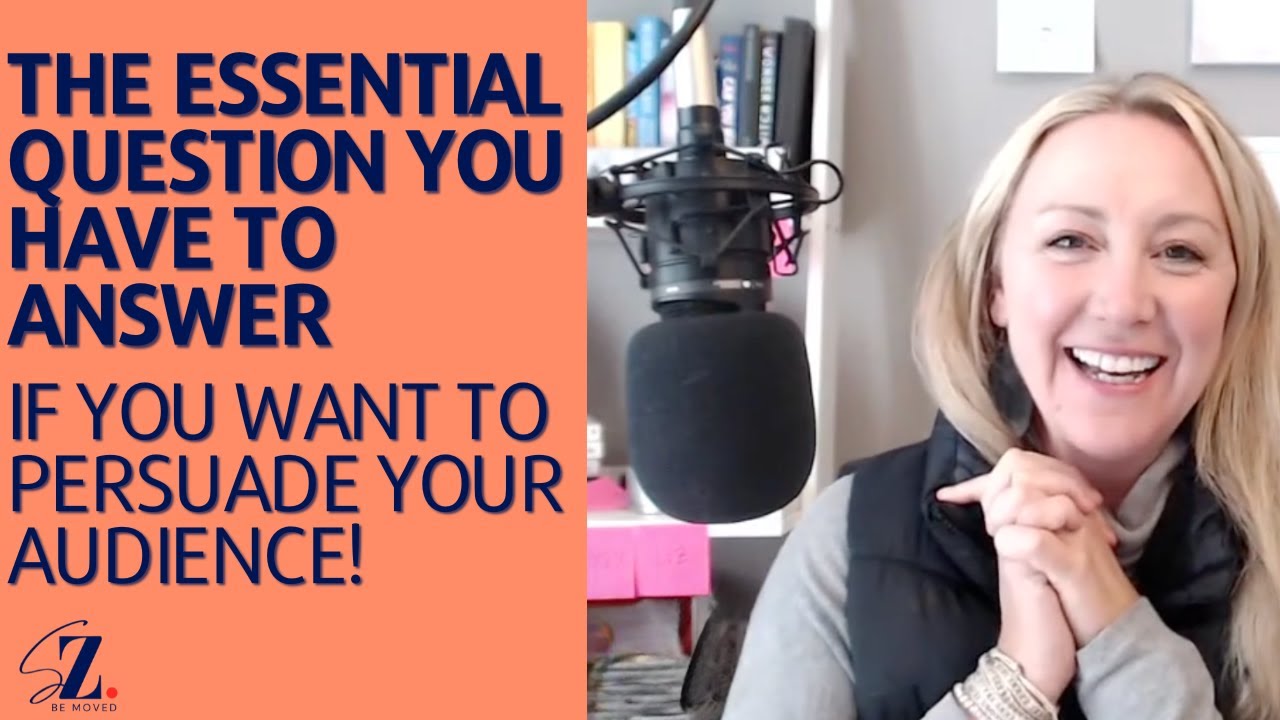
Sally Koering Zimney explains how to open a talk so people actually listen. The key: tell your audience what's at stake, what harm happens if they ignore you. She walks through this in a 10-minute coaching session with live viewers.
Chapters
Well, hello everybody. How are we doing? It's Movers Live, and I am first of all sorry that we had to postpone by an hour. My husband works. This is new. This is pandemic fun. He works right over there, and he also likes to keep the blinds closed. He suffered from a concussion about a year ago. Are any of you— have you been through that? Oh my gosh, the concussion, it is real. So, um, That's why I look a little darker right now because we've got all the blinds closed. But he was in a meeting right over there for, um, it just went a little past noon. It was still going and I was like, ah, this is not gonna happen on time. So I postponed an hour. Thank you for being here. Thank you for joining me. I know many of you watch this on replay, but I see some of you here. Hi, Silver Rose! It's so great to have you here. Thanks for coming. You are, uh, just a gem. Yay! Oh my gosh, Lisa, so you had one in July. It is, it is really intense, and, um, it's been a really long haul, a really long haul. So I love sunshine and brightness. I'm always like Open up all the windows and let the sun come in. And Andy comes in, he's like, close all the blinds and shut out all of the light. And he gets to win on that one because, yeah, health and avoiding migraines. You guys get it. Yes. Well, what we are doing here today is I was inspired by a conversation actually I was having with my husband Andy the other day as he was prepping for a presentation. He does lots of speaking and lots of training and workshops. And we were talking about how he was going to start his presentation. And typically, and this is important, we all know this, right? Like the first 4 minutes of your talk, even less than that, They're either pulled in and engaged and you have earned their trust, or they sit back and we have to work for it again and again and again throughout the rest of the presentation. So how we start is so, so, so important. And Andy was finessing his beginning and he felt like it was maybe a little too talky. Now I do think that that is one of the big challenges that we have is starting our talks with this chit-chatty blah blah blah. If people don't have a sense that this is essential or important, they're out right now. Showing up live like this is a different situation, but when you have— when you are given the microphone and all eyes turn to you There is a moment, and what we do with that really matters. Now, within those first few minutes, there is something that we have to make clear to our audience. And what I had realized as Andy and I were talking was he wasn't making this clear, and we have got to do this. So that's what I'm going to talk with you about. And this is going to be quick. It's going to be about a 10-minute quick training about this one idea. And I want to make sure that we as speakers make— are absolutely clear about this, because if we are missing this one idea, our audiences are not going to care. They are not going to be engaged. And, and I ask the question, why are we here? Because ultimately, of course, that is what we want. That is why we show up to our audiences. That is why we push through risk. That is why we step into discomfort again and again and again as speakers, because that is really speaking. We are stepping into discomfort again and again, and we do that because ultimately we want to create some kind of change. And the way we communicate that and the meaning that we can create around our ideas determine whether or not that happens. That's how powerful speaking can be. And so we are here to create change, and that is ultimately about persuasion. Now, you may not know this about me, but when I was 26, I went back to grad school and I studied persuasion. Yes, that's a thing. And it was fascinating. And what became very, very clear to me and this is embedded in my approach as a coach, is that persuasion is ultimately about harm and making the harm clear. Is that new for any of you if you are watching this? Uh, or are you like, yes, I know, we have got to make the harm clear. This is the question. This is the idea that if we are, if we have not wrapped our heads around this idea, we are missing it. We have to make the harm clear, absolutely clear. And another way to think about this is making sure that our audience, we're answering the questions for them, like what's at stake? How does this feel? Right? How did it feel in that moment if you're telling a story? These are the ways that we can pull out the harm. Who is impacted by these ideas? What, what are the pain points? Why does this matter? And it's, uh, often, um, we have to kind of peel the onion a lot to get there because what seems so obvious to us is not necessarily obvious to our audience. And so it is our job to make the harm clear. Now, for some people, and I would be really curious if this is any of you, for some people they're like, oh, I'm just very uncomfortable going so negative and dark and it feels kind of dramatic. And I'm not saying we overdramatize, but I have worked with many speakers over the years who are like, I just, I don't like going negative. I don't like pointing out all the horrible things that can happen. Now, I will tell you, pointing out the bad things that can happen is very persuasive. Can this be overdone and used as manipulation? Yes, but that's not us. We're being honest. We just need to underline the harm, underline the the, the impact that really happens if, if we don't do what we want people to do. So Silver, I'm thinking of you right now, uh, as you are out there speaking to your audience. They need to understand what's at stake. What is the harm if they do not find a way to happiness, real happiness? Deep, true, satisfying happiness. Yes, this is Silver Rose. She is a happiness expert, um, and she's fought for it. And so, Silver, sometimes telling your, your own story makes that harm clear, right? By talking about where you've come from. Uh, that's where we need to get to every single time we show up with our audience. What is the harm? What is at stake? Now, if you are somebody who's like kind of feeling uncomfortable with thinking about harm, bad, pain, all the terrible things, another way to think about this is thinking about it like possibility. What is truly possible? Right. And that's the same thing, but coming at it from a different direction. Now, harm, I think, is more effective than what's possible. I'm a super positive person, and so for me, it's easy to talk about possibility. The challenging part and the part that I have found most transformative and the places where I see the most head nodding and resonance with me and with my speakers is talking about harm. And getting really clear on what the impact really is. And so ultimately, this is a persuasive technique, and all persuasion comes from emotion. And I know this might be controversial for some of you because we think that persuasion is really about, uh, finding the most logical argument. We think persuasion is about showing the data and the numbers. Now, those are persuasive pieces, but they won't go anywhere without emotion. That number that you're talking about, what makes it impactful is a sense of harm. That, uh, logical argument that you're talking about, It's not going to convince anybody to make change unless they also feel something. And the way people feel things is by talking about harm and possibility, but more so harm. Yes. Good. Silver, I'm so glad that this is helpful. This is, this is essential. And we, You might know this, but knowing it and doing it are really two different things. And the doing often looks like this: uh, we write a draft of something and we are skimming the surface most of the time. And then we think about it, we speak it out loud, we know we haven't quite gotten there yet, and we iterate. We write again and we try and get as clear as possible, as crisp as possible, to the very heart of it. And it takes a little bit. We circle around and circle around until we get down to the real core of it. And you know, when you've done that, don't you? We know when we've hit on something because we feel it. And that is why as speakers, it is as much about being in tune with our own feelings, our own realizations, our own ahas, our own sense of harm and what's at stake and being able to articulate that. Because when we can tap into that, then we can communicate it most effectively to our audience. Yes. Does that all make sense? Are you with me? Lisa, Silver, Jerry. Jerry. Jerry's my dad. Awesome to see you here. Um, and we've had lots of people bop in. So great. Thank you for being here. If you have questions for me on this, you can pop them in the chat right now. I will take those questions with you, but I also wanted to let you guys know I haven't made this public yet, but I'm going to be doing a workshop in December. It's going to be for a small fee, but I'm going to do a workshop in December all around planning for our 2021 with speaking. OK, so what that means is if you want to leverage speaking in your business, if you want to use it as a part of a pathway towards more audience and more revenue, then I'd love for you to come along. We'll— it's a working session. I'm going to lay out some pathways and some information for you, and then you're going to walk away with, um, the beginnings of a plan for you in 2021. Okay, so I'll follow up with more info on this. Let me know if you're interested. Um, because if there's a lot of interest, I might do it in a few different places. But for right now, um, be on the lookout. Right now I'm looking at December 14th at 4 PM. So more info on this. Uh, Silver, thank you. You know, this is Ecamm. I use my Ecamm. Do you guys know about Ecamm? I know, Silver, you've just discovered Ecamm, right? It's game changer. I love it. I love that I can do this. Yay! I love that I can have music. I love that I can do these cool— I'm pointing at it, but you can't see it. I'm pointing at this, this overlay with my name right here is really cool. I like that I can go back into a little circle right here. I can move the circle around. I could do a whole thing on Ecamm sometime, but I love it. It makes me feel like a pro. And if you are showing up live to your audience, you've got to use Ecamm. So I have a, I have a link that I can send you so that you can, you can use Ecamm there too for whatever you do as you're showing up live to your audience. All right. I promised I was going to keep this quick. I will see you all again. I'm gonna try and be here throughout, really weekly here through December 18th, here in the group showing up. I'm also doing my B series. I think you've noticed that, you guys. The B series is really fun, but I want to hear from you. I've got a question for you every day. I want you to answer it, put it in the comments, and let us know so that we can help push each other to really be a moving speaker. That is what it's all about. Awesome, Silver, you're gonna learn Ecamm. It's gonna be fab. You guys are great. Thanks for being here. I will for sure see you next week, and until then, Uh, this moved me. What is moving you? I want to know. See you soon. Bye everybody.
More from Sally







Speaking My Story: The Talk That Changed Everything (Sally Z's Epilogue) | Speaking Story


The Walk-'n'-Talk and the Stumble-Through: Two Rehearsal Methods That Actually Work | Ch. 39