In this solo presentation, Sam Anderson, founder of Order Fulfillment Experts, argues that fulfillment is the hidden growth ceiling for many e‑commerce brands. He defines the "Fulfillment Fallacy" – the mistaken belief that fulfillment is merely an operational task that can be solved by outsourcing labor or a warehouse. Anderson outlines three maturity stages: (1) DIY survival (kitchen‑table operations), (2) the dangerous middle where revenue grows but systems lag, and (3) strategic infrastructure where fulfillment becomes invisible and the founder is no longer the operational backstop. He quantifies the real cost of a modest 5,000 sq ft warehouse (≈£250k/yr) and, more importantly, the opportunity cost of founder time (≈£35k/yr). Fragile fulfillment, he explains, forces founders to hesitate on launches, cut ad spend, and avoid promotions, thereby capping growth. He reframes fulfillment as a strategic marketing investment, citing Amazon’s 30% spend on fulfillment as a competitive weapon that drives loyalty, reduces returns, and boosts lifetime value. The talk concludes with a call to download a special report that details the bottleneck, stages, hidden time tax, and how to redesign fulfillment infrastructure, positioning it as a lever for scalable growth rather than a cost sink.
Chapters
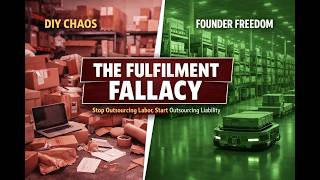
Around 70% of e-commerce brands are still running DIY or semi-DIY fulfilment. They might outsource the warehouse, but they keep the decisions. And somewhere between £2 million and £6 million in revenue, fulfilment stops being operational and quietly becomes the growth ceiling. Because the questions don't go away. Can this order ship today? Do we have enough stock to launch? Is this delay acceptable for the brand? You may have moved the stock, but you haven't removed yourself, and that's what, as I call it, the Fulfillment Fallacy. My name's Sam Anderson, and I'm the founder of Order Fulfillment Experts. Over the past decade, I've worked with 177 founder-led e-commerce brands representing more than £3 billion in traded revenue. And the brands that scale cleanly don't just improve their marketing, they redesign their infrastructure. The Fulfillment Fallacy is the belief that fulfilment is just operational, that if boxes are being picked and packed, the problem is solved. It isn't. If you are still the decision maker for every exception, if you are still checking dashboards at night, if launches are delayed because the backend can't cope. You haven't outsourced fulfillment, you've outsourced labor and kept the liability. There are 3 stages of fulfillment maturity. Stage 1 is the DIY survival mode. It's kitchen table, spare room, spare garage. It's hustle. Stage 2 is the dangerous middle. You've hired people, you may have leased space, revenue is climbing, but complexity is rising faster than systems, and this is where most brands between 2 million and 6 million pound turnover live. It looks successful from the outside. It is successful on paper, it really is, but it's heavy. Nothing is broken enough to force change, but everything feels tense. And then there's Stage 3: strategic infrastructure. Fulfillment becomes invisible. The founder stops being the operational backstop. Growth no longer feels like risk, it feels expandable. Let's talk about the real cost. Running a small 5,000 square foot warehouse can easily exceed £250,000 per annum before volatility is factored in. But that's not the expensive part— time is. If you spend even a third of your time on logistics and your strategic time is worth conservatively £250 per hour, that's roughly £35,000 per year in opportunity cost. But it's more than that. It's 70 how many hours per month you could reclaim. It's product development, partnership conversations, creative thinking, family presence. Time is the only asset you cannot reinvest. If fulfillment dictates your calendar, it kind of owns your life. Here's what most founders don't see when fulfillment is fragile: behavior changes. You hesitate before launching, you reduce ad spend because ops feels stretched already, you avoid promotions because Q4 nearly broke you and your team last year. Fulfillment doesn't just move orders, it shapes ambition, and that becomes your hidden growth ceiling. Control versus freedom. Control feels responsible. You know the orders are packed, you can fix problems immediately, but control has a cost: strategic clarity, energy, the ability ability to think 3 years ahead instead of 3 weeks ahead, or 3 days, or 3 hours. The question isn't whether you can do it yourself, it's what you're giving up by doing so. Here's a reframe: being close to your stock does not equal control, and fulfilment is not a back-end function, it's a structural architecture. It determines whether growth feels expansive or exhausting, Most founders think fulfilment belongs in operations, that if orders are being picked and packed, the job is done. But that thinking is outdated. The smartest brands don't treat fulfilment as a cost to squeeze. They treat it as a marketing investment that drives retention, loyalty, and lifetime value. Look at the biggest e-commerce company in the world, Amazon. In 2025, Amazon generated around $760 billion. $16.9 billion in annual revenue. 30% of that went towards fulfillment and delivery. Now, none of that happens without best-in-class fulfillment, fast delivery, reliable service, seamless customer experience. For Amazon, delivery and fulfillment are not an afterthought. They're a competitive weapon. And the reason is simple: great fulfillment isn't an operational cost, it's a marketing cost. It creates wow factor moments that drive reviews and referrals. It It reduces returns because expectations are met or exceeded. It increases repeat purchase and lifetime value. It strengthens brand trust in a world where, let's face it, patience is already very thin. When you start treating fulfilment as a strategic marketing investment, not just an operational line item, your business stops fighting itself. Outsourcing the warehouse isn't the same as redesigning the structure. You may have moved the stock, but until you remove yourself from the operational dependency, you haven't removed the ceiling. Your business should feed your life. As all founders, that's always been the goal, not to consume it. If you're still the safety net for your operations, if your growth feels heavier every year, if you hesitate before scaling because the back end might buckle, that's not a marketing problem, that's structural. I've written a full special report called The Fulfillment Fallacy where I break down the £250,000 bottleneck most founders never calculate, the 3 stages of fulfillment maturity, the hidden time tax, and how to redesign your infrastructure properly. And if you're building a serious brand and don't want fulfillment to become your ceiling, download it below. Then ask yourself a better question. Not, "How do I grow faster?" but, "Have I designed this properly to do so?" Thank you for watching. My name's Sam, and if you'd like to connect, there's another link in the description below as well as for the report.