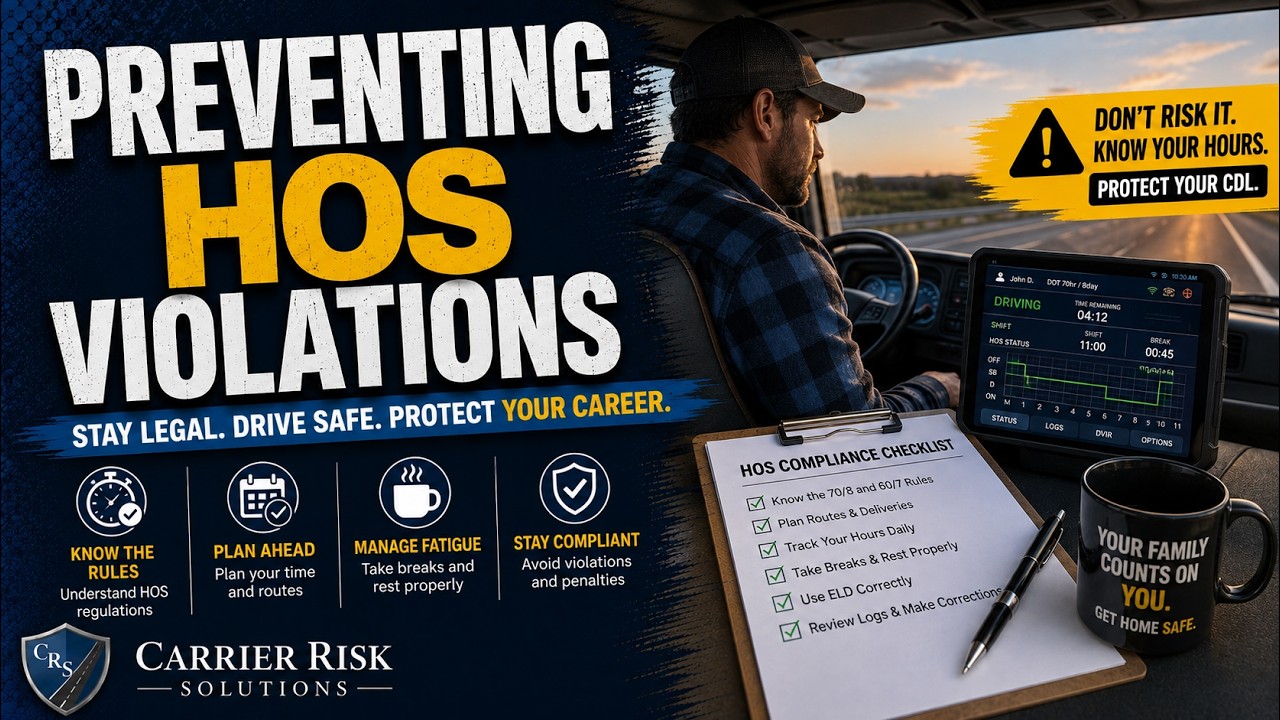
The presentation by Samuel Tucker, CPCU, CRM, provides a detailed instructional guide for commercial motor vehicle (CMV) drivers and carriers on how to avoid form‑and‑manner Hours‑of‑Service (HOS) violations under FMCSA regulations. It begins by classifying HOS violations into three categories—hours‑related, log‑falsification, and general form‑and‑manner—highlighting that the latter accounts for roughly a quarter of all DOT violations. The core of the talk focuses on the three key regulations that generate most form‑and‑manner issues: 49 CFR §395.8 (record review and certification) and 49 CFR §395.22 (ELD documentation, mounting, and portable device requirements). The speaker enumerates the specific obligations of drivers under these rules, such as daily review and certification of Records of Duty Status (RODs), accurate entry of personal and vehicle data, proper handling of edits, and maintaining up‑to‑date ELD software. Practical compliance tips are offered, including using an approved ELD, keeping the device powered, regularly reviewing logs, correctly setting time zones, and avoiding unnecessary edits. The presentation also outlines the mandatory ELD documents drivers must carry (8‑day paper log supply, user manual, data‑transfer instruction sheet, malfunction instruction sheet) and the mounting requirements for both fixed‑install and portable ELDs. Guidance on reporting and managing ELD malfunctions is provided, emphasizing prompt carrier notification and accurate duty‑status recording during outages. By following these procedural recommendations, drivers can reduce the risk of form‑and‑manner violations and associated penalties.
Chapters
Let's review some important tips that can help you prevent form and manner HOS violations. Accurate and complete records of duty status are essential for maintaining safety on the road and helping to prevent driver fatigue. Hours of service violations generally fall under one of 3 categories: Hours-related violations: These are when you violate your allowable driving or on-duty clocks or when you fail to take a required break. Log falsification violations: These violations occur when a driver makes a false report in relation to their duty status. This includes things like abusing personal conveyance status, unplugging an ELD device, using a ghost driver, or not properly accounting for unidentified driving time. General form and manner violations: These violations are far more common than in the other 2 areas combined. In fact, over 265,000 form and manner violations were issued last year alone. That accounts for about 24% of all driver DOT violations. These are generally simple recordkeeping errors or omissions, and today our focus will be on preventing this set of HOS violations. Most HOS form and manner violations stem from violations of 3 key FMCSA regulations: 395.8, 395.22, and 395.22. Let's review these critical regulations and then discuss how we can prevent violating them. 395.8 deals with the review of records and certification by the driver, and most form and manner violations stem from this regulation. These regulations require you to review your ELD records, make corrections if necessary, and certify the accuracy of the information in your records of duty status. You must review and certify your RODs for each 24-hour period. Any edits made must clearly indicate the reason for the change. Here are some tips on preventing the most common form and manner violations: Make sure that you're using an approved ELD device. Regularly review your RODs to ensure that they are correct and complete and make any necessary corrections in a timely manner. Always keep your ELD powered on and make sure that you log in as needed to avoid missing any driving time. Ensure that your personal information, such as your name and license number, is correctly entered into the ELD to avoid any incorrect reporting of your driving time. Take time to get familiar with your ELD and its features, such as how to certify your logs, how to edit entries, and how to transfer data to law enforcement. Be aware of any updates or changes to the ELD software, and make sure that you always have the latest version installed. Be mindful of changes when crossing time zones and make sure that your ELD device is set to your home terminal's time zone to ensure accurate reporting of your driving time. Make a habit of reviewing your logs regularly to ensure that your driving time is accurately recorded. If you notice any discrepancies or errors, report them to your carrier immediately. Ensure that all entries in the ELD are current to the time of the last change of duty status. Your ELD should automatically record the date and time of each duty status change, but check to ensure that your status is accurately reflected in the device regularly. ELDs automatically record information like duty status change, but you usually must enter details like shipping document numbers, vehicle and trailer information manually. You must ensure that you record this and all other required information accurately and completely. Avoid editing your logs unless absolutely necessary, as this can raise red flags during inspections. If an error is made, make a note of the correction and explain the reason for the edit in the ELD's comments section. Watch out for ELD malfunctions as devices can sometimes experience technical issues. Be aware of the procedures for reporting ELD malfunctions and for recording your duty status during any such malfunctions. Remember, any malfunctions or issues should be promptly reported to your carrier and addressed as soon as possible. The other 2 critical HOS form and manner regulations are found in 49 CFR §395.22. This regulation deals with required ELD documents and proper device mounting. You must always keep certain ELD documents with you, and they should be easily accessible in case of an inspection. Here's a list of the required documents: 8 days of blank graph sheets or paper logs to be used in case of device malfunction. Your ELD user manual must be kept in your vehicle to provide guidance in case of technical issues or errors. You must also carry an instruction sheet that includes information about how to transfer ELD data to an officer during a roadside inspection. Lastly, an ELD malfunction instruction sheet that shows how to report ELD malfunctions and record your hours of service until the issue is resolved is also Take these steps to prevent violating the ELD Information Packet regulations: Verify that you have an up-to-date and accurate user manual for the ELD that you are using. This manual should provide detailed instructions on how to operate the device, including how to log in and out, how to enter duty status changes, and how to certify the accuracy of the records. Ensure that you have an instruction sheet for data transfer mechanisms supported by the ELD, You should be familiar with these procedures and ensure that you can follow them if your records are requested for inspection. Be sure to also have an instruction sheet that describes ELD malfunction reporting requirements and recordkeeping procedures during ELD malfunctions. Ensure that you have at least an 8-day supply of blank driver's records of duty status graph grids onboard the vehicle. In case of an ELD malfunction, you must be diligent in recording your duty status and ensure that the records remain accurate and up-to-date. Lastly, 395.22 pertains to the use of portable ELDs. If you use a portable ELD, the device must be mounted in a fixed position during the operation of the CMV and visible to you when you're seated in a normal driving position. This requirement is intended to ensure that you can easily view and interact with the ELD while operating the vehicle, without having to take your eyes off the road or reach for the device. By following these guidelines, you can help ensure compliance with the FMCSA Hours of Service regulations and avoid potential penalties or fines from form and manner violations.