Online Accelerator Program M4 Waterfalls
This module (Module 4) by Sanjay Vora explains financial 'waterfall' structures used in capital raising and pooled funds. It defines preferred returns (prefs), shows simple and two-tier waterfalls (examples: 8% pref, 25/75 split, 50/50 above 20%), discusses handling operating distributions versus exit proceeds, and recommends simple fund-level passthrough or a flat service fee model.
Questions this video answers
8% annual preferred return
16% (8% × 2 years)
24% (8% × 3 years)
25/75 split (sponsor:investors)
50/50 split (sponsor:investors) above 20%
Chapters
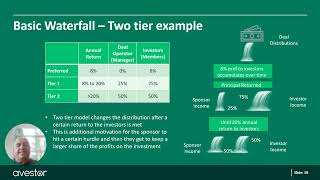
Welcome back, everyone. This is Sanjay Vora, and this is module four, understanding waterfalls. So let's get rolling here. So what is a waterfall? A waterfall is not what you always think of in terms of water coming down a mountain and, you know, looking pretty and beautiful. A waterfall in terms of capital raising is a common structure that is used when raising capital, mostly in syndications and traditional pooled funds. And, you know, we're going to extend it here for the customized fund as well. It's a key part of how a customizable fund can work as well. What a waterfall does is it is a way to really provide incentives to investors while balancing what the sponsor or operator is doing and making sure that they're treated equally. So it's a tiered structure where a sponsor takes a larger share of the profits as investors make more money. And really the goal of this is to align the interests of investors and an operator or a sponsor where investors really have no control over the deal. So the way a sponsor can ensure that the investors are taken care of is they provide them a specific set of returns before the sponsor and the operator who has control of the deal makes their own money. And so we'll go through exactly how a waterfall works and hopefully at the end of this training, you'll have a better feel for it. So a key component of the waterfall is what you call the pref. It doesn't have to be there, but it is very common and you'll see it in a lot of structures. And what a pref is, is a preferred return. That, and it's usually an annual. It's an annual return that an investor will make before the operator, sponsor of the deal actually starts taking their cut of profits. And the goal is to give the investors some clear set of returns before the sponsor starts kicking in their own. Because you don't want the sponsor or operator make all their money and then the investors get left hanging, especially when a deal goes back bad. And when a deal goes good, the waterfall allows the investors to make a good amount of money, but the sponsor can make even more money. Now, when you think about a pref, do not, do not associate it with the cash flow. Cash flow is the actual distributions that are coming out of an investment. A pref is more or less a promise that says you are going to give the investors a certain amount of money before you start splitting the capital gains or operating distributions with them. Okay, so it's not what the cash flow is. The cash flow could be less or it could be more than the pref so let's take an example of an 8% pref deal that lasts two years. If it lasted exactly two years, you would owe your investors 16% on their investment before the rest of the waterfall kicks in. If it lasted three years, you would owe them 24%. It accrues over time. So if the deal goes longer, then the pref you owe the investors is also longer. Now what happens as the cash flow is less than the pref in many years, and in that case, what you have to do is you have to track how much is unpaid of the pref every year and you have to accrue that. And then at the end, when the capital gains come and the profit comes at a refi or at a sale, you have to catch up on all of the pref first before the waterfall kicks in. Now, if more than 8 is paid out, then I'm going to show you a little way of handling that and how to deal with it. And that can vary project by project. But if you're projecting to have a lot more than the preface from an operating distribution standpoint, we'll cover that in a slide here in terms of what to do. So what is a basic waterfall? All right, if you look at the little figure on the left, you'll see kind of distributions coming in. Then you're giving 8% pref to your investors. That is accumulating over time. You're returning all the principal back to them that they paid into the deal. And then you're splitting it between the operator, sponsor and the investors. So what does that look like on a table? It's very simple. You'll see a preferred return row. That row basically says, hey, if there's a preferred return, here's what it's going to be. In this case, it's an annual return of 8% for which the operator or manager makes no money. And so really the investors are getting an 8% annual return on the pref. Then what you'll see is anything above 8, you'll see a 2575 split. That means once the 8% annual return is given, everything above that is split in terms of 2575. So this is a very simple, straightforward waterfall, can be executed quickly. Calculations are simple and very, very common structure that you can use. Now you can get a little bit more complicated if you have a deal where you're projecting, hey, it's going to be a super high irr. I don't want to give my investors all of that money when I'm doing all the work. I've come up with a plan here. Then you could set up let's two Trier waterfall. You can even get more fancy, but we'll stick to the two tier waterfall. So in this example again you have an 8% pref, but then tier one, you've capped it at 20%. So once you return a 20% return, you're basically up to 20%. It's a 25, 75 split. Then over 20%, you're actually as an operator taking more money and you're taking 50 and giving investors 50. And you could even go further than that. You could cap it and say, hey, I'm going to give you that 25, 75 to 25%. And then above 75 I keep 100% as the operator investors get 0%. You have the flexibility from a sponsor operator standpoint to set this up. But again, the model gives you a lot of flexibility. It aligns the interest of the passive investors to the interest of the operator. By giving a preferred return and then a split as the performance grows, the operator makes more money. This is very common in institutional deals and very well, you know, received by investors. So highly recommend this especially for equity investments. You should definitely consider this as an option. All right. Now in a lot of deals you'll have operating distributions and then you'll have capital events. And sometimes you might need to split those two waterfalls out. And the case is, especially when operating distributions are going to be heavy, you may want to have two waterfalls. And an example could be that one first waterfall would be for operating distributions. There you'd say, hey, it's a 75, 25 split across all operating distributions for let's say a five year deal. Then when we exit after five years, you have a different waterfall that's 8% pref and let's say 50 50. And so what you're doing is you're saying, hey, I'm going to give you 75% for the five years that the deal was running. But then I'm going to go ahead and make sure that the deal at exit ensures that you have an 8% pref across the five years, which would be a 40% total return and then 50, 50 structure after that. And so what that does is it allows a little bit more control when you're expecting heavy distributions, if you're not expecting high distributions or if you think your distributions and cash flow is going to be less than what the pref is. So let's say your cash flow is 5% and the pref is 8. I wouldn't worry about this. There's no need for the additional complexity in explaining it. But if it's a high, you know, high operating distributions, then it's definitely something to consider. All right, now let's take a step back. We've talked about the lower tier, where the waterfalls are happening. So let's say the top tier or the top table on the right shows the annual return, which is 8% pre F80, 20, tier 1, and the operator or deal sponsor is the operator. And then the fund has pulled capital together and invested. So now what's happening is the fund has received the 8% preferred and then the tier one kicks in and it's a 20%, it's a 20, 80%. All of those distributions, the 8% preferred and the tier one distributions of 80% are all flowing into the fund. But now you're a capital allocator. How do you handle it? You would basically take a service fee. So you would say all of the distributions that are coming into the fund, we're going to split those distributions between the fund manager and the fund investors. And what you would do is you would just take a flat rate of, let's say, 10%, and then 90% gets to the investors. In this model, it keeps it very, very simple in that you're not trying to explain a waterfall at the lower tier and then another waterfall at the fund level. Instead, there's a waterfall at the lower tier that talks about what the fund is going to receive. And then you as a fund manager get a service fee that's a flat percentage of everything that's returned to the fund independent of performance. So it's a simple model, easy to calculate, easy to control, as you're doing a lot of deals. And this is the model we generally recommend from an investor standpoint. So in summary, you know, waterfall structures are really, really important, and they set up a win win model between investors and operators. So, you know, don't make your waterfall too complicated. Just creates a lot of headaches later. And then what you'll want to do is summarize for your investors what they will receive from the waterfall, especially as part of the investment disclosure. So if you're an operator, you're taking that promote at the lower tier, you pass through all the earnings at the fund level, and then at the fund level, usually you don't take another service fee, you just pass it all the way through because you're making all of that income at the lower tier. If you're an allocator, you're not getting the portion of the promote that the operator or sponsor is taking. So you're receiving all of the money at the fund level, then I would recommend you take the service fee as part of the distribution. So now you're getting compensated at the fund level. So hopefully this kind of helps explain exactly how this all works. Explains simple waterfall structures. And again here, this is a very simple, fast overview, basics, you know, at our two day accelerator, if you haven't been there, we can jump in much more detail, talk about a lot more complex aspects of how waterfalls work. But this gives you a good preview. All right, thank you all and have a good day. Bye bye.