Facing the Fears behind your excuses LAW Video
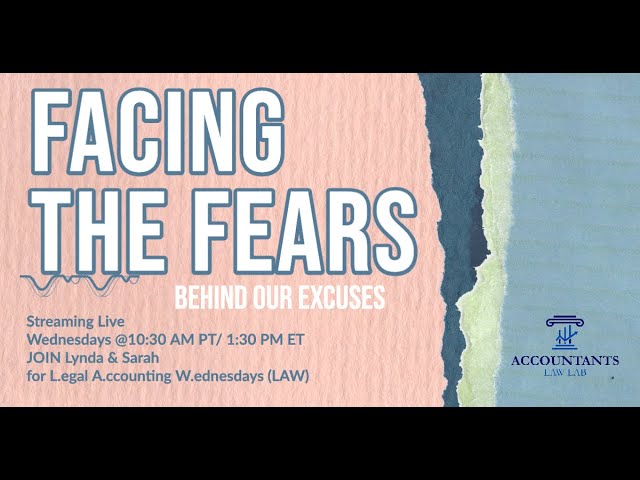
In this informal livestream episode of Legal Accounting Wednesday, hosts Linda and Sarah Prevost explore why professionals—especially accountants and bookkeepers—often stall on their goals. They identify the "I can't" mindset as a symptom of underlying fears such as fear of failure, rejection, timing, and procrastination. The conversation weaves personal anecdotes (Linda’s birthday sky‑diving wish, a yoga class sticky‑note exercise) with concrete tactics to break the cycle: writing down and vocalizing limiting stories, journaling, meditation, visual reminders (e.g., writing a check to yourself), flipping worst‑case scenarios, using the "T" instead of "I can’t" mindset, leveraging accountability partners, and learning to say no. They also discuss confidence‑building when dealing with attorneys or clients, the power of group support, and the importance of treating goal‑setting as an ongoing practice rather than a static list. The episode ends with a call to join their community groups for continued support.
Chapters
Nope.
Sarah, what's this?
Sorry, my camera's being silly.
Now I can't hear you. Oh no, can you hear me? Can you hear me okay? But that could be my computer because it's been that kind of day. Let me check because I've had my EarPods on with all my, uh, meetings today and I've been Extremely noisy. Let me check my other button. So it's not the other button because we've had that happen too. And yes, Zoom doesn't like me. Now I can hear you. It keeps switching to the Yeti, wanting me to talk on the Yeti. So hello, welcome to Legal Accounting Wednesday. We're still talking goals, right? So we're still— I can't wait for you to get drapes in here so it's not so loud.
Yeah.
We're still talking about obtaining your goals and We've kind of moved from last week, was a little bit about motivation, and this week we're kind of kicking it into what kind of stalls you and what can stop you, right?
Mm-hmm. Cheers.
Lots of things can stop you. OK, I'm going to share my screen and pray to God that it's the right one because the way today has gone.
I know.
Can you see it?
Yes, I can. I really like what you did with the photo there. That's pretty cool.
Oh, you know, the funny story about this. So the other day, because as you know, as you are well aware, I've got a milestone birthday coming up. And I know I was out with a bunch of my good girlfriends that I go out with all the time. And I was out with them and I said, hey, I've got this big birthday. You know, I want to celebrate with you girls because we go out all the time. Like once a month we get together. So I said, I want to celebrate with you ladies. What do you want to do? And one of them said to me, we'll jump out of an airplane with you. And I'm like, yeah. I said, yeah, you know, I've been offered this before. I've never been offered to jump out of a plane before. I offered to have somebody do it in tandem with me because she's like, I'll do it in tandem. I said, have you ever done it? She said, no. I said, I think I want to go with somebody for my first time that's already jumped out of an airplane.
I think you have to do it that way as part of the schooling and the insurance stuff.
I want to do that. I think you get a little bit more comfort out of it. I don't know. For me, I think it would be good. Yeah. She blurted that out. I was kind of surprised. I was kind of figuring we could go like— we kind of settled on maybe going to Key West and having some time in Key West. But I digress. So facing the fears behind your excuses. So how's everybody doing with their goals? So we've been talking about goal setting. I'm curious to know if everybody, anybody who's following us is still staying on their goal path and still staying with what they are wanting to achieve? You know, you wrote them down, we kind of worked through all that. Is everybody staying with that? Are they, are they considering keeping their goals or are they getting stuck? My biggest thing I mentioned last week was motivation. So we're just going to go through a few ways to stay on course. And some, we'll just talk first about what some of the things are that will That stop you, right? And I can tell you my excuse.
Well, the motivation part too, Linda, with motivation is, is, you know, comes with a lot of other— there's obviously some natural fear behind it. But if you, like we said last week, if you just start somewhere, if you write it down, even if you put this one goal, just one, get through your to-do list for the week or do XYZ for yourself for the week, it doesn't have to be just business related. But obviously starting something.
Exactly, it can be anything, right? It can be losing weight. I mean, there can be tons of things. Who doesn't have that goal already? Or wanting to get better, maybe not so much losing weight, but getting healthy. Certainly a goal. But if you think about it, the words, I can't, have you ever told yourself, I can't? In your head, you've got this goal. Let's just say like, I've got a revenue goal. I'd like to have, $500,000 in sales this year. Oh, I can't do that. I'm looking at my numbers, half the year's gone by. I can't. Or maybe I can't grow my firm. I'm stuck. I can't find anybody to hire. Or I can't market. I'm an accountant. I don't know how to market. Or, you know what, I'm done with this goal thing. I'm gonna put it aside because I can't reach my goals. So you start that repeat. I can't, I can't, I can't, I can't. And you're gonna Pretty much make that happen.
I would say I can't shelf, like, there's like a bunch of stuff. Like, just imagine that you're putting in the box and you're putting it away and you're putting it away. What happened to all of that over there?
Yeah, I could say it about jumping out of an airplane. I've pretty much in one part of my brain, I'd like to do it again with somebody. Actually, I've talked to somebody about it. So maybe with that person jumping out of the plane, you know who he is. Or I I, you know, I can do that. I'm kind of visualizing being 80 though when I do it. So if I screw up, it doesn't matter. Yeah. No, you know, I mean, it can be fun. You're funny.
If you screw up, it doesn't matter. Yeah, kind of.
I still expect to be working, right? So what causes the I can't? Is it fear?
It's everything. If you think about not just fear, there's timing, there's probably a bit of procrastination in there. Because you can say I can't for XYZ. There's so many, there's probably a lot of reasons why. I mean, you kind of talked a little bit earlier about why the I can't.
So, I mean, it could be, you could be sitting here going, you know what, I can't do this. Um, I can't market. It's going to look terrible. People are going to make fun of me. So there's like a fear of feeling a little bit rejected by your peers or your— maybe your clients, I don't know.
Or your friends or your family. Depends on who follows you. I mean, there's like, uh, it's— yeah, doing a lot.
I have a goal of $500,000 in revenue this year. Is it a fear that I'm not good enough to get to that point? Because these are the things that happen, right? You start to You have to really analyze where it's coming from. Or maybe you're just looking at it like, you know, I don't feel strong enough. I feel a little weak when it comes to this. Um, maybe it's just a fear of failure. Maybe you have a fear of failure.
Confidence.
What will other people think? I think a lot of people spend time thinking about what will other people think, right? Uh, a lot of times, you know, you could have that fear. I've had that fear when I've gone to a wedding. I've literally, especially in my first marriage, sat on the sidelines and wanted to be dancing, and he would not dance. And I felt kind of weird dancing with other people. I never— I think it was more, or even going to a restaurant by yourself. There's that fear of— it's a fearful thing to get up and just sit and have dinner somewhere alone, right? Maybe you have a fear of just being too nice. You could have that.
Yeah, yeah, you could. It's funny that you say the dancing thing, because I'm like, I'll just dance. I don't care.
Yeah, but some people, some people are sitting on the sidelines at wedding and you know that some of them want to dance but maybe their significant other doesn't.
Yeah, so they're afraid to do it alone. Yeah.
Yeah, you get over that fear. I had fear, you know. Yeah.
Oh yeah.
So what was— what's holding you back from, from accomplishing your goal and your mission? What is, what is tying you, tying you down from it, right? And, and this is the work. This is the work in getting these goals accomplished. You really have to do the work. It's not just write it on a piece of paper and, and And put it aside and hope it never happens. You really have to do the work for it. I'm kind of working on things now because I'm in this course that, you know, that's really— it's giving me that motivation.
Mm-hmm. Well, the other thing too is, what did some people say in some of the books I've read? Like, I think it's the Badass book or something like that where you write a check out to yourself and you put a date on it. That's a simple thing. Yeah. And you keep it really visual. I mean, it's not something you tuck away. But you, you keep it visual.
So I think this though, it's really about— I love this graphic because it's scratching out the T. So it's all about changing your mindset, which is what we talked about last week.
Maybe sometimes you need to start with what you can do to help get through the I can't list. Maybe it's that 2-sided letter T. Do the T instead of those credits.
You're going to have to go back in time now. That's okay.
Yeah.
So these are good questions. Yeah, I mean, if you've ever— have you ever told yourself I can't? Absolutely. I think every human being has. And then maybe write it down, write a journal, like what's holding you back and what are you afraid of? And sometimes what's holding you back is the stories in your head, right? So what are the stories that you tell yourself? They're most likely false, that you aren't strong enough, good enough, confident enough, right? Those are important things. I think sometimes too, if you can write down your stories, if you start to see the negative stories, write them down and figure out— it kind of makes it in your face if you're writing down like, fat today, like, I am so not where I want to be weight-wise. So you write it down and then you look at it, you're like, wow, I'm really mean to myself, right? I mean, that can have an effect on you too. And then vocalize it.
Self-talk.
Your thoughts.
Yeah.
If you start to sit there and see how many times you talk yourself out of something, right? I think that if you write it down and say it out loud, it's going to probably have an effect on you. Like, that is not true. That is not me. So you can start to shift your stories.
Um, what's the thing that you do? Um, there's the avatar thing, but really sometimes it's the way you see yourself. So you write a description of yourself, right? The way that you see yourself. And there's these tools out there that you can do, like, like, what's your perfect client? There's all these things that you can do, right? What you want to attract. And then you realize, sometimes you're writing about yourself, or your fears come through that. And absolutely, those are those moments that you can kind of deep— go into it deeper and understand, okay, why am I self-reflecting? What's happening here? So.
So Veronica is here with us and she said, when I started my business, I was frozen by fear. I kept saying, but I'm not an entrepreneur, I'm not a salesperson. I think that's a big one for accountants, right? That I'm not good at sales. And then she realized that she focused on herself. I just had this conversation with my daughter this morning about focus on the things you can change, not the things you can't change.
Yeah.
She was willing to make herself uncomfortable. And that is key, Veronica. You are absolutely right. That is key. I love it. You have to step outside of your comfort zone. Clearly, that's what I would have to do to jump out of a plane, but that's a really graphic way of putting it. But you have to step out of your comfort zone. So it's gonna feel scary, but I truly believe— oh, Stu's gonna leave us— but I truly believe that if you write it down and read it out loud, the things that are holding you back, you can shift your story. Um, it might suck at first. So if you start to see that you're a Negative Nancy to yourself, That might stink. I mean, you might be like, oh my God, but you'll realize it. You'll realize that you're talking yourself down. And then emotions might come up too. You might have a flood of emotions here with that.
There's the other thing too. I was reading an article about a self-made billionaire or millionaire, whatever, one of those. And one of the things that he learned in his journey was you flip it. So what could happen? What's the worst that could happen? Once you flip that, which I think is really what Veronica is kind of helping say is what you find that uncomfortable about. What's the worst that can happen? And then you lay that out and you kind of revert. And then you find that you find more I cans versus I can'ts, because the worst that could happen is this, you know, rejection, the answer is no, you're selling when you really don't want to sell. All of those little things that you're not really saying that you don't want to do, but you're not doing. Just, you've got to think of the hat that you're going to wear when you're doing it, not— what you're thinking you're portraying you're going to be. Just genuinely be you and put yourself out there in a different way, whatever that is.
That's a great tip, Sarah, because I think that if you— and we did a thing in yoga when I was in training with yoga, because we would sit in this circle called a satsang and everybody had their turn to talk for 5 or 10 minutes about what was going on in their life. And typically it would be like little short conversation, then you get to somebody that was just dying to tell something. And it got to the point, because we had 10 women in my teacher training, and it got to the point where we actually got a sticky note and people were writing on a sticky note in a Sharpie, I am beautiful, and you stuck it on your mirror. So every time you went into the bathroom, you said, I am beautiful, I am beautiful, I am confident, I am whatever you want to put there. And it's amazing, seeing the words can help lift you up.
Yeah.
And I think that that's definitely, um, you know, but when— if you start to just go through, I love the flipping it because that's a great tip, because if you start to Write it down and see that you're really talking negative. Or if you're afraid of something, thinking ahead of what's the worst that can happen. If I go eat dinner at a restaurant all by myself, what could happen? And I've done it. I've sat at the bar, so it didn't feel as weird as at a table. What's the worst that can happen? Bartender could talk to me. Guy next to me talked to me and said, hey, I'm from Rhode Island, when I asked where he was from. And then that whole turned into a whole other conversation. But I was afraid that day to go into the restaurant. I was all by myself traveling, and I was like, I didn't feel weird sitting by myself. It wasn't at an airport. I'm okay with it at an airport, but outside I felt weird in it. You have to get over that. You have to get the— and if you think about what could happen, what could happen there? It's a scenario, really not much, right?
Somebody talks to you that you don't want to talk to.
I'm sorry, but you— Out there very vulnerably, right? Yeah, I was afraid. Nobody knew it though. Nobody knew I was nervous about that, but I was able to change my story.
And the labels that you, you wear when you don't mean to wear them, but you've got them, and they're either up here floating over your head, they're on your shoulders, they're like you're saying.
But you need to perpetuate new stories. You can take away the old stories and take and make new ones to help you get to your goal, right? Um, And it's something that I think comes into play when we work with attorneys, right? So you don't want to show the attorney your weakness, for certain. You do not want to come from a weak place. If you're working with an attorney that happens to be very powerful, like I'm doing right now, stand up. Stand up in the meeting, separate your feet.
Yeah.
Steady yourself and just look at them. Look at them. Zoom's a bit different. You're not in person, but you don't want to show your weakness. You want to come in with 100% of confidence. You want to show them that you're equal in your industry, which we talked about when we did the personality thing. Jonathan Fishman gave us a great tip, which he's—
Oh, yeah.
This week. So this is really cool. Yeah. But especially if you're working with bigger firm and you're working with multiple partners. But we find that for us, I think, in fact, because we are partners, it helps us with that because we're not one person standing there, we're two. And we have people in the group that have to stand there. And part of what we're doing in the, in the group is helping to empower them and helping them with the words to use. That I think is one of the, one of the bonus tips from being in the group for certain.
Yeah, well, and it helps. It does. You know, if you are afraid of— if you have a co-partner that you can have on or someone that's a lead in your team that just can listen, they don't have to participate in the meeting, but they're a resounding sounding board for you. That may be affirmation of like, no, this is the way we operate as a company. Just whatever works to make it a more meaningful conversation to get what you need out of it, not to have a combative relationship kind of deal.
Yeah, I think it's easy. I mean, some of the people in our group have shared that because I'm just a bookkeeper, they've had all this schooling. Like, no, don't say those words. That breaks my heart every time somebody says that. Like, I feel so— they've had all this schooling and it's like, yeah, they had schooling for what they're doing. You're right here now having schooling. You are educating yourself and you are elevating yourself to a new place. That is what we want everybody that watches this to do. We want you to elevate. So, if you are goal setting, connect to the goal setting, try to stay motivated, maybe get that accountability partner because that is always good.
Yeah.
And then get past the stories, get past the excuses. The stories are in your head. Remember that your story is in your head and you can flip them. Like you said, you can flip them. One of the things big time for me For me, when I'm struggling, my meditation practice and my journaling. In fact, I think I even have my journal right here. I do have my journal right here. So, um, you know, I, I make it part of my practice to, to meditate, and then I journal right afterwards. And I have like a whole ritual with my meditation. It works for me to continue. I look forward to it now. Um, and I've got some really great tips I'm going to share when we do Scaling New Heights.
Okay.
And I've got a really good, like, point in the, in your head that you can— it's a Chinese medicine, it's an acupressure point, but it will help stop the clutter. Because this week, especially because I'm in the boot camp, my head is so full of clutter. I woke up this morning, my jaw was tight because it was tight in a good way. It wasn't tight in a stressful way, but it was like I had so much happening in my brain. Stories, stories, dreams were coming through.
I know.
Ideas. And I was like overwhelmed. So I mean, journaling helps get it out and then you can rearrange it. Um, the power of no. This is a tough one. I usually Every time somebody gives me an opportunity, I'm like, okay, sure, okay, sure. Sometimes you gotta evaluate. So take a breath. They don't need an answer right away. Step back.
Mm-hmm.
And then look at that opportunity and say, is this going to benefit me in the end? Is it gonna benefit me? And if you're helping a friend, that's one thing, but if it's going to benefit you, then maybe you can take it. If it's not, power of no is huge. So maybe you can use that time for something better.
And yeah, it's, it's an interesting— it's a hard one to do. It's an interesting journey to have for yourself. Admittedly, I struggle with this in all facets of my life. But I feel like what we can do is, even if it's not a no right up front, if it's a moment, give yourself the pause moment. Let me think about this. I'll get back to you. It allows you the opportunity to decide if it is, because sometimes people back you in that corner and you're like, Not ready yet, hold on. But how do you get out of that? So, so yeah.
I'm trying to figure out how to get the slideshow, but everything's really opened up really big on my screen. Oh, I can't even get out of it. Um, yeah, so I can get out of the slideshow, but it's not going to show you much. But yeah, so I think that, um, I— no clue, Zoom doesn't like me today. Big marker, forget it. I am like at my wits' end.
I know, I know, we're trying. Yeah, yeah. It's not letting you out of this at all to go— not to stop share or even—
Nope, it's, um, I can try here maybe if I stop this. Yeah, it's just been technologically challenged. Maybe that's just me, but I don't want to tell myself that story. I found it, it's the 2-screen thing. I don't want to tell myself the story that I can't do it. I'm going to keep trying until I get it right. Right. That's the thing. But I hope everybody enjoyed us talking about goal setting. We're really kind of wrapping our heads around this and trying to continue the conversation in different ways, hoping it motivates people, hoping it helps you to sort it out, because goal setting can be— it can be hard. You could set a goal and then go back and maybe change it too. I mean, you don't have to live by it, but you can certainly do that. I think that, um, and if anybody's interested in joining our Facebook group, we'd love to have you. And then we also have the other group too, so I'll put the links in there. Maybe, um, Sarah, if you have that information about how you can flip it, we can throw that in the group too.
Oh, that article piece? Yeah, I can go back. It's one of those things like you're reading, like you're up insomnia or something of that nature, and I'm like, oh, what's this? And yeah, I found it fascinating because it is a mindset that Allow— I feel like what it did for me is unlock, okay, what am I looking at here? How do I get past this? What is the worst that could happen? And when I ask myself that, that really helps me get to the next stage, right?
I feel— I know, and it does. And goal setting is a practice. I've been doing it for years, and I, um, I like to say it out loud. It makes a difference. It makes it real. And tell people, tell people, because you know what's the worst thing? If I told you I want to make $1 million this year Stretching in here. And Tina says she loves our ideas. That's great. If you throw it out there and you tell people, do you think people are gonna ever come back to you 6 months ago and say, hey, how'd that goal go? Maybe they will. And you just say, I'm still working on it. You don't have to really, you know, I mean, but if you say it and put it out there, you can make it whatever it is you want to. I think that, yeah, I think that you can shoot for the moon. Yeah.
And sometimes there's fear behind just saying it out loud, like, oh, but maybe if it's one thing you really want, just put it out there in the universe and let's see what goes with it and follow that.
Vocalizing can make it real.
Yeah, absolutely. Well, it's been fun, Linda. It's always great.
Another good Legal Accounting Wednesday. And we will see you next week. If you're in the lab, we'll see you in the lab. And thank you all for watching. Absolutely.
Thank you.
Bye, everybody.
More from Sarah





Mid-Year Bookkeeping Review: How to Catch Errors, Fix Discrepancies, and Set Up a Strong Year-End

Best Bookkeeping Software for Mid-Size Law Firms in 2026 | Clio, QuickBooks Online & More

Enhancing Cash Flow Forecasting: Tools and Techniques for Law Firm Bookkeepers

Trust Accounting Compliance: Avoiding Common Bookkeeping Pitfalls in IOLTA Management

Improving Client Billing Accuracy: Best Practices for Time Tracking and Invoicing in Law Firms

Year-End Financial Close: Streamlining Bookkeeping Reconciliation for Law Firms
