From 300 to Over 25,000 Subscribers with Beachly Brands
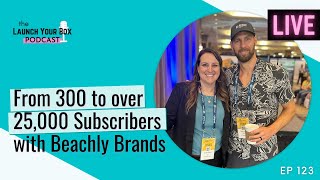
In this live episode of the Launch Your Box podcast, host Sarah Williams interviews Kevin Tai, co‑founder and CEO of Beachly Brands, about the evolution of his subscription‑box business. Kevin recounts his early entrepreneurial background, his first exposure to the subscription model through Loot Crate, and the initial Waterman's Pack experiment that taught him the limits of a niche market. He pivoted to apparel, launching a men’s surf‑apparel box in 2016, and later a women’s quarterly box in 2018 using a scrappy MVP approach (DIY photo shoot, low ad spend). The women’s launch generated over 1,000 sign‑ups in the first week and eventually grew to about 25,000 subscribers. Kevin discusses unit economics (pricing, CAC, AOV), the decision to keep the men’s box monthly and lower‑priced while positioning the women’s box as a premium quarterly offering, and the later addition of a beauty box as a down‑sell. He shares scaling challenges—fulfillment, moving to a 3PL, hiring customer‑service staff, and outsourcing marketing—along with the difficulty of reaching the first $1 M in ARR and the importance of understanding the full business model before scaling. The conversation ends with practical advice for aspiring subscription entrepreneurs: build an MVP, avoid over‑thinking, automate or outsource non‑core tasks early, track unit economics, and focus on sustainable growth, retention, and LTV in a market with rising costs.
Chapters
We are recording a live episode of the Launch Your Box podcast today. And so I am Sarah Williams, the host of the Launch Your Box podcast. Today I have with me Kevin Tai from Beachley Brands. We're going to break down Kevin's subscription box journey. He's got some strategy he's going to share with us and we're going to do it all live. Right here with a studio audience. Are you guys ready? All right, Kevin, let's talk about it. Let's adjust. Kevin is the co-founder and CEO of California-based Beachly Brands. Let's talk about your subscriptions first. Let's give them an idea if they don't know what Beachly is. What is Beachly? What subscriptions do you have? Let's break it down.
Sure. So Beachly is the leading subscription retailer of beach apparel, accessories, and beauty products. We have 3 3 core subscriptions. It's called our style subscription for women. We have a style subscription for men, and we also have a beauty subscription. And then in addition to that, we do have traditional e-commerce where members get special deals and early access to products as well.
I call that all the things. Kevin does all the things. So he has multiple subscriptions in the beach and the outdoor lifestyle arena. He's also an Inc. 500, one of the fastest growing companies in America. So we're going to talk about your journey for entrepreneurship. Entrepreneurship because my audience that listens to the Launch Your Box podcast are really in their beginning stages of being an entrepreneur and being a small business owner. So I want to get an idea how this started for you. Will you— let's go back. How far are we going back?
Oh, we're going far back. Okay. 20— 2014, I want to say, is where the ideas popped into my head.
Okay, we're going back to 2024. No, 2014.
2014, 9 years.
I don't know what day. It's fine.
You went to the future.
I did. Okay, so take us back on your journey. How did this start for you?
Yeah, so going way back, uh, it's kind of interesting. I've been a serial entrepreneur, started my first venture in college. I've had some successes, more failures. I've learned a lot more from the failures than I had the successes. But I had a company before this, it was called WeBrand, and I was fundraising for that company. I was in a, in a meeting with a potential investor and he had a space in LA. We're going to the meeting, I hear music just blasting in the background and I keep looking back and he sees me, uh, he sees me looking and he's like, oh, you hear the music in the back room? And he says, come check this out. And he opens the doors and it's, uh, Loot Crate. They were very early on and they had hired TaskRabbits for the day to go pack their boxes.
And you say a TaskRabbit?
Yeah, remember TaskRabbit?
I don't have a TaskRabbit, but I'm gonna write that down.
I don't know if it's still around, but it was one of those apps you could, yeah, hire people for the, for day work. So they're hiring people to pack their boxes for the day. And why this is relevant is this was actually my first exposure to the subscription model. So you see, when I looked up Loot Crate and I saw, you know, the subscription box for the Comic-Con crowd, they, you know, had a rise and a fall, but they were, you know, massive at one point. But that always stuck with me. That I was like, oh, that's an interesting business model. The company I had, uh, at that time ended up— that one did not work out. It was chalked up as a loss. Uh, but that's okay.
Failure comes for all of us. Okay, we all have failures. Lesson number one.
Yeah, so I was taking some time off, uh, after unfortunately that company didn't work out. I took a trip to Hawaii to reconnect with the beach life, the surf culture, all the things I loved that I had lost sight of when I was trying to, uh, go working on that other company. And I said, you know what, I'm gonna, I'm gonna give it another go. I want to start another venture. And I was like, what should I do? I want to— I was like, I want to build something around my passions and other people's passions. And since I was little, I'd always wanted to own a surf shop. And I was like, that business model is not that great, so what's other business models that could work? And it kind of clicked. I remember that day when I saw The TaskRabbits packing boxes for Loot Crate. I was like, let me explore this subscription box model. And I saw how well it worked when you have a passionate audience, a passionate target market. And I said, hey, let me see if anyone's doing this for surf culture, beach life, even in bigger picture action and outdoor sports. And there were no players in the space at the time, so I did a feasibility analysis, found it super interesting, and I reached out to some pro surfers I know to see if they'd be interested in, you know, coming on as a co-founder and helping me launch and got a lot of interest. And from there we were off to the races.
So you start, you start Beachley Brands and you start with the men's box first.
Yeah. Even— well, so the first iteration, lots of iterations. So you're constantly pivoting and growing. So the first iteration—
pivot's our middle name, everybody, right? Like pivot's our middle name.
Yeah. So the first iteration, was actually called Waterman's Pack. And what a waterman is in the surf culture is someone that is great at all sports, all water sports. And like I said, I partnered with a pro surfer. He's a big wave surfer from Hawaii, also known as a waterman. Waterwoman too. But, you know, so we were— him and his buddies were curating gear, all sorts of water sports gear that were going in the boxes, and we were sending those out. And that was our first iteration. Something I was really passionate about, something I thought was super cool. But we did a 6-month test. We didn't spend any actual money on marketing. It was all organic. We used his, we leveraged his social media following to drive some sales and see how it goes. And what I learned, which is super important when you're looking at starting your subscription business, is one, the market size was too small. So I was, you know, there's The products are polarizing. There's not that many people that actually want to be a quote-unquote waterman, even though, you know, so I was like, all right, this is— I love what I'm doing, but the market size is small. We're not going to make any money off this. And the margins weren't great either. Margins on hard goods aren't ideal. So what we did though, we saw during our tests that when we put apparel in the boxes, it always did well. So board shorts, t-shirts, sandals, sunglasses, things like that.
Everybody loves those a lot better.
Margins are great. Lots of, you know, plenty of options there. So We went to the drawing board and said, hey, if we're ever going to be able to get some scale and ideally make some money, we need a bigger market size. So we said, let's go back to the board and go back to the drawing board and let's focus on apparel. So then we launched in fall of 2016 our men's surf subscription, which is all focused on men's surf apparel and accessories and things like that.
And when you launched your men's subscription box, How many subscribers did you kind of start with at that time?
I think we had around 300 from the Waterman's Pack days from that test that came over. And then, yeah, we, and then we went ahead and started spending money on customer acquisition, you know, on day one. Not a lot, you know, a few thousand dollars a month, $5,000, $10,000, started ramping up and the numbers looked, you know, looked good.
So, okay, so then you're getting some traction with the men's box, apparel is working, and now you're shifting into women's. How does this come out? How did you decide it's time for you to go all in with a second subscription box?
Yeah, so women's was always in the roadmap, but at the time I was chief everything officer, literally. Customer service agent, I was packing the boxes, I was doing all that. And I was buying the product, and I can buy better for men than I can for women.
I can see that about you.
Yeah, so men's was the lowest-hanging fruit, but I knew looking at the success of subscription boxes, Women are obviously huge buyers of subscription boxes and early adopters. So I was like, "We'll get to that soon." But from day one, we had women reach— As soon as we started running ads, we had women reaching out saying, "Hey, why don't you have a box for women? Why don't you—" I was like, "Oh." I was like, "We want to." I was like, "We can't yet." But I was like, "All right, we need to fast-track this." It really wasn't fast-track. It still took about another year, year and a half before we launched a women's, but I spent that time researching what I thought would work on the women's side. And what we were doing for the men, I thought would be a little too complex on how many sizes— I mean, the men's in general, the size apparel, it was all size apparel and some accessories. But on the women's side, yeah, figuring out what did I think was really going to work for this audience and what does this audience want. And I saw the success of FabFitFun, of brands like Altru, and saw what they were doing and kind of took what I learned from what we were doing and, you know, the best of the other models and come up with an idea that I thought, hey, I think this will work for the women's audience.
So you launched the women's box. How does that go? Yeah, so we—
it was May of 2018 and I said, all right, let's— we'll do a— we called a down and dirty photo shoot where I shot the photos myself, hired a friend as a model, um, went and, you know, went to some surf shops, bought women's products, that type of stuff that could be in the box. Threw up a landing page and I think we threw $5,000, $10,000 into an ad spend and said my goal was let's run it for a month. Let's look at what our customer acquisition cost looks like. And if we acquired a couple hundred members, I was like, okay, based on what we were spending, I was like, this would probably make sense. We'll refine and then we'll relaunch officially and lean in. We had over 1,000 signups in the first week. Oh my goodness. So I was like, oh, this is what product market fit looks like.
So let's just back, let's pause there because you just dropped a couple bombs on us. He did his own photo shoot. He got his friends to model. He probably used his own camera. We don't have to hire all the things. We overthink that so much in our businesses that we have to get things perfect all the time. We just need to do it the down and dirty Kevin way. We're doing that every day in our own businesses. We're scrappy. We're building these businesses from scratch. Kevin's not any different from that. So you get 1,000 subscribers in your first week launching the women's box. How did that feel?
Yeah, real quick, just taking a step back, minimum viable product, MVP. And even at our stage now, I tell our team everything, just Do the MVP. You don't need to build it out perfectly to test the market and launch. And we did the same thing when we launched our beauty box and things like that. So all about, yeah, what you touched upon is MVP. Let's not make down and dirty Kevin way a thing.
I love it. We're gonna get you a t-shirt. You'll be an honorary member.
It'll be fine. But yeah, how did that feel? Really interesting, the first day we launched, ads were starting to kick off, weren't getting much traction, and then all of a sudden, we started seeing customer acquisition costs that we'd never seen before like that. The subs started coming in and we had super interesting, so the numbers on our men's box, and at the time we had a monthly men's box, it wasn't quarterly. The women's we did quarterly and I doubled the price, so it was $99 a quarter with a small shipping fee. The men's, We did monthly and it was half the price. We were doing $49 a month and our CAC at that time was in the 50s, but you're looking at a $49 or so with a discount, you're probably at a $39 AOV. We did zero discount on the women's, so we had just under $105 AOV and our CAC was $20. And we were just like, there's a—
It's unbelievable. Can we just relish 2018 Facebook ad spending?
I know, that's really cool.
Can we just have a moment of silence, rest in peace for 2018 Facebook ad spend? So you had a premium box, so you shifted. The men's was monthly and cheaper. You decided, let's go quarterly with the women's. We're not going to discount it. We're going to show that this is a premium subscription for women. We're going to hold its value. And it just went like wildfire.
Yeah. Yeah. And we were so much, you know, we were doing the MVP and then we were like, oh crap, we need to just go. Let's just go.
So we're scrambling now, right?
We're scrambling and just, we need to buy more product. We need to, you know, how do we ramp this up? So we just all of a sudden, yeah, rolling up our sleeves and diving in and how, you know, when you catch the momentum like that, you don't want to give it up. So at that point we just scrapped and said, let's, let's keep going, you know, and let's try to take, you know, I guess keep the momentum going as long as we can. Yeah. And yeah, it was a hectic time. It was exciting though, because we were like, wow.
What was the highest number you got on that subscription? Do you know that? As far as subscribers?
Like on how many subs there are today?
Yeah.
On that one? It was around 25,000.
25,000. Just say that casually. So let's talk about the beauty box then. So now we're full in, women's is working. I may be hearing that this is when you decided to shift up the product for the men and change it to quarterly. You think that what you were learning from the women's subscription applied and worked for the men's subscription too?
Yeah, and to be honest, we actually haven't. We've just been nursing our men's subscription. We haven't really spent a dollar on marketing it since the women's. We've been fully focused on— obviously we had a stronger product-market fit on the women's side, and we're still a small team and we didn't raise a lot of funding, so we said we have to go where the money is. Do what's working. Yeah, so our men's, we just, you know, have been nursing it. We do plan on going, you know, allocating resources back to that and growing it. I do think there's an opportunity there now, but Yeah, we've been fully focused on that main women's subscription, and we launched the beauty as an add-on.
So you're seeing this women's audience just really grow for you. You've got 25,000 subscribers, you're, you're in touch with the women's market now. What else can we sell them? Is this the mindset? Yeah, yeah.
Well, what else can we sell them? So, you know, other people will want more, but then also recognizing, hey, we price this as a premium box and that's not for everybody. So what are the opportunities in the market? And and how can we do that without cannibalizing our main membership? So we toyed around, we said, "Hey, should we do a $49 a quarter box?" And we're like, well, we're just gonna— one of the reasons we did $99 is just I'm really confident in the product that we can put out at $99, the amount, like the budget that you can allocate to product is much better and you can just put out a better product and something I can stand behind. At $49, you're competing directly with FabFitFun and those guys and at that scale, it's really hard to make a comparable product or level of quality that you want to stand behind. So we're like, we could do a 49. I don't love the product mix that we're coming up with, and it's probably just going to cannibalize. So what can we do that's a little bit different that can introduce us to a new audience? So the beauty market was interesting, a lot of opportunity there, especially we do clean and cruelty-free. That's a big trend. So beach-inspired, clean and cruelty-free beauty products. And, um, Yeah. And that's, you know, allowed us— I was like, maybe that's a market that you can use as a downsell. You can use it as a save-a-sale. Hey, if you want to stay a Beachly member and you don't want the $99 quarter, we can move you to a beauty subscription. If you like the quarterly and you want monthly, you can add that. Actually, we don't do monthly anymore. So we were doing monthly for a little bit, but that was— yeah, we moved away from that. So that's actually back to quarterly. But that was the thought process at the time. Yeah. Yeah. So it was interesting. Yeah, I thought there's just a lot of opportunity there and aligned well with what we wanted to do. Plus Private label is something that we do and more opportunity in the future and the margins on the beauty space is great. So that's something that was interesting to launch our own beach and beauty lines in the future as well.
It's so good. I know when we were talking last night, we talked a little bit about the challenges that you faced in the beginning and really it's that sweet spot from starting to getting to your first million dollars in sales. Can we talk about that for a little bit? Yeah, yeah.
I think that's your first million is the hardest.
The hardest. Yeah. Let's talk through that.
How did that look for you? Well, it was, you know, on the men's side when we started, it was— we had a nice growth trajectory, but it wasn't, you know, I was like, oh, this is nice, but it wasn't great. We— right before we launched women's, I think we hit a point where we'd be doing just about a million in ARR, but You know, it was definitely a grind to get there. When we hit the women's side, obviously that happened, you know, the women's, their first million of ARR came a lot faster and it unleashes, it's, you're in a stage when you're growing to that first million where you're pretty bootstrapped most likely unless you raise capital upfront. But so you're dealing with cash flow, you're dealing with trying to get your credit card limits up, you are rushing on, you know, you might be, we were at a 3PL at the time, but you might be doing fulfillment yourself. You might be, you know, those things where you're like, oh, now you're gonna outgrow. You know, you're either gonna be under-resourced or over-resourced. So if you plan ahead, you're probably gonna be over-resourced for a time period, but most likely if you all of a sudden hit a growth period, you're gonna be under-resourced where you're having, you know, a very small team or you're, you know, you're doing fulfillment yourself and you're like, oh, I can't send out this many boxes. You gotta move to a 3PL, you gotta move to better software, you gotta, figure out like you can't do everything by yourself anymore. And that's, you know, when you're getting to a stage where you need to outsource, you need to bring on a team and figure out how to do that.
What was one of the first things that you ever outsourced?
Probably 3PL. Fulfillment. Fulfillment, digital marketing as well. That came on where we brought on a growth agency obviously when we officially launched that men's box, the men's subscription, sorry, the men's apparel box. And customer service as well. That was my first hire that I brought on my team, took over customer service and oversaw the 3PL. [Speaker] Okay. [Speaker] Yeah.
[Speaker] And let's go back to that zero to a million for a minute. Is there any particular strategies that we could share on the podcast today about what got you to the first million in any of the other, in any of the lines, the men's or the women's?
Yeah, I mean, one thing I would just say is don't rush it. So when you're in that time period and you're moving a little slow and you're feeling out the business model, it's a complex business model and you need to know it inside and out. And when you're the CEO, the founder, Like, it's— you can't just know part of them. You can't be like, I'm just good at buying, I'm just good at marketing. You need to know it, you know, from A to Z, at least the, the foundation, the core functions. You don't have to be an expert in all of it, but that was one thing that was extremely helpful during the earlier stage when we had a little bit slower growth on the men's side, was gave me time to understand this business model inside and out. So when we did hit, hit high periods of growth for the women's, I was ready for it. If I didn't know the business as well as I did at the time, it would have I'm sure that the errors, the mistakes that we made, the mistakes you make when you're early on, it might be, you know, a few hundred dollars, a few thousand dollars. The mistakes that you start hitting scale turn into a $10,000 mistake, a $50,000, $100,000 mistake. And those are ones that can take you out if you're not prepared for it. So know the business in and out and take your time for that. And then strategy-wise, keep in mind and just, you know, do only the things that you should be doing at the very early stage. When you're just getting off the ground, you should probably be doing everything. But as you start to get that traction, again, look at where is my time best well spent today? And I know a lot of people have come to me in the early stage, they end up spending 5 hours a day answering customer service emails and packing boxes when they need to be doing the buying, they need to be doing the marketing, the branding, whatever they're doing. So figure out, understand which tasks that you're doing in the early stage that you should likely get off your plate. Plate as soon as you can afford to, as soon as you can, because that's— you won't grow. You won't, you know, yeah, you'll be stuck packing boxes all day. Your business isn't going to grow if you're stuck doing that. Did you hear that?
I'm going to repeat it for everybody in the back. If you are stuck packing boxes all day, your business is not going to grow. Okay, so we need to hire, and we need to hire sooner than we think we need to hire, because you can't do the tasks in your business to help it grow grow if you're packing the boxes all day long. Okay? I say that to them sometimes, but it's nice when someone else says that to them.
Well, it's true. And it's good in the early stage to get your elbows dirty and pack some boxes. And so you can understand when you get a 3PL or when you start outsourcing that, what that job looks like. But yeah, make a list of the things that you should get off your plate ASAP. And as soon as you get some traction or you feel it building up, you know immediately Okay, this goes first, this goes second, and, you know, kind of have a plan for that.
So if you're on a kind of steady plateau, say, say let's talk about the men's box because I feel like that's really relatable to a lot of people. Maybe you hit a plateau with that a little bit. Is there any strategies or any tactics you could give us that helped you push past that plateau?
Yeah, I mean, and even on the women's side, you're going to, as you scale, you hit plateaus at different stages. You'll run, you'll plateau, you gotta optimize, fix things, then you'll run, you'll plateau again. Depending where that plateau is, probably depends on your market size and how far you can run before that next plateau. But I mean, one is just understand your numbers and you do have to be real about what it takes to acquire, depending on what your strategy is and what your goals are. And there's plenty, we were talking about this earlier, there's plenty of goals with like, your goal can be, hey, I love this business model I just want to break even and I really enjoy this, or I want to make a little bit of money. And if you want to, or you might want to get rich and retire, you know, whatever. But depending on that goal, you have to align your strategy and the business with those goals. So I guess what that relates back to your question is just looking at, looking at the numbers in the early stages and trying to figure out, do the unit economics make sense for the business? Is this going to get you to where you need to be? And this isn't really pushing plastic plateau, but this is a gut check on do you have a real business here or not and where that goes. Then there are certain plateaus, especially with digital marketing. It's a lot different now, but if you're spending a couple grand a month on customer acquisition, it's not really enough in many cases to make a difference. To make a difference, or yeah, you're almost kind of— but it's scary. I know I've been there where you're like, oh God, I have to 'cause all of a sudden, you know, a few grand, I can stomach that, but you're like, oh, I gotta start putting 10 grand a month of my own money, 20 grand, 30, 50, 100, you know, whatever. But usually when you get to that scale, you're more confident in the numbers. So you do have to take a little bit of a leap of faith, but you know, a calculated risk. So you do have to do that to get past some certain plateaus. Digital marketing, as you mentioned, has changed a lot these days. You know, customer acquisitions obviously is extremely important in the earlier stages, so a lot of my focus it was and still is on the customer acquisition side of things. And that's, you know, I guess figuring out how to— you got to, yeah, keep acquiring numbers and lean into it a little bit more.
Keep finding that new person. You got to keep finding new followers, keep building your list, keep acquiring new people into your business, into your audience so that you have someone to sell to. Yeah.
And just, you know, track your numbers from an early stage. I think that's a big mistake I see is a lot of people, oh, I'm not a numbers person. I'm a product person. Well, if you're the founder of your company, you got to be both. So, yeah, you know, learn how to use, you know, if you're just starting out, you learn how to use QuickBooks, get your numbers in there, try to, you know, understand the unit economics of your business and make sure that, you know, your customer acquisition costs, the prices you're paying for product, all that stuff in the early stages, you're not going to have great margins, if any margin, but you got to understand where you're at and how you're going to get there. And that will help you break through plateaus too, because you can see what the numbers are telling you. Ultimately, the numbers don't lie, so that's what you have to look at. So what's next for Beachley Brands? Yeah, you know, the whole space has changed quite a bit, and it's exciting. There's a lot of opportunity. Digital marketing has changed a lot, so a big focus for myself and plenty of friends in the space are altering folks on really efficient customer acquisition. The last couple of years, there's been a lot of rising costs. So there's been margin contraction, I think, for everybody. So figuring out how do you combat that. So we really, this year, it's less about growth, it's efficient growth and it's how do you improve product, customer experience. So the people you have, obviously you want, you're making them as happy as possible, which equals LTV and the higher LTV will support a higher CAC that you might have to pay these days. Or support those margins, you know, the margin contraction. So trying to, you know, that's the big focus right now is—
I love that we don't always have to be growth-focused. Yeah, we want it, we're growth-minded, but we don't always have to keep pushing, pushing, pushing to grow, grow, grow, grow, grow. Just being able to sustain right now in this time that we're in and increase our retention, reduce our churn, and just be sustainable, that's a great, great goal. You don't always have to keep pushing yourself to grow, grow, grow all the time. So I love, I love that that's your answer.
Yeah, these businesses, the recurring revenue is extremely powerful, and if you know how to harness it in the right way, it can have your— whether you're growing, you know, growing quickly, growing a little bit, or being, you know, or just holding steady, there's a lot you can do with that and unleashes a lot of power. So, you know, also, as I mentioned, branching into other areas of the business. So lean a little bit more into e-commerce. We've been doing our our add-on sales or add-on markets, improving those for the members. Just how do we provide value at every step of the customer journey is a big focus now that we have some scale. Love that. Yeah.
What do you have, Kevin, advice for all of our live audience here, but also our podcast listeners that maybe are listening at home? What do you— what advice would you give for anyone that's kind of in the new stage they're nervous about starting their subscription box or putting the work that they need to, to grow their subscription box, what advice would you give them?
Yeah, there's, there's a lot, but try to pick one or two pieces. Buckle up. Yeah, I mean, any bit, any entrepreneurship, you know, any, any business you start, it's quite a, it's quite a journey, it's quite a ride, but it's really fun. The amount I have learned in the last 8 years or so, or 7 years since really starting this business is insane. You know, the amount that you learn on all sorts of, you know, from product to fulfillment to customer acquisition to customer service, you learn a lot. So really embrace that. You know, I mentioned, you know, some of the failures that we talked about, so fail forward. You know, take what you, you know, it's okay to fail. You're gonna fail in a lot of different ways. You're gonna make mistakes. Just Try to foresee those mistakes and make sure they don't take your business out. So that's where, make mistakes in the early stage, really understand that so when you get to the later stages you're prepared to lean in and just have fun with it. It's a really cool business model and there's a lot you can do with subscription, with subscription boxes, memberships are extremely popular. Obviously streaming services, you have everything that's subscription driven. So understanding recurring revenue is extremely powerful. So what you're going to learn there will apply to this business and give you a lot of opportunity beyond that.
Yeah. And I think that one of the most important things that you said today was that MVP or the down and dirty Kevin method, that just getting it out there, stop overthinking it, just get it out there, do the work, grab your phone, go do a photo shoot with your friends. It doesn't have to be perfect. It doesn't have to be right. Let's get it out there. And then someday you could be sitting here with 25,000 subscribers because you actually got started. You didn't overthink everything and you just kept working it. You kept relying on the data and you kept working it and you've got an incredible company and I'm really impressed by you. So thank you for joining me on this episode of the Launch Your Box podcast.
Awesome. Thanks for having me.
More from Sarah




I Almost Sold My Subscription Box… Until the Numbers Changed Everything with Ciara Stockeland






