3 TAX REDUCTION STRATEGIES EVERY BUSINESS OWNER SHOULD KNOW
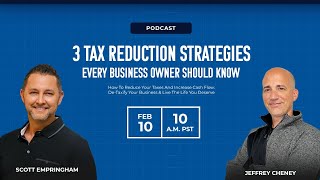
Recorded YouTube interview (hosted by Scott Empringham) with tax strategist Jeff Chaney (CPA, CFE). Chaney presents three core, actionable approaches businesses can use to reduce taxes and free cash flow: (1) change your tax bracket (trade cash for assets and act like investors or larger corporations to access lower effective rates); (2) shift income (move income to family members, convert nonpassive income to passive, pay children, use trusts/ownership structures, cost-segregation and real-estate investments); and (3) maximize deductions (structure activities to meet IRS "ordinary and necessary" rules, adapt behavior to qualify — examples include certifying therapy animals or structuring RV travel as business). The talk also covers entity selection (sole proprietor, LLC, S/C corps, partnerships), multi-layered entity planning, timing (plan early in the year), audit considerations, and Detaxify's 30-minute strategy consultation offering.
Chapters
All right, we are live and ready to go. Welcome to social media Secrets. My name is Scott Impringham and I believe that any business can get customers with social media faster than they ever dreamed possible if they have the right plan, the right tools and the right team. And the reason I believe that is for the last 20 years, that's exactly what I've been doing for big companies like Ford and Chrysler and GM to small businesses like restaurants and med spas and everything in between professional service businesses. For more information about our social media services, feel free to Visit us@scottembringham.com where you can enroll in some free training, learn about some AI tools that can help your business right now, social media secrets and techniques and tools and even coaching. So feel free to visit Scott impingham.com for more information. Today we're talking about something different. We're talking about something really, really cool. I had the good fortune to meet Jeff Chaney and he is going to share three secrets for businesses to save money on taxes. And so he's got three tax reduction strategies that every business should know. And I want to just give you a quick background on Jeff and I was very fortunate to meet him. He's a powerhouse in the space. And if you have a business that you're concerned about your taxes, you want to increase cash flow and you want to protect your cash, then this is something you don't want to miss. Jeff Chaney is a certified public accountant and a certified fraud examiner with over 20 years of extensive experience in that space in tax code navigation. And he helps a wide array of businesses do just that, pay less on taxes and free up cash flow. He's not your typical accountant either. His kit continuous study of developing tax regulations makes him very unique and makes him stand out in this space. And also he's one of the nation's most sought after tax strategist. So we're really grateful to have him. Welcome, Jeff. We're excited to have you. Could you, could you tell us a little bit just to give quick background on who you are and how you got involved in taxes?
Yeah. Thanks, Scott. Thanks for having me. And I first want to say that there is no better way to end a week, especially a Friday, right than talking taxes. I love this topic. So let me tell you exactly kind of how I got started in all of this because most business owners know what a CPA is, know what it means to work with an accounting firm and my kind of trajectory into what I do now started because I used to be an employee At a CPA firm. And I worked with a lot of business owners, and it was like, several years ago is around December 1, right before the holidays. And I was trying to help yet another business owner with their taxes right before the deadline. The thing is, at the time, I was frustrated because by this time of year, there was really little I could do for them as a cpa, but tell them how much they owed. You know, I could probably tell them maybe go buy some equipment or go buy another vehicle. And the big problem was this happened over and over again. And the accounting firm that I worked for actually steered me away from kind of strategy work because it didn't fit into the billing model. And so this meant year after year, technically I was doing my job, But I felt practically useless, which just kind of made me feel a little bit bad about this. So I was helping business owners stay compliant, but really not helping them save on their taxes. And that's kind of the point of why people hire us.
And so I realized, distinction, by the way, too, is. Is there's difference between compliance and actual tax strategy. And that was very interesting to me. Sorry to cut you off. I think it's an interesting distinction.
Oh, no, not at all. So I realized that the standard CPA firm is all about turning over tax returns, but unfortunately, it doesn't have the capacity to do much more than that. And this was not only in the company I worked for, but really in almost every single firm accounting firm that I knew of. And I realized that CPAs are just too busy to truly help business owners with their real needs. So something had to change. And so I started working directly with a group that's under Robert Kiyosaki. He's a rich dad, poor dad, Robert Kiyosaki. And I started working with them. And I learned about the big difference between tax accounting and tax strategy. So tax accounting is about debits, credits. It's about compliance. It's all linear. It's a little like looking in the rearview mirror. Well, tax strategy is totally different. It's very creative. It's about looking forward and modeling. And for me, that's when I got really excited. So it instantly became clear to me how to really help small businesses in a whole new way. Because I saw that if we started earlier in the year and created kind of an ongoing process, it opened up a whole range of new choices and opportunities to save on taxes, which ultimately frees up cash flow for the owner. So what I did was I started my own CPA firm to help businesses with their business owners with their taxes. But I didn't want to really just stop there. I actually created a whole separate educational arm with the goal of going into the business community and educating business owners on a few key things they could do to save on taxes, which, like I said, when you save on taxes, it frees up cash flow and creates more choices. And that educational arm is now a separate division for us, and we call it detaxify. So you see my little logo up here, but it's Detaxify. And with Detaxify, I now work with business owners with more than $100,000 in profit and help them save on taxes. And it generates a huge array of new choices for them going forward. And this involves really, really digging in and providing business owners with the help that they truly need. Excellent.
And you're going to be sharing some of those secrets with us today. Three of them.
Absolutely. I've got three secrets to pay less taxes and increased cash flow for. Pretty much any business owner can do this.
Excellent. Well, I'm excited. I'm going to add the presentation to the screen now, and if anybody has any questions, please don't hesitate to drop a note in the comment section. We'll put it in front of Jeff, and we'll get it answered for you. But I'm super excited about that because not only is Jeff a client, he's also a friend and working with them. I've really dug into these, and we're hopefully going to be applying some of these strategies for Africa Media Group. So I'm excited to learn. Jeff, the floor is yours. Go for it.
Great. Thank you. So today we're going to talk about the three secrets. And I have on the screen in my presentation, there's secret number one, which is changing your tax bracket, number two, which is shifting your income, and number three, maximizing deductions. Now, I want to start by letting you know that these are not really secrets. They've been widely available and are actually very simplistic to accomplish once you understand what we're actually trying to accomplish and that you may need to change your approach. That's the key, is that you may need to change the approach of the way you look at things. Now, I call them secrets because most tax repairs don't even bring these thoughts up to their clients. And most people I know really don't want to invest the time in reading the tax code. So let's start with secret number one, Change your tax bracket. All right, so the first thing we're going to talk about is actually changing Your tax brackets. And the reason this is important is because we are taxed on a graduated system that means that as you earn more money, the higher the percentage of tax you pay. For example, if you only earn say $10,275 of taxable income, that's going to be taxed in 10%. When you earn above that, you're then going to go to the next tax rate of 12% and then up to 22%, all the way up till 37%. And that's our highest current rate is 37%. Now typically you would say, okay, well how much can I make before I'm in that 37% tax bracket? Well, if you're married filing jointly, that's around $650,000. If you're single, it's actually around 540,000. It's not half of the amount. This is what we call the marriage penalty. So in some cases it's actually better to be single, some cases actually better to be married filing for your taxes. Anyways, I'm not talking about in real life here. Yeah, so you would. So this is important to know because when you have your highest, if you're in the highest tax rate or even in the higher tax rates, you want to be able to take advantage of using those lower bracket tax brackets so that your income is taxed at a much lower level. So we can change our tax rates and if we do, we spend a whole lot less money and we can then keep the money for ourselves and use it for investments or even staying in our own pockets. Alright, so we hear this every election cycle. How much the average taxpayer hates corporate America because they pay nothing in taxes and we all foot the bill, right? Well, the reality is, is that small business owners are the ones that are really footing the bill as a, as a percentage. And why is this? It's because we have all been trained that cash is king, but really that's not true at all. And if I have say 3, $300,000 in pre tax cash on my balance sheet, so actual cash on my balance sheet, or I have $300,000 in a real estate investment on my balance sheet, how much do I actually have in assets? And if we're talking about real estate, then I have $300,000, right? If we're talking about cash, then I actually have a lot less because the government owns a portion of that and in the taxes that will be owed on it. So this simple thought kind of tells us something, right? It tells us that our tax system is a consumption tax system that means we are taxed on the money we earn and then use for ourselves to live. However, if I convert that cash into another type of asset, that provides me a tax benefit I'm no longer consuming, I'm investing. And that also means I'm increasing my net worth and I could possibly do it with 100% of my earnings and not actually have to worry about a tax bill. So the first step in doing this is really truly understanding what type of taxpayers there are. So Robert Kiyosaki, actually I told you I worked with this group, he created a diagram to explain all this. And there are four types of there's employees, self employed people, big business or corporations, and investors. And the amount they pay is drastically different. And understanding this helps change the way you approach money to achieve exactly what you're trying to accomplish. Some people think that being an employee is the best type of a taxpayer, that they actually pay the least. The truth is there's so many withholdings that come out of a paycheck that we usually will ignore most of the taxes coming out because we're not having to manage it right, we're just managing the amount that comes to us. In actuality, employees are the second highest taxpayer. And some people think that self employed people pay the least amount of tax because they get to write off everything under the sun. And the truth of that is yes, they do get write offs. But these write offs mean that they have to spend their money which reduces their cash flow, that they actually get to keep. And then whatever is left is not only subject to income tax, but they also pay a self employment tax. And for anyone who doesn't know what that is, that's Social Security and Medicare. And as employee you have this withheld from your paycheck. But as a small business owner, you actually pay this amount twice. Add these taxes and they actually pay the most of all the four taxpayer types. Now some people think big business or corporations pay the least amount because really that's all we hear with big corporations making these ridiculous profits and then never paying any taxes whatsoever. Now the corporate, corporate tax is low, but they are not the lowest type of taxpayer. The investors, investors are the lowest taxpayers. And let me show you. So here are the tax rates the four kinds of taxpayers have to deal with. Most of us fall into the left side. We're either an employee or self employed. But you see on the right side, this is the side we all want to be in. So if you're looking at this quadrant, like which, which one do you really, really want to be in. My guess is you're probably going to say the investor, right? Because they pay the least amount of tax according to this. So how do we get there? We get there by doing what these taxpayers do. Meaning if you want to pay, say the big business rate of 21%, then you have to act like a big business. If you want to pay the investor rate of 0 to 15%, you need to act like an investor. So I know this sounds easy, but it's really not that hard if you change your approach. And let me give you an example. I have a client who was running a small business and making about $2 million a year in profit. You can imagine the amount of taxes being paid on that. And they were located in Massachusetts, so they also have state taxes on top of their federal taxes. Now, they had a ton of money in the bank because the profits were really high and they were pretty shrewd. So what we did was we exchanged the cash they had on hand for rental property. So we turned them into an Investor. And in 2020, he paid an effective rate of 5% and in 2021, only 8%. Even better was that his property appreciated. So his balance sheet actually rose while paying less tax. Okay, great, he paid less tax, right. But now he has all of his money tied up wrong. We actually refinanced this past year and pulled out all of his equity and put the money right back into his bank accounts. So now he has all this cash back. It's all right back in the bank. And he didn't have to pay those steep taxes on it. We turned him into an investor and not just a small business owner. Now, it is important to understand that this is not something you can do overnight. Right? This requires you to put in time, energy, and a good thought process mapping this out and exactly how you will achieve it. So let's move on to item number two.
I love this, by the way, is it gives it it. I love these examples too, because it starts to give you an idea of how if you're just a little bit proactive and like you said, you plan a little bit earlier, you can change the game for yourself and make the laws, tax laws work for you rather than against you. Is that a fair statement?
That's a completely fair statement. I think people are afraid of the tax code. And part of me says, yeah, why wouldn't they? I mean, who likes taxes, right? But the other part is you really have to understand what it is. And the tax code, it's not telling you what you can't do, it actually tells you what you can do to pay less taxes. And I think if people understand that better, they'll want to know more about it and actually use it to their advantage.
And are there. And there's probably 100 different folks in our mastermind that have smaller businesses that don't have the 2 million in cash, but they might have 50,000 or a hundred thousand in cash. Are there strategies available to that small business owner with maybe less cash to convert that into an investment and therefore reduce their taxable income?
Oh, absolutely. It's really the same, it's really the same kind of strategies. It's just you have less zeros after the numbers, right? So, but you can do the same thing. You may not save 100,000, but you'll save 10,000 right now, save 200,000, but you'll save 20,000. So the strategies are very similar. It's just taking advantage of them and then using what you have to make it work.
Got it. And when should someone start planning about this? If they hear this broadcast right now and say, wow, I really need to just start the process and visit detaxify.com the link is in the comments. When should they be thinking about this? When is the right time for this?
Well, there's really no wrong time, other than you probably should have already started.
It's like planting a tree. The best time was 10 years ago. The next best time is today.
Exactly. Because you, you, if you're already owning a small business and you already, and you haven't created a strategy yet, you've probably already overpaid in taxes. Right? So, so there's never really a bad time. It's just that when can you apply the strategies? If you wait, toward the beginning of the year is always the best. Because it's 2023 now. If I, if I start talking with somebody now, a strategy, I have the whole rest of the year to implement that. So it affects my 2023 taxes. Now if I come to a strategist in say, October, it's, it's going to be a lot harder to implement those for 23. I'll get to use them for 2024, but maybe not for 23. So the earlier you get started, the quicker you can get going and, and keep that money in your own pocket.
And I like the way you summed it up too, is think not about consumption, but about investment. So as you move through the year, be thinking about what you do with your cash rather than just consuming it. Be thinking about Investing it. Is that the key kind of takeaway from. From secret number one?
Well, secret number one is understanding that. That we want to trade cash for assets, but not just any asset. It's an asset that provides you a tax benefit.
Got it. Thank you.
Yep. All right. Should we move on to the second item?
Sure. And if anybody has any questions, feel free to drop them in the comments and we'll make sure we get them in front of Jeff.
Okay. So the second thing we are going to talk about is shifting your income. And the reason this is important is because you can have the exact same income, report the same amount, but pay less taxes just by shifting it the correct way. And why is this important is because if you shift it over, you can lower your tax bill and keep more of your own income in your own pocket, increasing your cash flow. So let's talk about exactly what this means. So we discussed before earlier on that we have a graduated tax system. The higher taxable income, the higher your tax rate is. So if we know what the tax brackets are, we can possibly move income around and have more income taxed at lower tax brackets. So there's two ways that this can be accomplished. First, in transferring income around to your family members, you can shift income around to other family members that actually don't have large incomes and use their tax brackets to your advantage. Let me give you an example. I have a client. They own an H vac company in the south. And this client made about $850,000 in profits last year. Now, his mother is aging and lives on Social Security and a very small pension. So she essentially pays no tax. Now, what we did was we made her an owner of the business and shifted about $200,000 of that income to her. So where the client should have paid, should have that 200,000 taxed at the highest rate of 37%. They used up his mother's tax bracket and only reached the 24% tax bracket, which means he saved well over 13% in tax. And if you figure out what 13% of 200 grand is, it's a minimum of $26,000 of savings. Now, there was a hurdle we did have to go over here and that my client was worrying about. Okay, that sounds great, but what would happen if his mother passed away and her ownership went into probate? Right, right. So there's other things that have to be considered. And in here, we obviously had to legally protect that interest, because while she's alive, she technically has the ownership. But we had to make sure that it then went to him afterwards.
That's really important to know. So I'm going through that right now. So there are strategies, what you're saying, there are strategies then to leave it with a parent and protect it from probate?
Yes, absolutely. A lot of what we talk about is tax. Right. But there's always. I shouldn't say always. There's sometimes a legal side of it too, that has to be considered. So we kind of look at the whole picture. Always. We don't just put one over the other. You have to incorporate them together.
Would you be able to guide a client in that direction if that's a situation they're facing right now? A lot of my friends that have businesses, I'm sure have aging parents that could benefit from that strategy, but are probably concerned about that as well.
Yeah. What we actually do in ours is we, we make sure that, you know, every, every business owner should have like a team behind them. You know, like an accountant, an attorney. So we'll kind of discuss all this stuff with their attorneys so that everybody's on the same page and make sure, because I'm not an attorney, so we make sure the accountants understand the tax side of it, we make sure the attorneys understand that the legal side of it. And so whatever happens, everything is considered.
Got it. Well, I'm going through this right now with, with my, my mom, so this is really good to know. I'm paying attention. Close closely.
Yep. Well, another way to shift family, shift to family members is actually to pay your kids. And I think a lot of people generally heard this, but there are specific rules that surround this. If you can find a job for your kids and pay them a reasonable salary, you can actually use them. You can actually use their tax brackets. You also have the potential to use some tax credits that you may not typically qualify for too. Here's. I'll give you two quick examples for paying your kids. First, I have a client who is a realtor of high end homes. So when he lists a house, he takes pictures of families living in the house to show the potential. Right. It's a sales technique. Well, he uses his three kids as models for every house that he lists. And he pays his kids around $1,000 a month to do this. Now, because the kids are under the age of 15, when he pays them the salaries, they're not subjected to Social Security, Medicare or unemployment taxes. So you save all the payroll taxes. Also, with them earning $12,000 a year each, not only are they free from those payroll taxes, but the income taxes as well. Their standard deduction completely wipes out their taxable income. So that means my client, he has three kids, shifts a total of $36,000 of income over to his children. And that saves a little over $13,000 in taxes. The other thing to note here too is that these kids are minors. So as their guardian, he is in control of the money, not the children. Now I'm going to actually show what I do in my own business using the same thought process. I own a few different businesses and I also like to invest in real estate. So I own Detaxify, which is my strategy business. I own Edwards Ingram, which is my CPA firm. And I own EI Books, my bookkeeping company. So a few years back when I was actively involved in the businesses, I hired my three boys, Caleb, Noah and Luke. And I hired them to help me with scanning documents on the weekend when I worked. They were spending pretty much all the time in the office with me anyways. So I made sure they had a job to do. And it's never too early to start them. So I figured out how much was a reasonable salary and I was able to pay each of my boys $10,000 a year, tax free. Now this saved me self employment tax of 15.3% on that $30,000. And it also sheltered all of that income from income tax. So I use this money to pay for their school. And so what, what this did was it indirectly I deducted the cost of their tuition by shifting the income to them.
Okay, so okay, I'm, I'm, my mind is blown right now because I'm, I'm thinking about this in parallel to my kids who want to help me with websites, editing videos ed and creating images. So you run that by me again if you would. So you're, you're paying them $1,000 or up to $10,000 a year. I think you said each, is that right?
Pay them $10,000 a year each, so.
You'Ve saved on the taxes.
So a single filer, which your children would each, each child would be a single filer. They get a standard deduction of approximately $13,000. So when they file their tax return, the first $13,000 is not subject to income tax whatsoever.
The first 13. Got it.
Right. So if I'm paying them 10 grand, that means the first $10,000, no tax whatsoever on it if it's on their tax return. If it's on mine, I'm paying 37%, but because it's on theirs, it's zero. On top of that, because they're an employee. When you typically hire an employee, you pay payroll taxes. Right? Which is Social Security, Medicare, unemployment. Well, because I own the business and they're my children and they're under the age of 18. They are. Those taxes are completely exempt. They are exempt from those taxes until they reach the age of 18 years old. So I don't have to worry about Social Security and Medicare and then also matching it because I'm a business owner. I don't have to worry about the unemployment taxes whatsoever. So that $10,000 I give to each one is payroll tax free and income tax free. So it's not 37%. It's 37 plus 15% plus state tax too. I live in a state that has an additional 6% tax, so I'm saving pretty much half of that amount. I'm saving in taxes. Cause I'm around 50%.
That's incredible. That's incredible. Just by knowing some of the laws. Now, not to get into the weeds, but is there a specific type of corporate structure? I've got an LLC now and I'm thinking about moving to an S Corp. Is there a specific type of structure of an organization that's ideal for this and maybe you're going to get there. So I don't want to get ahead.
Yeah, I'm actually going to talk about this in a little bit, but I'll just really quickly point out, in order for you to be able to legally pay your kids and, and be exempt from these taxes, all of these taxes anyways, it has to be from a non incorporated business. So.
Non incorporated business.
Right. So you could have an llc. As long as it's not taxed as a corporation, you're okay. And you could have a sole proprietor, a partnership. As long as it's not incorporated, you're completely able to do this.
Got it. Got it. Now, we had one question that says, wow, this is awesome. And then a question about audits. Is it, is it, is it any red flags that business owners should be aware of where they're actually sort of increasing the visibility or increasing likelihood that they get audited?
Well, here's the interesting thing about paying your family. If you go to the IRS website www.irs.gov it actually and you type in Paying my children, it actually details for you exactly how to do it. Now, as far as red flags go, there's a, there's a lot of things that can raise red flags. One of them is how you're presenting your information to the irs. And if you're a small business Owner, that alone is a red flag. So this doesn't increase it in a way. It's kind of like we're going to kind of get a little bit more into it. But based on the type of entity you have, that raises red flags. You can do all of this. And like I said, it's right on the IRS website, they tell you how to do it. Getting an audit is not something I really worry about too much. I know we don't want to have audits because they're very time consuming and they can be costly. But for us, it just proves we are doing, you know, we were doing exactly what we knew we were doing. Right. It just proves it. And then this past year, the government decided to hire, you know, several thousand new IRS agents. So I think the goal of that is actually to go after small business owners. So I don't think really anything you do anymore is going to matter. I think you're, if you own a small business, you're going to get audited. It's just a matter of when. So. So you want to make sure that you've got your eyes dotted and your T's crossed regardless, because I think it's just a matter of time now before everybody faces an audit.
Got it?
Got it. Okay. So one of the next ways to shift income is by making non passive income to passive income. But first we have to understand that for tax purposes, there are three kinds of income. There's portfolio income, which is your interest, dividends, and your capital gains. And then there's non passive income. And this is the income you trade your time for, meaning you're putting an effort here by investing your time in the business. Right. There's specific rules to what that means. But if you're putting in substantial time, this is what you're working in. Income from a W2 is also non passive. And income from your business that you work full time, non passive. The third is passive. Now, most people think that dividends is passive income, and they would be absolutely correct. But for tax purposes, that's called portfolio income. Passive income for tax purposes is income you earn from a business that you don't put substantial time into. Real estate that by default, real estate income by default is passive. And businesses that you don't really work too hard in, you don't put too many hours in, that could also be considered passive. So let me explain why this is important to know. We've touched upon, we actually touched upon this before, but trading your cash for other assets not only provides you the ability to possibly get extra deductions, but it gives you the opportunity to then earn more money. So when I have cash in the bank, how am I going to increase my cash flow? Well, I can have an interest bearing account and maybe earn 1% interest on it. I mean that's certainly not going to move the needle. But if I invest in the right kind of investments, I can also earn additional income on that investment. I have a surgeon client of mine who's located in Texas. He earns substantial income as you manage. He's a surgeon. Right. So instead of holding onto his cash, he invests into ATM funds and various investments like that. Now these funds provide for a loss tax wise because they have to purchase equipment, but it also sends them 12% return on his money every single quarter. So essentially he's getting a tax loss for purchasing the equipment and he's earning money tax free at a much larger rate than the banks are offering him without having any tax implications whatsoever. So for business owners, Business owners should know that they're paying 15.3% self employment tax on the business profit or on the business that you're involved in your non passive income. Once your profit exceeds $160,000, that 15.3% actually drops to 3.8% because it's a Social Security limitation. Well, this extra tax actually adds up quickly. Well, if I shift that income over to passive income and I stop working in my business and I actually become a business owner instead of, you know, just funding my own job, I can remove that self employment tax. Now isn't that kind of the goal of most small business owners is to work on our business and not in our business?
Sure.
If we do that, we actually accomplish a major goal. We save enormously on our taxes by removing the self employment tax that we pay 15.3%. I'll give an example. Here's what I mean. If I work in my business as a single person and I have $100,000 taxable profit, my federal tax is going to be $33,000. If I make this passive and I don't work in my business, my federal tax on the same income is only $18,000. As you can see, that's pretty significant difference, 33,000 to 18,000 just by whether I work in it or I don't work in it. So I'm going to show you how I personally did this in my own business. And we're going to get back to the example of paying my kids.
Excellent.
All right, I told you how I used to pay my kids salaries. Well, I have other businesses and I still do that in another business of mine. However, I changed this two years ago to shift additional income over. I explained that I like to invest in real estate. However, the losses I get from real estate are passive. And the passive rules state that I can only deduct those losses by offsetting against other passive income. Otherwise, the losses, I don't get to use them in the current year, they get carried forward to another year. But I want to be able to deduct my real estate losses against my income because I spent cash on acquiring these properties and I wanted to get the deduction for what I spent. Well, I want to trade income for assets, but I wasn't in the position to stop working in my business yet, right? So I took a look at my three core businesses. Dtaxify is a tax consulting, so it does require my CPA license. My CPA firm is the same. It requires a CPA license in order to own it. However, my bookkeeping company doesn't. So what I did was I changed the ownership from myself over to being 100% owned by my three boys equally. Guess who doesn't work substantially in the bookkeeping business? It's my boy. It's my boys. They don't. So this is passive income to them. Well, again, I want to trade my income for assets, right? So I set up an llc, also owned by my three boys, to purchase real estate I may want to buy. Important piece to mention here, though, is because some. Some of you might be thinking this. My kids are minors, and they are not legally allowed to own an LLC on their own. So I had to set up a trust for their ownership. And as the guardian, as their guardian, I'm actually the trustee. So this means that although my kids own these entities, I have full control. And control is the key here. I really don't need to own it. I need to be able to control it. A lot of people get that confused. They're saying, well, I don't want my kids to own it. I don't want this person to own it. I don't want that person to own it. Ownership is not the issue. Control is. That's the important piece.
And forgive me, Jeff. All right, I'm following you, I think. So on the bookkeeping side, your boys own it and you control it. Do you control it through the trust?
Well, again, there's a trust. I'm the trustee, so I'm actually in charge of everything that happens with it because my kids are minors. So it's pretty much as if I own it. My kids can't do anything with, you know, around me. I am legally, I am considered the owner of it. All right? So now back here, now, my kids have passive income from the bookkeeping company, right? And we can wipe out all of that income because I have the passive losses from the real estate purchases that my kids also own. So we've got losses from real estate income from bookkeeping. They offset each other. I couldn't do the shifting of these because of my personal circumstances. So I used my children to do a double shift. And there's absolutely nothing illegal about this. All right, let's say you manage to stop working in your business or you have other passive income. Again, we want to trade our income for assets, right? I've said that multiple times. It's a piece that I feel is most important to learn from anything today. Trade our income for assets. So here's a real example we used for a client of ours who owns several bakeries. The bakeries are passive because she doesn't spend substantially any time. In one specific one. As a whole, she does. But because each of them are all separate LLCs, they each stand on their own. Well, she had $500,000 of business income. She had other income and was in the top tax bracket of 37%. She does have an expensive lifestyle, unfortunately, so she does need to consume a good portion of her income to afford what she likes. But I did convince her to take $100,000 of her profit and invest that profit into real estate, because the banks only required, at that time, 25% down. We were actually able to purchase a $400,000 Airbnb real estate rental with only $100,000 of that cash. And then we leveraged the rest. In the first year, she was able to take the $100,000 deduction on that property with depreciation. Now, because her bakery is passive, she can take that deduction and save $37,000 in taxes. So another way of looking at this is that her investment now, instead of costing her 100,000 now, really only costs her $63,000. And yet her balance sheet shows she has $100,000 asset. Also another way to look at this is that her balance sheet shows $100,000 of real estate and is an income producing property for her. It saved money on taxes, and she gets approximately 27% ROI on it annually. So that worked out very well.
And she do this every year?
Every year. We do this every year.
And her assets grow. She minimizes her taxes and increases her cash flow. All at the same time.
Absolutely. It's a wonderful thing, the tax code.
So many people, I think, fear it. But one of the things that I've learned in working with you, if you know the rules and you play by the rules, you can actually benefit tremendously.
Yeah. It actually starts to become almost like an addiction when you realize, oh, wait, I can do this, I can do this, I can do this. Then it starts to become like this game of, okay, how can I find all these little things that I can do? And people start actually researching more, and then you start to become like me, which may not necessarily be the best thing, but you don't want to be a tax geek. But. But I like it. I benefit from it.
Yeah. Yeah. And so do your clients. So do your clients.
All right, so going back to that last example, you know, how did she get that deduction? We had a. What's called a cost segregation study performed on this property. And one of these studies actually gives the ability to fully depreciate about 25 to 30% of the property value. In this case, the money that she invested became the amount that she could actually deduct. So she no longer has $100,000 in cash, because after taxes, that would only have been $63,000 left as an asset. Now she has an asset of $100,000 that's producing a really good return on her investment and actually has a real cash value. So that actually brings me to another important piece of this that's vital to know. Entity selection. Many people choose the wrong entities and accidentally cost themselves more money in taxes and legal protection. So I want to go over the difference in entity types real fast. There are a few main types of entities. Most people know of their sole proprietor. Llc, S Corp. C Corp. Partnerships, trusts. The key here is understanding that a legal entity is not the same as a tax entity. And you must always distinguish the difference so you don't accidentally cause problems for yourself. Now, most of these are straightforward. If I'm a sole proprietor, I legally have no protection, and I file the business or rental directly on my tax return with no separate filing. It's part of my personal return. Quick rule of thumb, this probably should be avoided as the way of filing, because as a sole proprietor, this is actually where the IRS audits the most. So we talked about red flags a little while ago. You want to avoid a red flag, don't be a sole proprietor. Number one audited tax form. And the reason for that is that of all the entity types, all the other ones file a Separate return. And they report a balance sheet and an income statement. So there's checks and balances. But a sole proprietor reported directly on your personal return. There are no checks and balances. That does not report a balance sheet for the IRS to be able to make sure the checks and balances are in. So what does that mean? That means a very high audit risk. Corporations, they provide stronger legal protection. And for tax purposes, they can either be considered a C Corp or an S Corp. Partnerships, they have different levels of legal protection. For tax purposes, they file a partnership tax return and then LLCs. Now these are a completely different animal. Legally they provide really good protection, but for tax purposes, they can actually be any of these other entities.
What does that mean? What does that mean? Oh, I see, you're going to share.
Yep. So I'm sharing this.
So you have the legal entity and you're making the distinction between the legal entity and the tax entity here.
Yeah. So an LLC is simply a legal entity.
Got it.
But for tax purposes, it can be taxed as a sole proprietor, a partnership, an S corp, a C corporation. And depending on your tax choice, this also affects the tax rate. So. Well, I'm going to also reiterate that a sole proprietor is rarely the best choice for tax purposes.
Got it.
Now why do I bring this up? Well, each one of these tax entity types has different rules for what you can and cannot do. For example, if you, if, if I want to pay my children and avoid paying payroll taxes.
Yeah.
I can't do this with an incorporated entity. Right, we talked about that. Also, like S corporations, they only pay Social Security tax and medicare tax on the amount of salary paid to the owner, amount of W2 wages and the remaining profit avoids self employment tax. And then corporations, they allow certain fringe benefits that no other entities can pay to a shareholder owner. So which one do we choose? I personally believe we have the potential to choose all of them if there's a good business reason for it. And this is actually called multi layering entities. And it's often overlooked tax strategy for small business owners. Remember in the beginning when I showed you the four types of taxpayers. Yes. And big business was one that paid lower tax.
Yes.
And I said if you want to pay their rate, we got to act like. Like a big business. Right.
Well, business has multi layers.
Multi. Exactly. So if you act like a big business, you can lower your tax bill and keep more money in your pocket. And I'll, I'll show you an example of what I mean by this.
And, and just so I Understand this on. Oh, you're going to go here because the Last1 was LLC. You could have a legal entity, but then a taxable entity. So you could have an LLC but still behave as a partnership in S Corp or C Corp, is that right?
In my understanding, Exactly. So an LLC LLC is again just a legal entity, but for tax purposes it is taxed as either a sole proprietor, a partnership, an S Corp or a C Corp.
I see, and then you're about to walk us through examples of how to do that.
Yeah, I'm gonna walk examples of kind of just what I have for myself.
Okay, perfect.
All right, so here we go. My business partner and I own another bookkeeping company that's actually run by artificial intelligence. So it requires minimal work and completely automated. We own this business as an llc, but it's taxed as a partnership to provide us with the correct legal protection and gives us the freedom to distribute profits as we see fit. We can't do this in another type of entity without paying some serious taxes. Well, we're considered non passive, but we don't want to pay self employment taxes on the profit. So we own these LLCs with management companies that are taxed as S Corporations. This allows us to pay ourselves a reasonable salary where we pay Social Security, Medicare, but anything outside of that salary, the remaining profit, we avoid the 15.3 self employment tax on the rest of it. And we also have a corporate entity that owns all of our software. And we do this because the law allows us to sell our business and not have to pick up $10 million of gain in a C Corporation. Well, I also want to pay my kids and ship some income. So I created yet another LLC that I own as a sole proprietor. Here's where it can actually work. And I pay my kids through that business because it's not incorporated and I charge the main business a fee for their services. So I have four different entities to accomplish several different strategies and it saves me thousands and thousands of dollars in taxes. And the only way that this can. This can be accomplished is because I've layered multiple entities. Give every. Give me a second to digest that one while I drink some water. Yeah.
Now, if you have any questions for Jeff, please pop them in the comment. Perfect. Thank goodness somebody asked a question. Because I've got so many questions in my head, I don't even know where to start. Here's a question. Do you show profit at the end of the year or zero? Great question, great question.
It. It depends, right? That's the. Isn't that the typical answer from a cpa? It depends. It depends on what you're trying to accomplish. The goal that we try to do is get to as low taxes as possible. If I earn $200,000 a year and I want to take $200,000 and move it all into other assets that provide me a tax benefit, I could pay zero. But, but we also, we talked about this before. We have a consumption tax system. So I need something to live on. Right. And that kind of money right there, I may not be able to have enough deductions to wipe out the money I live on. So I may need to pay tax on that, have a little bit of profit. Best case scenario is can always show zero in each entity. Maybe not, but all the entities together. We try to get as close to zero as possible.
How much time does it take to set something up like this? Like say, say somebody watching this says, okay, I get the strategy of coming up with a multi layer entity. What's the time commitment to set all this stuff up? Once you look at a person's business, what's the time commitment and what's the, what's the, what are the fees typically associated with something like this?
Registration fees aren't that, aren't that ridiculous. Depending on what state you have to register in, it can be anywhere from say $100 to like a thousand dollars per entity.
Wow. Okay.
New York is, you know, New York's one of the really high cost ones, but most states, it's usually a few hundred dollars to set up each entity to save thousands.
It's a no brainer.
Right. And you know, the other side of this too is because I hear this a lot. I'm a simple person. I don't really want to complicate my life.
Right, right. It feels complicated.
Yeah. Well, would you rather add a little complexity and save maybe a few hundred thousand dollars in taxes, or do you want to be simple and you can just pay the few hundred thousand dollars to the government? Right. Yeah. I vote for this mindset is everything and. Yeah. So it's important.
Well, everything was complicated at first until you did it too. Everything that the small business, the person that's running the business right now is actually probably running a business that at the beginning felt very complicated and now they understand it. They can run it in their sleep. Here's a quick question for somebody, but somebody on Facebook. How do you pay yourself beside the payroll check? How do you pay yourself?
Great question, great question. I think we're probably referring to here is an S corporation so in an S Corporation you get paid in two ways. As a W2 payroll check employee and then as a distribution of profits where you just write a check out of the business directly to yourself. Very, very simple to do if it's a corporation. Again, you pay the W2 salary through regular payroll means and then you would actually cut yourself a dividend check again, another check out of the business. But it's considered a dividend as opposed to a distribution of profits. So very easy to do. It's just knowing kind of what the character of that payment is.
And it also sounds like, and I guess I'm going to phrase this as a question, multi layer entities would be applicable perhaps to many businesses. They just have to think about their business a little bit differently. Like I've got a digital marketing business, but I've got an agency business. I've got a coaching business, I've got online course. Is it possible that I could just look at that business, Emperor Media a bit differently and, and think about it as putting different pieces or creating different layers?
Yeah, there's, there's almost, it's, it's really about what you're trying to accomplish. Right. And I mean I know the discussion here is we're trying to accomplish how do you pay less taxes. Right, Right. So keep more money in our pockets. But you really have to kind of go through and say what am I really trying to accomplish? Is it because I want to pay my kids? If I want to pay my kids, I need a non incorporated. Right. So I had to set up the LLC taxes, sole proprietor. I want to sell my business one day and I know that if I do I'm going to make a ton of money. Why don't I pay tax on it? Oh, there's a corporation entity, a C corp that allows me to, you know, avoid $10 million or exempt the first $10 million of that towards taxes. So I want to have it as a corporation. Well, I want to have these profits that I can keep mostly for myself but I want to pay all the taxes, self employment tax on it. So I'll split it up as a partnership and then also use an S corp in it as well. Right. So it's figuring out what you're trying to do and then putting these, making these pieces fit together.
And Jeff, I imagine you've got the, if somebody's working with you, they've got the flexibility to change your goals. For example, at this stage of my life maybe my goal is just to minimize taxes. Next year I have children and as they get a little bit older, that strategy might change. To actually be able to pay my children and protect taxes in a different way, and then my business matures even more and I can sell it and they could change it once again. Is that a fair statement?
Oh, absolutely. So, so what we have on the screen here is what we call an entity diagram. And we actually do these for all of our clients. And so because it's sometimes a lot easier to see it as a picture.
Yeah.
And, and then we talk with the attorneys and we make sure that everything gets done right. It's really not a super expensive endeavor to do.
Well, it's actually very expensive. It's more expensive not to do it. I'm thinking about all the hundreds of thousands of dollars in taxes that people are probably paying right now, and they're probably not even thinking about it, but they're just bleeding right now. And if they were to actually invest a couple dollars in putting together the right strategy, they could actually save massive amounts over a prolonged period of time.
Oh, perfect example is let's, let's take the C Corp. I said, do you have any business owners I ran into that didn't realize that if they had set it up correctly, they could avoided tax on the first $10 million of the, of their business that they sold off? It's like infuriating to them. So imagine, yeah, to spend a thousand dollars. And I, I don't, I'm just throwing that number out. But to spend a thousand dollars to have to potentially save tax on $10 million. I mean, like, I do that all day.
If they could go back and say, gosh, it felt too complicated at the time, I bet they'd probably figure out a way to get it. Uncomfortable, complicated, right?
Exactly.
Is there any way to look at this also in retroactive terms? Like, let's say that I haven't. It's the end of the year. We're coming to, you know, coming. Is there any strategy that you can recommend if somebody contacts you@detaxify.com and schedule some time with you? Is there any advantages to looking back or is it about all looking forward?
Rarely does looking back help too much. There are, there are a few strategies you can implement going backwards, but it's, you know, I tell everybody not to really get your hopes up. Once it's passed, it's passed.
Okay.
It's, it's, there are a few things we can do to save a little bit of money, but really forward thinking is where you're going to save the most.
And last Question, Jeff. Or I know there's probably going to be more questions, but does the average person have a time horizon? Like, I guess it's, it's maybe just contextual. Do when people come to you for the first time, are they thinking about what do I do this year? Are they thinking about long term, 3 years, 5 years, 10 years, 20 years? Or is it a mix of everything in between?
So most people will come to me in December or January and what do I do about the year that just passed? That's what most.
Buy a bunch of equipment.
Yeah.
Buy a truck.
But those like I have, I have a group that I'm working with right now. And you know, I told them right in the beginning, this is all for 20,000, you know, 20, 23. And going forward, mostly everybody wants to see, they want to get a return pretty quick on their money. So we kind of help them understand if we do it for this year, this is what's going to mean. Right. So we're really looking short term first, which is first two years and then we're going to look to see how does this affect years 5 through 10 and will we need to make a change then we can worry about it necessarily. Then it's really, we have a long term goal. Most people are using it as a short term goal because the tax laws change so frequently that that really can only out of a strategy. Sometimes you're only going to get up to five years out of it, sometimes a lot more. But you may have to, you may have to shift a little bit, you know, once it gets to like five years. Because there might have been some tax law changes that affect it somehow.
Got it, Got it.
Right. Okay, so let's go to, let's go to number three, our third secret. Now, we all know what deductions are. It's the cost of doing business. But sometimes there's a line.
Sorry, Jeff, one more, one more question. Keep them coming. By the way, we really appreciate these questions on Facebook. Somebody's saying or asking. I'm assuming each entity can write off the CPA costs. That's a great question. Can they do that?
Absolutely. In order for a business to write off an expense, it has to be ordinary and necessary. And so that's, that's the guideline. CPA costs are obviously ordinary and necessary for businesses. So written off in every entity.
That's a great question too, because there's two, there's two objections. I would think a small business or business owner would have, gosh, it feels complicated. It's actually not that complicated. Or maybe this is really expensive. So not only is it expensive not to do it, it's not terribly complicated. If they go to somebody, like, detaxify, and then they could deduct that expense when they do it.
Absolutely.
Wow.
Awesome.
Okay, so I keep going and. Great question, great question.
Okay, so talking about deductions, and there's sometimes a line in what we can or cannot deduct. How many times have you asked the cpa, can I deduct this or can I deduct that? And the answer is no. Or it depends. Depends is always the answer we love to give. Right. Or you get some ridiculous answer that basically says no. So this happens probably way too frequently, almost completely all the time. So I want to help everybody understand something. And I mentioned this earlier on, and the truth is the tax code tells you what to do in order to deduct the items you want to. The key, though, is that you may have to change your behavior in order to deduct the items you want. So I get this question a lot, and I'll give you an example of something that often gets answered no by CPAs, yet we actually help the client, too. A child therapist client of mine asked if he could deduct his pet, and my response is not typical. I often say, well, let's see what the code allows first. First off, in order for. And we're gonna go back to this, a business deduction has to be necessary and ordinary. Right. In order to be deductible. So that means there has to be a court case that allows it. Otherwise, you will become the court case.
You don't want to become the court case, I'm assuming.
Not if you can. Not if you can help it, Right? So I asked a couple key questions. I said, I asked if the dog could obtain some certification that would help him with child therapy. And the answer is that there is. I also asked him if there are methods that he could employ in this therapy session to use that dog and if it could be documented. And the answer was that there is. So my client got the certifications necessary, and it created a therapy system by which he uses his dog in his practice. So we've met the criteria that the tax code asks of us, which thereby allows him to use that deduction. So we adapted to. And we played by the IRS rules. This is what we need to do in order to allow us to do, to take deductions. Here's another case. I have a financial planner client of mine who always wanted to travel by RV around The United States. He asked me if he could deduct his $100,000 RV vehicle in his business, which would mean $100,000 deduction for him to vacation all over the US like he wants to. Well, the IRS lists rules for deducting travel expenses. Generally, you have to work four hours a day to be considered business. Well, he does a lot of podcasts and meetings, so we set up an area in his RV for him to do two hours of podcasts every single day and then take client meetings for two hours every day as well. So he. So now he's met the four hours per day that he's using his rv. So now his travel and his RV become business expenses. So he gets to write off his vacationing because he's willing to adapt and play by the IRS rules. So all this is basically to say that you have to understand what the IRS code actually is. I know we all view it as, like, a punitive set of rules, but it's really not that at all. It is a rulebook telling you what you can do. The question you have to ask is, are you willing to change your behaviors to meet those rules?
I think most people would say if their goal was to travel with their family throughout the year in their RV and the cost was to do two hours of podcasting, since they were podcasting already and set up a couple of meetings every day, I think the cost is certainly worth the juice, is worth the squeeze, if that is your goal.
Understanding the rules helps. There's actually other ways to do so what I do, I like to bring my kids to Aruba every year, and I enjoy the nice, sunny weather. I actually wake up super early, and then I actually go to bed really late. So before my kids wake up, I do two hours of answering emails and. And maybe a little bit of work. And then when they go to bed at night, I spend two hours answering emails and then maybe a little bit of work then, too. So I get two hours and, you know, before they wake up, two hours after they've gone to sleep, I've met my four hours in the day. I can write off my vacation. So there's. There's ways to do it if you adapt it.
Well, I am. I think I mentioned this. I am off to Netherlands to speak in April, and so I'm taking my family to Europe for a month. So Epiring Media is soon going to be hopefully working with you if you'll take Epigham Media as a client. And we're looking forward to working with you.
All Right. So I shared three items today. Change your tax brackets, shift your income, maximize your deductions. As part of this, we also shared about multi layering your business entities and then trading your income for assets. So again, these aren't really secrets, even though I call them that. Every single business owner can implement all of these items if they have the right person to help them. And this is not a tax preparer cpa. It's a strategist who works with your future and not just with your history. So thank you for all the time you've spent listening to me today. I appreciate it. I know this isn't everybody's favorite topic, but I think it's something important to know, Jeff.
I think if you're a business owner and you're interested in reducing taxes and having more freedom and more time to spend with your family and your loved ones, this is a fantastic topic and I appreciate everything you shared today as we. We've just got a little past the hour. Jeff, thank you so much for all of your time. We do have time for maybe one more question and we'll wrap it up. If any question comes in from the folks that have been here with us during the, during the session, feel free to fire off a question. Otherwise we will start to wrap things up. But Jeff, what is the single most important thing? Somebody's listening to this and they say, wow, I want to take advantage of this. What can they do right now to get the ball rolling to just take the very first step and make it super simple?
The very first step is to schedule an appointment with a tax strategist who can help you understand how to achieve the goals you want to. We may own small businesses and everybody's very good at what they do, right? But taxes is an animal, it's a beast. And most people are scared of it. So it's not something to be scared of if you have the right people helping you. So best thing to do is to find the strategist to help you to, to meet your goal.
Excellent. I've posted your link in the comments, both on YouTube, Facebook, all across the LinkedIn when they schedule and hopefully they will schedule a strategy session with your team, what does that first strategy session look like, what does it do and what does it mean for the small business owner to spend schedule that 30 minute call with them with you guys.
Well, we have a 30 minute consultation and really, really what we're doing is trying to gather information together because we need to analyze what's there to see what the potential is. We do ours. A little different than most strategists is that we want to be able to hand, we try to pay for ourselves is what we do. So when I'm going to work with somebody, I'm going to show them that although I may charge this amount, this is how much money you're going to get back from investing your time and money into working with me. And I always make sure that amount is much higher than what I charge so that I pay for myself. So we're gathering data in that first consultation meeting to figure out exactly what savings are available, what strategies we could recommend. And then what we do is we take that information, we compile a summarized report and then we present it for that purpose so that it's a lot easier to make a decision. If I say, hey, I'm going to charge you $1,000 and you're going to get back 10,000, right? Or if I said $10,000, you're going to get back 100,000, it's a lot easier of a discussion to have when you know what your investment is going to cost you and then you know what your return on that investment is going to make for you. So that's the approach that we take in the first go round.
I would say 30 minutes to find out whether you could save money. And then if you can save money, there might, there's a fee associated with it, but the fee comes out of the savings.
Exactly.
It's a fair deal. Jeff, thank you. Thank you so much. This was fantastic. We're going to save this on all the different platforms and I can't wait to see you again, speak at some of the other different groups that you're a part of, Entrepreneur organization and Vistage and all the different groups that you're a part of. Thank you so much for, for, for joining us today.
Thanks for having me. It's been fun.
Absolutely, absolutely. And if you have any questions, feel free to visit jeffetaxify.com schedule that 30 a 30 minute session with him and his team and get started today. Thanks for joining Social Media Secrets. My name is Scott Imperingham. For more information on tools and techniques for your business, Visit us@scottemperingham.com and you can check out our workshops, our tools, our techniques to help you grow your business with digital market social media. Thanks so much.
More from Scott




🔥 PRESSURE IS A PRIVILEGE #PressureIsAPrivilege #LeadershipMindset #MentalToughness


🚨 YOUR NEXT LOCATION WON’T FIX YOUR PROBLEMS #BusinessScaling #MarketingSystems #FranchiseGrowth

🚨 AI CAN ACTUALLY MAKE YOUR MARKETING WORSE #AIMarketing #MarketingStrategy #BusinessGrowth


🔥 STOP RUNNING FROM WHAT’S CHASING YOU #FaceYourFears #KeepGoing #MentalStrength

🎥 STOP EDITING EVERY CLIP YOURSELF #AIVideoEditing #ContentRepurposing #ContentCreation