🔓💭🚫 How to Break Free from Negative Thoughts 🙅♀️🙅♂️
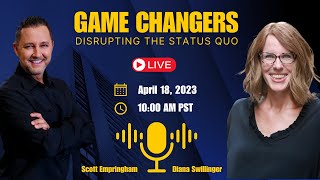
A Game Changers podcast episode featuring Diana Swillinger, a life and speaking coach, who describes moving from discouragement to purpose by learning to identify and change thoughts. She presents a practical Mind Shift approach: pause, write down what you think/feel/do (and note what you get), use small hacks (e.g., prefixing a limiting thought with 'maybe'), and adopt daily practices to renew the mind (grounded in faith for many listeners). Diana discusses obstacles (shame, brain's default of conserving energy/avoiding pain/seeking pleasure), coaching stance (illuminate thoughts; responsibility is a choice), communication tips for pitching and speaking (connect with people, tell emotionally resonant stories), recommended readings (Enough About You, Let's Talk About Me; Cialdini's Influence), and resources (dianaswillinger.com; free Mind Shift coaching calls).
Chapters
Sam. Foreign.
We are live. I am super excited. Welcome to Game Changers. It's the podcast that brings you insightful conversations with industry experts who are disrupting the status quo. I'm your host, Scott Impingham and we are sponsored by the AI Training Academy. So if you're a marketer or business owner that knows you need to get started with social media or but maybe you don't know where to start, you need to get started with AI or you don't know where to get started or how to get started, the AI Training Academy is for you. I'm going to post something in the comments, a free code for a trial on our new AI powered software to get all your campaigns created. Give it a try for free. Today I'm beyond excited to introduce my guest, Diana Swillinger. I met Diana in Cancun, Mexico. She was one of the senior trainers in EO at the EO Global Speakers Academy and they called her, and I think I have this right, Diana Scissorhands because she could make mincemeat of an overblown presentation and she could just shred them up and cut it down to the absolute essence. She's an absolute genius. I've never seen anyone like her. Her mind is lightning fast. I'm really excited a bit about Diana. Diana is a life coach. She's a business and speaking coach and the host of the Renew your Mind podcast. She spent decades trying to do the right thing, to be a good person, the best person she could, and have a great career, smile at people on the street, volunteer and even recycle. But instead of feeling great about her life, she felt stuck and sometimes miserable. And finally she found the daily joy she was looking for through practical mind renewal tools. Today she teaches other how to experience the same thing. And after creating a successful coaching practice, she now teaches and and helps others create business processes that they can use to make their dreams a reality. So welcome to Game Changers. Diana, thanks so much for being here.
Well, I'm really excited to be here. I've been looking forward to this for a while when we were in Cancun. Don't tell anyone else. Maybe no one's listening. You're one of my favorite people to work with because you were an incredible student. You applied everything and came up with an incredible talk. So yeah, I'm a fan of you.
Awesome. Well, thank you so much. You made it just an absolutely amazing process and I'm super excited to catch up with you because what you were able to do with our stories and other People's stories. I've never seen anything like it. So if we can, let's go back to the very beginning. You're a life coach now. Let's go back to some of the early experiences. Early. Diana, what inspired you to become a life coach, and how did you get started in all this?
Well, like you said, I tried to do all the right things, and I ended up feeling stuck and miserable. And I specifically remember this one day. It was a beautiful summer day like we had here in Wisconsin last week, but now we're back to snow. But anyway, it was a beautiful summer day, and my kids were little and playing the kind of stage in life where Legos are all over the floor and I don't even know what they were doing. I just was in quite a state where I was. It's hard to even describe. I was just beside myself. I was exhausted, and I felt done. I remember walking into the bedroom, shut the door, like, pray to God the kids are going to be fine. Because I was just so spent. I plopped my head down right in the middle of the bed. I didn't even grab a pillow, and I just laid there. This was my life. A few minutes later, the phone rang. I didn't move at first because I was just, you know, I was just so much out of energy. Finally, I was like, that's probably my mentor calling me on the phone. My mentor from church. I remember I called her earlier in the day. I know it was like I was coming to. I'm like, I better answer the phone. So I answered the phone. I don't remember most of what we said, but somewhere in the middle of the conversation, she said to me, diana, I think you're discouraged. And it was like I woke up inside you. Usually you'd think if someone says, oh, you're discouraged, you'd be like, oh, yeah, I'm discouraged. But I was like, I'm discouraged. Like, it was great news, because up until this point, I had it, like, gave words to what I was feeling. For a marriage that was in a terrible state. Finances were terrible. We had had a foreclosure person come knocking at our door. I felt like a terrible mom. Everything felt like it was falling apart. But then when she said, I think you're discouraged, I somehow felt empowered. And so something switched in me that day. And I'm like, I've got to figure out what this is. Why is it that someone could name my emotion? And then suddenly I feel empowered. And so I started reading things about, what do our emotions mean? It's more than mad, sad, happy, glad, like we talk to with our kids. There's a whole myriad of emotions and they're all nuanced. And that was a whole world opened up to me. And I went back. I had gone back to school at the time to finish my college degree. And so I started adding psychology courses. And I was spending more time with my mentor, reading all these books, watching all the psychologists on YouTube. Then I had three people say, you'd make a great life coach. And I was like, what? No, as they saw me changing, I think. But I thought if three people said it, this could be something. And so I dove into that and I got certified as a life coach and an advanced certification, and I started going to Masterminds, and I was applying everything I could to my life. And it worked. So it didn't matter what happened in my life. It didn't matter if we still had money issues or if my marriage still had issues or. Or there were other areas of my life that I was struggling. I learned how to feel content and have some. Some sort of happiness and peace and stop feeling so much anxiety, regardless of what was going on. And it worked so well. I'm like, now I gotta teach this to other people. I've gotta do what they said. They said, become a life coach. I'm gonna do it. And so for the past five years, I've been teaching other people how to apply these same things to their lives. Cause we don't have to change what's going on around us. And I know a lot of people listen to your podcast, are probably business people. Don't fool yourselves. We get filled up with all these negative emotions as we're trying to change the world and make the world a better place and grow a big business. And if we can learn how to take control of what we're thinking and feeling, we don't have to stay stuck in the emotions that hold us back. So I think I'm going to do this till the day I die. I absolutely love it. And we can apply it to all areas of our life.
I love that. And so if you can. You had this, you had this epiphany, and she put a name to something. And I really like how you, you, you. You mentioned that. For people that may be stuck, for people that may be discouraged, they might have just all this tremendous success on the outside, but they might be feeling stuck. What are some practical tools that you jumped on? What are some practical tools that you took advantage of early on that you teach now? Or that you could share with people that might be feeling stuck right now.
Yeah, it was actually hard for me. Even as I started as a life coach, it was hard for me to articulate some of the tools that I had used on myself because I think I was internalizing a lot and doing things. And so as I started coaching people, I really. I kind of build things as I go. And so I was making notes of all the things I would say over and over and over and over again. And I did end up creating a tool that helped me just stop the presses of the spin in my brain. Hit the pause button and take what's going on and put it down on a piece of paper. So it's just an easy tool where I give people a place to write down what you think, what you feel, what you do. Because so many times we're just reacting to what's going on around us, or ideas pop in our brain and we start acting on them or feeling something because of them. It's all happening in our head, and we think we have no control over it. But when we hit the pause button and we lay things down on a piece of paper, we can see. Oh, when I thought, you're so stupid, I felt like a failure. When I felt like a failure, I left the meeting early and went to Dairy Queen and got an ice cream. You know, it's like, oh, well, that makes sense. Because we don't stop and think about it. We're always just letting things happen and wishing they were different and then throwing spaghetti at the wall and hoping if we try to think something different or do something different, then everything will be fine. Like, everyone out there is saying, all you have to do is think more positive and everything will be fine. And I am saying, that doesn't work. I've tried that. But if you can slow things down and decide, move not just think positive, but think something that is purposeful, that can help fuel what you feel and direct what you do. Now you've got something where you can be so intentional. So that's my absolute favorite tool. I mean, we could talk for all day about all the other little tools I give people and different ways to reframe how we think. But if I. I would wrap it all up into that one thing. Because when. When you get that awareness of what's going on in there now you've power. You're like, I don't have to think. I'm so stupid. Next time I. Somebody you know snickers when I talk in the meeting. Now I could think something different. What do I want that to be and what do I want to feel? And what kind of behavior do I want to have because of that?
I love that. And it reminds me of something Stephen Covey talked about where between stimulus and response, there's agency, there's the power to decide what it means and maybe a new action. Is that where you're going with that, to stimulate, stop things between the stimulus and response and actually take ownership of which direction you're going to go?
100%. Because I believe that free agency or free will and agency are the two ways I typically refer to it with the people I coach. Free will and agency happen in our thought life long before it shows up in our behavior. We think we're making choices about how to behave and that's our free will. Well, and I guess we are, but that choice is happening in your thought life. Your free will is your thought life. And I think I tend to coach Christian women in the business world, I coach anybody. But when I'm doing one on one coaching with these kind of tools, it's Christian women. And it says you will be transformed by the renewing of your mind. That's why I call my podcast the renew your mind podcast. Transformation happens and at that granular thought level. And if we are willing to take ownership and have agency of that moment, we can change anything we want to in our life.
So I think that's so important. And by the way, Beth, thank you for joining all those folks. Feel free to write in your questions if you have questions for Diana. Let's talk about renewing your mind. So many people say people don't change. You know, the way things are are just the way things are. That person won't change, that person won't change. Or maybe they're saying thing that they won't change. You talk about renewing your mind. I personally had a transformation where I was baptized in 21 and it changed a big piece of my life. A massive, massive change. What does it mean to renew your mind? Kind of demystify that in real plain language. What does it mean to renew your mind and why is it important? And where does someone start like lots loaded in there?
Well, yeah, lots loaded in there because renewing your mind is a lifelong process. So I am not a psychologist. However, I, I learn from psychologists all the time and psychiatrists and neuroscientists and I read all those geeky books. It's super fun. But a lot of people, there's a buzzword now about neuroplasticity. So it's fun. I think that science is giving a name to what God's already known has existed or what's already existed in the human mind since the beginning of time. The ability to renew your mind. Well, that's neuroplasticity. So it's. It's something, I think, we decide that we want to be a part of for the betterment of our lives and the betterment of the people around us on purpose. And I think there's times when we just haven't made that decision. Like, we know we want. We know we want things to be good in life, but we're not thinking of it in such a way where we really dive into it and want to make that. Those deeper changes to the way our mind is working. So I could probably geek out on this like crazy, but I'm just going to say, in general, when we're growing up, we are instilled with values from the people around us. We create a belief system based on those values and things that we're experiencing and witnessing. And our experiences tend to make us think. We kind of know, like, the cause and effect of how the world works. And all this has developed in our childhood. There's a lot of psychologists talking about things like personality disorders these days. Narcissism is a big one that everyone's talking about. When Johnny Depp and Amber Heard were in a trial, she was diagnosed with cluster B personality disorders. And so there's a lot of buzz about that. And I think lot of that is out there with a lot of people. Everything exists on a spectrum. But, for example, some people who have some of these serious personality disorders are going to have a real hard time changing because they're not willing to take a hard look and see what's going on within themselves and then be inspired to change those neural pathways and renew their mind so that they can bring more goodness to the world, more love, more empowerment for themselves, and more good things for the people around them. It takes that and then it takes baby steps to make a lifelong commitment to being. I talk about being courageous, to take a look at our thoughts. A lot of times we don't want to know what's going on in there. Can't tell you how many times I coach people, they're like, I didn't even know I was thinking that. And that sounds kind of ridiculous now that I say it. And I'm like, that's okay. We're not going to judge it. We're just going to get it out there. We're going to be courageous to look at all the wacky stuff in our brain and then take responsibility for it, how it's affecting our lives and how we show up and then be courageous to decide to do something different. So, you know, you and I talked before we got on Scott, and you mentioned it with your baptism, you are in the middle of, of renewing your mind in a deep way, just like any journey. You know, sometimes if we were on a cross country journey or we wanted to walk from one side of the country to the other, some days we walk fast, some days we walk slow. Some days we walk for 10 miles, some days we walk for one mile. It's going to vary depending on a whole bunch of things going on. What's the weather? How am I feeling? Am I sick? All of. Am I going up a mountain or am I walking across the plains of South Dakota? Every spot in our mind renewal journey is going to be different and have a different pace. But if we are all in for becoming a better person, becoming more of who God created us to be, and wanting to bring more goodness to the world, and you're courageous to look at those deep, dark corners, you'll be well on your way to renewing your mind and bringing more goodness to the world.
And I want to go to something you said, and I think I understood it, but I want to dig a little bit deeper. What prevents us or what obstacles do we face in renewing our mind? I think I heard old beliefs or maybe antiquated beliefs, old habits, you know, or perhaps a disorder or some challenge, some psychological challenges. Are those some of the core obstacles that we face? Are there others that are right in front of us that are actually easy to remove or, or more easy to remove?
I think, I think all of them can be hard. It's so individualized. There's many times I'm working with somebody and I'm just like, are you ready to let go of that thought? Does that thought serve you and is it true? And they're like, no, it doesn't serve me. It's not true. Well, do you want to change it? Yes. Are you ready? Yes, let's do it. And other times it's like, oh, well, that. I mean, I've believed that all my life. It's kind of weird that you're saying that might not be true. I don't think I'm ready to grasp that. I need to think on that one for a while. And so it's not like one. Old beliefs are harder to work on than Habits or, you know, I'm going to stay out of the personality disorder area and just stay in this place. For those of us who are willing and want this kind of mind renewal, I think one of the hardest things is shame. And if anyone wants to research this and how it applies to their lives and how they can work through some of their own shame coupled with vulnerability, Brene Brown is the absolute authority on this these days. She's got endless studies into the human experience with shame. A lot of times we don't want to look in there. That's why I say we need to be courageous, to look in the dark corners within where, you know, it's, it's hard to look at where we think we made a mistake, where we think we might fall short, where we're not living up to the standards that we want to. It's easier just to keep going through the motions of daily life and like, I'll worry about that some, some other time. So I think that's one of the, the biggest things. And the other thing I'd say is there's this triad of our primal brain where it on default wants to conserve energy, avoid pain and seek pleasure. Now, trying to change your old beliefs or do a new habit or uncover some area where you have doubt or shame is going to not necessarily be pleasurable. It's going to take some energy and it might mean you need to process some emotional pain. So our default brain that just functions to keep us going every day, keep us safe, save us from the predators and all that stuff is also just kind of running that constant program that this is the same reason. It's just kind of like, yeah, I know I should go for a run today, but it's so much easier just to sit here and read my book on the porch, right? Because we. That's more pleasurable, it saves energy and there's no pain. And it does the same thing in our thought lives.
You mentioned, you mentioned in some of your podcasts or a lot of your work is about trying to, and I may be using the wrong word, but the importance of controlling our thoughts and emotions or influencing our thoughts and emotions. What practical steps or what practical tools do you suggest for someone who's on a good path, perhaps like myself, but sometimes takes two steps forward and one step back. I might know a guy like that. How do you, or what do you suggest to. For people to help control thoughts and emotions and keep them moving in the direction that they want rather than falling back into old patterns, old beliefs and old habits?
I'd say we do fall. We're going to fall back. It. We're. We're never on a perfect path of always steps forward. There's always a couple steps back. I feel this all the time in my own self confidence where I feel like I'm so amazing with self confidence. I know what I talk about. It's like the back of my hand. I'm such a good coach. I really am great at this. And then I'll end up in a situation where I'm like, man, I'm such a loser. I hear it in the back of my head. I'm like, well, it's come. That thought's coming up again. I mean, and they, they also might just keep coming up. Then I'm like, I. I could embrace. There's that thought. I'm such a loser. That thing just pops up once in a while. It's all right. It's here. I wonder how long it'll feel real. Like I. I don't really need to grab a hold of that and stroke it and take it in and be like, yes, I am such a loser. Let's, you know, hang out here for a while. I can just be like, there it is. There's that thought. I'm such a loser. I see it. I'm not going to grab hold of it. It's just here can hang out here with me for a while. I feel kind of, you know, I like a little nauseous and kind of like I want to leave the room, but I'm just going to stay here and feel this way. And then eventually it just goes by. So it's kind of embracing that entire human experience, having grace for yourself when that keeps coming up. And then reps. Every time that thought comes up, I'm like, it's a rep. I'm thinking, I see the thought. And I also know while sometimes I feel like maybe I'm a loser, I also know I'm crushing it. And I can make space for both. But let me ask you, Scott, you kind of opened the door here, so I'm going to push the door open a little farther. So a person like you who's on this path, what is one of the thoughts that comes up for you that seems bothersome or some area where you're like, I wonder what Diana would say about this.
Wow. I think it would probably come back to not deserving feeling less than having a big company before and all the success and then losing it all. It was on one hand, humbling, which was really good for Me, because I learned so much through that. But then I remember being sitting in my dad's office between a filing cat. Two filing cabinets was my d new desk with absolutely nothing starting from scratch. And there was a thought that went through my mind that it finally came to pass. I never really deserved any of that. I've read thousands of. I don't know how many hundreds of books I've gone to the seminars, but the truth is, I'm back to where I probably should be. And there was this feeling of, like, almost as uncomfortable as I was. It was kind of like, yeah, a thought that maybe this is exactly where I need to be, that I didn't deserve all that success anyways.
So does that thought still pop up for you? Like, maybe I don't deserve this, or. I bet the BR will get pulled out at some point because I was.
Talking to a good, good friend of mine. She actually was a global speakers academy. Stacy Baron Fuss.
Yeah.
And she actually called me on it, and she goes, that's the third time you said that. I notice this. And she said that. And you guys are on the same wavelength because she said, I noticed that. That's the third time I've sort of asked for your help in this area. And you kind of said, no, no, no, no, or, like, kind of just rebuffed it. And I'm just wondering where that comes out. I forget exactly what she said, but it was very much calling attention, not so much telling me I was wrong, but just notice that thought that just kept coming up. And are you ready to let go of that? Because you said that, and that's one of the things she said that that was really interesting. And so I'm working on letting go of that and really doing the reps, like you said. Every morning I've got my morning routine. I read journal, I meditate, I pray, and I just stick to that routine. My exercise, all those things are little building blocks to help me continue to move forward and break through that. Even when I don't want to do those things, I still force myself 99% of the time.
So one of the strategies I'd give you, which would probably apply to thanks for giving me that great example, and you'll get a little bit of help. Right now. This will probably apply to a lot of people who are in that growing space where, like, life is good. Most of the time, I manage my mind. It's not too bad. But there's that one little thought that keeps popping up, and I want to work on it. All right. So I wrote down I never deserved this. What is the actual thought that's popping up for you occasionally? Still, I don't deserve this.
It's a thought that, I guess it's underneath it is, I'm not that smart. I work really hard and there's a feeling of I'm probably not that smart. I'm just. And therefore I don't deserve it. I'm not that smart. Like, what gets me by is working 3, 30 in the morning, 14, 15 hour days. That's my secret sauce to cover up for the fact that I just, somewhere in there I'm wrestling with that sort of inadequacy about, you know, about my ability to add value.
Okay, so this is just like a quick hack that anybody can do. I'll give this to you. The thought is, I'm not that smart. Just put the word maybe in front of it.
Maybe that's smart.
Yeah. So what happens when you say that? If you were to say something after that, what would you say?
Maybe I am. Yeah, maybe I am. It knocks the legs of certainty out of the statement too. Maybe I'm. Maybe I'm not that smart, but maybe I am.
Yeah, maybe, maybe. Maybe you want.
Yeah.
And so it lets you. Because the problem is, this is why I said in the beginning, positive thinking doesn't work. Like, just think you're, you're smart, Scott. Everybody else thinks you're smart. We see it. Why don't you just think positive? Because it doesn't work. We're trying to white knuckle it and be like, okay, I do believe, I do believe, I do believe. And, and it's still, we get tired of it after a while and then we have a day where we just fall into that. I really am not that smart. And it affects everything we do then. Because when you think that you feel inadequate and when you feel inadequate, you're going to shrink back, not go forward. So if you say, maybe I'm not that smart. All right, well, maybe I am.
Yes. I love that. And this is Janine Ward. I worked with her. Do you know Janine as well?
No, I'm just like echoing, yeah, you are smart.
Oh, that's really cute. They're so smart. She is one of the, she's like you, she's brilliant. I had the good fortune of working with her on the Lincoln Mercury business at a big ad agency and she ran the analytics department, the digital teams. And she's, she's, she's brilliant too. And Janine, if you've got a question for Diana, now is the time. What's interesting is also she mentioned something. I thought I'd just pull up here. This is also relatable. I just voiced the loser feeling yesterday, which is so crazy because I knew Janine back then and I, I knew she was brilliant then. And what is that? So what is that disparity? Why, why do people have this view of themselves? Is it just old programming, old beliefs that they're carrying around like old luggage that they just need to get rid of?
I believe it is just being a human. That's it. Every single human doubts themselves, doubts their abilities, wonders if people like them, are they good enough? Will they measure up to what God's expected of them? Will they ever be able to accomplish what they've expected of themselves? Will they meet their parents expectations? Does that co worker down the hall think I'm terrible or do they like me? Does my boss think I'm doing good enough? It's, it's just everybody and, and so I have to. It's either God intended it for our own, for the reason we're here on earth, so that we can grow emotionally, spiritually and mature in that way, and so that was supposed to be part of it. Or you know, not to get too religious, but if you eat of the apple of the knowledge of good and evil and then you suddenly see all the evil and your own evil and you might be riddled with shame. And so it's just part of the human experience. I just had a conversation with somebody this might put, shed a little different light on how we could think about this. I was talking with a couple people recently about what is humility. And we think humility is. Some people think humility is like lowering yourselves. And it does say that in some scripture, right, to think of yourself as, think of others as better than yourself. But I don't think that was meant for us to make ourselves lowly. And yet we do all the time. If I'm going to be humble, I have to think of they're better than me. But I believe true humility and maybe that is, is the remedy. Humility and vulnerability would be the remedy to shame. But if humility is, it's seeing you, Scott, is. You are so valuable, you are so amazing. You have tremendous worth as a human being, but no less and no more than me. But your worth is high because God made you. My worth is high because God made me. But I am not better than you. You and I are amazing and that's humility. I think if we were to rest more in that and see the beauty in other people and then also see the beauty in ourselves and who God made us be to be in that humble way of lifting each other up. Shame. Like, what is shame? Like? We're just all humans trying, trying to do things. Sometimes we make good things happen, sometimes we make boo boos, whatever. That's the human experience. So shedding light on it and, and having humility, I think are great ways. But why is it. It just is, Scott. Like, we can blame Adam and Eve, I guess.
And, but it's beautiful.
Grow. It's, it's our power to grow. It's our opportunity.
So let's take that thread now. You talk a lot about faith and hope, and I believe I've got it right. Ultimate hope comes from our faith now, but practical tools and intentional living are necessary for more freedom. How do you combine the sort of the, the concept or, or how do you make faith real? Let's talk about faith for a second. What does applied faith look like? And how do we know we're applying faith? Because there's faith, the concept, but then there's also faith, the action when it becomes real. How do we demonstrate faith? And what role does faith have in progress and forward momentum and becoming better people, better, better professionals, Better people.
Yeah, well, I don't know why I feel like I have to be a theologian to answer this, but I don't. I'm just going to answer from my, my own experience in the work that I do with, with a lot of people, I think faith is a mental construct. And in that way it's just the stories that we have in our heads. I mean, I believe God is real. And yet how, if you want to, like, go deep into the philosophy, how real is he to us if we don't think about Him? If we don't know if he exists and we have no thoughts about him, how real is he to us? Does that make him any more or any less real? And, and where is our, our faith in all that? Our faith is only then going to exist inasmuch as we spend our thought life focusing on who God is and who he says he is in us and in this world and for us and all of that. I also, when you go deep down the rabbit hole of philosophy, you could go as far as to be like, well, if it only exists in our head, what's the point? And at some point you just have to, I mean, what is faith? It's believing. Is it Hebrews 11:1 to. Oh, I have it right here. Faith is being sure of what we hope for and certain of what we cannot see.
Say that one more time.
Sorry. Faith is being sure of what we hope for and certain of what we cannot see. Like, how do you grab hold of that? However, where we see it being real is in our experience. So if we choose to trust God, as we go back to the Mind Shift tool that I use, what you think leads to what you feel, which fuels what you do, what you think, what you feel, what you do. If you think God's got my back, he's for me. What will you feel? Confident, maybe. Or hope. Having hope. Right. Versus if you think God's not happy with me, you're going to feel something different. You're going to feel afraid or sad or disappointed, or if you think there is no God, this is all random. You might feel hopeless. There could be, and everyone has different emotions based on different thoughts. So it could be all sorts of things. But faith lives in our thought life. And so I think, well, what is the downside of having faith in a God? A God who is love, who brings hope, peace in. In all circumstances, joy, no matter what the situation is. What is the downside of spending a great deal of my thought life thinking on that? Huh? I can't think of any. And. And it, it makes me more bold if God's got me. So if we go all the way back to that first. When we first. You first asked me a question, I talked about laying on my bed and feeling discouraged. Then I had to challenge that thought. Over the years, I challenged that. I'm like, well, it makes sense that I feel discouraged. I validated it totally. Every emotion makes sense. God gave us all of them. Great. I'm discouraged. It totally makes sense. Do I want to stay here? Will it help me to stay here? Or what's the opposite of feeling discouraged? It's hope. If I feel discouraged, what do I do in my life? If I feel hope, what do I do in my life? And I decided I want to feel hope. So I have faith that God will do good things, and that gives me hope. Go ahead.
What do you do to encourage people to take responsibility? I watch the news and sometimes I get discouraged about people seemingly not taking responsibility. If you're coaching somebody, how do you encourage them to take responsibility? And how do you make them aware of maybe places where they aren't taking responsibility? And how do you make them aware of that so they can challenge them to do that?
I mean, that's why I mentioned the Mind Shift tool. I fall back on that all the time. Because if I can show them what they're thinking and how that creates their feeling, and then from that feeling, what they do from that space, they've got to take ownership of that right now. They might not want to change. And then I just tell them, it's fine by me. I don't care if you change. In fact, sometimes I've given people homework. I'm like, you know, so when your cleaning person reorganizes things in your home and changes where the soup cans are and they're not alphabetized anymore, you know, you're feeling frustrated. Great. And she, I. She wasn't ready to change. We don't have to change. We don't want to. It's a choice, Scott, you got baptized when you were ready to get baptized, you changed your habits. When you were ready to change your habits, you weren't going to change them before that. So it's never our job to get someone else to change. I love just showing people what's going on in their heads and how it's creating their emotions and their experience of life and what they're doing and how it affects their relationships. And then they have a choice. So I'm like, you can just feel frustrated all week. Just go do that. And sometimes people are like, but I don't want to. Well, I know, but you still believe this thought, right? I'm pointing here because I usually have a whiteboard up here where I write their thought down. You still believe this thought, right? Yes. Then you're going to feel frustrated. Are you ready to think something different? I guess so. So it. How do you help encourage people to take responsibility? Just show them. I think illuminating people to how they're creating what's in their life is the best way to help them take responsibility. Now there's a lot of people, when people come to me for coaching, they want to take responsibility. Usually it may be hard as we work through it. The people who really don't want to take responsibility, they don't seek out people like you and me to make things better. They just wallow in the misery of their life and all the problems around that that happen every day. And they, we. What we. My mom says we turn our shame into blame. And so they take that all, project it outward, blame other people and try to push all their problems off on other people. We can't do anything to help them. They've got to want it.
I'm curious. You've had the opportunity to coach men and women, obviously a global speakers Academy in Cancun. There were. There were men and women, and you travel and coach men and women, but you also coach a lot of women in your programs and in your coaching business. Are the unique distinctions for the women that are listening, are the unique distinctions or issues that come up as women grow in their careers or in their professional life and they're juggling all the demands that a woman of today has to juggle? Are there unique issues or challenges that you see that impact women maybe differently than men.
In the business coaching space? Yeah, it's been pretty equal on. On men and women that I've helped. And I think as far as it comes to the challenges of business, women are willing as far as the tool I bring as well, with the mind shift tool and looking at what you think, what you feel, what you do, women are much more willing to dive into that space and see how their emotions are. Are affecting what they do. And the last bit is what you think, what you feel, what you do, which I didn't say. The very last bit is what you get. Just very important. Doing some mind work around business coaching stuff. Because that outcome that you get in the end is going to like Shakespeare has or Hamlet. Is it. Wait, who wrote Hamlet? I don't know. There's some line about as a man thinks it will be. So. And it.
Oh, yes, Hamlet.
I don't. I can't remember it right now.
Yes, there's also a book, as a man thinketh, and I forget who wrote that, but it's. It's similar. Similar idea.
Yeah. And so women are much more willing to kind of dive in and see how a thought's going to create an emotion, which is going to create a behavior. And then that's what you get in the end. And they're like, oh, it's all on me. I see it. I want to do something different. And. And I think men kind of want to just, okay, I'm thinking this, forget the emotion and. And what's the result? And so I listened to a podcast the other day where they were talking about how in our culture, we think women are more emotionally capable than men. And they argued that our brains are not more emotionally capable than men's. It's just that in our culture, the girls were playing toys when they were little, where dolls are relating and they're relating with their little friends that they're playing with, and they're talking about their feelings. If they're like, you took my toy, you hurt my feelings, and they say stuff and they develop emotional intelligence, and the boys we send out to throw rocks and be like, I don't want to play with you anymore. And they don't talk about their emotions when they're frustrated or anger is the only one they get. Right. Either everything's fine or I'm angry. And so I, I do see how that plays out. I, I don't think it's any fault of men. They're just a little bit less. They're a little bit more resistance to kind of dive into. And I, I think that's unfortunate. I think if they would be willing to look at their emotions, they will. And how their thought creates that emotion and how it influences what you do. I think they could just unlock their superpower to create whatever they want in their business. Because what you think, what you feel, what you do, what you get. You want to play around with the Mind Shift tool, you can start with what you get. What I want to get is a $10 million year business. Great. Now let's back it up one step. What do you need to do for that to happen? Great. When you see these actions I need to do, I need to get out and speak five stages every month. I need to, you know, put these systems into place. I need to call all these people from my last job and get them on board with helping whatever it is. In order to do that, what do you need to feel where men are usually like, I don't know, you know, if they would tap into that, then you can choose a thought that fuels that. I have this one worksheet I use with people about creating what you want in your future. And I first ask them what thought and emotion you think you have to achieve that. And then when we dive in, something totally different, like they think they need to be excited or feel empowered or whatever. It's usually something a lot less exciting like commitment or, I don't know, some other emotion that doesn't feel as great. Because I don't think some of those emotions that we use as entrepreneurs to build our businesses feel that great. We think hard, you know, determination and commitment and motivation feel great. They don't. They usually don't feel that great. Right.
Yeah. I really like that idea of where do you, where do you, what do you need to feel first? The first thing I, I thought of was I need to feel unstoppable. I need to feel certain. I need to feel confident. And the more I access those feelings, I usually get those feelings exercising. I start the exercising feeling like heck. And by the end of the exercise, with the right music and the right stuff. I 99.9% of the time I'm a lot closer to that. Especially if I include like affirmations, other things I do. I do feel it's up I did get I want to share this comment. Rachel I've been coached by Diana. She is great and has a gift and can help you. I think that's so great. I think that's so great.
She's one of my number one fans. Hey Rachel, thanks for joining us.
Another another thing that came in here from someone and who do you need to be becoming your true authentic self, who God uniquely created you to be? Great. Great nugget. Who do you need to be each day?
Yeah. You know, one phrase I love to attach to that, another little hack is you can say I'm the kind of person who like that's who we're being. I'm the kind of person who wakes up at 6 every day. I'm the kind of person that lifts weights even when I don't feel like it. I'm the kind of person who loads my receipts into excel. No what QuickBooks when I hate doing that because that's what that's the kind of person I am because I'm going to run a tight business.
Yes, I there was, there's I years ago I read a book and it was Ben Franklin and I forget which book it was, but he wrote down his 13 virtues. But I really liked about it. It was a daily practice and he said I'm going to try to be these 13 things. I think it was 13 virtues every day. And he would put an X if he lived that virtue, industrious, humble, whatever it was. And he would leave it blank if he didn't do that. But the vision was if you want to change your life, change your month. If you want to change your month, change your week. If you want to change your week, change your day. And the measure of his day was transposed across who he wanted to be in the future. I thought that was kind of interesting and it's similar. And you have a tool like this. Is it available on your website? Do you have a tool like on the Think, feel, do and be? Is there a tool or some things that we can get on your site for people who are listening?
I should probably do that. I do have one. I guess I can I I don't know how quickly I could grab the link. Didn't even think to I was just so excited to talk to you and I should do this. This is what I Coach people to do. Have your offer available and ready to go.
I'm gonna do it for you. You keep talking and then I will.
If you. If it's just dianaswillinger.com, i think it's gonna pop up there. So what I have very simple way to walk through what you think, what you feel, what you do. I think it's called the three steps to stop the Negative Thought Loop or something like that. And so it's not the Mind Shift tool on paper, but it's just a way to walk you through it. It's for beginners who just need to like, let me hear this one more time. Let me give this a try. And you could try this on your own. And then the Mind Shift tool is available within my coaching programs. And so if you want to learn more about that, I still do free Mind Shift coaching calls. And the link for that's on my website as well. And you can get on a call with me for 40 minutes and we'll run through the Mind Shift tool with you and I'll send you a copy and you can print it and work on it for forever from that day forward. I'd be happy to help you.
I love it. I've got a couple other questions here for you. I want to try and sneak them in before we end. If you could go back in time and give one piece of advice to your younger self, call it 16, 17, 18, what piece of advice would you give 16, 17, 18 year old? Diana?
I had a client make me a mug with my two words. In fact, Scott, when you've created some reels, I think I. You asked me what the billboard would be. Yes, I said, let them.
Let them tell us about that.
So my sister said it to me when I was in my early 20s. I don't know, we were just out and about and I was feeling cranky about the behavior of some other random strangers in public. And. And I was like, don't you hate it when they blah, blah, blah, don't remember the details? And she was like, no, it doesn't really bother me. She's like, just let them. And I was like, just let them. She's like, yeah, like they're gonna be them. Just let them be them. Because I think we walk through life trying to change other people all the time. If, if my child would get good grades, then they'll have a good future and I won't have to worry if my spouse would just remember to take the trash out every week and mow the lawn and I Wouldn't have to nag. Then our marriage would be better if my boss would just stop dumping projects on my desk. Then I could actually enjoy my job. And we put all of our emotional well being, like, I could feel at peace, I could not worry, I could love my job. All emotional experiences if those people would do these things. And then we're giving away our power. Take the remote control of my emotions. You push the buttons instead. We can just let them be them. My boss is doing a really good job being my boss. She always dumps stuff on my desk. That's what she does, you know, and, and it. When you release people then and let them be them, it takes all of your emotional angst out of it. And you can just have some critical thinking like, oh, my boss always dumps stuff on my desk. I'm gonna let her do that, I guess. Let her be her. And also who do I want to be? That's what I have control over. I'm going to let her be her and I can be me. What do I want to do? Do I want to talk to her about it? Do I want to get a different job? Do I want to ask a co worker for help? I have so many options. And I can be me and let her be her. So whoever it is you think you need to change in the world so you can feel better, you don't need to change them at all. You can let them be them and you take responsibility for what you think, feel and do and it'll set you free.
I love that. And I think that may dovetail into this. Diana, what's your guiding virtue that empowers you or drives you? Is there a cousin to that one? Is that the one? Is it something similar?
It's something else. I just did an interview for an upcoming podcast with a friend of mine. I have a friend series coming up, which is super fun. And we just spent the last five minutes talking about, you know, what if everybody just embodied love? Everything would be great, right? You know, like if every person we saw, we were filled with love instead of frustration or judgment or whatever else comes up for you. Love. So if my daughter walks in the room and, you know, she's like, I didn't get my homework done and blah, blah, blah, blah. And I'm so stressed out, then I think, what do I want to bring to this moment? I want to bring love and, you know, and then think of. I could give, I keep giving scenarios. I could give lots of scenarios. But when any of those moments crop up, what do I want to bring to the scene situation. I want to bring love. What does love look like? What would love do? And so that is my guardian virtue.
I love that. I love that. Here's one. One. I thought this was interesting. Yes. When we stop fighting the present moment in ego, we surrender and transcend our ego. That sounds to me like let them is part of it. You get your ego out of the way and you let them be them. Is that. Am I tracking with that?
Yes. And it's back to humility. Like they're a valuable human being who lets to go through. Who gets to go through the earth being them. And that's fine. I mean, yeah, sometimes people do mean things to each other and that we still have to let people go on. On their journey and not make it all about us. I love that comparison to the ego with that. I mean, let them love humility. It's all wrapped up in that. And I mean the world would be a better place if we could all just sort that out and stop trying to make everyone else fit into our box.
Yes. You know, I'm dying to ask you this too. Is. So I'm shifting gears now. I'm going back to. Somebody's watching this. They're about to walk into a meeting. Public speaking or speaking. What is the distinction? What is a tool? What is a strategy? What should they do? What they should. What should they not do? What when they go into their next meeting. And if you've got a speaking role, if somebody's got a speaking role and they're going to lead a meeting, what should they do? Kind of like give me the start. Stop. Keep practical tools to do. To stop doing or to keep doing if that's what they're doing.
Well, that you give me some very broad scenario. So I was trying to picture like, what is this moment that I'm really talking about? And. And there's so many.
Somebody's going to pitch a big idea to their boss or the meeting and. And they need to persuade, they need to sell. They need to convince an audience that may not be ready to hear their message.
Oh my gosh.
Does that give it a little bit more context?
I guess I would still say I'm going to put this across the board. Even if you're in different scenarios that aren't exactly a pitching moment. And this kind of goes back to a lot of the. A few different areas that we were talking about. But everything we do is people. Just about everything we do in this world involves people. If we want to move things Forward. If we want to create opportunity, if we want to do good things, if we want to make a living, everything. There's relationships. You want to go buy a car. Relationships is relationships everywhere we go. And so no matter what moment you're walking into, I. My biggest advice, this doesn't even have to do with what you learned at the Global Speakers Academy, is to see every person in the room as a person and connect with them in some way where you can show value, that you appreciate them. I think, Scott, you and I do that with each other a lot. We're just always like, I think, you know, you're doing great. This is cool. Thanks for including me. I love what you're doing. You're so good at that. And how is your family? How are your kids? How is your business? We're connecting. And then there's relationship there. So we might have the temptation to walk into. Onto a stage and be all business or walk into a boardroom and be all business or walk into a pitch and be all business. And we're missing the opportunity to connect with the human beings that are there and create a special moment. And guess who we want to work with, by the way? Guess who? If. If we want to sign up for someone's pitch or take what they're offering us or do the next thing with him, or we want to choose an accountant or take a job or whatever, even if you don't realize it subconsciously, you are greatly influenced by your ability to connect with and trust the other person. So if you're skipping over an opportunity to do that, I think you're missing the whole point. We're doing life with people now. If you're going to go on stage and speak, you're going to go into a room and pitch. The very best way to connect with people and. And build some trust right off the bat is to tell a story that includes shared common emotions. See how we're relating? Like, we all face a time where we're frustrated or we have uncertainty or little doubt about the next step. Tell a story. And if that's going to help lead into your pitch, tell a story where it all connects with. With those three emotions. Whatever you're walking into, know the audience and see them as real people and connect and build trust. Number one, I love it.
In the few minutes we have less left, what book or books are you reading right now? Or book or books that everybody should read?
The first one that came to mind, I'll say it. It's enough about you. Let's talk about me.
That's a book. Enough about you, it's totally unrelated to.
What we're talking about. Yeah, it's a book I read recently that I thought everyone needs to read this, hey, talk about personality disorders. We mentioned that before. Enough about you, let's Talk About Me is a guide to walking through life with difficult people. And we face them everywhere, go everywhere we go. Could be a neighbor, a friend, a co worker, a business partner, a parent, I, I don't know. Let's talk about relationships. But if you can manage some of those difficult people who don't quite get this stuff the way we're talking today and having emotional EQ and all that, they don't get it. There are strategies that you can use to navigate that. And so that's the last one I finished. Enough about you, let's talk about me. Dr. Les Carter.
So I love that. I love it.
Other than that, you just speaking about going into the boardroom. Oh shoot. If I could remember. Robert Cialdini. It's called influence. That's it. Yes. He has persuasion too, which I've heard great things about. So if there's more business minded people here, less relationship minded, and you want to get a little more into how minds work and how you can persuade people or get on the same page or find different ways to bring people along to the common goals and it's been a struggle before. Robert Cialdini. And influence is excellent.
Yes, yes. And that's a good segue too because at the AI training academy, in our workshops, in our course, we actually outline the six triggers of influence that Dr. Robert Cialdini talks about. And we show you how to apply that with your advertising, your emails and your blogs and all of your posts about reciprocity and authority and all the different triggers. So I love that one too. That one is a really, really unplanned segue. Yes, I know. That was good. That was good. Now, in our final minute, one last question I have for you. We what question? Didn't I ask you that? You wish I did.
You know, you told me you were going to ask that and then I totally forgot about it. Well, I, I, I guess. Maybe I kind of answered it in the beginning, but it's, it's the why. Why do I really do what I do? You want the answer?
Yes.
I just think there's enough pain. We've gone through enough pain and enough struggle in this world. And when we have something that can make life better or easier for someone else, it's our responsibility to take it to the world. So many of us. You know, I learned these skills for myself. How selfish would it have been for me to just apply it to my own life, tell a few friends or maybe, you know, do a little talk here, help a few people there, but not get out there and share this with the world. The reason I started the Renew youw Mind podcast, the reason I'm expanding my coaching practice to a membership this year, the reason I started a training program for training other people how to be life coaches, is because the work I do is so good, it would be selfish for me not to get out there and share it with absolutely everyone I can. So if I can help hundreds of thousands of people have more hope, more joy and more peace, then I've done something with who God created me to be that's adding beauty and value and light into the world. And so I would leave that with everyone else who's listening here today. Each one of us has something that we're good at. Each one of us was gifted or we've learned something incredible. We have something that made our lives better, that can help other people. It's our responsibility to get out there and offer it. So I encourage you all whatever's holding you back. Remember we talked about old beliefs, habits, shame, want to conserve energy, you know, pursue pleasure. Before I started my coaching certification program, I got coached. I'm like, I'd rather just sit by the fire drinking coffee and reading a book than spend an extra 10 hours a week creating my certification program. And she's like, really? And I ended with, no, I can't, I can't do that. I've got to get out there and help people. So it's okay to feel uncomfortable but don't let any of that stuff hold hold you back. You've got something great for the world. So get out there and share it.
Diana, I couldn't think to end on a better note. I thank you so much for being on Game Changers and sharing your wisdom and your light. You really are just an amazing spirit and you're doing amazing things. I had the privilege to meet you in Global Speakers Academy. I know you're hoping helping a ton of people. So thank you so much. If you want to learn more about Diana, visit her website. We put her website address. I'm going to drop it in there again. Dianas Willinger.com make use of those tools, reach out to her, say hello, grab a coaching call. Lots of comments and well wishers coming in right now. So thank you so much and I look forward to seeing you again.
Thank you. Thank you, Scott.
More from Scott

🔥 PRESSURE IS A PRIVILEGE #PressureIsAPrivilege #LeadershipMindset #MentalToughness


🚨 YOUR NEXT LOCATION WON’T FIX YOUR PROBLEMS #BusinessScaling #MarketingSystems #FranchiseGrowth

🚨 AI CAN ACTUALLY MAKE YOUR MARKETING WORSE #AIMarketing #MarketingStrategy #BusinessGrowth


🔥 STOP RUNNING FROM WHAT’S CHASING YOU #FaceYourFears #KeepGoing #MentalStrength

🎥 STOP EDITING EVERY CLIP YOURSELF #AIVideoEditing #ContentRepurposing #ContentCreation