How to Combine Passion and Purpose to Create a Successful Business: Lessons from Natasha Miller 🎵
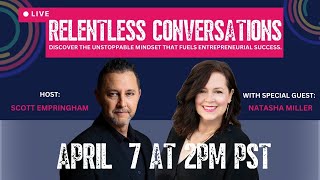
A recorded YouTube interview (Apr 12, 2023) in which Natasha Miller—musician-turned-entrepreneur and CEO of Entire Productions—describes escaping a violent home, using music as a refuge, founding Entire Productions, and building resilience. Key moments: her homelessness at 16; music as both emotional refuge and professional foundation; running Entire Productions for ~22 years; pivoting to virtual events during the COVID-19 pandemic (produced ~400 virtual events over two years); her book Relentless (memoir aimed at entrepreneurs and young adults); training including Goldman Sachs 10,000 Small Businesses and study at Harvard/MIT; practical advice on momentum, belief, and designing memorable events/meetings.
Chapters
Sasha, welcome, welcome. Hey. Thank you everybody. Welcome to Relentless Conversations. Discovering the unstoppable mindset that fuels entrepreneurial success. Sponsored By Anthony Jurassi Esq. @ move your biz manage out sorts virtual employees as well as EO Inland Empire chapter. We thank both of them and all of them for putting this on. My name is Scott Abraham. I'm going to be hosting today and we have a true game changer that I'm excited to talk to. Somebody that exemplifies relentlessness. We're going to talk about your book, tell you about all kinds of cool stuff. But if you are looking for a relentless mindset, you need look no further than Natasha Miller. She's the CEO of Entire Productions, a go to experience design, event and entertainment production company in San Francisco. Her passion and commitment to giving back is also drives her contributions and participation in numerous charitable organizations, lots and lots. She's also a talented jazz vocalist, a trained classical violinist and she's also a proud graduate of Goldman Sachs 10,000 small businesses and studied entrepreneurship at Harvard Business School at mit. She's an author, a best selling author of Relentless Homeless teen. To a. I can't read my writing. I just ordered it too, so it hasn't come yet. To a achieving, achieving the entrepreneur dreams so much. A member of the recording academy, Grammys, asap, SF travel meeting professionals, on and on and on. We're super excited to talk to you, Natasha. Thanks for being.
Here. It's awesome to be here with you, Scott. Know you through eo gonna meet you in person very.
Soon. I'm looking Forward to relentless. May4, 5th, 6th and 7th and.comess.com all right, let's get into it. I want to just go all the way back. Natasha, what inspired you, what moved you for the first time to move in the direction of entrepreneurship and take us back maybe to the title of the.
Book. I'm not sure how I ever got to be an entrepreneur and I, I've wondered about this but you know, the title of the book lends itself to the possibility that I had to fend for myself at a very young age. So I grew up in the Midwest in the mid-80s and if you know anything about that, it means there's not a whole lot of mental health and family communication and, and, and things. So if things go awry, you're pretty much on your.
Own.
Yeah. So on Christmas day When I was 16 years old, my mother for the thousandth or more time was threatening to kill me and chasing me around the house with a Butcher knife. And the police came after I called 911. But back in that day, unless you were gushing with blood or had visible broken bones, they couldn't do anything for you. So they handed my dad a card and said, if you don't think she's safe here, you can take her to this homeless shelter. And I had five minutes to stuff things into a hefty garbage bag, went to that shelter and never got to come home. So I don't know if I became an entrepreneur because I had to fend for myself or I had it in with, in me, within before. There's no way to know. I would say this, though. I was already at that age considered. Now remember, I'm in a small city in, I mean, you know, small place. I was considered a prodigy. If you stack me up against people from major markets all over the world, I probably was not anywhere near a prodigy. But for the sake of my time and place, I was as that. So I had that one thing, music that was, that ended up being my savior, but it also ended up being my career. And it also ended up being the catalyst for which I built my core business, entire productions. And a lot of people would say, oh, I wouldn't change a thing. You know, my hardships are, you know, what created what I am today and all the successes. And I'm here to say that, yeah, I would, I would have changed everything because I would like to know what it feels like to be loved and protected by the family that I had. So the book details my life through incredibly low inflection points, but also incredibly high inflection.
Points. Well, I can't wait to dig into that more and thank you for sharing that, that experience when you were younger. I would imagine that would have just obviously a profound impact on who you are and who you become and also drive a lot of the contribution that you're doing now. So, so thank you so much for that. Growing up, what do you suppose sets you apart, sets other entrepreneurs apart? People that are watching this are business owners. Many of them are going to be business owners. They're members of entrepreneur organization or they're people that are interested in becoming entrepreneurs. What do you believe in your experience sets entrepreneurs apart than the normal.
Person? I think that entrepreneurs are risk takers, they're creative, they believe in themselves. But successful entrepreneurs have all of that. But they have this relentless ability to be disciplined, laser focused and, and shut out all the noise for them to be able to get to where they're going. And so that's you know, that's two things. Being an entrepreneur is one thing, being a successful entrepreneur is another. But your, your experience or, or what you think of as successful is going to be different for every single person. I'm a very successful entrepreneur, but there are other entrepreneurs out there that are, they're still going for something that they haven't attained yet, and they don't feel success. It's all relative and.
Objective. Gosh, there's so much I want to dig in there. There's a couple questions I have. Is one, you definitely seem to have cultivated this relentless spirit, overcoming early adversity. Once you get momentum, once you begin to become relentless or feeling unstoppable, how do you keep that momentum? How do you keep that on a daily level that you seem to have, have. And which, it's interesting is I think you're, you're. There's a lot of modesty there. You said you may, may not be a prodigy, but I'm looking at your list of accomplishments, and I wasn't even done, but I felt like it was overkill. You, you've accomplished so much, so.
Much. It's. It's almost embarrassing where I'm like, oh, my God, I sound crazy.
But. But there's clues there. What, how. What do you do that keeps you at that level over a consistent period of.
Time? Early on and up until somewhat recently, I was looking for being the best version of myself so that other people would value me. So other people would look at me and say, she's worth time, energy, money. She's worth saving. So I still had a bit of an internal victim feeling, I think. I'm not sure that's completely gone, and I'm not sure I care about it. Right. It's at a healthy level now. But I would say this. I am relentless at achieving my goal. And then once you achieve that goal, there's a little fall down, right? There's a little depressive moment, there's a little. And then what happens for me is I need that journey and I need to take that ride to that high. So I'm. I mean, anytime I'm going for one thing, there's six things banked, right? Because I cannot be down in the normal atmosphere where other people live for very.
Long. In your book Relentless, who should be reading that? Who. Who is your ideal person, where you said, boy, if I could put this, this person's hand, male or female, man or woman, who would it be and why? And why should they? Why, why, why do they need to read this? Because I've read about it and I can't wait to get my.
Copy. Okay, reading this, of course, because it's me, have two answers. One is I think that people, kids in later high school and early college, especially kids that don't have a strong family or support system, should read this. Because if you read my story and you're that person, you're going to think, oh my God, if she can do that, what she did, I can do this. Okay. But the people that are reading the book are mostly entrepreneurs, 28 to 55. I thought mostly women would read it and mostly women might be reading it. But guess who I hear from, hands down, more than anyone in the world, it is men. Men, especially entrepreneurs. But what, what I'm finding from them, which I love and did not expect, is that they're fervent and adamant about reaching out to me and telling me their experience with the book, underlining, highlighting, saying, expressing to me, maybe secrets that they've kept that I've given them a voice to be able to start saying or even thinking about saying or admitting these things out loud. Some men come to me asking me for advice about their own kids and own daughters that might have gone through some of the emotional turmoil that I had, even though maybe they, the parents weren't the cause of it. So that's been one of the most. Over book sales, over awards, over best selling status, over money, over speaking engagements. Those reactions and those interchange, those exchanges have been the most rewarding and.
Surprising. Was there anyone that reached out to you that their story of change or transformation or impact made a particular impact on.
You? You mean after they read the.
Book?
Yes. You know, I hear mostly in audiences because when I speak, I typically engage the audience and it becomes a conversation. I hear people thinking out loud about what they could possibly do that they don't think they have access to, that they don't think is for them or they'll never make it. And I hear them, I can see the clock ticking in their mind. And then with the audience and my, you know, acceptance and excitement for their thought, I know for sure that ignites that confidence within. Do they go forward and do it to the nth degree? I don't know. It's going to take a little longer than four to eight weeks or, you know, that kind of a thing. But I do know I am impacting. I think everyone, and I say this because Jack Canfield of Chicken Soup for the Soul read the book. He said he couldn't put it down, he couldn't stop Turning the pages and it was brilliant writing and that it impacted him. He's in his 80s, he's incredibly successful. If I can impact him positively, I'm pretty sure that somewhere in the book, some, anyone reading it will be impacted.
Positively. Well, I am a huge fan. I can't wait to see you speak at relentless in May 5th, 6th and 7th. Yeah, I'm super excited. I want to shift gears to the music. You mentioned music in the beginning. You have this background in music. How did you fall in love with music? How did you get exposed to music and how does that influence you now? And you're kind of your, your, your path of.
Entrepreneurship. Music was within me from probably the moment I was brought home from the hospital. My dad was a pianist and not professionally, but very good self taught, but was playing Chopin and Joplin and like very complicated things. So might have gotten a little talent from him, I don't know. And I, I, I have photos of me reaching up, you know, as a toddler in diapers, you know, on the keyboard with him playing. So it was, it was my safe place. So we would come home from dinner, or, I'm sorry, from work before dinner, and we would spend about an hour or more depending on when dinner was going to be ready in there. And that was my cocoon of safety. That is a place where my mother didn't enter and didn't interfere. And to me, I'm not a drug user and I don't drink. I have been drunk a couple of times, so I know what it feels. But to me, making music, especially with someone else is kind of like it's the most incredible high. And so I got addicted pretty early on. And then when I learned how to sing, and then I started to learn how to play the piano. But then in fourth grade, I started the violin. That scooped me out of a lot of pain and suffering at home and gave me a bubble. And when I say a bubble, sometimes I mean literal bubble. Because if you imagine practice rooms for musicians are very small, like isolation booths, even if they're all lined up in a practice hall. You know, you. As I got older, sixth, seventh grade, I started studying with a college professor. So I would insert myself in these practice rooms and practice for six hours a day. Sometimes I would skip school, skip classes to practice the violin in order to be good enough for this college professor to teach me. But also I was hiding, right? I was keeping myself very busy. My brain was con when you're doing something like arpeggios and scales and Bach and Mendelssohn. You can't be thinking that once you get home, you're gonna be attacked. You, your mind is on the music, so you can see where that all.
Went. Yeah, yeah. And I seem to remember reading somewhere that you've made the connection between music and then leadership or leadership styles. Did I read that correctly, that there was a connection.
There? I mean, certainly there was, especially in classical music. So when you're, when you're taught classical music, you are to play exactly what's on the page. If it says, you know, mezzo or piano or, you know, these are Italian words for how loud or how you have to do it on the page. And then you're, you're playing at a pretty quick clip, but you have to look three to eight measures ahead to know where you're going. So I think I learned systems and processes. I think I learned not math, like addition and subtraction, but spatially, you know, what math was supposed to be like. I was not good at math in school, but I can, I have a better understanding now, and I'm incredible at systems and processes and most creative people aren't. So I may have been born with that equal left and right side brain, or, or I might, or I might have had to develop both sides to survive. Again, I don't know if we can ever.
Tell. I'm curious you, as you describe your childhood and some of the challenges that you had and how you overcame adversity there. Let's bring it forward now. Give me a scenario at Entire Productions again, if we can, for everybody. Give everybody a snippet of what you do, who you serve with Entire Productions, and then take us right into an experience that was one of the single biggest professional challenges you ever.
Had. That's so easy to discuss. So Entire Productions, we produce over the top amazing, whimsical corporate events, which sounds kind of like an oxymoron now that I just said it that way, or mostly Fortune 500. But I'm in the Bay Area, so we're talking Google, LinkedIn, Apple, Facebook. Just keep naming down the list of tech companies. Those are our, our target clients. We've been doing it for 22 years. And when the pandemic came, I can't even believe we have to still say that word. Guess what happened? Nobody could get together to have an event. So Entire Productions, a profitable multi million dollar business, went to a zero in revenue, which equals zero in profit, by the way. And I had to come up very quickly after having a little bit of a real panic attack. Laying off half my team. 80% of the event industry was gone for almost two years. But I came up with something, and this is that pivotal moment where everything. Me being my best self in a challenge, unfortunately, me having to be super creative, me having systems and processes, I came up with something that we were ahead of our time. We had to wait for these big corporate tech companies to get to us and to go, oh, that's right. So we created a virtual event solution and ended up producing over 400 events in two years virtually.
Wow. How did you. How did you get the word out about.
That? Oh, gosh, it's so funny, Scott. I created this deck, a presentation deck. It was before we had proof of concept. It was before I could actually show anybody how it would work. Guess who the first person I was that.
Called.
Who? I called the CEO of Mansueto Ventures, who they operate Inc Magazine and Fast Company magazine. I don't really know why I thought of him, but I did, and I presented it to him and he was blown away. Then we started. Instead of trying to tell people that we have this product, this solution, this service for them, what did we do? At entire productions, we produced the entire variety show that had four 15 minute segments. And those segments were either an interview or. Or a performance with a musician or some sort of talent. We had aerialists perform, we had mentalists, magicians, we had stretch breaks. We had interactive activities. Sometimes we brought on a fashion sketch artist and we would award some of the people that would tune in a fashion sketch of them. You know, we would take a screenshot of them on the call. This is how we promoted that service. We created it, we invited people in. It wasn't. There weren't ads, There weren't, you know, sound bites of like. It was just at the end, if this is something you want to do for your company. So we have 13 episodes on our YouTube channel, and you can see what we did. And you can see, man, we were scrappy. I mean, we launched that within six weeks of complete.
Shutdown. I love that. In. In Tim Grover's book Relentless, he talks about a cooler, closer and a cleaner. And one of the distinctions he makes between a cooler and a cleaner is somebody who operates on gut, on instinct, that they've been here before. They've prepared so relentlessly for something. When adversity strikes, as it always does, they just react with gut. Do you agree with that? Disagree. Like, did you think through that or was it just a natural adaptation? When adversity hit you, you immediately started thinking about what can you do to turn this around? Take advantage of it, capitalize on.
It. Honestly, Scott, when I knew that my business had gone to zero and everything was shut down, the first thing that came to my mind, and I have to paint the picture. I lived at the time in a gorgeous but small condo in Union Square in San Francisco, where Prada and Hermes and Cartier and Valentino were on my block. The first thought I had, my instinct was, I'm going to be homeless. And I'm. And I checked myself, can you sleep on a cardboard or drag your mattress down under the awning? And my answer was, yes, I can. I can do that. That's a little dramatic. That is what happened. And it was the course of having to come to the reality. And I laid people off earlier than anyone else in my industry. And honestly, I was laying people off before EO members were, because I knew that we weren't going to survive this if I didn't. But then after that. So it was only after that, and let's call that one to two weeks, I went to bed, and then my brain started clicking. And similar to when I write songs and I've got a good hook or I've got a. A great melody, it just, you know, spirals. It keeps going and going and going. I do think I fell asleep. But during that sleep, it all cemented in. And that next morning, I created the. The Proposal Deck, which, by the way, we didn't really have to use because once we produced that first show and started producing them every month, that's what we.
Used. That was the advertising. That was the. That was the whole thing. So let's go back to that. So I'm super, super obsessed with this idea for people that are watching that may be experiencing challenges in their own life, in their own life or their own business, in whatever format that is. I think the one thing I really love about what you're talking about is that comparing it to music, once you have that hook and once you have that sort of melody or whatever that was you said, then the rest starts to flow. If there was a recipe, if you were going to prescribe something to somebody who's stuck, who's challenged and facing adversity, they're on their back. What is that recipe? What is that two or three ingredients that you would recommend that could either snap them out of it or can get them up and get some momentum again, what would you tell them to.
Do? I wish I had done this in those, you know, couple days after I would get out a piece of paper and start writing stream of conscious style, meaning don't worry about what it looks like. You might want to worry about how you write because if you can't read it, it's not going to be very helpful. No punctuation, no spelling. Just write out all of the things that you're capable of, all the things you love, all the things that you want to do. Right. And then start crossing off the things that you've already done or you're not that interested, and really zero in on the things that light you up, that you have access to and that you have ability to do in the, you know, next month or two. And that's where I start becoming obsessive. Now, not everyone might be like me, but if you are on the, you know, down and out, or you don't see a way out, just use that as the guide and do the things to learn and grow and create those things. Now you may veer off and go, you know what? I don't really like that as much. But this over here, this adjacent thing, or even this thing completely unrelated, I'm gonna double down on that. And I think it's really that relentless attack on doing something better or different or more whatever it is that's keeping you down. And I think shutting out the noise is really important. The. The outside noise that's not helping.
You. It's interesting. I also noticing that in doing that, it's almost like you do your music and re establishing that focus. You create a focus, you create a bubble and you get some momentum. Even if it's just writing it instead of playing music, you're writing it, you're. You're creating the music, and then you're getting momentum. Yeah, you. You sparked another thought when you were saying that for those who are watching and they have some momentum now, how do they keep momentum? And we kind of touch on this a little bit. Is there a mentor that you had or. To what extent does environment play with your momentum? And what do you do to keep momentum? And what can other people do to keep and. Or build momentum once they have.
It? Sometimes I've had mentors. Sometimes I've had other external people that have believed in me, like my conductor in high school, Diane Pope, like the college professor, Dr. Beal. They didn't really know what was going on at home. They may have sensed there was something a little not right. But back in the day, you don't get into people's business, so they didn't really know. I would say with the pandemic I had to. I had to lean on myself. Right. My daughter was there with me. She was supportive, but she wasn't coaching me. One guy did call me from EO San Francisco, Bill Gallagher. And I appreciate this. I appreciated this so much. And I think he offered this one hour free call to everybody that was affected. And he helped calm my sort of obsessive need to. To do. He was like, okay, Natasha, I just heard you, like, rattle off nine things that you can do basically so that you don't end up homeless. But I don't know if I told him that, but you know, that I could help. Help get better during that time. And he said, okay, I want you to write a list. I want you to write one header that says things I'm going to do and then things I am not going to do. And what did I think? I'm gonna do them all. Guess what? I might have done them all, but I didn't do them all at once. Right. Because you can't tell fast action entrepreneurs that are crazy and creative not to do something. Because what. What are we going to do? I'm going to show you. I'm going to show you I can do it all. But I appreciated that. So I did get that support. Even though I didn't work with him ongoing. I really appreciated his time and interest and also was looking around going, why me? Why are you doing this? It wasn't occurring to me that EO is a family of people that give to each other, especially in need, but I was still coming from that less than.
Moment. Well, something you said really touched the nerve there is. In 2018, I had my own challenge where I had this business awards every. All. All the success. And then the following Monday, essentially lost it all. Founded two of my largest clients had lost their business, which meant I was out of.
Business.
Wow. After I shut everything down, I'd gone through kind of a spiral and I didn't know what to do or where to start or where to turn. And I got a knock at the door from a guy we both know, Anthony Jurassi. Anthony Jurassi had a very similar recommendation. He did two or three things that absolutely changed my life. Number one, he got me to focus on the things I still had. And by taking a look around and some of the pictures were behind me of my children and. And having me look at the things I still had. Then he had me look at some of the assets. I said, you still have 20 years of contacts, relationships and experience and expertise. And that helped. And then the third Thing he said, he said he got me to. He reframed the entire thing and this was the game changer for me. And then there's a question for you. Beliefs and attitudes. He did the ultimate. I don't know whether he intended to do this or not. The guy's a genius, so I'm sure he did. But he said, you know, I have a question. What if, what if you could actually use this as the ultimate marketing ploy, like tell everybody what happened, that you're broke, that you lost everything and come back and show them the way to do that with a course and a coaching program and a workshop and show them. And it was just crazy enough. I thought if I could, that would be really cool. And, and it was just enough to get me moving. Of course that's ultimately what happened. What, what role do beliefs and attitudes play in being relentless? Figuring out a way to break through when nothing else is, is out there. There's no reasonable reason that you can achieve. What role do beliefs and attitudes play? Gosh. Oh yeah, I fired up your.
Cat. I think belief in attitude for me is a non negotiable. It's something that there's nothing I could do to not believe in myself. What's the opposite? I know I've heard people saying, well, some people just stick their heads in the sand. I'm like, I don't even understand what that is. I don't understand it. And it's good thing that I don't because I wouldn't be talking to you. Right. And then attitudes, I mean attitudes fluctuate. Come on, let's be.
Honest.
Sure. I'll be. Go, go, go. Everything's going to be fine all the time. But the core attitude is kind of circling back to what you were talking about. Belief is belief in yourself. And sometimes people have to remind you, Scott, that, you know, when I was thinking I was going to be homeless, I forgot, I completely forgot about all my skills. All my.
Skills.
Yeah. I could create eight to 12 different businesses that have nothing to do with event and entertainment. But that was not occurring to me and I had to have that reflected back to.
Me. And, and the other, the other thing that I notice about people that succeed at high levels is their voracious appetite to.
Learn. Oh.
Yeah. And I'm looking at Goldman Sachs 10000 small businesses. You, you did the program called Goldman Sachs 10000 small businesses and study entrepreneurship at Harvard. Three. Three. What is Goldman Sachs 10,000 small businesses. Tell us a little bit about what it is and what are some key takeaways that maybe we could all use in our business, in our marketing, in our.
Life? That is the Goldman Sachs 10K SB that's what they're calling it. I believe it's still running. Goldman Sachs had an endowment to put 10,000 small business owners through a program. It was about three months long. I went to Babson because they didn't have a facility near San Francisco, which is weird, but. And you basically, I mean, I was in class with people with anywhere from a $250,000 business to 30 million. One of my classmates had an MBA from Harvard and owned five separate pharmacy that catered to Latin American culture. And we're all taking our success to this, to this level, then re engineering it from the ground up. So we like people like me. I didn't have a business degree, I didn't study business. So I didn't have some of the systems and processes in place. I didn't have that foundation in place. Some things I did, some things I didn't. I'll tell you one thing I didn't. Before I went to Goldman Sachs 10KSB. If you had asked me how much my payroll was or how much my net was every month or what my profit was or showed me a P L or a cash or any financial report, I had no idea what I was looking at. Worse of all, I didn't care. And that's because for me, making a humble living and owning and operating a really cool business was more important to me than learning those things and making profits, net profit. And I was terrified of learning financial report. Understanding my teacher, Mike Fetters scared the living daylights out of me. I was like, I was back in that don't call me, don't call on me. Oh my God. Oh my God. What is ebitda? Why do I need to know that? That's such a horrible word. And he kicked my butt. And I can talk to any financial expert now, not at their level, but I can have a conversation as confident as I'm having with you now about numbers. However, my daughter, who is 27 years old, can run circles around me on my P and L. And she is not even trained or interested in entrepreneurship or business, but she had to learn it at a previous job. But I can talk to her about it. We can spar, right? We can. She can be like, well, what's wrong with your cogs? And I'm like, why do you even know that word? What's wrong with you? You know, like. But she'll be like, yeah, that number's really high. I'm like, oh, my God. But at least I can have the conversation with both her and a.
Cfo. And yeah, I'm excited. Michael sue is going to be speaking at at EO Relentless as well. So I'm excited what he has to say about on the financial side as well. I'm curious. With so much change that's going on in the world, we're all business people, events. And what you do applies to all of us experiences. With the advent of new technologies, new work styles, what trends do we need to be aware of as business people that may be impacting us in the experiential space, in the event space, what trends are going to be out there that we can maybe capitalize on or at least be aware.
Of? There's so much to that. So on the coasts specifically, which is very different than Middle America and even Southern America, we have an exponential amount of office space empty in New York, San Francisco, Los Angeles, and they haven't. You know, what do we all need those major markets? We need housing, right. We don't need office space. People are not going back to the office on a regular basis. And for how long, I'm not sure. Everything kind of goes in 9 to 10 year trends. So if that is so, we have a long time before we're all back into the office commuting Monday through Friday. This is not new news, but I think some people are shutting their minds to it, which I think we can't do, especially with the millennium. The millennials being able to work anywhere, that was their mindset before the pandemic is like, give me some freedom. I don't want to be chained to a desk for the, you know, from the age of 22 to 62. It's a whole new world. And if you don't have a millennial, you may not get it. I have a millennial, so I get it real good. I think virtual events and virtual experiences are here to stay in a different form. I know a lot of our corporate clients saved millions of dollars. They didn't have to fly in, put overnight at hotels, four to five star hotels, rent hotels, rent event space to do their sales kickoff meetings or, you know, their manager meetings. Some of them are saying, we're never doing that again. But what they're doing is they're putting some of that money into more experiential, more bonding, more deeply connected events. They're putting the. Here are the facts and figures and here's what you need to do on virtual and there are many incredible platforms that can really. And of course, if you use entire productions, we can make it so. And this is, by the way, Scott, this is what made our virtual event sticky. Our goal was to get people to say, oh, my God, they're gonna do what on a virtual event? I can't wait to see that. Then they're in the event we want them to go, that is so cool. Oh, my gosh. Oh, my gosh. Wait, it's over. I don't want it to end. And then they change their attention to another segment and they have that same. That same thing. We never wanted someone on any of our events to go, I get it, I get it. Okay. What is.
This? Look at their watch. Yeah, so. Okay, so let's stick with that for a second and make it totally universal. We all run meetings. People on this, people watching this are going to have a family meeting or a business meeting or. Or a board meeting when it's appropriate. Maybe it's always appropriate. How do we make our meetings stickier, more interesting, more memorable? So people want to be at our meetings and aren't checked out. What can we do to make our meetings more sticky? Anybody could.
Do. Yeah, family meeting, business meeting. So anyone can do the following. Maybe at entire productions, we took it to a level that's not actually achievable for most people. But what you can do is talk to people authentically by their name, not just, oh, I see Scott and Jerry and, oh, there's Suzanne, and they're all logging in. Okay. Yeah, we do like to hear our name called, but we like more is that authentic connection. And especially from the person running the event. Right. Because that's the. In the pecking order of the triangle, the person at the top is the most important at that time. Right. And then interactivity, that is. That has outcomes. So maybe it's a heartfelt connection. Maybe it's learning something. Maybe it's discovering something you really wanted to know and you didn't think you would ever get to it. So giving someone that experience, that's meaningful. Right. At entire productions, we take it another level where we're entertaining, we're surprising and delighting people. And I don't mean by having, like, office happy hour where we all drink, you know, bring our drink, like, okay, that it can be fun, but it's a little.
Passe.
Right. But doing something where. I mean, we had a client that sent out. Well, first of all, they had seven different performers of. And one of the performers was a chef. And prior to that, event that the chef was on. We had sent out these boxes of ingredients, fresh ingredients, which can be trouble and problematic, where people were having to, like, literally, I mean, try cutting into a butternut squash. If you've never done it, it's really hard. It's not an easy task, but, you know, where we're actually preparing. And so these people are coming out of these, like, cooking sessions going, oh, my God. Hey, I've never cut into a butternut squash. And B, I didn't know how good they would be on a taco. So, you know, that kind of a thing. But again, that's going a little bit above and beyond. But that personal touch and that personal, authentic experience I think is really.
Important. I love that. And let's bring it to somebody specific who's doing an amazing job with. Yeah, EO Relentless event. She's watching right now for people that are planning events. She's planning an amazing event, EO Relentless. You can find out more about Idealist.com May 5th, 6th and 7th. What suggestions, if any, do you have for Linda? Tim Grover's gonna be there. Folks from the EO Inland Empire be gonna be here. You're gonna be there. I'm gonna be there. People are coming from all over for three days for this incredible learning event. What should Linda be thinking about? What could we be thinking about to help Linda to make it the best.
Ever? Well, Linda, if you haven't already thought of this, and it's a little bit. It's not too late, but it's a little on the late side. So I'm going to assume I'm not planning this event, but I'm a part, you know, part of it, which I'm so excited for, that I'm going to get some kind of EO swag. I don't know what it is. Don't tell me, but that's pretty typical. But if you wanted to surprise and delight me, I might get something. Either a product or a service or a note that wasn't branded, that, you know, depending on how many people it is, that would be special to me. But, you know, that's, you know, if we're doing a smile, like 20 or less, you could do that. 20 or more, that's harder to do. Surprise us with a guest that. That's not on the bill. Anything that surprises and delights or is a shift from what everyone's expecting, I'm expecting we're gonna have lanyards with the card down here below my boobs. Okay. That's how most 90% of conferences roll. I would love it if there was another way to show who we were that was easy for people to read where you're not going, hello, belly button, hi, Scott. Right. Those kind of things. And again, you know, at entire productions, we focus on experience, design, which is another layer of planning events. And we think about what experiences and what things we can do to make our clients go, wow, what was that? And in fact, I'll give you an example that has nothing to do with entire productions. I was down in Baja with Chip Conley at the Modern Elder Academy, which by the way, is a phenomenal experience. He ran and owned joie de vivre hotels. He worked for Airbnb and now he owns the Modern Elder Academy. And he does not leave any stone unturned. So when you get to Mexico, it can be a little weird, right? If you don't have somewhere exactly to go or someone picking you up, people are constantly coming at you. We were told, do not speak to anyone. Go to this man with a picture of the man with this sign and don't speak to anyone else. So I felt taken care of. Then we got in the car and there were little goodie bags of fresh nuts, a piece of fruit and water because there was a 45 minute drive. Now, the drivers and that, that company didn't think of that. Chip Conley thought of that. And that was from Modern Elder Academy. When we got there, I was with four people. None of us knew each other. The people greeting us knew who we were. They knew us by name and they asked us to leave our luggage right here on this patio while they gave us a tour of the place and that our luggage would be put in our room. I'm thinking, how do you know who I am? How do you know what room I'm in? And how are you going to put my luggage? Like, first of all, how are you going to know our luggage apart? I don't know how they did it. They just knew. Their entire staff knew my name. There were 24 of us on the first day and we were not wearing name tags. I could go on, but I'm going to leave it.
There. Well, I think you've just raised the bar for Linda. So she's going to know everybody's guest by name. She's going to know where your luggage goes. She's knows everything. Well, that's fantastic. I, I have had similar experiences where you just think, wow, that was a, that was a great experience. I love that. I think one thing that I'm really excited about I think Linda put it together is the lunch with Tim, and I thought it was really cool. I think there's still one seat up for grab right next to Tim. And yes. So she said, hey, by the way, I do look up to Natasha and her business. So, yes, the bar is raised. I think we all do. I think all of us. All of us do. I love that. So we also have an opportunity to sit right next to Tim. So I think that's kind of cool. Just be in his.
Ear. He's a cool dude and he's quite.
Handsome. So he's quite handsome. And you've. You've met him.
Before. I've not met.
Tim. I was just seeing him in his.
Videos. Oh, yeah. I mean, we have the same title. The. You know, of our book. Both of our books are called Relentless. I didn't know of him before I wrote my book or titled it, but when I looked it up on Amazon to see, you know, who I was competing with, I thought, it's fine. Tim Grover and I will never be in the same world. The only time I'm at a pro sporting event is when I'm singing the national anthem. I know what's going on in baseball. I kind of know what's going on. Basketball, but forget it. For football. But now look at it. Look at me.
Now. Yeah, you guys. I can't wait to get a picture of both of you next to each other with. With your books. Relentless. I think that'll be really, really cool. And we have time for a couple more questions. By the way, if there's any other questions you have, please ask them. Here's just sort of an interesting question I thought was. It's off the topic of Relentless for a moment, but what is an unusual habit or absurd thing that you just love? What's an absurd, unusual habit, absurd thing that you just.
Love? Okay, hold on a second. Absurd, unusual habit that I love. I just kicked my. I just kicked a habit that is a little bit absurd. Although a lot of people have habits like it. I used to have to drink a chocolate hot chocolate every morning, which is ridiculous. Now I don't drink coffee. I don't drink booze. I don't drink soda. I just don't like it. But I love my hot chocolate, and I kick that. I don't know how. Let me think of how weird. I love to go kayaking. That's not absurd or unusual, but I grew up in a landlocked state, so maybe that's why that is a weird and. And cool question. That I don't know if I have a good answer.
For. It's an odd question that Tim Ferriss apparently asks. And I've got another Tim Ferriss question for if you're up for it. Okay, I thought this was another one. What is something that you believe that you believe that other people might think is just insane or unusual? What's something that you believe that other people just shake their heads and go, I can't believe Natasha believes, believes that. And it could be about business, it could be about life, it could be about.
Anything. I, I would say definitely my inability to appreciate and enjoy alcohol completely baffles most people. They don't understand it. Here's the deal. I don't understand it. It doesn't taste good. It doesn't make you feel good for more than like you've got this tiny window of feeling good and then it just goes up and downhill from there. I wish I knew what it felt like to say, oh, I need a drink or let's go to cocktails or happy hour. It's embarrassing, it's almost embarrassing to say it challenges me socially because if you were to say to me after our talks, hey Natasha, let's go to a bar, even though I know I don't have to drink alcohol, right, to go to a bar, it is not a prerequisite. My whole body says, but why? Right? Awkward weirdo. And now thank you for letting me announce that to.
Everyone. Well, I will share that I'm an equally awkward weirdo. I quit drinking and now I, I, it, I look back on it and I think about all the times that I did and it doesn't make any sense to me. That's on my own thing. And I, I, I'm equally weird in that regard. A couple final questions, couple final questions. One of them I was really interested to ask. As you start to connect with more women entrepreneurs around the world through EO and just through your books and your talks, do you notice a common thread of relentlessness that is, that is consistent with being a, being a woman entrepreneur as opposed to maybe a general entrepreneur kind of mindset? Is there any kind of unique thread where you connect with another woman entrepreneur or business person in a unique and specific way just from that experience of being a.
Woman? Well, unfortunately, a lot of women, maybe most women, you know, they bear the responsibility way more responsibilities than our male counterparts do with tending to a home, children, daycare, medical. I mean, most women I know, if their kid is sick, their husband is not beelining at home to be with the Kid, it's sort of a universally accepted that the woman is. And so in order to be an entrepreneur and have a successful business and stay on that track, you have to be able to navigate that. And, you know, I, I think women have this, maybe quieter lions roar inside of their heart and gut that aren't necessarily as, well, that aren't as loud as men's, but they're just as fierce. And I think that is an interesting thing to look at. Like, I'm thinking of my entrepreneurial master's program at mit, at the women in that program and, and the men. And, and I would say I'm probably one of the more outspoken people, men and women there. You know, I'm pretty confident. I like to voice my opinion, but I also like to engage people in conversation. And there's a lot of the women that are kind of. They're internal, they're sitting back, they're probably absorbing everything. They're probably calculating and crunching data, but they don't need to have their hand up. They don't need to be the one, you know, with the bravado. So that's kind of what I see in, in general, in, in being put on the spot. I have, you know, my, my version is of, of answering these questions are, oh, I want to study this. I want to really think about it, I want to ponder, I want to weigh before I make, you know, comment. But that is off the, off.
The cuff, in the, in the spirit of the whole talk, relentless. In the spirit of the event, relentless. How do you personally and or professionally define the state of being relentless? How do you define.
That? You know, going back to earlier, laser focus, discipline, shutting out the noise and not letting anything stop you from achieving the goal. Love.
That. Finally, if you could have a word or a phrase on a billboard, fairest question, a word or phrase on a billboard that's going to last forever. That's going to be sort of your motto, your thing. What word or phrase would that be? And then I have one final.
Question. I got, I got it. You know, there's a logo, there's a catchphrase. It's everywhere. Everything I do, it's be relentless. And if you want to be, you know, millennial about it, or even, what am I? Gen Z or Jen? I don't even know what I am. Hashtag be.
Relentless. I like that. Where can people find you? Where can people learn more about your company and, and all the stuff, the cool stuff that you're.
Doing? Yeah, my. I'd love everyone listening to go to natasha miller.com. especially since I just got that URL after 30 years of begging for it from a woman that had it, that never used it and never was going to. I digress. And if you want to know more about entire productions, go to entireproductions.com. i hope that you'll be blown.
Away. All right. I am sending it up there and it's entire.
Productions. Entire. The whole.
Thing. Entire productions. Got it. We are pushing that out to everybody and we'll make sure we get that to everybody. Natasha, it's been an absolute pleasure chatting with you. I can't wait to meet you on May 5th, 6th and 7th. Eorelentless.com if you haven't got your tickets yet, I just was talking to Linda and some of the folks that are promoting the event, putting it on the EO Inland Empire chapter and Anthony Dri's team. I think there's like 10 tickets left. If you haven't got your ticket, get your ticket now. I believe there's still a ticket up for grabs for the lunch with Tim Grover. Natasha will be there. I'm going to be there. Lots of wonderful, wonderful, amazing, spectacular entrepreneurs are going to be there. I hope you'll be there, too. Natasha, thank you so much for joining us today on Relentless Conversations. We'll see you next time. And we'll see.
You. That was a blast. You're.
Amazing. Thank you so.
More from Scott

🔥 PRESSURE IS A PRIVILEGE #PressureIsAPrivilege #LeadershipMindset #MentalToughness


🚨 YOUR NEXT LOCATION WON’T FIX YOUR PROBLEMS #BusinessScaling #MarketingSystems #FranchiseGrowth

🚨 AI CAN ACTUALLY MAKE YOUR MARKETING WORSE #AIMarketing #MarketingStrategy #BusinessGrowth


🔥 STOP RUNNING FROM WHAT’S CHASING YOU #FaceYourFears #KeepGoing #MentalStrength

🎥 STOP EDITING EVERY CLIP YOURSELF #AIVideoEditing #ContentRepurposing #ContentCreation