📢💪 "How to Leverage Health and Wellness for Business Success!"🚚
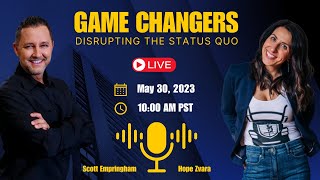
A recorded interview on the Game Changers podcast (host Scott Empringham) with Hope Z. Zavara, CEO of Mother Trucker Yoga, about integrating health and wellness into business success. Hope narrates her path from yoga and recovery into creating Mother Trucker Yoga, describes practical, small habit changes (micro-movements, hydration, label-reading) for truck drivers and remote workers, outlines her offerings (app, 90-day program, corporate/CDL programming, book), and gives tactical business advice on messaging, product naming, and speaking. The overall tone is practical and motivational, stressing simplicity, audience-centered messaging, and ownership of habits.
Chapters
Foreign.
Welcome to Game Changers. This is a podcast that brings insightful conversations with industry experts who are disrupting the status quo. I'm your host, Scott Impingham and we're sponsored by the AI Training Academy. Now, do you want your next marketing campaign written by AI? What if you could have all your ads, emails, blogs, social media posts, video scripts and more for your next campaign written entirely by AI in minutes, just by answering six key questions about your business with AI Content Pro, all of that and more is possible. Click the link in the comment section. It will drop in a little bit later on. Use the 10 day free trial code. You'll be blown away.
Away.
Now we're going to get to our guest. Have you ever felt that balancing your health and your professional life is an uphill battle? I know I have. Are you struggling to incorporate simple yet effective fitness routines into your busy schedules? Do you wish there was a way to align your wellness goals seamlessly with your business goals? Are they at odds right now? And do you wish they were more aligned? Meet Hope Z. Zavara. Now, I met Hope in Cancun a few short months ago and she radically changed my life, everybody else's life that she had the opportunity, we had the opportunity to meet with her and learn about from Entrepreneur Organization. Hope is a speaker, a business coach par excellence, and the dynamic CEO of Mother Trucker Yoga. She's been featured in Forbes, Yahoo. News, PBS and hundreds of other radio and podcast shows. Hope has risen to prominence as a health leader, particularly within the trucking industry. So we're going to get a dig into that. But beyond that, she's not just a leader and the reason she's on this podcast, she's also a pioneer. She's successfully coached thousands of entrepreneurs, helping them craft compelling messages just like the folks at Entrepreneur Organization and create brown breaking groundbreaking products. And we're going to talk about some of those products right now. And above all, she believes it's simple and enjoyable. Actions are what lead to business growth. I asked her in the beginning, before we started, I said, are you busy? She said, I'm not busy. My life is full. So I'm excited to hear about that. So welcome Hope to Game Changers.
Thank you so much for having me on, Scott. I am super excited for our conversation today and let's do it. Let's have some fun here.
Excellent. Well, let's start with the very beginning. Now, much of your background is in health and fitness. What drew you to health and fitness early on? What drew you to that part of the business Part of life.
Well, I always tell people that yoga. I didn't find yoga. Yoga found me. That was really where I started, was in the yoga space. I was struggling with addiction, anxiety, depression, and I don't want to say my family gave up on me through my teenage years and into my early 20s, but I felt like they didn't know what else to do for me. And then one day I was at work at my job, and one of my co workers looked at me and said, you look like someone that would practice yoga. And I mean, something in me just flipped and I went home and, and got on the Internet at the time when dial up was still a thing. And, and I was like, oh, I found this yoga class that was in a neighboring town. And next thing I know, my Wednesday night yoga class is my weekly ritual of second chances. And those second chances eventually led me to a yoga teacher training. Because my yoga teacher said, hey, you're really good at this. Have you ever thought about teaching yoga? And again, something in me just flicked and I went home, got on the computer, found a training in Colorado. Next thing I know, I'm there for 30 days. And I kind of pivot from the college four year career route into teaching yoga. And, and as I was doing that, I eventually opened a yoga studio, eventually opened a yoga school here in Wisconsin in my home state. But through that process, one of the things I learned was one, how to heal myself, how to find peace, how to work through a lot of this stuff. For those of you that are listening, if you've ever struggled with addiction, we become professionals at running from ourselves, running from feelings, running from dealing with things. And yoga has a way of being, making you stay present on the mat and deal with the stuff that's in front of you in a safe space. I call yoga an incubator. And that incubator taught me how to go out and then live in real everyday life. Have to integrate and talk and share my story with my students in this safe place. But along that journey for 15 years, working in the yoga space, teaching teachers, traveling around and teaching at conferences, working in my local community, I always felt like that was not really where I was supposed to be. Like it was a stepping stone. It wasn't really like my end goal. And in that quest to try to find something more for myself, I started doing some business coaching. But then I found myself at a local business mixer in my small hometown. My husband has a county board supervisor, not that you need to know what that means, but basically he's in local Politics. And I show up at this event and I start talking to this guy that I never met before. I'm trying to pitch him corporate wellness because that was partly what I did at the time. And he didn't get beat. He looks at me and says, do you have anything for truck drivers like in the cab of the truck? And I think I'm funny sometimes. And I threw up my hands and I said, mother trucker yoga. Just trying to get her eyes out of this guy. And he looked at me, stuck out his hand and said, that's brilliant. You want to go into business together? Called me up the next day. In four months, we built the business from scratch, we meaning me. And a year later, I bought him out of the business. And since then I have been helping truck drivers who are living sedentary lives and struggle with things like back pain, mid drive, brain fog, sleep issues, what to eat at the truck stop that's healthy, with small simple changes, all from the cab of the truck.
That's fantastic. And that actually was my second question is how did you make the bridge from yoga into the trucking space? Now, many people that are watching this podcast or business owners or marketing, a lot of the folks I work with are businesses, business owners and marketing. How can you. What problems can we help them solve? What problems do they have that might be similar to the folks you work with on a day to day basis in the trucking business?
Oh, absolutely. We all of us, I don't care where it is you work. We are kind of stuck within our space. I have a home office, but I spend a lot of times in front of a computer. Even though I have the ability to move freely and go where I want, most of us don't. And so we're in a confined space. It might be a computer, it might be a home office, it might be your phone in an airport. And so knowing that there are small movements that you can do throughout the day, things as simple as just reaching up overhead and just kind of side bending, how many times do you do that during a day? Reaching your arms back and opening your chest, you know, stretching your neck back, adding a twist in these might seem so silly, but if you do that 3, 4, 5, 6, 7, 10 times through the day, 10 seconds or less, all of those movements add up. And those are, those are basic or essential lifestyle movements that we need to do in order to age healthy. There's actually four of them. But trying to incorporate them more into your day, I'm just so happen to teach these to truck drivers. But we can all add more lifestyle movement into our day. However it is that be for you. I have a set of hand weights down by my feet that when I'm watching things that I need to for work, I'm doing bicep curls. When I go into the bathroom. I have a 10 squat rule. I always go and do 10 squats in the bathroom whenever I go in there. And now it's kind of automatic. And so where can we fit fitness in? Where can we fit health in instead of putting it in a box? Like if it's not 10am or it's not 5:30am or whenever it is, I'm not going to go to the gym or if I don't have my workout clothes, well, I'm not going to do anything. And we compartmentalize health and fitness. And if it doesn't have these qualifiers, a lot of us just throw it out the window and say, oh, I can't today. And I'm telling you that you can today.
I love that. And so can you. Share with us a success story. You're one of the masterful storytellers. Tell us a story about somebody that came to you that might be a trucker, but then we might be able to identify with people that are working at home, stuck at home, working in front of a computer.
Absolutely. You know, the first person that comes to mind is really one of my very first clients, and that's Robert. Robert was struggling with weight. He was, I would say, obese. And he just kind of gave up on himself. And I think for many of us, we may not be struggling with massive need for massive weight loss, but we often are struggling with ourselves. And the first thing first was his thoughts about himself. He kept looking at this idea of fitness, like he has to do these massive things. He has to make these big changes. But if there's anything I know about the human brain, when we tell the human brain we can't, we actually resist. And so trying to show him these small wins that, hey, a lap around your truck. Hey, you know, just try to eat one healthy food today. Hey, I know it's tiring to go up those stairs, but let's see as far as you can get. And showing him these small wins and celebrating those, not looking at like, oh, I failed. He was able to start not only getting the weight off, he's lost over £100 since I started working with him a few years ago. But he's gotten a lot of his life back as far as how he feels mentally and how he looks at himself and how he looks at the opportunities in front of him. Because, let's be honest, you can look the part, but if you're not right up here, that can be really difficult. Another driver that comes to mind is Dean Key. Dean Key. When I first started working with him, he came through one of our challenges. He was on several different medications. He was pre diabetic, he. He had high cholesterol, he had high blood pressure. He definitely need to make some changes. He was probably, you know, 20 plus pounds overweight. Not a lot, not enough to like be like, oh my gosh, Dean. But he knew he had to make changes. And it was the implementation of the small changes. Getting out during your break and just walking, making sure you drink water in the morning as first thing. If you're not a water drinker, dude, sometimes you just have to do things you don't like because you know you're good for you. And the biggest change for him was learning how to read the labels on the backs of food. I'm not talking about the fat, carbs, and protein. I'm talking about the ingredients. And once he started realizing that he needed to eat real food, that was a game changer for him. He's not only lost over 20 pounds, but he was also able to get off two of his medications. His blood sugar levels are now in check, his blood pressure has gone down. All because it was an accumulation of small, little things that have added up to really big results. So my question to those of you listening, you might not be Robert, you might not be Dean, but where is it in your life today? You can just make one small change and commit to it, be consistent with it. That's really when we see results for the long haul.
I love that because that was my next question is if you find somebody that sort of stuck, it says they know what to do, but they can't get themselves to do it, where do you start and break it down?
I like to break it down and go all the way back to the beginning. So I don't care if this is in your health, in your business and your parenting, whatever it is. A lot of times we look at a task like, okay, let's say you want to write a book. Well, just the idea of writing a book is really not step one, like, oh, I want to write a book, I'm going to write a book. Well, you need to first keep working backwards until you get to the starting line. So if I want to write a book, probably need to get in touch with a Publisher. Well, in order for a publisher to take me seriously, what do I probably have to do? I have to write a book proposal. Well, in order to write a book proposal, you know, what do I have to do? Well, I probably have to write an outline. Well, if in order to write a book outline, what do I need to do? Well, I probably need to map out my ideas. Well, if I need to map up my ideas, what I need to do first, Well, I probably need to set aside time on my calendar in order to do that. Well, if I need to do that, I need to actually look at my calendar and I need to put aside time in order to kind of bring my thoughts to paper. Most people, health, business, life, whatever, aren't stepping back far enough to where they actually are in order to move forward, to build the momentum that they want. I don't care what aspect of life you're talking about. We're biting off too much. We're trying to jump forward from where we are. And I don't know if it's an ego thing, I don't know if it's like a, a worthiness thing or it's just like you don't want to be left behind. But if you want to go further f. In business, health, life, you know, wherever your finances, you got to start from the beginning. And the only way to do that is once you identify that goal, keep working backwards until there's nothing left for you to do first.
I love that. And one of your mantras seems to be about simplicity, keeping it really simple and breaking it down into simple elements. Do you see a connection between, or a distinction between your ideal customer, your customer, that is a trucker, versus an entrepreneur or business person, or their similarities that you see.
So there's definitely similarities. And here, here's the interesting thing, and I didn't 100% recognize this until a year or so ago, that my approach to how I do things with my truck drivers, with health and wellness in the transportation industry, and how I work with my business, coaching clients, when it comes to building their programs or their, their, their speeches or mapping out the back end of their business, whatever it is, my strategies are actually exactly the same. And I think this is where being super clear on your own personal branding, your own personal aesthetic, like, what are you good at? And one that just takes practice, most people just don't are doing it long enough to figure that out. But it occurred to me about a year or so ago that the core commonality in everything I do is always small, always simple, always Breaking things down into bite sized pieces. And if I go back a step further, that's really how I got into recovery. That's like the core of everything I do because I tried for years to do everything, the fancy programs, the inpatient or the outpatient treatment, the therapy, this, that. But it was like always these big pieces. And it wasn't until yoga was like one pose hope, one breath, hope, one moment, hope, one day hope that I started to recognize this is applicable to every aspect of life. And that's just been embedded in my core. And it doesn't matter who I work with or what I'm teaching. That is just something I just believe so much has to be present in order to be successful. At least when I work with clients.
Take us through a day. When you're working with mother trucker yoga, you're working with truckers. Where is it that you work with them? Do you work with them online or do you work with them in real person? How does that, how does that look?
Yeah, that's a great question. So a couple of different options. One, we have an online program and an app so drivers can join, they can access our videos, they can access our content at any time. It's kind of like a DIY self serve, you know, just go at your own pace. They get all my, my content. But for those of the drivers that want a little bit more, I once a year run a 90 day program. That means they get to work with me for 90 straight days, cycle live, and they, they get to ask questions and they get to learn different things. And I kind of hold them accountable to jump start that small, simple change commitment to get them going. But really on a, I would just say on an average day with truck drivers or with companies, it's my corporate wellness programming. It's my school programming for CDL schools where they get customized content just from me to them based on their customers or their really their drivers and their students needs. But it all goes back again, Scott, to small little things. When people look at our programming, a lot of times they're like, where's the other stuff? And I'm like, that's the problem. You have too much stuff. You have too much content. You are overwhelming people. They don't know where to start. And when they open up your course and they see 900 videos and all these trainings, you know, that says to them a new person, it says, I don't have time and I'm overwhelmed. And I see this across all industries. They're actually giving too much. This Idea of over delivering people have translated in their head. That means I need to vomit information all over. People like you don't need that. Go on the Internet. You can find that anywhere. What really people are wanting in today's world, and I think I've really zeroed in on that in the trucking world, is organized, condensed, compressed, digestible content. And that really comes through in our app, our 90 day program, and our customized wellness programs.
Well, I have to say, having worked with you and Cancun at Global Speakers Academy, I saw you expertly work with a number of people and be able to pick out the essence and the core of what the stories that people were telling. I'm curious, you talked a little bit about this, the mind body connection. How important is the mental aspect of fitness and do you find that to be a precursor to really breaking through on the fitness side?
You know, it's a great question. When it comes to the mind body combination, I think the first thing is, is however you come to fitness in the beginning is right for you. People will used to always ask me at my yoga studio, should I start with meditation first or should I start with with yoga class first? Like, how should I start? And I'm my answer to that is you should start however it is you're approaching it. If you're like, oh, I'm interested in a yoga class, well, then take one. If you're like, oh, I think I want to learn to meditate. We'll learn to meditate. And in our culture, we're obsessed with like the path. But I think when it comes to fitness, one, it's just the awareness of your interest level, whether it's in food prep or whatever it is. That's step one and then step two. As you enter into that space, it's being aware of the thoughts associated with adapting and adopting to that change. Many of us, we are our worst enemy and we are our greatest asset. That it's like, oh, I'm gonna go to the gym. I just bought this membership. I really like, want to work out. I'm excited. That's awesome. But then all of a sudden our alarm comes on and we're like, oh, 5:15. My bed is so cozy. And we hit the snooze button. This up here is the only reason why you hit the snooze button. And so recognizing that it's happening. Oh, I hit the snooze button for the fifth time in a row. Oh, that's an excuse. I said I was tired. That's a lie. Or I went to bed too late. That was my fau. Like, I love calling myself out on those mental things. And once I can do that, we can't change things we aren't aware of. Then I start working backwards. Well, why was I tired this morning? Well, I went to bed at 11. Well, why did you go about at 11? Well, because you were up watching a Netflix show that you didn't need to be watching because it's called Pause and you didn't go to bed early. Well, why did I do that? Well, because you were really stressed out about a work meeting and you couldn't stop thinking about it, and Netflix was distracting you. Well, how do I fix this? Well, I need to send an email to this person today so then I can have a better night's sleep. So do you see what I'm doing here? Like, I'm pulling back the layers to why I'm making those choices. And when I work with drivers, this is a big part of our conversation. Because the reason why they don't think they can be fit and healthy, yes, it's an industry stereotype, but a lot of it is up here. A lot of it is they're. They're cutting themselves off before they get in. They get started. And I'll leave you with this on that. When I make a healthy choice, I feel good about myself. When I feel good about myself, I want to make a healthy choice. When I make a healthy choice, I feel good about myself. When I feel good about myself, I'm. You see, you see this circle that we're getting in, and that's really the loop that I want everyone to be in. When it comes to fitness or business or life or whatever it is, what you're telling yourself is the actions that you create.
And it sounds to be one of the keys to starting simply because I, I'm curious what your recommendation would be. I know a guy who was very goal. Is very goal oriented. He had an event that he was working very, very hard towards. He was speaking at that event in Palm Springs, and he had it on his calendar. 90 days, 80 days, 70 marking down. And he was pouring everything into it. He had the event and it went really well. That was two weeks ago. That same guy is really having trouble getting up and working out at the same level. That guy, you know, is me. What suggestions or recommendations would you have to get back? Because I am in that loop where after the two weeks, it's sort of a letdown and I, and I, I'm having trouble getting traction. What advice Would you give to that guy? Maybe me?
Yeah. I think the first thing first is to recognize how you categorize fitness or working out as a level priority in your brain. A lot of people look at it like, oh, it's just because I want to be healthy or I want to work out or I want to lose weight or not gain weight. But I look at it as a critical piece for my business success. So me going to the gym, me walking my dog every morning, me stretching every morning is a critical piece. For me to run a successful business, I have to reframe it. You know, in the beginning, it was for me to stay in recovery. Now, now I'm past that, and now it's if I don't, I know that I'm not present at work. I know that I'm not focused like I should be. And when I'm categorizing it as me time, it feels selfish to me when I'm like, oh, this is like my time. Well, I'm separating it too far away from being a good mom, from being a great business owner, from being on, on. On a speaking event like this. If I don't do those things, the ramifications are very high where it counts most. So I would first ask you, what's your relationship to that activity? You might not be putting enough connection to all these other categories in your life as essential. Because if it meant for your business to skyrocket to another six figures or not, you better believe you'd be in that gym at 5am every single day. If it meant that, like, your cancer, you know, was not going to come back, you better believe that you'd be in that gym every single day. There's not a high enough connection for you. There's not enough ROI for you to make you want to get up and do that. So that's the first thing. The other thing I would look at is what is it? What is it that you're telling yourself you're going to go in and do? Like, are the. Or is the plan too big? Like, for me, every single morning before 9am I have to be back. So I just work backwards. I take my dog for a walk, and so sometimes it's at, at 7, sometimes it's at 8. It depends when I get my kids to school. But, like, that determines the route I take. So no matter what, I'm always going to walk my dog hell or high water. And depending on how much time I have, depends on how much, how much, how far I go. So now I'm to the point where it's like I got to get out the door fast because it's like I want to go farther. Why? Because I feel so much better when I do. It's like I want to do it. Like when I get up and go to the gym at 5:30 with my friend Sharon, it's like I feel so awes. I connect with her, she energizes me. I come back and I'm just like ready to kill it. And I've memorized that feeling so much. It's not even about the gym. Like it's, I push harder, go harder there because of how I feel afterwards. You got to memorize that feeling, Scott, and try to duplicate it. Now I want those feelings all the time because I know my business goes farther, my family is better, I'm a better person, I'm a better human, I'm better with my va. I'm not leaving or hanging all of these things because I've re categorized what fitness means to me. And I'll leave you with this and I want to hear your input. I get flack from people sometimes, usually some peers and friends that they're like, oh, it must be so nice. Oh you're so lucky. And I'm like it's not lucky and it's not nice. It's because I see the value and priority. I'm going to the gym, walking my dog, doing yoga, you know, meditating, listening to high frequency music, like doing these things, that's actually a part of my work day, that's a part of my lifestyle day. And you just haven't seen that connection and priority yet. And I hope you get there one day. And it took me a long time, but that, that's what I have to say to you about that.
I think you nailed it. You nailed it because you reminded me of something that was really critical, that one of the things, the glue or the pieces that really kept me at it prior to that speaking event was I was on stage just prior to one of my heroes, a guy named Tim Grover. And he coached Kobe Bryant and Michael Jordan and he's incredibly fit. And the event was called relentless. And so I had this vision. In 90 days I was going to be in some of the best shape I've ever been in. So that was hugely important to me. I pictured it night and day as the days counted down. So, and then now I will, the event's over and I don't have that same level of importance. But so by remembering that that is a key integral part of Success in business, that health and that vibrancy, I think I can work back there and start setting goals again and get back after it. So I think you're right in the money. That helps a ton.
Awesome. And then everything else that comes afterwards, and people are like, well, what do I do at the gym? You know, what, What. What kind of yoga do I start with? And that, I feel like, is the next question to ask yourself. But you got to get clear on your why and the motivation and the connection to why you'd want that. This is why. You see moms, you know, go for broke and lose all this weight because they can't care for their kids anymore. You know, because it's like, man, I'm gonna lose my kid. I'm gonna lose this relationship. I have to do something for me. And all of a sudden, the switch flips. And I'll tell you what, a lot of those people that I've met over the years, they have zero fitness background. While these drivers are changing lanes in their health and fitness with me, they're not fitness gurus. They never went to the gym before. A lot of them have never done anything like that in their life. And they're figuring it out why? Because now they see the connection and they go and they buy a hand weight, and I just know how to do a bicep curl. Hope that's all I'm doing. Like, my squats aren't very good, but I'm doing something. I'm going till my knees hurt. We will figure that piece out. But you gotta know what it does to make you show up or none of that matters.
I love that. Yeah, I think you're right on the money. Yeah, I think you're right in the money. I want to shift a little bit to. One of your other areas of expertise is business productization, creating products, and also speaking and naming products. Could you talk to me a little bit about how you got into the speaking side? When I saw you coach, when I experienced you coaching me, when I saw you coaching other people, it was jaw dropping. One of the things I do as a marketer is I help people with their messages. I've never seen anybody better at it than you and the other coaches over there. So how did you get involved in speaking and how did you get involved in crafting messages? Then we're going to go into some of the nuances for business people that are watching.
So funny little. Little tidbit about me. So when I did go to college, after, I dropped out after a year, but I wanted to be a public speaker. I was studying theology, and I wanted to do some type of motivational speaking. And yoga just kind of rerouted me. And for 15 years, my yoga mat was my speaking platform. And then eventually I would say, like seven years ago, I kind of pivoted into the women's space, into the addiction and grief space and started speaking there. And I think one of the things that probably gave me a little bit of a leg up was I had already been teaching in the fitness world, and so that kind of helped me with my communication skills. One of the reasons I think I'm such a great coach, and I don't say that arrogantly, I just my based on feedback is yoga really taught me how to read between the lines, how to listen to people, how to feel people, and I'm able to kind of respond accordingly. But I mean, truth be told, I think we're all built or we're all born with gifts and talents that are unique to us and communication and connection and just the art of listening has always just been something that I've been very good at. I didn't see that as a skill set. No one, like, taught me that or like clued into that. I think yoga kind of helped me with that. But when it comes to productization and it comes to naming, one of the things that I tell all of my business and speaking clients is they got to make the change. Everyone else is telling you, you know, get clear on you, focus on you, you know, whether it's in health or whatever it is. And that's true. But eventually what you have to do is you have to make the flip and you have to start focusing on what the client wants, what the client needs, how the client speaks. And I'm obsessed with embodying my, my clients clients. And if more speakers would do that, they'd flip the script from come hear about my life, me, me, me, me, me, you know, come learn from me to here's my story and how it benefits you. And I was just on a call with a client this morning. We were working on talk titles for his speaking and summaries and takeaways. And I was like, hey, Sam, do you see this? Like, this whole talk is about your 172 pound weight loss, which is great and awesome. But I'm reading this, and if I was a client, all I'd be thinking is, wow, cool and inspirational story. What does that have anything to do with my problem? So there's a gap here, and you probably see this in marketing where Business owners and online entrepreneurs and speakers, they're so stuck talking about themselves that they haven't shifted the script to eventually include them other people. And I see this on social media a lot. My story, me, look at me, at this place, me with this awesome person. And as I'm scrolling reading, very few people connect their, their brag book session to why it matters to me. And if you do that, I guarantee you you will have more clients, more engagement, more people wanting to do business with you because you've done the work with connecting the dots to your successes, your triumphs, the things that you're sharing and why it matters to them. Because just like you, they're concerned about one thing and one thing only, themselves. And if you can talk about them just a little bit more in your product titling, in your program, naming what they want, oh my gosh, just wait for them to start coming to you versus you trying to convince them or over explain what your program is or what it does or what it means. If you find yourself having to take 20 minutes to do that and you're probably not in the right boat when it comes to what your customer really wants.
So if somebody is watching and they are a business person, they're a manager, they're a CEO, they're a vice president, and they have a big meeting and they're going to present an idea, they're going to present a campaign or an initiative that that business is kicking off and they really want to reach people, they really want to persuade people. And you had two minutes with them before they took that meeting, before they stepped out in front of everybody. What advice would you give them to make sure that message landed and it carried weight and people took action on it?
First thing I would ask is, you know what, what's in it for them? So why, why do they care about this initiative? This is a big disconnect for CEOs and, and, and people in upper, upper companies with other people underneath them is they see their visit vision but they're not connecting it to why those other people should care. So that's the first thing. Again, obsessed about them, not necessarily about you. Get clear on your why, get clear on your vision, but eventually you have to shift the clarity to the other people. So that's the first thing. What's in it for them? The second thing I always ask myself is what would be the objections as to why they wouldn't do it or why they wouldn't show up with bells and whistles or why they wouldn't buy what Is it? That means I have to know them. And so what is it? If I. I have a rule. If I get to the objections first, I win. If the client gets to the objections first, they will never let go and you lose, they win. And so whether that's in a title, whether that. We have a product called Rough Relief. It's actually like a cr. It's called Rough Relief Lips and fingertips. Crack bomb. People like crack bomb. That's so clever. Yeah. Because they work with truck drivers. Like, everything's all cracked up. Like, I know there' reason why our label is black because of the person that I work with. There's a reason why there's a truck on our label because it's attracting our audience. They don't want flowers. They don't want purple labels. They want something rough and tough feeling. There's a reason why it says intensive repair formula because that's what they're looking for. How do I know these things? Because I asked actual truck drivers what they wanted and I listened to their objections. When I came up with my book, Trucking Yoga Simple Fitness for the Long Haul, my cover was yellow and the words I think were black. And I showed this to my. I call it my test group of drivers that I trust. And immediately they were all like, no, not yellow. And I was like, why? Because yellow makes me think of safety and all those safety meetings and all the safety rules. So we switch it to green. That was a huge game changer for me. I listened to them. I figured out what their objections would be. They wouldn't buy something that's yellow because it triggers something in them. And then I responded accordingly. I fixed the problem before it happened. Now that's talking about products. But you can do this with meetings, you can do this with programs. You can do this in an intro video to your online course. Tell the listener what the objective is, what's in it for them, and then address the obstacles before they happen. So many people, I see this in parenting all the time. It's like we talk around them, just hit the. Hit the thing head on and be in the driver's seat and watch everybody around you rally and respond because of that.
That's really powerful. That's really powerful. So now we've got the business person walking in front of the group. They're making sure that they're delivering a message, delivering first what's in for them, the listener. And they're addressing the objections before the other person does. Love that. Now they're going to go for the close and get them to take action. And they have to come up with a name for this initiative. What are your suggestions around naming an initiative? Naming a product. You touched on it, let's hit it one more time. You have the same manager, the same business person for another minute or two and they said, I need a name for my initiative. What do I call it? And what are some strategies around naming it so it has impact. Influence and people really sink their teeth into it.
Absolutely. So first thing first, people listen to people that understand their problems. Okay? So if I'm a speaker or I'm, I'm in charge of a team, people listen to people that understand their problems. I need to validate their problems. I need to let them know I know their problems. And one, I just actually need to know them. So if you don't know them, you got to do a little bit of research. So once I build that level of trust, people typically buy results. Okay, so what is a results based title that you could use that tells the buyer because your team is technically buying the idea when they agree to it? When they say, yeah, I'll stay, I'll stay an extra hour every Thursday when they say, yes, I'm going to be on that project with Tim, who I don't like. But I, I'm accepting this, this idea. I like this, I'm buying into it. Buying is not always just with money. People buy with time a lot, especially in the business world. If I go to an event and I listen to someone speak, the first time I'm buying from that person is actually when I give them 45 minutes of my time. So if they didn't show up, I'm asking myself, well, why didn't they? They probably didn't like my talk title or my talk summary or my talk takeaways. It wasn't what they wanted to buy with their time. And the same is true in an employee space. If I'm showing up for a meeting with my boss and this is like not about what I want, what I want to buy into, do you think that that employee is going to show up invested? You think that that employee is going to show up ready to go? So one results based title. Something that those people want to rally behind, something that those people want to get behind and get excited about. And I love the, I love the organization of is does means. And so when I'm describing that, that product or that offer, whatever that is in the business meeting, I'm going to tell them what it is. What is this? This is a 90 day sprint to get our product to market and be able to be on track to sell a hundred thousand units by the end of the year. That's what this special team that I'm trying to get these people in my marketing department to, to be on and rally behind. Okay, that's what it is. What this does is allows us to map out exactly what has to happen for all the key team members here today. That means Joe in design and Sally over in social media, that we're all on the same page and nobody's doing things they don't need to. So is does. What this means is we put a product out right the first time. I know in the past we've been, you know, struggling at the end because we miss things. We're going to do it right this time, and this team that we're building today is going to be able to set us all up for success so we can all celebrate after July 31st when we see this thing go to go to product or go, go, go to market. And I want to celebrate every single one of you. So now I gave them a reason to buy. I overcame all their objections already. I told them what it is, I told them what it does, I told it what it means. And when you focus on the right things, it actually doesn't matter when the team meets. It actually doesn't matter, you know, that the calls or the meetings are an hour or 90 minutes long. It doesn't matter, you know, what is required because they want to be a part of it. And the best way products that I have seen companies create actually don't even tell the client when they meet, how long the calls are, if they're on Zoom or where to buy the product. The consumer, which is the employee or the actual customer, they're both the same, actually just seeks that out themselves. Like they're just willing to buy and figure that out later. Like when you call the doctor, you don't say, well, I'm only available on, on Wednesday at 10. They're like, well, you either have Tuesday at 1, Thursday at 3, or Friday at 9:45. That's all I have. Like, they're telling you because you know the value of that appointment going in. Do you see this now? Do you see this logic? So that's, that's what I would say.
I love that. I love that. And you're giving me ideas for our stuff as well. So thank you. Now, what is an objection? What's maybe the number one objection you hear with business people who say, well, I speak in front of groups. I'm a CEO, I'm a manager, I'm a vice president, I'm a leader in my organization. But maybe I really don't need speaking. Coaching or coaching on speaking. What's one of the objections you hear most often where you just think to yourself, oh my gosh, that is absolutely so not true. And how do you get through to people without objection?
Exactly what you said. I, I don't speak, I don't need coaching on that. Speaking is just another fancy word for clear communication. Whether you're speaking to one person, to 10 people, to 100 people or a thousand people. It's all varied levels of communication. When I'm up on stage, for me it just so happens I'm communicating, but it's more of like a one sided conversation. And I'm, I'm just assuming in those special moments throughout the talk that the audience is nodding their heads and understanding. And how do I know that? Because they're nodding their heads and understanding. So it's non verbal communication back the majority of the talk, but it's still a conversation. And there are so many people out there that are so brilliant, like the smartest person on the planet in their, in their field, but they are not good communicators when it comes to explaining it. When it comes to bringing the other person in, they're so tunnel visioned into only being able to talk about their thing. Very technical, very analytical. And to those people, I'll say you're going to struggle. You're going to struggle because it's really hard to get other people on board with you. And this is why a lot of times those people partner with somebody else. There's a reason why Tony Robbins and Dean Graziosi are partners. Because Dean's very analytical, he's very technical, he's very focused in on all those details. Tony is very aspirational. Tony's very big. He's out there. He's like just a heartfelt connector. The two of them together create a very big powerhouse. A lot of people don't have both skill sets unless they've worked really hard to cultivate them. And so when you're thinking about wanting or not wanting speaking, coaching, I, I would just say if you plan on getting anywhere in your business, in today's world, with today's technology, speaking is the gateway to communication. Whether you're speaking on social media, one to one, one to many, it all boils down to can I clearly communicate myself in any capacity? How else do you plan on getting clients you have to have that communication.
So.
So transfer the word speaking from communication. And now that whole idea of needing coaching could possibly shift for you.
One more question along those lines. I was talking to Tim Grover and he said something very interesting. He said getting to the next level oftentimes isn't addition, but subtraction. Something you said about simplifying. What is one hack strategy or tactic that you could recommend to someone that's speaking in front of a group that they can immediately subtract, eliminate to make their communication better, more effective, more clear while speaking?
Like they're already speaking up on stage.
Yes. They're about to take the stage and you are going to make a recommendation about removing something subtracting.
I think the number one thing to look at is most people are just sharing too much information. If you're getting on stage and you're like, man, we got a lot to cover today, so get ready, buckle up, I'm here to tell you you're doing it wrong. What you need that hurt. Because that's self edit. You need to self edit and share your best stuff in the beginning and kind of pull back that other stuff. Most people are sharing too many unnecessary slides, too many unnecessary stats and statistics and graphs that by the way, are too small to read anyways. And so by pulling back and delivering your best stuff and having great examples around them and bringing to life the concepts that you're trying to teach, man, the audience is just going to lean into you even more. The number one thing whenever I'm speaking, I always want to walk away is knowing if someone asks, asks me, what does the audience learn from you? Or what did the people in the audience learn? Today I can easily zone in on at least one core topic or three smaller topics that I talked about. Because the person that leaves the audience saying, whoa, that was great, with their arms full of information. Now I gotta go home and I gotta unload this all. You just made more work for them. Why would anyone sign up with you if now they have more work to do, they have more research to do, they have more stuff to think about? What they're looking is for something to simplify their life, to organize their life, to decomplicate their life, to help them go further, faster? And if you're not the one to do that and you show them that you're not, guess what they're going to do? They're going to go two doors down and find the person that is.
What, what is the first step someone could take a business person that's watching this right now and they want to get better at public speaking. What's the first step to reaching out to you? What do they need to do to connect with you? And what's the first step in working with you?
Absolutely. So the first step in working with me is one, having a clear plan, having a clear plan on what it is that you do in your business. I unfortunately don't work with new businesses anymore. My clients tend to be businesses that are already established and they don't have to be speaking necessarily, but they're already making money and they've already been doing this enough to kind of flush out what isn't, isn't working in their business so that I can come in and I can speak strategically not only to the setup of their programs, but to where it is that they want to speak. So I think that's the first thing is you have to know that you're making anywhere between 100,000 to 500,000 to a million plus in revenue with repeat customers. Like it's working, something's working. So that's the first thing. But the second thing is, is you want to grow your business by leveraging speaking. And that means one on one and phone calls. Like I look at a sales call as a speaking opportunity. I look at coffee at Starbucks with a potential client or colleague or sponsor, you know, as a stage. And so kind of knowing what I'm going to say, say and having clarity around those things. We can create a Talk that is 1 minute is 100 minutes is 10 days long, whatever it is that you want to do. So kind of thinking about that and then the last thing is, is reaching out to me, you know, going to my website, hopes of OurA.com that's Z V dot com and shoot me a message and saying, hey, I'm interested in, in growing my business through speaking. I'm interested in creating clarity around my business messaging. So people like Scott are a good investment for me when I want to go out and I want to put myself on social media and I want to be able to, you know, kill my industry with great content. Most people don't have that first foundational piece set up. And I've worked with businesses that are, you know, several million dollars plus and they like skip this step. They like stumbled onto success. And it's like they don't have this foundation of who they are, their core values, you know what it is they're really trying to accomplish who their audience is. And they kind of just found their way, but now they're stuck now they're stuck at a ceiling and they can't get past it. And always comes back to these foundational landmarks, these foundational, really business strategies or business clarity so that things like you, things like Facebook ads, things like sports speaking make sense.
Jumping to the other, other group of people. There are people in the trucking business. There's a man or a woman in the trucking business right now that's watching this and says, you know, I know I need to eat better. I know I need to start feeling better. I know I need to start treating my body better, but I just can't seem to get started. And maybe this isn't for me. Maybe I'll just continue down the road. I'm going, what suggestions would you have for them if they knew there was hope? They just didn't know where to get started. And where do they start?
I think first things first. Every single one of us today, whether you're a truck driver or not, can start by drinking more water. Most of us are dehydrated, especially in America, and that's making us feel like we're hungry. It's making us feel like we want certain things. It's causing even health conditions that can go away or be eliminated simply by hydrating your body. So where is it that I can just drink that bottle of water and get it down? Everyone else is telling you that you need to drink eight bottles of water. I'm saying, dude, if you haven't even drank one in, how about we just have a cup of water? Like, let's just start small and celebrate that success. So that's the first thing is adding more hydration, more water into your day in a way that feels comfortable for you and consistent for you. But if you're ready to take that next step, really, that's joining our app, joining our program, our online program at 7.99amonth, it's the Mother Trucker Yoga Lifestyle Jumpstart membership app and platform. And this is really a database of videos and exercises and breath work and meditations that drivers can do right in the driver's seat, right in the sleeper, right outside the truck while you're filling up with fuel. What I'm doing and where I am is what you're seeing. That's one thing I really recognized with course creation is if there's a gap between you and your audience and you're not in their environment or you're not seeing, speaking their language, they're like, I don't get it. How does this apply to me? And so I'm where you are. What this does is empowers drivers that they can do it because they see. Oh, oh, I can just grab the seat belt and turn my body. Oh, yeah, that feels really good on my back. Oh, that's awesome. Oh, I can just roll my shoulders while I'm driving. Oh, I see what she's doing. She's finding the headrest to just, like, check in with her posture. Oh, I could do that, too. Now they're seeing those things. And what this means for a driver, what this means is they are finally empowered to add healthy, small choices into their day and feel the difference in their everyday life. And that, my friends, is a recipe, is a repeat recipe for a healthier, happier life, both on and off the road.
Hope you are the real deal. I really appreciate it. What final piece of advice, or maybe actually a better question, is, what question? Didn't I ask that? You were thinking, man, I wish he asked this question. Is there any question or suggestion or piece of advice you had for somebody that maybe I just didn't even touch on?
You know, this is because kind of like where I am in my life right now, I At the end of every day. So I had someone ask me this a while ago on a podcast. I kind of stuck with me. It's like, what? What? Do one thing do you do at the end of the day? And one of the things I've been doing for years at the end of the day is when I lay down and go to bed, I go through my day and I look at all of my choices. So, one, you have to be able to have perspective on yourself. If you're stuck in your poor me, if you're stuck in your problems, this is really hard to do. You have to be able to pull yourself apart. But looking at your day, looking at your choices, and saying, what can I do better tomorrow? And so I reflect on my day from morning to night. My choices, the things I've said, the things I didn't do, and I call myself out. And I said, well, why? Why didn't you do that, Hope? Like, how can you fix this tomorrow? Like, why did you say that to that person? Like, oh, it's because I was really stressed out and I took it out on them. How can you make that right tomorrow? And this isn't to, like, get down on myself, which is sometimes response some people have. This is for me to take ownership over my life because for years I didn't have ownership over my life. For years I let my addiction run my life. I had my. My addiction brain and I had my healthy brain and my healthy brain and my healthy mind was so loud, I wasn't even making choices for myself. And now I get to. Now I get to steer the car. Now I get to be the one to make the decision. So for those of you listening today, reflect tonight. Be the person that can look through your day and say, why? How? What can I do different tomorrow? And then here's the kicker. Do it. Do it tomorrow, and you'll be stuck in that cycle of healthy thoughts, make healthy decisions. Healthy decisions, make more healthy thoughts. Healthy thoughts, make healthy decisions. And before you know it, you'll be showing up at the gym at 5:30am no matter what. You'll be having those tough conversations with your business colleagues. You'll be showing up at the dinner table with your kids no matter what. Why? Because now those things matter. And now you know why you weren't acting on them previously. I believe you are the gatekeeper to all the success you want in life, but you are also the person that has the ability to take it away. And the second you take ownership over that, you will watch your life transform. I got to watch myself do that. I've got to watch thousands of clients do that. And I cannot wait to see you do that as well. Today is the day to step into the driver's seat and make the changes and steer that truck towards the life and the future that you have always wanted.
Hope Zavara. Thank you so much for being on today. If you'd like to learn more about Hope, go to the link that we posted in chat Hopes of our comm and learn all about her and take advantage of the resources on our site. Hope, thanks for being here today.
Thank you so much.
More from Scott

🔥 PRESSURE IS A PRIVILEGE #PressureIsAPrivilege #LeadershipMindset #MentalToughness


🚨 YOUR NEXT LOCATION WON’T FIX YOUR PROBLEMS #BusinessScaling #MarketingSystems #FranchiseGrowth

🚨 AI CAN ACTUALLY MAKE YOUR MARKETING WORSE #AIMarketing #MarketingStrategy #BusinessGrowth


🔥 STOP RUNNING FROM WHAT’S CHASING YOU #FaceYourFears #KeepGoing #MentalStrength

🎥 STOP EDITING EVERY CLIP YOURSELF #AIVideoEditing #ContentRepurposing #ContentCreation