🔥How to Stand Out in a Noisy Market 🔥
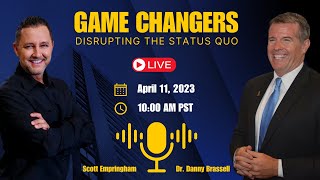
YouTube interview (recorded Apr 12, 2023) in which host Scott Empringham talks with Dr. Danny Brassell about standing out in a noisy market by using storytelling, humor, and practical “nuggets” to engage audiences. Brassell (introduced as a speaker/coach who has spoken to thousands and authored many books) describes his mission to bring joy back into education and the workplace via four channels: global speaking/coaching, a large reading-engagement program for parents, Cyber Smarties (a moderated kids’ social platform), and coaching entrepreneurs/executives on persuasive presentations. He emphasizes vulnerability (share failures), self-deprecating humor, giving one practical takeaway per talk, ‘universalizing’ personal stories so audiences see themselves, and continual practice (watching speakers + reps). He offers freebies (FreeGiftFromDanny.com) and lists DannyPurcell.com for contact.
Questions this video answers
April 12, 2023.
Over 3,500 audiences worldwide.
16 books.
Leadership Begins with Motivation.
Children ages 5 to 12.
Chapters
All right.
All right, Danny. Thank you so much for being on everybody. Welcome to Game Changers Disrupting the Status Quo, sponsored by AI Training Academy. I'm Scott Ibrahim, your host, and today we're with a true game changer, Dr. Danny Brisel. If you ever wonder what sets successful business owners apart from the rest or you want to stay ahead of the curve in a very, very fast marketing world, today we're with somebody that can help you do that. Look no further than our guest today, Dr. Danny Bricell. Dr. Bresel is a renowned speaker, a trainer, a coach who's spoken to over 3,500 audiences worldwide, authored 16 books, including his latest, Leadership Begins with Motivation. He's known as Jim carrey with a PhD and is on a mission to help entrepreneurs, executives, and business owners increase their income, increase their freedom and impact through engaging presentations. I am thrilled to have you here. Here. I met you and I had the privilege of meeting you in Cancun, Mexico, with entrepreneur organization Global Speakers Academy. And it was a pleasure meeting and I learned so much. Welcome to the show.
You're the man, Scott. Thank you so much. Thanks for spreading joy in the world. And I just love everything you do, and you're a fellow Trojan, so I appreciate that. Here I get. I got my helmet above me.
Oh, nice. Nice. Fantastic. Well, let's, let's, let's get right into it if we can. Tell us about a specific moment or a time. What tipped you in this direction? What tips you into speaking? What inspired you to start a career and go back as far as you can with some of the early memories, if you would.
When I was in second grade, my second grade teacher was Ms. Hess in Iowa Falls, Iowa. And one day we were all sitting at our desk doing a math assignment, and she interrupted us and said, kids, and she holds up her pencil. She's like, raise your hand if you can see this pencil. And all of us raised our hands and she said, good, now come with me. We all followed her out to the hallway, and she said, raise your hand if you can see that exit sign at the end of the hallway. All of us raised our hands and she said, good, now come with me. She takes us out to the playground. She's like, raise your hand if you can see that house up across the street. And all of us raised our hands and she said, good. Now this is a tough one. Raise your hand if you can see the water tower five blocks away. And all of us raised our hands and she said, good. Now here's my question. For you. How far can you see? And one girl says, I can see a mile. And I said, I can see two miles. And one little boy says, I can see five miles. And she said, good. Can anybody see any farther? All of us shake our heads and she says, good. Now look up. We all looked up and she said, raise your hand if you can see the sun. And all of us raised our hands and she said, good. Did you know that the sun is 92.9 million miles away from Earth? And the longest any of you said could see was only 5 miles? You are all grossly underestimating what you are capable of. And that stuck with me for the rest of my life. Always push further. Because you can always push further.
I love that. And is that so? I see that as also an opportunity for you as a child to push you in two directions because education is a direction you went in as well as speaking, as well as, you know, encouraging people to think bigger and look further. Is that one of the primal, sort of the first experiences that sort of got you in that direction?
I guess. I mean, you're shaped by lots of different things, Scott. I mean, my mission is to bring joy back into education in the workplace, and I do that in four ways. So you had already mentioned, I speak all around the world trying to show people hope and positivity in a very negative world lately. Second of all, I've got the world's largest reading engagement program online, which teaches parents in just a couple of months how to get their kids to read more, read better, and most importantly, love reading. Third, this is how you and I met. I get to speak and coach entrepreneurs, executives, business owners all around the world on how to use powerful presentations to get their audience to take the next step, whether it's to purchase your product or to donate to your cause, or most importantly, to get interested in your idea. And then finally, I work with a company called Cyber Smarties out of Ireland, founded by Dermot Hudner. It's a wonderful company which is basically a social media platform for kids ages 5 to 12 that teaches kids positive social media habits. So, for example, if I type a message to you, I say, scott, I think you're ugly. It won't let me message instead of pop up. Because that's nice thing to say to Scott. Here are some positive things you could say to Scott. And it frustrates kids that it slows them down so much that within two weeks, the they are all sending nothing but positive messages. And the program has basically completely eliminated cyberbullying. In Ireland. Now we're in India, we're in New Zealand, we're in Turkey, we're in uae. And I'm now the North American director trying to install it into American schools.
Wow. So is it. Is it. Is it powered by AI software that has recognition?
It's a little bit of AI, but it also has. We have monitors. So first of all, you have to verify that it's a kid. And so the school and the police department have to verify it's a child. So no adults are allowed on the platform. And then we also have based on. Because there's different languages in schools. So, for example, right now we're trying to get the program in some schools in Florida. And so we'll have actual human beings stationed hopefully in Florida, but we'll also have people in India, but they'll be able to speak Spanish, English, Haitian Creole, and whatever. Because what we found this is interesting. Girls are a little bit trickier about the way they can say negative things to one another. So it might not sound negative to a person, but you have to look at the context. So, for example, like, one little girl might say, oh, are you going to Sasha's party this weekend? Knowing that the girl isn't. Because they weren't invited. We can ding them that way also. But it's really interesting. I mean, we just went into one school in New Zealand, and they reported a 100% elimination of cyberbullying within 24 hours. I was like, wow, that's great. It's designed to take a couple of weeks, but, yeah, we'll find it only takes a couple of days. And, you know, we need to have the platform for kids. So it's basically Facebook for kids only. There's nothing negative allowed. And now we also have all kinds. The way I met Dermot is he and I are both into how do you instill positive habits in humans? And so that's how we matched. And I love it. I think. Scott, I was judging a speaking competition recently, and there was over 1300 speeches, and not a single one of them was funny. And it just depressed. And I'm not saying that depressing doesn't work. I mean, you know, there's plenty of research that shows pain over pleasure, but we just. We just survived a global pandemic, Scott. I think the world needs a little bit more hope and happiness. And so that's what you and I were working on is I. People like to work with me because I'll add humor to their presentations, ways to get people smiling again, because just Too much negativity. I mean, I was watching a horrible show on TV last week called the News and it totally depressed me. One of my mentors was Charlie Tremendous Jones and he said, you're the same today as you will be in five years, except for two things. The people you meet in the books you read. So I always encourage people, be wise, surround yourself with people that lift you up like you, and make sure you're filling your mind with lots of really good books.
It's so true. And I want to dig in on something, a couple of things that you just said that are really interesting. On Thursday and Friday, we have a global speakers summit. Now, people that are watching, people that are listening, they may be speaking in business in front of small groups, big groups, or they may be speaking in front of their families. What is one of the best pieces of advice you can give somebody who's about to communicate to an audience that will help them be more persuasive, connect more deeply and get their point across?
I'm a big fan of Brene Brown. I've told you this. If you really want to become a better speaker, you got to give lots of speeches and you got to watch great speakers. So I watch tons of great speakers. But Brene Brown, she says something in one of her talks which I completely agree with and it's how to become more vulnerable with your audience. And so the strategy I would suggest to all those leaders out there is don't share your successes, share your failures. Because not everybody in your audience has succeeded, but they've all failed. And the more you're willing to share your own failures, they're going to love you. A lot of people think that you need to do these extraordinary things to be an incredible speaker. And I would say exactly the opposite. I think it's the more normal stories, the people talking about their struggles, getting their kid to go to bed at night or you know, how to just those regular day to day struggles are what more and more of us can relate to. Not everybody has climbed Mount Everest, but all of us had a challenge in our life and had to deal with adversity. And I'm much more interested in seeing how you dealt with that adversity.
I love that. Who's one of the great speakers right now that you think is just fantastic? You listen to their speeches, who's the greatest speaker of all time that you've seen speak and, or who's speaking that you just, you just can't get enough of their stuff right now. Brene Brown is one of them, obviously.
Well, I didn't know him, but I think Jesus was probably a pretty good speaker. He did a pretty good job of building his posse. That was a pretty good one.
His message carried.
Yeah, exactly. You know, the people that I listen to, a lot of the people that I listen to have passed away. I mean, I think Jim Rohn is fantastic. If you look at Jim Rohn, he's the person that basically taught Tony Robbins Jim Rohn is. The tone of his voice just cracks me up. He said, you know, one of his lines, like, if you want to change, change. You're not a tree. I love Zig Ziglar. Zig was a mentor. And Zigzag has one of my favorite quotes. He's like, you can get anything you want in life by helping others get what they want in life. And that's where I always tell people. I hate the term servant leadership, because by definition, a leader is a servant. The best leaders are serving. Currently, if it's a motivational speaker, a friend who's one of the greatest speakers out there, he's probably the top motivational speaker on the planet right now is Les Brown. He's been given his speech for 40 years. I think is fantastic if people want to watch a great TED Talk out there. One of my favorite TED talks is Benjamin Zander. And Benjamin and his wife Rosamund, they wrote a great book called the Art of Possibility. It's a short book. It's only like 200 pages. Everybody should go out and get that book. But Rosamund, his wife, I think she's like a clinical psychologist. Ben is the director of the Boston Philharmonic or one of those orchestras in Boston. And his 20 minute TED talk is about how to get people to love classical music. And like any good speaker, if you have no interest in classical music, 20 minutes later you're going to be trying to download as much classical music as possible. He's that fantastic. Those are the most persuasive. But you know me, Scott, I like funny speakers. Ken Robinson, Sir Ken Robinson. His TED Talk on education is. It does everything a good talk should do. It shows his own vulnerabilities. It gets you to laugh, it gets you to cry, it gets you to think, which is a wonderful presentation. So those are a couple of my favorites. You know, one of my favorite women is Debbie Silver. She has just so many funny lines. She has one line, she says that her ex husband and her, they. They divorced over religious differences. He thought he was God and she disagreed. I mean, I just. Wonderful line. It's Priceless. You know, I've been blessed. I get to speak with lots of wonderful people. There's people out there making real impact. But there's different types of speakers out there also, Scott. There's people. They're there just to train you. Some people are there, you know, to inspire you, to get you to tears or whatever. I mean, you know me. I like to give everybody energetic. I like to add humor. It used to drive me nuts when I used to participate in speaking contests, because I get everybody all listening and all. They're all laughing and having a good time. And then the next speaker comes up and she says, the first time daddy touched me, I'm like, I've lost the. I've lost the competition. Everybody likes the violin story again, and I'm not putting it down. But there's three things that I tell people why I don't like sad stories. First of all, I think the world's been through a lot. Everybody's had a sad story. I don't think people need to hear sadness. I think they need to hear hope. Second of all, do you really want to tell a sad story a thousand times? I mean, I have a friend. His daughter was murdered, and he's told that story a thousand times to audiences. Scott, I don't know about you. You got to be a stronger person than me to tell that story a thousand times. The worst moment in your life. Here's the thing, though, and this is where people are getting angry with me. Here's my big thing. Humor lasts. I can tell you the same joke over and over again, and I can be sincere. I'm just trying to get you to laugh. I think when you tell the same sad story again and again after the 20th telling, I think you've lost authenticity. I think it's crocodile tears at that point. I mean, there was. There was actually an episode of Cheers years ago where Norm was in charge of firing people, and he. He'd cry with them as he was firing them, and they all liked it because he took them out for beer. And by the 20th guy, he couldn't cry anymore because he was used to doing it. I'm like, that's true. That's human psychology. Again and again, I think it becomes really false. So that's really. And people are going to disagree with me on that because they. They tell their sad story. But I. You know, life's too short, man. That's why I like you, Scott. Yeah. I mean, your story. You. I. I hope you tell your audience your story. The Hewlett Packard USC story is one of my favorite stories. I've been telling people that one. I'm like, that's great. It's so bold.
Yeah, that is. That is a fun one. That is a fun one. And so. And I want to go. I want to go back there for the people that are watching that have a meeting coming up. What's like a practical takeaway? They haven't had a chance to watch a bunch of speeches, and maybe they don't have the opportunity necessarily get trained by you or someone like you right now. What's one nugget you would give someone to say, hey, before you go into that meeting, before you present that idea, try this one thing, and I promise you it'll make everything easier.
Great.
Any practical nuggets you can offer?
Absolutely. And you already gave it in. Your question is give your audience at least one practical nugget. I mean, I see plenty of people. They do talks, and they're just trying to sell people on things. I'm like, well, if you want to establish trust with your audience and make them think that you're helpful, here's a hint. Be helpful. You know, help them. And this is interesting. The research actually shows that how you're helpful doesn't even matter. All that has to happen is you have to have your audience associate you with being helpful. So I have a friend, he speaks on reading, and in the middle of his talk, he says, oh, going to teach all of you something amazing. This is amazing. If you ever lock yourself out of your car, but you have your cell phone, call your significant other and have your phone, and you put your phone next to the door of your car, and it will unlock your car. Scott, I've tried this. It actually works. It worked from 2,000 miles away. I don't know how these doors operate, but this friend of mine, he has people, 20 years later say, oh, my gosh, you're the guy that taught me how to do that. That's the most helpful. You see what you've done? Psychologically, they associate you with being helpful. I mean, I was working with.
A.
Woman, she's a life coach, a couple of weeks ago, and she was trying to help her audience. I said, well, give them here. Tell them that smiling actually produces endorphins in your brain. Just the act of smiling will produce endorphins. And if people don't want to smile, all you have to do is, is if you bite on a pen, it actually causes you to smile, and it fools your brain into actually producing those endorphins. And she's like, does that work? I'm like, yeah, there's actually research on this. And the audience love that. I tell people all the time, I'm like, you know, the cell phone, when used properly, can be a wonderful tool. Now most people just waste time on social media. I use it to learn things. And so I have updates every day. So I'm a bad Christian. I'm trying to learn different pieces of scripture. And so every day at 8:18, I have an alert to remember Deuteronomy 8:18, which is, remember the Lord your God. He is the one who gives you the power to be successful in order to fulfill the covenant he confirmed to your ancestors with an oath. All right, I got that. I read the book Dune by Frank Herbert, and there's this great thing called the Litany against the Litany Against Fear. And so I practice that one all the time. Where is it? I don't have it every day anymore. I put it on a different day. But the way it goes is I must not fear. Fear is the mind killer. Fear is the tiny death that brings total obliteration. I will face my fear. So I go through that. That's at 911 every single day. I love King Henry V by Shakespeare. My favorite part is the Saint Crispin's Day speech, which is 50 lines. It's in four. Every day before I practice this speech, which is what's he that wishes? So my cousin Westmore, I'm not gonna go into the whole thing. I got married on December 20th. And so every day at 12:20, I have an alert to tell my wife that I love her. You know, and people like, that's not nice. A lot of people say, that's not very romantic. It's actually very romantic because I'm programmed to remember to do it every single day. So. So that's just. That's a strategy. I give the audience. So the nugget for your audience is give your audience a nugget. Give them something that they can use immediately.
I love that.
And.
And I remember that coming up over and over at Global Speakers Academy, there was different opportunities where each of us had an opportunity and a specific assignment to offer something of specific value. I have a question. So one of the things I know that you were brought in on Global Speakers Academy, you did an amazing job with the speakers. Is looking for opportunities for people to interject humor into their presentations. Humor is hard. Or is it not? Is it Maybe I'm just thinking about it. And how do you approach humor? If you're if I'm a speaker and I'm going to go, I have a speech on Thursday and Friday. I have zero humor in it. And you just made me acutely aware that I'm going to be the most boring speech ever. How do I introduce humor? Is it good to introduce humor? What's the strategy there?
Well, I think it's definitely good to introduce humor. And the strategy is humor is what a good leader does anyway. It's just looking at the world in a totally different way. I actually bet you your AI can probably figure out some ways to introduce humor. There's some easy things anybody can do. I mean, the most important strategy anybody can do when introducing humor is to make fun of yourself. So one of the strategies I like to teach people is don't brag about yourself. If you're going to brag, write it in your introduction so that the person that's introducing you, they're bragging about you. And, you know, I'll make my introduction make me sound like Jesus Christ. And so the person makes me sound like Jesus Christ. I'm like, yeah. And so my first line is, yeah, Jesus Christ forgot to wear his dress socks today. And I'll show everybody I'm wearing my socks. And you see, what I just did is now everybody's like, oh, you know, he's a successful person, but he's down to earth. He's humble, just like me. Because that's what you're really trying to do, is this is somebody I can talk to. A speech is a conversation because we have one goal in your presentation, and you and I know this. I say, you know, the goal of your presentation is not to get a standing ovation, although you may. The goal of your presentation, not to have people coming up to you afterwards saying, you're a great speaker, although they may. There's only one goal in your presentation, is how do you get your audience to take the next step with you to go for that second date? Whether it's to purchase your product or to donate to your cause or to invest in your idea, how do you get them interested? And, you know, one of the strategies I teach people is, you know, I watch. I watch a lot of award shows. I mean, because when people win an award, they only have 45 seconds to give a speech. And most love it. Most of them just are like, thank God. Thank my agent, thank Holly. You know, it's silly, but there was a couple of years ago, I was watching the Academy Awards, and there was a gentleman, I can never remember his name Joe. Joe. I think it was Joe Walker. Joe Walker. He won the Academy Award for best film editing for Dune. So best film editing. He's in a room with all of the most important people in Hollywood. A lot of celebrities are like, oh, it's film editing. That's not an important category. I'm not going to pay att. Well, here's what Joe Walker does. He gets up there and he says a lot. He was British, so I'm gonna do my British accent. He says, a lot of people don't know this, but when phrased properly, the term Academy Award nominee can be used as an insult. Now people are starting to pay attention. They're chuckling. He says, for example, yesterday I got in an argument with my 17 year old daughter and she, she said, well, Academy Award nominee Joe Walker. Now everybody is laughing hysterically. I watch him get off stage. Meryl Streep wants to meet him. You know, Brendan Benedict Cumberbatch wants to meet him. Will Smith wants him. Everybody wants to meet this guy. That's the power of a great speech. It only took 45 seconds to do that. Watch commercials. Commercials are the same way. I was watching the Masters this past weekend and There was an AT&T commercial about our fellow Trojan, Lizette Salas, about. Her father was a groundskeeper, a Hispanic groundskeeper at a golf course. And he calls the golf course and says, hey, I'm willing to do extra work around the course if you'll teach my daughter how to play golf. I mean, I'm in tears every time I watch that commercial because I'm like, wow, this humble groundkeeper. His daughter is on the LPGA tour. She's been wildly successful. I mean, that's the power. Can you do that in 45 seconds? I see people, they ramble on. Watch politicians. I watch politicians all the time. This isn't to be political. This is just in speaking style. So Ronald Reagan did something amazing. He was the first president at his State of the Union address. Rather than address health care to people, he did something different. He says, I have somebody in the, you know, do my regular up in the gallery, say Joe Walker. That'll be my name for the day, Joe Walker. So Joe, stand up. Everybody give Joe a big hand. So everybody gives Joe a big hand. Joe works at the GM factory in Louisville, Kentucky. And Joe got injured on the job and he didn't have any insurance and he's had to pay these medical bills and it's just completely dried out. His family, they're having a tough time making payments on Their house. Wow, that was brilliant. So now what Reagan has done is he's taken an issue and he's put a face on that issue. So now we don't think about health care. We think about poor Joe Walker and his family. And if you watch every president since Reagan has done that in their State of the Union, it was Stalin who said, a million debt is a statistic, one debt is a tragedy. And he's right. That's what a good speech should do, is you're crafting a story. I'm a big fan of Donald Miller. He runs a company in Nashville called StoryBrand, and he says the purpose of your presentation is that you are the guide and you're making your audience into the hero. You know, you're Ben Kenobi, your audience is Luke Skywalker, and I'm a big believer in that. And this is what you and I had worked on, is how do you take your story? How do I take all my eyes and turn them into a bunch of yous? So the audience is like, yeah, it's like he's talking to me. And then I want to make it so it's our story, you know, and that's where I'm basically, you know, if you ever go to Las Vegas, Treasure island, they have this great ship battle. And at the end of the battle, the lead actors, like, now come with me to Treasure island, to the casino. Let's find the treasure together. I'm like, that's a really smart approach. He's taken the story, and now he's inviting people to come with him as he will lead them. And that's what a really good presentation should do. So very, very long answers to your short question. Scott. So this is.
This is so key, though. And I remember we learned this called the universalizing statement. Can you give some specific examples? I know this is out of left field, but, like, for somebody that's about to give a presentation to persuade somebody, and like you said, they're going to be talking about. I like, on Thursday, I'll be talking about something and. And everybody that's watching this will have a presentation at some point, whether it's a small group or a midsize group or big group. How do they universalize it? How do they make it about?
We.
What's the specific approach? What's the thread?
Yes. Examples. Maybe. Maybe you didn't climb Mount Everest. Maybe your Mount Everest is. You're struggling with the relationship with your spouse. Maybe your Mount Everest is. You haven't finished that novel. Maybe your Mount Everest is you're trying to get your company from a $1 million, your profit to a 5 million dollar profit. So you're taking. This is my Scott story, but it's also your story. And that's the important thing. I mean, this is one of the things I taught you. Everybody listening? What you should do tonight is get a pen and paper. A libation of choice, and I want you to sit down and I want you to write every story that's ever happened in your life. And I don't mean the entire story, I just mean triggers. So for example, the time I locked myself out of the car out in front of Costco, the time dad spilled mustard on his tie at that fancy restaurant, you'll be amazed in like an hour or two, you'll come up with four to 500 stories. And then the second part of the exercise is then I want you to look at each of those stories and figure out what's the teaching point, what's the moral of that story? So, oh, when I lock myself out of the car, that's really a story about overcoming adversity. Oh, when I channeled on my brother in first grade for breaking the base, that's really a story about responsibility. And you'll have all these, I mean, if you look at my computer, I have folders and folders of all these different concepts. Like here's stories about loyalty. Hear stories about responsibility. Hear stories of leadership. And that's, that's how, and even the people. It cracks me up. One person says to me, oh, I'm not that interesting. I've never had anything happen to me. I'm like, that's, that's completely false. Everybody, everybody peed their pants in school, in first grade. That's a story. Everybody has that story worse. Absolutely. And I love those stories. Those are absolutely the best stories. The stories that connect the best are usually the ones from your childhood. You know, I already gave you example, Ms. Hess, in second grade. I mean, those are the stories people want to hear. You know, overcoming their feeling self conscious over your braces. And then again, what you're going to do is you're going to. But again, some people, they don't think they have any stories. So, okay, if you don't think you have any stories, don't worry. I mean, one of the most successful personal development books of all time is Think and Grow Rich by Napoleon Hill. If you read that book, Napoleon Hill doesn't give any personal stories. All of his stories are about interviewing successful millionaires from all these different industries. So Pointing out, then you just need to find other people's stories and tell their stories. I mean, I'm working right now with. I'll be coaching him after this podcast. I'm working with a gentleman. He's a marketing director. And he said, danny, I need some really good marketing stories. Well, so reading is my specialty, Scott. And so this is the strategy for everybody out there when you read, be very intentional about your reading. So if you're writing a presentation on artificial intelligence, you need to read books and articles about artificial intelligence. So you're the best read on it. You know, one of my strategies is I'll go to the library or the bookstore, and I'll. I'll go to the children's section and I'll read a lot of picture books about people in AI or whatever, because in about 64 pages, there's pictures and tells me all kinds of interesting facts. But I didn't have to waste, you know, three days reading a book. I'm like, oh, I just got through that. I'll go through 10 books a day that way. And so this marketing director, I've been reading a whole bunch of marketing books because I need marketing stories for him. And I always tell people, you know, it's worth reading an entire book, even if it's lame, if there's one good story. And so I just read such a book. It was horrible. I hated the book. But there was one story which made the book worth the entire thing. So it's about this marketing director who was going around the world looking for the next big thing. How can I make my millions on the next big thing? Well, he was having no success, but then all of a sudden, he finds himself in Chile, and he's watching these fishermen, and they're fishing, and he notices the fish they're catching. There's also some fish that they're not supposed to catch. And so they're throwing that into a different bin. And what he noticed was that the fishermen would eat that fish. And so he said, oh, are you eating that fish because you're not allowed to eat your catch? They're like, no, we're eating this fish because it's much tastier than the one that they pay us. And so he said, can I try the fish? And they said, sure. So he tries the fish. He's like, oh, my gosh, this is the best fish I've ever had. What's it called? They're like, oh, it's called the toothfish. He's like, the toothfish. That's the worst name I have ever heard in my life. But he got an idea. So he introduced the tooth fish to America, and now it's the best selling fish in the fanciest restaurants in America. He just, he renamed it from the toothfish. He renamed it Chilean sea bass.
Oh, wow.
Wow. Great marketing story for this guy. There's a marketing story power of a name. Yeah. If, you know, I was just being interviewed and they were asking me leadership stories. And I said, well, they're talking about the relationship between reading and leading. And I said, well, there's all kind. I mean, it doesn't matter what field you're in. I mean, all, all successful leaders are also avid readers. All, all very effective leaders are always reading. So I gave the example. When Kennedy was president, at a press conference, a reporter asked him what he was reading and he said, oh, just to relax. I'm reading this spy novel by this guy named Ian Fleming about this secret agent named James Bond. Well, based on that answer, MGM bought the rights to James Bond. And that's why we have the James Bond franchise, was because of a quip from the President of the United States. I mean, you know, I'm, I'm a very spiritual person, Scott. Every single night, I say a simple prayer. I say, dear Lord, please let Oprah talk about one of my books on her show. You know, I mean, just what happens when Oprah talks about a book? Instant bestseller, you know, that's the power. But I could have kissed is. It's in everything too. Even, you know, athletics. I tell people, LeBron James, when he was playing in the NBA Finals for the Miami Heat, they showed him before the game in the locker room reading the Hunger Games by Suzanne Collins. And I'm like, that, dude, that picture just did more for literacy than anything I can do my entire life. It just made me so happy he would do that. I mean, you look at, if you're talking business, people, Warren Buffet, he spends his entire day reading Elon Musk is running four billion dollar companies. And they say he still reads at least one book a day. You know, you should read that book with the AI and everything, Scott. I mean, I read his biography by Ashley Vance, and there was two anecdotes in that book that were phenomenal. He's at a Mexican restaurant with Ashley Vance's biographer, and he's dating a new woman. And he says, I'm considering allocating eight and a quarter hours per week to my new girlfriend. Is that sufficient? I mean, who talks like that? That's like Spock Talking. I thought that was hilarious. But then the story that was really fascinating was he's always asking questions of his engineers on the floor at SpaceX. And they were getting annoyed, like, hey, I already got the job. Why is he interviewing me again? But then in the lunchroom, they started talking to one another and sharing the questions he was asking, and suddenly they realized, wait a second, he's listening to our answers and he's learning it. And we think he understands it better than we understand it. I'm like, wow, that's. I mean, because the book tells you he was beat up when he was a kid. I mean, he grew up in South Africa, and so he spent all this time in the library after he read every book in the library, then he went to the bookstore and started reading those books. I mean, the guy is an avid reader. When I read the Rise of Theodore Roosevelt by Edmund Morris, I mean, that book, Teddy Roosevelt, they say by the time he was 30 years old, he had read over 20,000 books. And so, yeah, that's what my kindergartners would say. Wow. All right, kids. So we're going to read ten books a day. I mean, a lot of the books and pop up, but I do read 10 books a day, but a lot of those filled with great nuggets. And so again, that's a very long answer to the short question. But, yeah, that's how you universalize is it's, it's all about us. I mean, hey, you know, maybe you didn't win an Olympic gold medal. You know, maybe you failed at the business that you were doing. Maybe you failed it. You know, I'm working with a network marketer right now. Maybe you failed in Amway as a distributor, but you don't. I mean, it's not failure until you give up, right? That's what I always tell people. I'm like, you know, the opposite of success is not failure. The opposite of success is quitting, you know, or not trying all together. I mean, people remember Babe Ruth at 60 home runs in a single season, an amazing feat, a record that stood over 30 years in major League Baseball. Most people conveniently forget he also led the league in strikeouts the same year with 89. I, for one, want my team swinging for the fences every day because every miss gets us closer to the next home run.
It's so true. It's so true. And I think Kevin asked a really interesting question. I'm going to pull this in a pretty funny question. I'm curious to hear your answer. Are there people that just Flat out, can't be a speaker. Where you've worked with, they've called you. Dr. Danny Brussell is there, the breakthrough artist, the guy that's going to help them. And then you work with them, you think, oh, man, this guy's hopeless. It's just not gonna work. Have you ever had that happen? And is there hope for somebody who thinks they might be that guy or that gal?
So, Kevin, speaking is a skill. Every skill can be trained. I mean, I can't guarantee I'll make you the world's greatest speaker, but I definitely can make you a speaker. I was speaking in India to a school, and after my presentation, got all the kids all pumped up, and there's this little boy, he has tears in his eyes, about six years old, and I notice he has a stump for his left arm. And he looks up and he's like, how can I succeed? And so I crouched down to his eye level and I said, you know, when I was your age, you know, I went to 18 different schools. Before I was 12, everybody called me stupid because I couldn't speak right. I stuttered. And basically I went to school and there was a teacher who was patient enough to sit with me one on one, and she would sing things to me. And I found when I sang, I didn't have my stutter. It's kind of like the movie the King of Speech. And I eventually lost my stutter, and I became a swan. But I looked at a little boy and I said, isn't it interesting that the little boy everybody said was stupid who couldn't speak right now gets paid ridiculous sums of money to go around the world to do what? To speak. And he smiled. So that's my answer to you, Kevin, is anybody can speak. I mean, if I can. I mean, look, Les Brown. I already gave you. Les Brown stuttered when he was a child. James Earl Jones, you know, like the voice of God. He stuttered when he was a child. It's like, when people talk about, you know, reading is my thing, they're like, oh, dyslexia, a problem. Like, you know, over. Over half of the Fortune 500 CEOs in the world are dyslexic. And the way you help dyslexics is when you're getting them to read. Dyslexics tend to process information a lot better with their ears. And so I always tell dyslexics, well, just start listening to audiobooks. I mean, one of my favorite apps is Libby. Everybody should get Libby. Libby gives you access to every library in the world is absolutely incredible. So I'm constantly using my. My car as. As a mobile university. So, Kevin. Yeah, there's hope for everybody. I mean, I've worked with people. I work with a lot of engineers, and let's just say engineers aren't usually Mr. And Mrs. Personality. They're very, very straightforward. And so what you do, then? I mean, this is what you were asking. We insert humor, you know, Perfect example. Al Gore. Again, this isn't a. This is a political example, but it's not about politics. Al Gore, when he accepted the Democratic nomination for President in 2000 at the convention, he said, this is Al Gore. He looks at the audience, he's like, this is Al Gore excited. This is Al Gore in pain. This is Al Gore happy. And that was great. You see, and that's what I always tell people, like, you need to take what you perceive as your weakness and turn it into your strength. I had a statistics professor in college, and he was about 4ft tall from Britain, and when he introduced himself to our class, he's like, I came to America to the University of North Carolina on a basketball scholarship. The guy's like 4ft tall. Immediately, we're all laughing, and I love the guy. I mean, wow, in 10 seconds, he built rapport. So this is what you do. I mean, I. I think I complained to you about this, Scott. I was recently coaching a couple of people for a speaking competition, and one guy used my line, and he won, and the other guy didn't use my line, and he lost. And I'm like, if he would have used the line, he would have won. So the guy that won, he had been a prisoner, and he was trying to act. He's trying to figure out something funny to say about prison. I said, well, did you ever speak in prison? And he said, yeah. And I'm like, well, you had a captive audience. Everybody laughs. Now, the other guy, he got a better line, and he didn't use it. And so I can't remember exactly what his name. He was Indian, and his name was Majid Maharaj or something like that. And so I said, okay, he's a very stiff guy. So. Okay, so I want you to print to start off your presentation. I say, hello, my name is Majid Maharaj. Pause and say, oh, I sure hope I'm pronouncing that correctly. You just got to work. It works for you. I mean, it doesn't take a lot. I mean, last week I was in. I was in Milwaukee working with a guy. He's a. He does something finance. He sells 401ks. I asked, well, he was trying to get. He's trying to get makers. 401ks. I said, well, that's. And he said, well, I'm like, so you're talking to people that they don't know anything about 401ks? And he said, yes. I'm like, okay, just say 401k. My dad says he can't even run a 5k. It's not like hilarious or anything, but it's going to get people to smile. And that's all you have to do is you got to keep people engaged the whole time. Give them a reason. I call them bus stops. You know, what can you do during the presentation to keep on connecting with them in the audience? You got to just keep them. This is my strength as a kid. Stops.
I like that concept a lot.
Yeah, it's bus stops. Keep them engaged. How do you keep them engaged? You're always paying attention that way. I mean, I learned this, you know, I started off, I taught high school, and I went from high school to middle school, to upper elementary to lower elementary to pretty soon, instead of preparing kids for college, I was coming home with snot marks all over my pants for my little ones hugging me all day. And what I learned is what works for the 12th grader does not necessarily work with a kindergartner, but what works with a kindergartner works with all age levels. It was up to me, everybody, kindergarten. Humans are best. It's the truth. I call kindergarten New York, New York, because if you can make it there, you can make it anywhere. Because they have a seven minute. You gotta keep things going or they're gonna start going all over the place. And I loved it. That was actually really good training. It was actually what prepared me as a corporate speaker for years. I said, why would a corporate audience listen to me? I'm just a teacher and a friend of mine, he runs $100 million company. He's like, hey, Danny, you were able to convince inner city middle school boys to read Shakespeare. I'm pretty sure you can deal with my sales force. And I'm like, oh, I never thought of it that way. But actually, so what he did, Scott, is he universalized it for me. I was just taking my own circumstances, but I didn't think about how those circumstances benefited me in a larger way. So, Kevin, thank you for that question, Kevin. But anybody can improve, and the way you improve is two ways. You watch lots of speakers. So I watch speakers all the Time. Every day I'm watching speakers, you know, politicians, comedians, televangelists. I watch them in front of large audiences, in front of small audiences in Indiana, in India, you know, audiences react very differently. And then the second thing you got to do is you got to do the reps, you know, and so. And Scott, this is the first thing I told you is after we put together your presentation, I said, start, you know, start going on podcast. It's low stakes and high, high value. I mean, it's going to give you practice, practice, practice. The more it rolls off the tongue. The tongue. Every. Every town in America has a Rotary Club, a Lions Club, an optimist club, a Kiwanis club. Go speak. I mean, think about those. Those clubs have a poor program director who's stuck with trying to figure out how to get a person to come to the Holiday Inn at noon every Tuesday to give a free speech for 15 to 20 minutes. But it's giving you reps. Gives you the rep. Speak to school, speak to synagogues. I mean, speak, speak, speak. I mean, even if you just practice, one of the guys I'm working with right now, he has a deadline of May 5th. And I said, I want you to record this, record yourself giving the speech every day, posted privately on YouTube. Send me the clip, and I'll tell you what we can improve on. And that's what he's doing. We're doing it every single day. And it's improving, but it's because of the repetition. You know, that's like when you're driving, when you first. When you're first learning how to drive. Like you make sure your hands are 10 o', clock, 2 o'. Clock. You're paying attention to, you know, all of your mirrors and stuff, you know, Now, Scott, I'm sure you're driving with one hand on the wheel. You're eating fries. You're 100%. You don't think. Balancing my checkbook.
I love it. I want to make sure I get this, so thank you for that. Your latest book, Leadership Begins with Motivation, explores the connection between motivation and leadership. Two of my favorite subjects. What inspired you to write about that subject, and what are some key takeaways that the readers can expect?
Great. Thank you, Scott. So you're better than a pimp. When I was a middle school teacher, I was the only student teacher in my school not to have a single student tardy. And the reason was because I always started off by reading the kids a Paul Harvey story. I don't know if you're as Old as me. Scott, I love Paul Harvey on the radio. He come on every day at 12:15. He passed away a couple of years ago at the age of 325 years old. But Paul Harvey would come on and say, I'm Paul Harvey with the rest of the story. And for five minutes he's telling you a story. The whole time you're trying to figure out who's he talking about or what's the company or place. Well, my kids love those stories, but a lot of those stories are about like, Sears Roebuck. Well, kids today don't know what Sears Roebuck is. And so when I wrote leadership begins with motivation, I'm like, okay, I want to create. And I use the same thing with CEOs now. I'm like, hey, you want to open up a meeting with something inspiring? Let's get everybody on the right track. So if you'll permit me, Scott, may I share a really story. So here's a quick one. These are just meant to get people excited. So on the morning of January 17, 1977, Gary Gilmour, in a plain T shirt strapped into a chair with a bag over his head, awaited a firing squad of five law enforcement officers to execute him at the state prison in Draper, Utah. Convicted of murdering a gas station employee and motel manager in Utah the year before, Gilmore would be the first person in the United States to be executed in nearly a decade. Shortly before his execution, prison officials asked Gilmore if he had any last words. Neither he nor anyone else that day would know the impact of those words over 10 years later. In 1988, Dan Weeden, an advertising executive who co founded the Whedon Kennedy Agency in Portland, Oregon, made something of a morbid pitch to a struggling fashion company. He recalled the inmate's final words and used a slight variation for his pitch. And seemingly everyone hated his idea for the company's new slogan. Trust me on this one, Whedon implored the company's co founder and the co founder. His company and the public have not looked back since. The co founder's name was Phil Knight. The struggling brand he co founded was a shoe company called Nike. And advertising executive Dan Weedon slightly altered death row inmate Gary Gilmore's final words. Let's do it. Into the phrase just do it. So this is how you use stories to build camaraderie. I mean, again, for leaders out there, I implore you figure out what it is that you're struggling in and then read stories that will address that type of issue. You know, if I'm, if I'm trying to build up my employee engagement. I'm going to talk about stories of employee engagement. Steve Wynn, who founded all the Wynn hotels in Las Vegas, has over 13,000 employees. And I think there's something he does which is fascinating. He doesn't have employee of the month. Instead, at meetings, he has people share their stories of incredible service. And so a person will say, oh, you know, there was a person lost trying to find their room. And so I took them by the hand and I took them to their room. Well, then a bartender is like, well, I had a guy, and he. He forgot some of his chips where he'd been sitting. And so I was able to find him, you know, and it's fascinating. Everybody starts to one up one another. They want a better story. Oh, give me a better story of service. And that's what people are looking for. I'm constantly. You set the bar higher all the time. I can't stand every team I've ever worked with. I say, if you have an excuse, just tell me. Peru has a new dictator. And people said. I'm like, come on, repeat it. Like, peru has a new dictator. What's that got to do with anything? I'm like, well, one excuse is as good as another. It didn't get done. Don't waste time. You know, And I don't. I don't penalize failure. I mean, look at Herb Kelleher, who used to run Southwest Airlines. One of his employees made a mistake which cost the company $10 million. And so what did Kelleher do? He promoted him to vice president of the company. He said, this is exactly what we need, a person that's thinking on how to take risks to get this company in the next millennium. I just thought, wow, that's amazing. You really should be rewarding those people for taking those risks. And so that's what a good speech, a good leader is doing, is they're kind of looking for ways. I mean, when I wrote the book, it was, how can we inspire people? You know, there's so much misery in the world, so let's get people looking at the hopeful. That's why the one show I tell everybody to watch is CBS Sunday Morning. Every Sunday morning, I tape it. There's one of their reporters, Steve Hartman. I was a journalist before I was a teacher. And the reason I became a journalist was because I want to be the next Charles Kuralt and do all these positive stories around America with little mom and pop shops. Instead, they put me on the political beat. I was like, oh, it's horrible. But I love Steve Hartman. Every week he gives the story about the, the autistic kid that they put in the basketball game at the end of the game, and all of a sudden the kid hits seven three pointers in four minutes. And people are like, oh, my gosh, it's amazing. Or the little old lady who refuses to sell her house and so the Chase Manhattan bank has to build their building around her house because she's not willing. I mean, I love stories like that. I think people, you know, this is how you keep your people enthusiast. Enthusiasm is contagious. You know, just like negativity is contagious. I mean, I used to go to work and I'd have. I'd get. I'd get to school and a person be like, Morning, Ms. Purcell. What's you. You. Are you sick? I'm like, no, I feel great. Morning, Miss Purcell. You sick? I'm like, no, I feel great. Morning, Mr. Purcell. You sick? I'm like, well, I guess I'm kind of having a headache. I mean, they talk me into a sickness, but they can also talk you into being positive all the time. I mean, hey, Danny, have you lost weight? Well, heck, I can go three days on that one. I mean, every day, all of us, Scott, we have that choice. You can be the light or the darkness. Darth Vader or Ben Kenobi. Choose to be Ben Kenobi. Make a person's day. I mean, one of my favorite games every day is I'm looking for a miserable person, which is very easy because I'm in a lot of airports. And every day my goal is to get that miserable person to laugh, to smile, and it's very easy. It doesn't take that much. But I mean, think about that. It's a butterfly effect. Now that person's in a little bit better mood now they're going to treat other people a little bit nicer. I mean, that's. That's. Mother Priest always said that that's what leadership is. Leadership is one on one. It's not these big things. It's, what can we do? I mean, think about what you're doing right now, Scott. There's somebody paying attention right now that they might be down in the dumps and you have the opportunity to be that light to get them in a more positive mindset. I think that's very powerful.
Well, it's literally. You literally read my mind. Because one of the questions, one of the final questions I had for you is if there is somebody out there that's feeling stuck or they're feeling unmotiv, motivated, and they know they're called to something bigger, different, better, and life is just sort of beating them down or they're sort of going through some circumstances. What do you suggest or what advice do you have for individuals that might be feeling stuck, might be feeling a little bit unmotivated, but know they're called to do more?
Yeah, that's the. They're three feet from gold, Scott. That's what I'll tell them is usually you got to be at your lowest before you reach your highest. I mean, there's so many examples of people throughout history that they were just beaten, beaten, beaten. I mean, here I'll give you a perfect example. I mean, look at the, the actor Bryan Cranston, who had all these bit parts for 20 years and just was wondering, man, is acting really something I should do? And then he gets the show Breaking Bad, which to me is one of the greatest shows ever created. And it made him this hot commodity. So now he's, he's been nominated, he's won Emmy Awards, but he's won Academy Award. He's been nominated for Academy Awards. He's now got another TV show he's producing. He's doing all these things. I mean, you know, if you, if you feel like you're not succeeding, just add the word yet. I mean, that's all there is to it yet. I mean, that's. What's. The. Christopher Logue has that poem I like. It says, come to the edge, we might fall. Come to the edge. It's too high. Come to the edge. And they came and he pushed, they flew. Sometimes all of us just need a little push. And that's what you and I are doing, Scott, is we're pushing people to go a little bit outside their comfort zone so that they can accomplish what they were meant to accomplish. I love that.
I love that final question, Dr. Brussell, if you could have a word or a phrase on a billboard to last as long as you to want, what would that word or phrase be?
Well, I'm going to say faith. My faith is what keeps me going. I've been, I've been very blessed. I've stumbled so many times in life. And it's my faith. It's just same. It's not just a faith in God, it's also a faith in humanity. Everybody else looks at all the negative things happening in society. I look at it exactly the opposite. I, I was just doing a conference where people were freaking out about AI And I'm like, wow, when used properly, AI might be one of the greatest innovations we've ever had. It might make your life so much better. But again, you and I are a little bit different. This is why I really support what you're doing is how can we get people to look at the world in a positive way instead of in the negative way.
Yeah. Yeah, I love that. Dr. Purcell, thank you so much. I really appreciate you being on the the podcast. My very, very first episode. It's a privilege. I always learn when I spend time with you. I learned so much from you in Global Speakers Academy in Cancun. And if anybody is hooked and they want to learn more, I'm going to make sure that we post your information. Where could people find you? Where could people get your books? And I'm going to post your information in the comment thread right now.
Well, you can go to Danny Purcell.com My last name's really easy. Remember how to it's felt like bras sell. No, I never took any grief over that as a child. But as a thank you gift to you and your audience for putting up with me, Scott, I wanted to give everybody a couple of freebies. So if you go to Free gift from Danny.com Again, free gift from Danny.com I'm going to give everybody a complimentary E copy of my book, Read, Lead and Succeed. This is a book I wrote for a school principal who was trying to keep his faculty and staff positively engaged. So I said, okay, I'll write your book. So every week I give you a concept, inspirational quote, an inspirational story, a book recommendation on a book you should read, but you're probably too lazy because you're an adult. So I also give you a children's picture book recommendation demonstrates the same concept. You can read that in five minutes. I'm also going to give everybody access to. Last summer I did five day reading challenge online for about 700 parents around the world, where every day for a week, for an hour, I give you all kinds of ideas on how to get your kids to read more, read better, and love reading because the more excited we get people to read, the more likely they are to read. And the more you read, the better you get. That's where I get. You know, some people collect stamps, other people collect trading cards. I collect stories. I love stories and I love the stories that I'm allowed to share with audiences to get them to feel a little bit better about themselves and overcome those obstacles that they're facing.
I love that. Thank you so much Dr. Purcell. I am going to be going to free gift from Danny. Com. We have a ritual around here. We read in the morning, read in the evenings. So my kids just have now more good stuff to read. Thank you so much for being on. I look forward to seeing you again.
Thanks for all you do Scott. God bless. God bless.
More from Scott

🔥 PRESSURE IS A PRIVILEGE #PressureIsAPrivilege #LeadershipMindset #MentalToughness


🚨 YOUR NEXT LOCATION WON’T FIX YOUR PROBLEMS #BusinessScaling #MarketingSystems #FranchiseGrowth

🚨 AI CAN ACTUALLY MAKE YOUR MARKETING WORSE #AIMarketing #MarketingStrategy #BusinessGrowth


🔥 STOP RUNNING FROM WHAT’S CHASING YOU #FaceYourFears #KeepGoing #MentalStrength

🎥 STOP EDITING EVERY CLIP YOURSELF #AIVideoEditing #ContentRepurposing #ContentCreation