LIVE With Don Williams: The Proven Entrepreneur
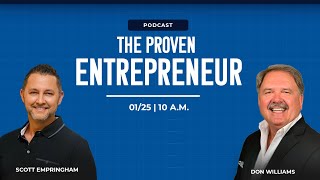
Live YouTube interview (host Scott Empringham) with Don Williams (entrepreneur, four-time author, podcast host and consultant). Key points: Don recounts a defining moment that pushed him into entrepreneurship (partner not honoring a distribution), emphasizes keeping every promise, and credits mentors (father, Judge Ziglar). He defines the "Proven Entrepreneur" via sustained exits and scale, describes pivot strategy (ask for help, learn, act), and shares a 2022 client success that unlocked a new high-margin service producing about $3.6M top-line and ~$2.5M bottom-line. He frames the customer journey as acquisition → retention → win-back and argues for "romancing" customers. Williams has written four books (including Gratitude Stories from Our Hearts), runs author workshops (Mar 23–24 in Dallas/Fort Worth mentioned), donates book profits (every penny above publishing costs) to St. Jude Children’s Research Hospital (noted daily budget ~$4.5M), and hosts the Proven Entrepreneur podcast (started ~1.5 years before the interview). Contact: donwilliamsglobal.com and major social platforms.
Questions this video answers
January 26, 2023.
Four (with plans mentioned for five and six).
March 23–24 (year implied by context around the interview).
Approximately $3.6 million top-line and almost $2.5 million to the bottom line.
St. Jude Children’s Research Hospital; he cited a daily budget of about $4.5 million.
Chapters
Foreign.
Don welcome and I want to welcome everybody. Social Media Secrets My name is Scott Impingham. I'm the CEO and owner of every media group and I believe any business can get customers with social media faster than they ever dream possible. They've got the right frameworks, the right tools and the right team. And the reason I believe that is because for the last 20 years it's exactly what I've been doing. I've been blessed to work with some of the biggest companies on the planet as well as restaurants on the corner and help them accomplish their goals. And if you want to learn more a little bit about some of those tools, feel free to Visit me at scottandbringham.com or we have a workshop tomorrow where it's a pretty aggressive workshop. It is free for business owners, marketers. It's called fire your marketing agency. Get all your ads, emails, blogs done in minutes not months. You can Visit us@smart90workshop.com It is I think the doors are closing at 5pm and then we are going live tomorrow at 10 to talk about some new tools for business owners. But that is it for me. We are here to talk about Don Williams. I am really really excited to chat with you. We're me just share just a little bit about Don. 30 plus year entrepreneur, four time.
I started when I was four Scott.
When you were four?
Yeah, four years old.
Perfect four time best selling author. I can't wait to talk about that. A podcast host, advisor and an investor, Don's helped over half, I love that half of the Fortune 500 on marketing, sales and service. He helps entrepreneurs and companies make more money by providing solutions that are guaranteed to produce results. I saw some of the stuff on your website. It's an amazing this spectacular guarantee that you offer. Lastly, don is a 9 year EO Fort Worth member. He trains SAP chairs on how to get big sponsors. So for those of you who are eowers, you know exactly how valuable that is and you help them around the globe and and you currently serve as a leadership director for the US Central Market. So Don, it's a privilege to have you here today. I'm excited to catch up with you.
Thank you so much. I hope I can live up to all that.
Yeah, well you know when I told people that I was going to be meeting with you today, there were other fellow fellow eoers. They were all excited and they had nothing but good things to say. They were excited about learning from you as am I and I think one of the things that I wanted to do And I had a privilege to be on your podcast recently. Is. Is. I'd like to go back a little bit. And as other business owners that are maybe watching, I like to begin at the beginning. And I'd like to ask you a question about maybe a defining moment that you had in your life that set you on the path to entrepreneurship. Maybe looking at things a little bit differently. Was there a defining moment for you that kind of put you on that course?
Oh, my gosh, what a great question. And. And yes, and there were many steps towards that defining moment. But the defining moment was I had helped a gentleman build his business. We tripled his business. I'd work my way into partnership with him. And it came time for the first distribution, and he deferred and said, oh, for whatever reason, we haven't had a chance, and so we're not doing it today. And I said, okay, how much time do you need to correct it? And he told me, and I came back on that day, and he said, no, we haven't done it. And I said, I can't work with you anymore. And. And I basically became his competitor. And. And we reconciled before he passed away. But. But I learned that day that I could be a really good follower if I could find a really good leader. But really good leaders are hard to find. And the other thing, and I think people sometimes overlook this, is you have to keep every promise, no matter how small. That actually is a small promise. But even if you make a small promise, if I tell you, Scott, I'm coming to this call today, and I literally slid in with like, 60 seconds. But. But that doesn't matter. I. You know, you have to keep every promise if you want to build trust. And you can't make sales if you don't build trust.
Excellent. I love that. And that actually sort of dovetails into my next. My next question. And we're going to talk a little bit about some of your books, and I want to get into that. As you mentioned at the beginning of that, you mentioned that you're willing to be a good follower if you can find a good leader, and they're hard to find.
Hard to find.
What mentors did you have early on? Or was there one specific mentor early on that really stands out in your mind as someone that sort of defined or raised the bar for leadership where it gave you something to aspire to?
So initially, my father, who was a United States Marine, he provided an excellent example of leadership. And. And I think leadership is something you catch more than you. You know, you Observe and you adopt. Not. I'm not saying don't attend leadership courses and read leadership books. There's some really good stuff out there. But it's really. You can catch. You can catch the fever if you ever observe someone who is really, really good at it. Another. As a very young man, I started my sales career at 18, and within 12 months, I was the top salesman in the country out of 450 salespeople, and then went into sales management, became the top sales manager in the country. And I had an opportunity to work with Judge Ziglar. Who. Judge was Zig Ziglar's brother. And they were not twins, but they looked dressed, sounded almost alike. And the interesting thing is, while Zig had this pretty significant degree of celebrity. Yeah. See, Judge had far less, but Judge was actually the world record holder in pot. And, you know, they made their. They made their bones. They. They got their rep in pot and pan sales.
I didn't know that.
Which. That was. You know, you. You go to somebody's home back then, you would cook them dinner, and you would sell this lifetime guaranteed cookware. Yeah. And back then, it was probably. I mean, this was the 50s, was probably $300. It would have been like $2,500 today. So it was. It was a lot of money for a set of pots and pans. And. And so I had the opportunity to work with Judge, and he was a phenomenal leader by example. He kept every promise. He was a man of extremely high character, extremely high integrity. And so early on in my career, I had the opportunity to work with some exceptional people that if you're a leader, if you'll lead exceptionally, you'll be surprised at. At not, I say, the number of people that follow you, but you'll be surprised at the number of people who lead because you led. And to me, that's the definition. You're not really a leader if you just generate followers. You're a real leader when you generate leaders.
Was. Would you say Judge? Was it Judd or Judge?
Just like. Just like Judge at the courthouse.
Out of curiosity, I think I know the answer to this question, but what do you suppose was the best business advice you ever got when you were young? It turns out we've got a lot of folks that are younger on YouTube. We're streaming live there. The twenties and, you know, early twenties. What's some of the best advice you ever got or one or two of the best pieces of advice you ever got in terms of business or in terms of, you know, your leadership?
So. So here's the first one that comes to my mind that's kind of humorous is Low tide shows who's skinny dipping. Okay. Yep. Okay. Yeah.
Low tide shows you skinny dipping.
Yeah. And, and so the business application is, you know, the people that look like they're doing very well and look like they have a lot of money but are highly leveraged, highly in debt, you know, a bad economy shows their parts and maybe they don't want, they don't want shown. And, and so I love that. And then Zig, he, you know, he was very big on having an attitude of gratitude. And even though I've heard that my whole life, it wasn't until I was maybe 50 that I had a deep comprehension of that. And so my fourth book is a book on gratitude, Gratitude stories from our hearts. And then I think, oh, here's the best. So I was kind of an odd child and maybe odd adult too. Unique. Yeah, unique. So, so the first self improvement book I read was how to Win Friends and Influence People by Dale Carnegie. Sure. Which has about a hundred year old book at this point.
Yeah.
But I read that book when I was 12 the first time. And I've told that to people and they're like, that's weird. And I was like, well, I didn't know how to talk to girls and I figured girls were people and I wanted to influence and make friends with girls. And so that was my motivation for reading that book. And I'll, I'll tell you, girls are people. And the principles in that book will work with anybody because you know, at the base level we're all humans and kind of react the same way. But that book, I'm fortunate to be a very high paid consultant and I can't tell you how many times with a client I'll ask, have you read this book? And they're like, nope. And I'm like, okay, well this is like human 101. Okay. And so we're going to go to Amazon and spend $5 or whatever that book costs and you got to read it because it's, it's just foundational for how humans get along. And I don't care what business you're in, we're all in the people business. If you can manage the people part, you can work the rest of it out.
It's so true. It's so true. I absolutely love that book. I've read it I don't know how many times. I know I violate a number of the tenants in the book over and over, but I certainly do my best to do better. I'm curious, let's flip that around. With so many gurus out there kind of preaching about different things on business or money or finance or investing or entrepreneurship, going back to the early days of Don Williams, was there one piece of advice that stuck out to you? What was the worst piece of advice you ever got that maybe derailed you or challenged you in a way where you follow that advice and well, wow, that didn't turn out to be good advice at all. Was there one piece of advice you ever got that was just really, really rotten?
There probably was. But Scott, you know, the interesting thing is most of my life I've been highly independent, which is a trait of entrepreneurs. I. I've not been open to advice really at hardly any time in my life. Certainly I was not open to any advice that I didn't solicit, I didn't ask for. And so, you know, one of the beautiful things about EO entrepreneurs organization of which we're both a part, is that people will share experiences and the words you should are forbidden. And so I became an entrepreneur not out of a profit motive, and I am profit motivated, but I became an entrepreneur because a gentleman did not live up to his promise and because I'm resistant to authority. And so I always said I'd be a great follower if I could find a great leader. I just never found one. And so I said, well, I, I can be a bad leader and, and I bet I can learn to be a good leader and a great leader. And, and I humbly think I've been able to do that. And so.
I've had the chance to read a lot about some of your successes, and I'm, I'm really interested in digging into the proven entrepreneur. Tell me, what is the proven entrepreneur and what does it mean to be a proven entrepreneur? What's the distinction? What's the unique distinction? How do you be a proven entrepreneur? What is it?
I so love that question. So I started, I launched a podcast, the Proven Entrepreneur show, about a year and a half ago, and Scott was a great guest on the show. Thank you again so much. Of course. And, and it's been really successful almost entirely due to the quality of guests. It would be more successful, it had a little better host, but the guests have been superior and I've done okay.
And so tell everybody just a few of the guests you've had on. It's really remarkable.
So, you know, when I first started, and I think this is true with most entrepreneurial activities, when you first start, it's hard. And what you thought was going to be easy isn't. And what you thought was going to work doesn't, and the money you thought was going to come in the door day one doesn't. And you know, you got to kind of be able to power past that to get to the good stuff. But, but at this point we've, we've had enough exposure and that I really don't have to, I have to filter guests requests. And so we unfortunately turned down way more than we approve. But Roland Frazier, who's a South Carolina, his pictures in the hall of fame for entrepreneurs and Roland's a friend, but, but he was a guest. We had Shahar Aris, who is an Israeli entrepreneur that went from a pure startup to a hundred million dollar exit. So from zero to a hundred million dollar exit in 30 months. Wow. Jeff York is coming on. And Jeff is one of the owners of Paycor, which is in the payroll space and has a market cap of, I don't know, billions. And, and so we've just been fortunate. But you asked the question about the proven entrepreneur. What's proven? Yes. Interesting thing is this. All of our guests are at least mid sized entrepreneurial ventures, up to billion dollar ventures Universal. The guest says, you know, I wondered about coming on because I'm not sure I'm proven. And you're like, oh my gosh, you've started a dozen companies, you've exited eight. You've, you know, you're a current principal in seven. I think that's proven.
It should qualify.
Yeah, but, but it's interesting that I'm gonna say when I say this, I don't mean this struggly but, but all of us suffer from imposter syndrome at some point in our lives and maybe at some point every day where we wonder, am I really good enough? Did I really deserve this? And the answer is, yeah, you are really good enough. And yeah, you really do deserve it. And yeah, keep going. Because while it, while what you're searching for may look to be on the horizon, you know, we're all one phone call, one customer, one day away from a magnification, a multiplication of success in your business.
It's so true. And what you said about how we sometimes start a business, we think that the money's going to roll in and the customers are going to roll in. There's two questions I want to ask you. The first one is in working with clients, you've got a chance to work with all kinds of different clients as a coach and as a consultant, can you share one example of a client you were working with where you had to help them pivot and guide them in a new direction and maybe a success story that came out of that. There's a lot of folks that are watching right now that are facing some. Some headwinds, they're facing some changes in their business. So what's the mindset? What's the tools? And. And maybe just a specific example, like an experience. Share on how you help somebody pivot and move in a new direction and maybe a success story.
Love that. So, and keep in mind, pivoting might mean I'm going to do something different, and so I'll be a little ridiculous. I was a plumber, and now I'm going to be a carpet manufacturer. Okay, well, that would be a pivot, but that'd be a pretty dramatic pivot. Okay, maybe that pivot is. I used to market in this manner, and now I'm going to. Here's the three steps for success from the Book of Dawn. Ask for help, learn something new, put it into action, and keep the hardest.
You suppose?
Pardon?
Which one of those is the hardest, you suppose, or is it different for every person?
I think it varies on most people, but I think acting is where there's a disconnect most of the time.
Yeah, yeah, yeah.
The acting, they learn, but they don't act. And so with my consulting clients, we don't just do strategy. You won't just be good at Trivial Pursuit. We have to actually go do the work. Yeah, we'll. We'll strategize, but then we'll move into execution. And so I have. I have a client. Well, this is my number one success story from 2022. And all of my clients are up considerably, but this one client had an operational issue that prevented them from realizing a new revenue stream. And as we were talking about it, I was like, oh, I'm almost positive I know the exact way to solve that. And so I think you hire a coach or a consultant, one for what they know, and. And two for who they know. And so this was a what they know. And I was able to share with him the strategy by which we'd be able to open that line of business. And they're in professional services, but this was a high margin Service. And so 3.6 million top line, but maybe more importantly, almost two and a half million to the bottom line. And you and I both know we've been entrepreneurs long enough that top line makes the newspaper. And people will tell you You're a genius. But my banker's really only interested in the bottom line.
Yeah.
And so that was a total pivot into a entirely a related but new line of business that they'd previously been unable to get any traction into at all. And, and it wasn't instant, but it was nearly instant. It was, it was, oh, I now know how to turn on the light. I'm going to walk to the light switch and I'm going to flip it on and the lights are going to come on. I know how to access this business. I'm gonna, I'm gonna do the necessary things. And instant presto, change. Oh, there it was.
I'm interested in coming at it from another angle now. So you've helped people pivot. I love that we said about you. Hire a consultant for not only what they know, but who they know. I think that's brilliant. I think it's really brilliant. When you're working with a client that's reluctant to change. Have you ever had to change your approach with a client to help them change or do something different to trigger them in a new way where they were just reluctant to change? Have you ever had to pivot your approach to get them to moving, to get them moving in a new direction?
So I'm a real big believer and really probably the foundation of everything I do lies in mindset, and that's a really big bucket. You know, their self image, that's obviously part of it, but equally as big a part as this. I'm a big believer in seeing everything and taking every action from your client's point of view. And if you, if you want to be a world class salesperson, you can be, you know, here's two tips. Quit selling, stop today, resign. I'm no longer going to try and make people do something, okay. And instead see everything from their point of view. Everything from their point of view. Your point of view doesn't matter at all, okay? Put the blinders on yours. See it through their point of view and take every action from their point of view. Stop selling and start helping them achieve their goals. So, so in my business, because that is foundational to who I am, my relationship with every client is like having a bespoke suit crafted for you. And the principles may be the same, but the methodology is probably going to be entirely custom tailored to you, the client. And the reason for that is this. Number one, I believe you should do everything from the customer's point of view. And number two, change is really, really, really hard for humans. We don't like it and we're not good at it. And so rather than trying to propose huge wholesale changes, it's much easier to get real and real lasting results if we look for the smallest things we can change that have a big difference. So like a lever, you know, I can lift 50 pounds with a lever, I can lift 500. So how can we find those types of levers in you and your business where we make little bitty changes, small changes that pay off huge.
I want to dig into that. So you posted something, I think it was today or yesterday and it was the ocean. The notion of the vast majority of the clients that many businesses have in today will not be with them in five years. And part of that is they're out selling instead of retaining and romancing the customer. So one of those levers I would assume, or maybe wrongfully assuming, but is one of those levers client customer retention? And then two is a follow up. How does that tie into romancing the customer and one of your books? And could you talk a little bit about that?
Okay. Boy, there's about four questions.
I know, I know, I got greedy.
I got greedy.
But I'm really interested in this.
That's okay. So. So I think the customer journey begins with pre acquisition and ends either at death or with win back. Okay. And everything that happens in between those two points is the customer journey. I see. The customer journey is perfectly parallel to the romantic journey. Okay. So I'm 62 years old. I was born, raised in Kansas. So that's the frame of reference I'm going to speak with. Please don't be offended if I don't, you know, use how you see romance to anybody in the audience. I'm going to speak from one perspective. So you know, Johnny likes, well let's say Dawn. Dawn likes red headed girls. I don't know why, I just am. And I'm married to a red headed lady who I love very much. But, but young Donnie liked redheaded girls. So that was kind of my market. Okay. And in your company you should know, you should know who is your market.
Yeah.
Okay. Who do you like? Who's good for your company? All customers are good. But I bet you could look at your customer list and find two or three that are really, really good and if you could find look alikes to them, that would be a win for your company. And so that's kind of pre acquisition. I've defined my avatar, I've defined my target. Who's the one group of people I'm going to Help, which almost everybody starts there. And then as I move into, I ask Lita, my wife, I ask Lita out for the first time. That's kind of like test marketing, okay? I'm putting myself out there and I'm listening to what the market's going to say about me, okay? And sometimes I win and sometimes I lose. And, you know, I maybe even get a first date. And so a customer does a trial order, okay? And it goes well. And so I get to a second date and they do a second order. And then at some point, maybe they sign a master services contract, okay? And at that point, that's a little bit like standing at the altar and saying, I do, okay? We're making a commitment to a long term relationship, either as a company and a customer or as a wife and husband. And so. And all of that would be acquisition, okay? Retention starts after I do. And you married men, if you ask your wife, am I bringing enough romance to the retention effort, the marriage effort, almost all of you, your wives will say, you could bump up your game a little bit, okay? Back when we were dating, you did, you were a little more romantic, okay? And so in romance, your customer, we should learn we got to pull some of that romance across acquisition into retention, okay? And. And if you were, I'll just say at and T, you know, 80% of your marketing budget would be assigned to acquisition and maybe 15%. And I'm pulling these numbers out of the air. 15% to retention. How do I show my current customers I love and value them? How do I show my wife today that I still think you are hot and I still love you more than the day I married you? And then win back is, something went wrong, something went haywire. Maybe it's my fault, maybe it's your fault. Maybe it's all our fault. I don't know. But you've left. Okay? How do I reach out and say, dear customer, I'm so sorry. We were such a great thing. I screwed it up. I'm sure I didn't mean to. What could I do for you to come back? And if you were a Fortune 100 company, you'd spend about 80% of your marketing budget, acquisition, 15% retention, and 5% in win back. And that would be huge. That'd be a huge success for your business. And even though as an entrepreneur of a small to medium sized business, you can't apply everything a giant like AT&T does, but you can apply some of it. And you're wise to deploy some of that. So big Believer in acquisition, retention and win back as being a comprehensive solution for the health of your business.
That's fantastic. And that thread is followed in romancing your customer, is it not?
It. It is excellent.
Excellent. And that is available on Amazon right now.
It is available on Amazon. And, and I'll say this, I'll give a plug to St. Jude Children's Research Hospital. So I am a entrepreneur and consequently I am very interested in profits. But on my book sales, every penny above publishing cost goes to St. Jude. And so I have a real soft spot for kids and I have a really soft spot for sick kids. And so my, my books help set kids somewhere somehow. And I'm grateful to do that. St. Jude's phenomenal facility, daily budget of about four and a half million dollars. Daily budget, daily budget of four and a half million dollars. And a parent never receives a bill for anything. And so, you know, support the, the philanthropies that you like. But, but if you don't have one, that's a good one. Helping sick kids.
Well, I think that's, I think it's phenomenal. That goes with all the books. And you've written four now.
I've written four. I'm gonna do five and six here. We should wrap them up. I don't know if we'll make it by March 31st, but I'm, I'm having a three time author workshop in Dallas, Fort Worth March 23rd and 24th to where a person who's never written a book can. They'll leave my workshop a three time author in two days with one big barrel of fun. And so they'll be co authors in two of my books. Though I never list anybody as a co author. I list everybody as an author. And then I have a system and the software to support that system to help you write your book from A to Z. And it'll do 85, 90% of the heavy lifting. And you know, 99% of the people in the world will never start a book. 99% of the people who start a book will never publish a book. And so I think everybody has a story and I don't think there's anything you can do. You need trust to make sales. You need authority to have trust. The root word of authority is author. And so I don't think there's anything you can do that will have a bigger impact than writing your own book and positioning yourself as an expert in your field.
I never realized that about author authority.
Most people haven't. Words are kind of my Friend. You know, I'm a, I'm a talker and I'm a podcast host and I on social media a lot, just giving away tips and, and I've written four books and there's a lot of different ways to write books. You can, you can literally today hire companies that will go straight your book and you know, you'll invest 30 to $100,000 depending on what you want to do and you don't ever have to write a word and they'll write it and slap your name on it and you'll be an author. I'm not knocking that, but I have my own words. Okay. And I will tell you that people will like your words better than a ghostwriter's words because it's the real you. And being an author is better for your business than not being an author. Being a two time author is better than being a one time offer. Being a three time offer is better than a two. I'll be a six time author at that point. And so I've had, I've helped people for years write their books just from a coaching and consulting standpoint. And, and I thought, you know, we'll, we'll put a room full of people together and every one of them will leave a three time. They won't have their book finished but they'll be on the path. Okay. They'll have the two stories for my two books done. Okay. In the two days and they'll. And they'll be on the path of their own book. And no better business card than a book. Yeah, nothing better than a book.
Is that your last book right there?
That is. That's Gratitude Stories from our Hearts. This is a compilation of 2025 stories from 24 authors about a time in their life when they ex. Experienced or witness the power of gratitude in their life. And I've kind of funny story on gratitude. So you can see over my shoulder here, this galvanized pale. Yes, I bought. I bought. And if you ever see myself on social media, this galvanized pale is always with me. I bought this galvanized pale and I wrote the word gratitude on a card. And I have another card with patience and another card with love. And because these were three areas I needed to improve in my life, I felt like I needed to improve my life. And so I carried my little pail with me everywhere I went for about six months. And your reticular activator, that part of your brain that when you first see. I saw a new lucid, new electric car brand that's that's on the market. I saw New Lucid the other day, Lucid Air. And I've seen about 10 of them. Right. And. And it's just part of your brain that once it wakes up to something new, it starts focusing on that. And so I began a daily intentional gratitude practice, and that has gone around the world. Many people, they know that I start all my meetings. This is your meeting. So I didn't start it that way, but with one good thing where I share and then. And the amount of value it brings for company culture and for customer experience is off the hook. Because when humans actually perform at their very optimum, their very highest level, and I don't care if you're a hurdler or a speaker, you are perform at your very highest level when you express or experience gratitude, and at your very lowest, when you express or experience fear or shame. And so if you want to be more grateful, you practice. If, you know, if I wanted to be stronger, I'd practice strength training. If I wanted to be thinner, I'd practice calorie control. If I wanted to be whatever, I'd take steps that were proven to help get there. Well, if you want to be more grateful, you practice gratitude.
And.
And that has been transformational in my life. That for sure. You asked me earlier what was the best piece of advice I've gotten. They didn't give that to me as advice, but I heard the story and instantly knew that even though I had been really successful in a lot of different areas, I was one of those people who was never really grateful. You know, we could win our version of an Oscar. Okay, not the Oscar Oscar, but my. Our version of the Oscar. And I'd be like, yeah, that's great. But what about this thing over here that. That we're late on, that we're behind on, that we drop the ball, not even celebrate it for a second.
Yeah.
And you know, I now know you have to celebrate all wins. If you want to win a lot, talk about winning, reticular activator will go to work for you. If you want to win a lot, talk about wins. If you want to be really successful, talk about success and hang with people that are more successful. However you define that, if you want to be more grateful, practice gratitude.
I love that. I don't know why, but it triggered the thought in my mind. About years ago, I went to a Tony Robbins deal, and you walk on the hot coals, right? And he talks about five things that are going to get you through this experience. One of Them was kind of getting in state. Two is visualizing. Talk about winning. Exactly what you said. Talk about it over and over. You visualize. Third, you take firm action. You take decisive action. You don't rush, but you don't dawdle. You take firm action across the hot coals. But the fourth one, he said, don't forget to wipe your feet. Take care of business, but then celebrate. And the fifth one was celebrate and after you took care of business, because the coals could get in your toes and burn your feet. So it's kind of like that metaphor of, before you celebrate, make sure you take care of business, but when you do take care of business, make sure you celebrate to reinforce that you're going to do this again and again. And winning is a good thing, and it really is good to celebrate those successes.
I love that, and I wholeheartedly agree with Tony on that.
Yeah, yeah, yeah. A couple other questions I do have is what strategy they can do, because there's a lot of folks out there that I'm talking to on the executive side of things. There's a lot of shifts at Salesforce, at Amazon and some of our clients. What are some specific steps that you might recommend? Somebody that's considering entrepreneurship but considered it before? Could be some specific steps they could consider that might be first steps, looking at a new business or looking at a side hustle and looking at ways to. As a second income.
I love that. And I think that everybody ought to be an entrepreneur at some point of their life, in some area of their life, you know? So here's a good. Here's something that will help convince you in case you're a little reluctant. So as a W2 employee, the way the laws in the United States of America work, the way the tax laws work is your employer withholds taxes from your income and literally probably pays those taxes to the federal government. You know, you look at your check and you see your gross pay and then your federal withholding tax and your Medicare and your Social Security and then your net pay, and you get. Let's just say you get that on Friday. They probably paid your tax to the federal government on Thursday. Okay. In most cases. And so as a W2 employee, your money is taxed before you even get it. Actually, the government gets it before you do. And you're like, what's up with that? Okay. And as a business owner, okay, you pay income tax at the end of the year or maybe quarterly, okay? But you pay your tax either way. You pay your tax after you get Your money. And so just think about that. I can pay my tax before or after, okay? What's best for you. They're both 100% legal, okay? So on that one, probably you ought to pay it after, okay? And, and so that's a good reason to launch that, even if it's a side hustle. Hey, some of the biggest businesses in America started out in somebody's garage company. Little companies like Google, like Apple, literally started in some dude's garage with another guy. And they were sitting around daydreaming, okay? And their little daydream blossomed into a titan global business, okay? So the next thing I would say is this. Get, seek counsel. Seek advice from people who've done it, okay? And here's why. Most people will seek advice from their family and friends. I love my family, I love my friends. My entrepreneurial, my non entrepreneur friends think I'm a little crazy. They're like, I would never do that. Oh my gosh, the risk, okay? Where my entrepreneur friends, they don't see they're more risk tolerant. And you're gonna have to accept some risk, okay? So seek some counsel. You know, I think the average human, if I ask you a question and you give me an answer, I think the average human defaults to I know the right answer no matter what. I ask you the first thing that comes to your mind, you as a human, I'm not picking on you. It's me, it's everybody. We think we know the right answer, okay? By just by default, I'm right, you're wrong. If you disagree, you're wrong. But the reality is, as humans are wrong far more often than they are right, okay? And so I don't want to tell you not to trust yourself because you're going to have to trust yourself, but trust yourself to get input from people who might know more. Okay? I think everybody's trying to go from point A to point B. A coach, a consultant, a mentor can kind of push them a little closer together and make it easier for you.
I love that. And that that sets up for the perfectly. For the next question I was going to ask you. There's a business owner out there who's watching this and who's going to come across this episode in EO or YPO or just a business owner outside of Vistage. It doesn't matter if you overheard them saying, I have these three problems. I'm struggling with this, I'm struggling with this, or I'm struggling with. And you overheard them, what three problems would those be? If for you to say, oh my gosh, they need to call me. If I'm a business owner, if I'm an entrepreneur, I'm struggling with these three things. Don is the guy I should be calling him.
This is going to be an unexpected answer to that. Scott. If they'll use the word struggle, it's worth even a free 15 minute consultation with me. I hate the word struggle, even if we talk about other people, because I know my reticulator activator works towards things it hears and sees. And so it's kind of like the difference between saying, I'm a small business. I don't like that either. I think that's a. Don't think that's a good mindset. I'm a growing business. Well, I like that a lot better. Yeah, okay. And I'm learning how to overcome this area. I like that a lot better than I like struggle and words. I mean, words are my friend, but words are really important. Our brains really can't, at a subconscious level, can't decide what's pretend or imaginary and what's real. And that's why you hear, you know. So my Dallas Cowboys, gosh darn it, just lost in the playoffs again. Okay. But I can remember when Troy Aikman, hall of Fame quarterback, won three Super Bowls and, and they asked him what his secret was. And Aikman was a very accurate passer and he didn't lose very many games for you. He was not the kind of quarterback who would throw very many interceptions and almost never a fourth quarter interception. I mean, if we were in it, we, you know, we were going to win. But he said, you know, I. The game plan, the first 15 plays is set before the balls even kicked off. We know exactly what we're going to do. And I imagine running those plays and those plays being successful for every game. And you're like, so really you played the game in your mind and then you let your mind control your body on the field. So, you know, sometimes people, when you talk mindset, they're like, oh, that's hoo ha. And that's. And it's a little wah wah. And. But I'm just telling you, you know, science tells us we use about 10% of our brain. What that other 90% doing? Do you think God or the universe just gave you ten times the brain you needed? I don't think so. Right. So, you know, in, in the book of dawn, you know, foundational is mindset. Next step up is leadership. A great leader gets things done because we're in the people business, we need other people to execute on our vision. And then you break off into marketing and sales and service and culture. Okay. And eventually, you're all the way. You've climbed Mount Everest, all 29,000ft. But foundationally, you start with mindset.
Yeah.
And the next step's leadership. So if. So. So if they say struggle, they're my kind of people now. Specifically, if they're looking to bring more money into their business, my superpower is finding ways to ring that cash register over and over and over. And that makes you a pretty popular guy, because, truthfully, if you elevate sales to the right level, half of the problems in your business will go. They'll just vanish. And you'll have enough money to hire somebody to fix the half that didn't vanish. Right, Right.
I love that. I love that. As we wind down, I have two more questions, and one of them is, what question? Didn't I ask that? You wish I did, man.
That's a great question. You know, I'm a real big believer in wise words. And if you follow me on social media, I quote Aristotle to Warren Buffett because I don't care how old the words are, if they're wise, they're. They're wise. So my favorite quote. So I'll share my favorite quote. You're far better, far smarter, far stronger than you think. And that's a very wise philosopher. Do you know?
No.
That wise philosopher is Winnie the Pooh.
I love that.
Christopher Robin, actually, in the book. Right.
I love that. I love that, too.
Excellent.
Well, then we'll end with this. What's one good thing that you are grateful for, man?
I have a lot. I. I journal every day, and. And the book, if you're so inclined, we'll help you start. It'll get you through 25 days of gratitude journaling. I currently am really grateful. We're just coming out of the holidays, okay? And Christmas Eve, one of our traditions is we have the entire family in laws, outlaws, and claws everybody in. And we've done that for years. And four hours before the guests are due to arrive, I get a telephone call and a piece of commercial property that we own. A tenant's calling and saying, you have a busted water line, and water is running out the back door of the building and down the driveway to the street. And this building sits on the back of an acre, so that's a lot of water. And so I go to the building, get the water shut off, we push some water out, and I go home and so I'm grateful that I understand the priority of what's really important. It's really important for me to be there, to be present. The best present I can give humans is my presence. The best present is my presence. And, and then the following morning, and I had people who could do this, but the following morning is Christmas morning. I went back to that building and shot back the water. And I have people who could do that, but I would have been interfering on their Christmas Day. And we do our Christmas celebration on Christmas Eve. And so grateful that I have a good sense of priority.
I love that. I love that. And you know, I remember many years ago, I heard a leader starts by leading themselves. And for that I'm super grateful that you are an example of that. You know, you, the, the things that you've talked about today and I've seen your feet move too, and I've read all about you. I've looked at what you've done over the last 30 years and you've certainly been an example to a lot of entrepreneurs. You're helping entrepreneurs today and people, charities and other other really wonderful things. So I thank you for that. Where should people, where should people get.
A hold of you, man? Go to donwilliamsglobal.com that'd be the easiest. And we got a lot of companies and a lot of websites. But, but if you can remember, I'm Don Williams and you can remember that I've got clients almost. I don't have any clients in Antarctica yet. I need a client in Antarctica. Scott. Okay. But I have clients everywhere else. And so I'm global and so. Don Williams, global. You can go to the website and there's all kinds of different ways to contact me and you can find me on most of the major social media platforms. Facebook, Instagram, Twitter, Tick Tock, all of them.
Awesome.
Awesome.
Well, Don, thank you so much for joining Social Media Secrets and learn more about Don. Check him out on LinkedIn. Don, thank you so much for spending time with us today and for everybody else that's joining, thank you for being on. We look forward to seeing you in our workshop tomorrow, hopefully smart 90workshop.com and thank you again for joining Social Media Secrets. We'll see you next time.
Thank you, Scott.
More from Scott

🔥 PRESSURE IS A PRIVILEGE #PressureIsAPrivilege #LeadershipMindset #MentalToughness


🚨 YOUR NEXT LOCATION WON’T FIX YOUR PROBLEMS #BusinessScaling #MarketingSystems #FranchiseGrowth

🚨 AI CAN ACTUALLY MAKE YOUR MARKETING WORSE #AIMarketing #MarketingStrategy #BusinessGrowth


🔥 STOP RUNNING FROM WHAT’S CHASING YOU #FaceYourFears #KeepGoing #MentalStrength

🎥 STOP EDITING EVERY CLIP YOURSELF #AIVideoEditing #ContentRepurposing #ContentCreation