MyEO Global AI Summit (Meet The Speakers)
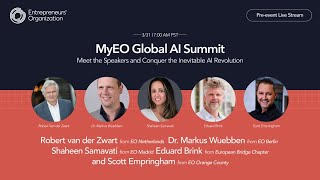
A live YouTube conversation (April 1, 2023) hosted by Scott Empringham with Markus Wubin, Edward Brink, and Robert Vanderswort promoting the MyEO Global AI Summit: "Conquering the Inevitable AI Revolution". The summit is scheduled for April 13, 2023 (4pm–10pm CET / 10am–4pm EST), is free for EO members, and features ~12 speakers across regions and domains covering AI use cases, ethics, hands-on prompt engineering, and business opportunities. Panelists discuss motivations for the summit, speaker selection, adoption gaps among entrepreneurs, practical AI use-cases (marketing, medical education, e-commerce returns, customer-data prediction), and societal risks (misinformation, privacy, regulation).
Chapters
Sa. Foreign.
Gentlemen, we are live. I am so excited about today. My name is Scott Abraham. I'm with EO Orange county. And I am joined today by three other spectacular EO folks and we're going to give them a chance to introduce themselves. I'm with Dr. Marcus Wubin from EO Berlin. Doc Edward Brink from European Bridge Chapter, and Robert Vanderswort, EO Netherlands. Fellas, thank you for joining us today.
Hey, Scott, thank you for having us.
All right, if you, if you can, let's Everybody introduce ourselves. Dr. Marcus Wubin, why don't you introduce yourself, Tell us who you are, what business you're in, what chapter you represent, and a little bit about how you started to come up with this idea. We'll go right around the, right around the horn and then we'll get right into the speakers and what everybody's going to learn at the event. By the way, this is brought to you by my EO. I shouldn't delay on this. My EO Global AI Summit Conquering the Inevitable AI Revolution. It's going to be hosted on April 13, 2023 from 4pm to 10pm CET. And it's brought to you by my EO. I'll kick it back to you, Marcus. Tell us who you are, what, what chapter you are and what business you're in.
All right. Hey, Scott. Hey, everyone. I'm Markus. I'm a proud member of Eoberlin in Germany. And my business is a SaaS business. So what we do is we provide a customer data and prediction platform for maximizing customer lifetime values, which is super important in times where it's more about profitability than growth and user growth. And of course, in our customer data and prediction platform, a large part is AI is the prediction of customer behavior and customer value. So what is the customer going to be worth and that stuff. So to make marketing more efficient and more effective. And that's what we're all about. And you know, naturally we at crossengage, we look at AI all the time. And I met all these wonderful fellows, actually you, Scott, as well, at the Global Speakers Academy, a wonderful event from EO last October, as well as Robert. And we started basically just kept talking. It's just great network of people in eo, right? And we kept talking and we're just flabbergasted by the EO revolution, mainly driven by generative AI. But when you think about it, like ChatGPT and Midjourney and all these things, but when you think about it, it just affects all of our businesses. More or less. And that's how we started talking about why don't we bring this to all your members to bring awareness to the, this, you know, revolution, this inevitable revolution that is rolling right now. And that's why, you know, we get, we, we get started and actually it's Robert who's really pushing this initiative. So I hand over to Robert.
Absolutely. I love the speakers that you guys have gathered and we're going to dig into those speakers and talk about some of the takeaways. Robert, if you would tell us a little bit about your business and the chapter and some of your background.
Hi, my name is Robert. I represent EO Netherlands. I have a company specialized in medical education and I'm fascinated about working with AI because we're in the business of generate, generating content for online video, but also for marketeers. It's always very time consuming. It takes a lot of time to write a good script. It takes a lot of time to write good social media content. And AI is such a great help to me to generate content and help me create these medical scripts. Although it's not perfect, it's a great companion to boost productivity. And I also fascinated by the talks that we had next to the pool in Global Speakers Academy in Mexico. And we seem to share the all the same worries and we see all, all the same opportunities working with AI. It's a great opportunity to share our experience and let other EO members taking full advantage of that.
Excellent. Thank you, Robert. I'm going to pass it over to you, Edward. Tell us what chapter you represent, what business you're in and tell us a little bit about your background approaching.
So my name is Edward Brink. I've been a member of EO for seven years and two years ago I started swapped my Dutch chapter for European Bridge. It's a phenomenon I can highly recommend. The Bridge chapter brings so much cultural diversity and my business is in lighting. I'm a lighting designer and a lighting wholesaler and we do large projects, mostly universities, hospitals and offices. And I am quite proud to be an early adapter in some fields. I was the first one to launch a website in lighting in the Netherlands and I still run my company on software that we wrote ourselves. And coming across this new phenomenon that was not there a couple of months ago, I'm really intrigued by the speed of things and I'm even more intrigued about the lack of knowledge we as entrepreneurs are currently showing. I just came back from the retreat we have in the Netherlands chapter which I'm still a member of and we run some questions there and not even 20% are actively using it in their company and about maybe 30% haven't even done anything with AI until now. So this for me is a big eye opener. And yeah, I'm intrigued where this will take us in a couple of months.
Edward, thank you for that. It's a really interesting point and we'll definitely dive into that because I think there's the adoption and there's a lack of adoption. That's really interesting to me that and I think it's going to separate a lot of businesses before we dive into it. I just want to ask, I think it was Robert, how did you come up with the idea for the, the Global AI Summit? What inspired you to organize it and kind of what was that background like? And then we'll dive into.
So one of the things is that we had a discussion about helping small, small business owners generating content. It was basically December 1st when there was a first article appeared in one of our newspapers talking about the quality of GPT3 and just keep on busy on how can we use it, how can we, can we make this. Well, we need to pay attention to it and if you don't, others will and will be pushed out of the market. And I also noticed that a lot of our fellow EO members, I run a master class early February. We have 200 seats and it's sold out in like half an hour. And there's so much need for information and assessment on how it impacts our businesses. And well, one of the beauty of, of EO is the sharing of the experience so we can share our successes, we can share our new insights. And this is something that really fulfills the need of a lot of EO members. So bringing this to the next level we invited, we were looking at like can we find like the AI experts in Europe and in, in. In the US and can we create a summit that benefits the whole EO community? And we also. So for us in Europe the four to ten o' clock time slot is a bit weird but we really would like to have the opportunity creating an, an option for people on the west coast, but also people from Latin America to well participate in this summit, making it also available to Africa, Europe and even the Middle east. And well, it's a pity that we cannot host the guys from India and Australia because of the time difference. But there's. We figured it out. It's called video over Internet and we'll make it available to them as an online video program so they can also share the knowledge and expertise. So that was basically the background. So creating an opportunity for the EO community to share experiences and assess how AI can impact and how can we benefit from AI.
Thank you. Thank you, Robert. Dr. Vubin, this question is for you is what were some of the biggest surprises and. Or challenges you really drove getting speakers out there? What were some of the biggest surprises or challenges you encountered when you were organizing this kind of AI summit?
It was full of surprises. And the surprise was how collaborative everybody was. And everybody was jumping on the idea immediately and actually saying, hey, this is a great idea. Let's do it. We've gathered great speakers, really, for this conference. I mean, the conference is free for all ELL members and we really got great speakers there because they all see the challenges that we as entrepreneurs are facing. So they were super willing to collaborate and it was actually real fun finding all the great experts on the topic. And Robert and I had some really nice talks with the speakers beforehand. We were talking about what we plan on doing and they were just right, immediately jumping on the train and say, like, yeah, we're willing to help, we're willing to share our knowledge. And it was. And that was across all the disciplines of AI. Right. So we talk to people about the ethics of AI, about, you know, how AI generates new business models, how, you know, you can actually do prompt engineering, like hands on. All these different aspects and facets of AI we actually covered. And the surprise was really that all along, you know, this entire, you know, bandwidth that everybody was willing to. To cooperate.
Love it. Thank you for that. Edward, question for you. How did you go about selecting and inviting speakers to the summit? What type of speakers were you looking for? Could you tell us about some of the speakers that we're going to be able to get to hear from? And then you can also, also do a round robin if you have a lot of speakers there.
Yeah, well, basically my role was to put some names in the hat, and basically Robert and Marcus took it from there. But I agree with Markus that the first response was really open and there was a lot of people willing to participate. So apparently we struck something. And I'm very proud of the amount of female speakers that we have. So we did really well there. But that was basically my role.
Excellent.
Go ahead.
No. Okay, excellent.
Marcus or Robert, can you tell us a little bit about the speakers that we're going to hear from? And I could maybe even share my screen and then scroll through the site too, if that helps you let me know.
I think that really helps Basically what we're looking for, a group of speakers that we, that we don't focus on one single topic but we have a real overview, 360 overview what's currently happening. And we also wanted to have a diverse group of speakers from other continents, male, female. So it gives a really good overview of what's happening around AI. So that was the base.
Can you see my screen right now?
Yeah, we do see. Yeah.
All right.
And the other thing is it should be very hands on. So no concept, no. How do you call that?
You're talking about just hands on where people are going to be able to get their hands dirty and use some.
Of the AI really hands on experience. Okay, how can we implement AI basically today? Because there's not much time to wait and to wait and see. We really have to act now. Don't stick your head in the ground. So it asks, yeah, we're actively looking for practical hands on experts in the field.
Yeah, absolutely. And I mean like we were able to secure like great speakers. Fabian Westerheide, the organizer, founder of Rise of AI Conference, going to talk about the history of AI, where things are going, what is going to change even on the policy side of things, right on the global scale. Super interesting what he has to report on. Just check out one of his videos, you can easily find them. Also on our site I linked a video from him so you get an impression of what a great speaker is. We also have Nigoy Brittner, CEO of mtx. She's developing AI driven business models with her company and really implements them. So she has really transformed businesses from non AI to AI and you know, from all kinds of perspectives in the sense of, you know, really, you know, innovating business models but also improving processes, all these things. So super interesting on that side. But you know, well, we also have Abigail pong from Ghana, NLP. She's going to talk about, she's one of the 100 women in AI in ethics and AI and she's going to talk about the ethics side of AI because we all know just, I think it was yesterday that Elon Musk and a thousand other big tech guys were saying, hey guys, we need to pause the AI development for half a year. That's what they were actually saying, right. We need to pause it for six months because we need frameworks, we need, we need policies to control this revolution, otherwise it's going to go out of hand. So this is.
Did I hear you right? That actually Elon Musk actually called a pause to this?
Yeah, yeah, Six months, six month pause like with another thousand people signing it and saying like hey this is going too fast. Fast. We need policies, we need frameworks and I think you know this is, this is really like, I think it makes it so interesting. We see this unlimited number of infinite number of opportunities and we also see the risk and I think you know we, we want to make sure that you know we're not, we're not afraid and only see the risk but see a very good path forward of, of leveraging the opportunities that are there. And that's, that's why we have all these, these, these speakers there. We also have Suchi Saria. She's she, she is, she's revolutionary in, in, in health and AI. We got to talk talk actually do an interview with her around this, around you know, AI and health. The development we Svenia Techmeyer, she's running an AI driven business to reduce the number of returns in E commerce by recommending the right sizes and leveraging the data that you know, every E commerce company has in order to be more sustainable and to be more customer. Customer friendly. Right. So super interesting. On that side we have Sarah Hawk, Lecturer of AI she's seen it all. She has implemented AI projects really hands on for 10, 10 years. She knows the good, the bad and the ugly because we all see, you know, these are the opportunities all seem so easy but you know, we have to make it happen and she really has the hands on experience around that and hopefully I didn't forget anyone right now because I'm doing it from my.
Hat but can you see, can you see my screen?
We have, you're actually showing us basically not the website.
So.
Okay, hold on, hold on, hold on.
We have just, I'll just continue. We have, we have Anna, a female founder of Impact ii. How do we make you. I'm more human. We have Glenn Yocha, founder CEO of Ultralytics. How can we use AI for the greater good? And they develop great software for example in California to you know the problem of, of of the burning woods. Right. And they've actually created a software you can you know identify very small fires from, from the air and really just you know, quickly extinguish the fire. Super nice. Like you know, using that software. Exactly, exactly. We had Svenia there. Let's go a little bit further down. We also have, have Luis Cortez so he's actually running the MY E O AI group. So you might know him from this group. Yeah, he's also, he's going to talk about the opportunities of investing in AI. So a lot of us entrepreneurs also are investing in companies. And I think this is going to be really interesting on what we need to look at if we want to spend our money in developing AI companies, in investing in AI companies. And there's Javier Lopez. Check out his Twitter. It's awesome. He's actually an expert in generative AI. He's a magician in this field and he's going to enlighten us with his skills on the keyboard. And I'm really, really looking forward to some of the magic. And one thing, and then my handing over to Edward because Edward has a very special project and it's a very special thing in our program called the Secret Project. Right. Tell us a little bit about this, Edward.
I get to consume all these, these great talks and yet have a very interesting and exciting side role because let's put our money where the. Let's put our mouth, where our money is. Money where our mouth is. That's the saying, I guess. So I asked a couple of accelerators from the, from the Dutch EO accelerator program and challenged them, would you be able to please come to the studio and let's build something during the event? So we're going to start with nothing, a basic idea and we're going to see where we get in six hours. So they took on the challenge and that's pretty exciting. So we'll be checking back and forth to the, let's call it the green room and see how, how much progress they're making. So this will be exciting to see where we are at 10 o' clock Central European Time.
And Scott, you also make an appearance in our program. What are you talking, what are you going to talk about?
Ah, I thought you'd never ask.
No, no, that's comes last.
I'm really excited. No, I'm going to learn so much at this event. I'm going to be talking a little bit about generative AI as it applies to marketing. I've been in marketing for 20 years. I've built frameworks in my courses and my coaching program to help small businesses. And I had a unique opportunity actually chatting with Robert and you at Global Speakers Academy. And as soon as AI came on, the light kind of went on. When I thought, how could I apply the frameworks that I teach small businesses with AI and couple them, and we created a software that allows businesses to go on and create an entire marketing strategy, an entire campaign, all the content, ads, emails, blogs, everything they need in about 2.4 minutes. I mean, it's ridiculously simple. So it's a first beta. We're really excited about it and I'm excited to learn because we're at the very, very beginning of everything. So we've developed the software to help small businesses. Those, those you said like 80% or I think it's. Edward, you said 70% have not adopted generative AI or played around with chat GTP. This might be an on ramp for them so they can just fill out four questions and then be done with it. So that's what, that's what we're doing. But it is the very, very beginning. I had a question, Edward. What challenges do you see AI posing for your business and what opportunities? I'd really love to hear each one of you, especially in light of what Elon Musk is talking about. What challenges or opportunities do you see specifically impacting your business and your niche and your kind of category? Edward?
Okay, exciting question. Because we've been collecting data for about 20 years. I can go really go back. I think I can go back with 15 years inside visits and metrics around deals. So I haven't done anything about processing of using AI to process that. But yeah, the challenge that I'm currently working on is it's a lot of work entering new products in our system and changing the prices and to be able to create a framework that actually collects the data from several formats. Once I tackle that, I will be saving about 2 FTE. That's pretty exciting. And it also allows for putting a lot more SKUs on my website.
And what type of customers should be paying attention to this and be thinking they should be calling you, who should be calling you to say, hey, I need to learn more about this if they wanted. What are the types of customers? It sounds like in the consumer package.
Business, it's not really consumers, it's. It's the installation companies. And I do some business outside of Europe and it's mostly in the, in the hospitality world. So if I'm found, I see on certain articles. Yeah, that would be. That would be very good.
Excellent, excellent. Same question, Dr. Vuvin. What are the specific challenges you see in your niche in your industry and your customers should be paying attention to? And what risks do you see AI posing?
Yeah, so I think everything in terms of data is going to be interesting. I think, you know, data is the fuel for AI and the problem is how do we generate data? In my specific field, we're talking customer data. And I don't know if you remember all these, you know, Cambridge analytical scandals like A couple years ago where like this one company was abusing Facebook data in order to kind of manipulate elections, he did it kind of worldwide. And that actually sparked a huge discussion over in, over in Europe even beforehand. And there was GDPR introduced to general Data Protection Regulation here in Europe which basically gives you know, the, the consumers the right to, to handle and control their data. So what I'm the risk that I'm seeing is that we have, if we overdo people are not going to contribute their data to, to AI and they will, there will a lot of models only work with immense amounts of data. So picture wise for example, there is data all around, right. But it consumer data, it's becoming more and more difficult to get this data. So if in my niche we really want to leverage AI, we need to make sure that we create trust and value for consumers in order for them to give us their data. And that's going to be a big challenge. And also in California they got the California law, I think it's CCPA where it's basically equivalent to the European law. So this is something that we need to worry about. And when it comes down to my business, of course I'm looking into Asia where the regis, the legislation is a little bit different. It's easier to get the data there. So are they going to advance, you know, are they going to be faster than us in Europe or can we actually make a business out of this kind of a unique selling proposition with ethics and AI? So this is kind of the, you know, the challenges that I see in my field. Wonderful.
Thank you. Robert, same question. In your category in health and some of the things you're doing, challenges, opportunities.
So in my company it's really helpful in creating the content, helping marketers with creating the content. But I'm also involved in another project that's helping PhD students to have their, their peer reviewed, helping them to prepare their peer reviewed journals. The beauty of the medical research is very structured and with these structures if you can feed it in into a system, it can really speed up the process of writing a publication and submit it for peer reviewing. And normally it's like a time frame of six months that you are devoted in writing your article. I think we can shorten it in to well, weeks. Of course it isn't an automatic system and you still have. There are some issues. Where's my data going? Is my data on the service? Am I losing my, my experimental data with all the insights that I have? So that's something that we need to work on and this coming Monday, I will record a podcast for the EO Media House specifically tackling this. And the information that is, that's in the podcast will be shared also during this summit, but it will also be available on the EO Media House podcast series. So if you're interested in PhD research and shortening your, your writing, your, your peer reviewed articles and shortening the, the, the time spent to this, that's something that you really should listen to. Excellent.
Thank you, Edward. As we start to, we're going to wrap up in like 10 minutes, we're gonna do a couple of fire, fire, fire questions. Edward, what specific advice would you give to people in your industry as it relates to AI? What specifically do they need to do today, this week, this month to prepare for the future?
I'm not going to tell them. I was astonished. I was at the introduction of a new product and I spoke to a few of my competitors and I was sort of hearing them out where they were in this area and nothing really came back. So for me, it's more interesting to have people with a lot of knowledge about this play around with my business model and actually be doing the stuff that I wish my, I sincerely hope my competitors are not doing. Yeah, basically I'm gonna use AI to see, okay, how can I disrupt my own business. And that's, yeah, I don't want to, I don't want to be an expert already to limit my, my search. So I'm really looking for information. And yeah, I'm still astonished about the frontiers because the possibilities are every day you look, there are more possibilities and more people that connect different tools together to create amazing products.
Excellent, excellent. Thank you. Dr. Rubin, same question, and it's a challenging question and I'm not sure how I would answer it, but what specific advice would you give to people in your industry and in your niche? What specific things should they be doing or thinking about this week, next month as it relates to AI?
Yeah, get acquainted with the basics. You need to understand a little bit how this stuff works. And it's not, it is absolutely astonishing. But the basics are actually, you can understand, everybody can understand them. And I think that will create a great kind of starting point for going deeper. But I don't think you can really understand, you know, where things are going if you don't really understand what feeds the entire system and these neural networks. That's basically what's, what's behind this entire revolution, or very much behind, especially a visual revolution, voice revolution, all this stuff. Just get acquainted with that. Look at some basics. They're great websites where you can just look into how this works. There are super simple examples like for example everybody at home on their computers can build an AI to identify numbers from 0 to 1 monochrome. It's super simple. You can download. It's a little program as well described what it does and you just kind of, it just opens your perspective and I think that's super vital for everyone, you know, to not be you know, left behind. And that's, that's required in my view.
Excellent. Robert, Same question.
Yeah, it's pretty straightforward. Don't stick your head in the ground or in the sand. Don't deny it. You know, it's a revolution. And the thing is it's not a revolution that we've seen in the past like the introduction of the Internet. People start saying maybe the Internet, there's something in it. You don't have the time for it. You know it took like weeks to reach millions of chat GPT3 users. It is revolution going to revolutionize our world and we don't know where it's going to end. But it's, it's. You cannot stop it. And don't deny that's the whole thing to it. And there are some great tools out there that you can try for free and just experiment. Maybe it's not something for you unless you are a farmer. Your, your, your industry and your company will be impacted it and even farmers, even hard working labor, manual labor will be affected one way or the other. That's also why we have Abigail in the program. Because AI can help the African country in helping in healthcare, helping in agriculture, creating new opportunities for people that work with phones. You can put AI sims in your phone. Same question to you Scott.
Well, so I'll answer, I'll. I'll answer it this way and then I want to hear this. I have the same question for all of you. I'm really interested in this and then it's going to be the aha moment. So, so I want to frame it this way. There's 70% of the people said you said that haven't really experienced chat GTB.
3 or 4 or deny or, or.
AI or anything or deny go. That's probably not that we do. It's not that good. Well, I'm super interested because I had an aha moment. I had an OS moment and I'm saying oh s. Because people might be listening at work but I had a moment where I sat back in my chair and I went. And just my head exploded. I'M super interested in hearing one of your. Whatever that first experience was. You got one. And so in answering your question, Robert, my the answer would be is this is going to fundamentally, obviously disrupt the marketing scheme of things. And for me, I had an aha moment. I've been working in the automotive space for 20 years. I do sales events, service events, and test drive events. These take months to prepare. The creative and the copy. The abundance of material that's needed for event landing pages, for email campaigns, well written ads, well written posts, all the email camps, all the content that goes into it at a $10 million agency, that's all we did. Sales event, service events and test events. I meet with you and Marcus and Edward and I go back and you guys got me thinking. And in about 20 minutes, with the right prompts, I came up with a marketing. Oh, by the way, a friend of mine on LinkedIn said, Nah, I don't care because, because when it does strategy, that's when I'll worry. And I went, it's a good question. Does it do strategy? So I said, help. And I prompted it to help me build a strategic marketing plan for a dealership. It did, and it was darn good. It was really good. And then I built the content calendar. I built all the content in 20 minutes. I had a marketing plan, a strategy, focus vehicles, competitive set vehicles we were competing against. It brought the material. It was a beautiful email campaign, video scripts, everything, all in about 30 minutes. And we presented to the dealership and they went, you can literally, it was a mic drop moment. We developed the campaign for them in 20 minutes. Mic drop moment. My head just exploded. I thought, this is changing everything and people need to stay take. And I feel like in the automotive space, I might be just standing on top of a mountain screaming and nobody's paying attention, but they will. And the dealership that saw this, they saw it. Edward, what was your OS moment when you saw AI work and go, this is changing everything.
I've been using a text writer in South Africa who writes blog posts for me on certain topics. And I basically had to write the angle of where I wanted the post to be. So I gave Chat GTP the same question. Write a blog post about an American lighting designer who was the founder of the Ground Rules for Lighting Design. It's called Richard Kelly. And I must say, after tweaking it a little bit, asking two or three times to emphasize certain elements, it came up within with a blog post as good as the one I paid $200 for.
Yeah.
Then the Other thing was, I think was only a day later when a friend of mine recommended two books, he said, you should read this. And I asked the chat gdp, okay, what's the, what are the, the similarities between the two books? And it basically summarized the two books and said, hey, this is where it overlaps. And it also made a comparison. And I was, I was really, yeah, blown away by this.
I love that example. That's a really specific example. That's a, that's a, that's definitely one of those mind blowers. Dr. Woobin, what was your aha moment? We went Holy Mac. Where you set your book down, you leaned back in your chair and said this changes everything.
Yeah, so, so you know, I work with AI quite a bit. But just, you know, just a couple of months ago, it was, it was, it was the start of chat GPT3 really like when it was, was getting subtraction quickly getting traction. But what I like to do, my company, I like to quiz our employees and the team members. Sometimes I'm just asking them random questions on marketing. So one of the questions I asked was the following. How can the customer acquisition cost sync and drop if, if, if the cost per clicks are going up, like should be more expensive. And just like three minutes later I got this. So we use, we use slack, right? You can also use text and blah blah, blah. But so I put most of this question slack. Like two, three minutes later, like this answer came back. It was the finest answer you could ever get from a person who really is not working in AI at all. Right? Sorry, not in marketing really at all, right. It's more of an engineering focus, right? So it was this very specific question around marketing. This person is like, oh my God, you know this, that's Perfect. I use ChatGPT. And I was just like flabbergasted. Like this is crazy. Even in this specific field, right? This little, you know, this little, this little question that I posted there, you need to think about a little bit of the structure of marketing, right? To understand that. And it was just like bam there. And that was like, okay, this is changing everything. And I also led unfortunately in one way or the other. But let our content writer that we had as a freelancer, we stopped the contract because essentially the time I spend on briefing this person, quality control, check ins, and now it just takes me like five minutes and I get perfect text, I have to say, right? And then you can still modify it a little bit, but it's not like this back and forth interaction with people. And that's just bam. And. And it was just always saves me. It saves me thousands of dollars a month.
Yes. This is that. What you just said is a warning to agency owners who have a manager, a content writer, an email writer, a web developer, a designer, and there's a fundamental org chart businesses I'm working with say I'm going to get a virtual assistant, plug them in with AI, we could produce the same, if not better marketing material than ever before and with a far less overhead. Love that. Robert, what was your aha moment where you said, holy cow, things have changed.
I had two of them. One of them I had to write a blog post and I had a. I was suffering a bit from a writer's block and I had to write a blog post on personal branding. So I was basically prompting a chat GPT write me a blog post with a clear introduction, middle and end and include references. And it generated for me a fairly good blog post in just like five seconds. And the other moment was like I had to write a medical program on thyroid disease. Normally it takes like two weeks to write it if it's going to be used for medical purposes and medical training. It took me like 10 minutes. And it also included the references, but also a test bank with multiple choice questions, 20 of them, including the right answers and the reason why these answers were correct and the references where you can find the information. And it took me like in total 20 minutes to create not a perfect a medical program, but it was what, like 85, which normally tooks me. It took me, it took to me like four weeks. So that was me. Okay. This is serious. Wow.
I. I have. We're over time, but I have to ask this question. There's a jump ball question. I'm curious on all your, all your answers. I got to go back to this. Elon Musk said, let's pause. He's a pretty bright guy. He put a rocket in space. He put his car in that rocket. Two things I've never done. I've been an entrepreneur for a long time. What does he see or what do you think he sees as a risk? Who wants to take that question?
I can comment a little bit on it. The first thing, the lion is out of the cage. So I think what he meant to do is to draw attention about what is going on. I don't think he was serious about pausing because there's no such thing. This ship has sealed.
So.
So he was just raising the red flag. Caution.
Yeah, it's. I think it's within tremendous speed and I Think the speed in itself is going so rapidly. So Chat GPT was about to release like six months from now and it's already here and there are already rumors about chat GPT5 and we're talking already about artificial general intelligence. Now this is going to be a bit scary because what can you do with this and what can you. What? And do we want that? So there are a lot of ethical issues that need to be solved and need to be answered, but it's difficult to manage the entire process and I think that's a bit scary.
Dr. Ruben, what do you think he meant? What are the distinctions between 4 and 5? What are the risks? Any specific risk you could think of?
Yeah, so. So, so people and society doesn't change quickly. We as humans and our brains, we're still structured like 10,000 years ago, believe it or not. For me, like if I look into the, into the mirror, I can see that, that I haven't really advanced for 10,000 years. I'm still the same person. However, technology has really gotten through speed. So the change of people is really slow. Technology is going up like this, which create differential. A lot of potential threats. And one of them is, it may look very funny, but I just saw a very nice picture of Angela Merkel flirting with Barack Obama, you know, happily jumping through the sea and they were eating ice cream and it just, it was, it looked real. It was really good.
Mid journey.
Yeah, it was mid journey. Of course I was. It's really good. But think about it. We understand that this is fake, but just imagine if people are using it, right, to push news into the market. You know, once the damage is done, things are set there on the market, right? Even to correct bad information is really hard. You know, the soft from the, from the yellow press, right? It's just, it's hard. So once there's something else to kind of really understand whether this is fake or real is a real power. The other thing is, and I, I come from the west of Germany and my ex girlfriend comes from the east of Germany, which used to be gdr, so associated to Russia. And sometimes we notice that we look at the same thing from totally different angles, right? So the history is not one thing, it's the way to interpret the things. So now If I ask ChatGPT on whatever the history of Beryl in the Second World War and, and the times past, that there are two stories, right? There is the western story and there's the eastern story, which one is right. And so if I ask ChatGPT this, we all expect a concise, quick answer. But essentially ChatGPT needs to kind of generate PhD thesis around that to really look at it from all angles. And nobody wants that. So the question is, what is going to be the truth? And this is so powerful in terms of, you know, the media that we live in, the Twitter phenomenon, the short attention times and everything. That is a real risk. And I think we are currently, as a society, many parts of the society, not ready to handle potential risks of these technologies.
And that's why I think it's better a misuse. Misuse of AI.
Misuse, Exactly. Misuse.
People will stay in their bubble even more. I mean, they. They get the information they're looking for. So that is a huge problem that we're going to address during the summit.
Oh, interesting. So, Edward, what you're suggesting is that with the advent of AI, it may actually cause people to retract further into.
Their own little bubble with the youth. The kids nowadays are not really interested in the difference between, between life events and virtual events. So this is very scary material.
Yeah. And in reality, what's real and what's not real, it doesn't really matter.
Yeah, that's funny. Like, I think Disney created the first AI character. And actually this character is not perfect. I think it's a. I think it's a little girl and she. She sometimes stumbles and bangs her head. It makes her human and just imagine that. So it's not a perfect robot, but it actually, it's like a human. You just stumble, you kind of joke around, you fool around, you, you trip, you, whatever, you follow the skateboard and, you know, then whatever. This, like, really human. And just how does that change kids in society in the future? If you were actually just talking to a machine, but this machine can actually respond emotionally as well. And we love these characters even more than we did, you know, all little teddy bears that we had when we were a kid. Right. So this is completely new level. What does it do to these kids? What does it do to society? How does it generate bubbles in itself? How do we make sure that we still kind of, you know, leverage the great times of, let's say the 90s, where the world opened up and the doors open up and we could. I remember, you know, times where I grew up to the Dutch border, where we actually checked at the borders to the Netherlands. We always went there. My dad went there to get gas. It was cheaper, it was not allowed. But, you know, it was. It was this way. So I still remember these times.
And now you Were starting with the question why we wanted to organize this, this summit in this event. Basically we are dealing with these questions and we would like to try to find some answers and share the experience, the collect the collective experience with all the experts that we have try to answer these fundamental questions. How to use AI.
That's a great way to sum it up. I appreciate you saying that. I think it brings us full circle. The My EO Global AI Summit is on April 13, 2023, 4pm to 10pm CET, 10am to 4pm Eastern Standard Time. There are 12 speakers. It's one day. It's zero cost. And like Dr. Rubin, you said on the website, there's infinite opportunities to learn from speakers that are really, really at the forefront of all of this. So I'm certainly grateful for entrepreneur organization being a part of it. I know all of us are. As we wrap up, I'd love to ask each one of you to kind of give a final thought and whatever you want to end with. Robert, why don't you kick us off? What is the final thought?
My final thought is, you know, EO is such a great organization and this is something that we basically thought of, of ourselves, and it's basically a corporation between Yo Berlin, yo Madrid. Yeah. Netherlands. The Bridge Chapter, Orange County. It's not never done before that from an EO event that we have been or that we are organizing. Event that we think, okay, that benefits from us all is being paid by the local chapters to create such a great event. Makes me very proud to be part of this.
Thank you, Edward.
Well, my final remark is please, please register if you want to get the link to, to the content later. And of course, there will be not that many following the whole event the whole time. So if you miss stuff, make sure to register so you'll have access.
Excellent. And I posted the link in the comments. I know we've got a couple of folks watching and they've been bouncing it out. If you have any questions, now's the time.
I'll.
I'll just share. This is in my life, I've seen three or four watershed moments for me personally and in my business, those watershed moments, of course, the mobile phone or the iPhone, video games, you know, all the way back to Pong, the Internet for me, social media, Facebook, because I built the social media agency and that light bulb went on. All of those watershed moments pale in comparison to what I'm witnessing now. This is beyond anything I've ever seen. It's beyond anything I even understand. So I'm super grateful to be on this, this, on this live stream with you all. And I'm even equally, if not more, grateful to be a part of what you guys have organized here later on in April. So for those of you who are an EO watching, go to global-AI-summit.com or hyphen AI. The link is there. Global hyphenai summit.com Register how many people do we have now Joining?
Close to 400. Yeah.
How many?
Close to 400.
Close to 400. I think we've got capacity coming up, so register now. Get your spot before we run out of room. Thank you all so much for this. This was really, really interesting and exciting. And Dr. Marcus Wubin, EO Berlin. Robert Vanderswort, EO Netherlands, and Edward Brink, European Bridge Chapter. Thank you all so much. We'll see you soon.
More from Scott

🔥 PRESSURE IS A PRIVILEGE #PressureIsAPrivilege #LeadershipMindset #MentalToughness


🚨 YOUR NEXT LOCATION WON’T FIX YOUR PROBLEMS #BusinessScaling #MarketingSystems #FranchiseGrowth

🚨 AI CAN ACTUALLY MAKE YOUR MARKETING WORSE #AIMarketing #MarketingStrategy #BusinessGrowth


🔥 STOP RUNNING FROM WHAT’S CHASING YOU #FaceYourFears #KeepGoing #MentalStrength

🎥 STOP EDITING EVERY CLIP YOURSELF #AIVideoEditing #ContentRepurposing #ContentCreation