Relentless Conversations: Discover the Unstoppable Mindset That Fuels Entrepreneurial Success
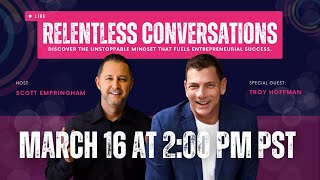
A YouTube interview (March 17, 2023) hosted by Scott Empringham with entrepreneur/consultant Troy Hoffman about the "relentless" entrepreneurial mindset. Troy shares his origin story—early hustling, a mid-1990s e-commerce/T-shirt business, bankruptcy around age 23–24, then later scaling and administering legal settlements (6,000 matters; over $4B distributed). He gives practical guidance: "body-first" routines (sleep, nutrition, predictable daily "metronome"), psychological tools (NLP, Byron Katie), the value of peer support (EO, mentors), investing preferences (coachable founders or those who have built-and-lost), and leadership lessons (ownership, building management). The conversation also promotes EO Relentless (May 5–7 in Rancho Mirage) and sponsors (MoveYourBiz / Anthony Gerasi), and ends with contact pointers (troyhoffman.com, eorelentless.com).
Questions this video answers
March 17, 2023
May 5–7 (dates referenced during the promo)
6,000 matters administered and over $4 billion in distributed funds
Around age 23–24
eorelentless.com
Chapters
All right, welcome to Relentless Conversations. My name is Scott Impreham, CEO and founder of Impregnate Media Group. I am with Troy Hoffman, and this program was put on by EO Relentless, the Inland Empire entrepreneur Group. I'm super excited to be talking to Troy Hoffman. Troy, for those of you who don't know, is a seasoned entrepreneur. He's a business architect. He's an executive consultant. As the founder of CEO Simplouris, he successfully scaled his company into a national leader and legal settlement administration, 6,000 matters administered, and over 4 billion in distributed funds. Today, we're talking about being relentless. What it takes to be relentless. What it takes to overcome adversity. We are Counting down to EO Relentless on May 5th, 6th and 7th with Tim Grover, and everybody knows. Tim Grover is the author of Relentless, author of Winning, Coach of Kobe Bryant and Michael Jordan, Dwayne, everybody, you name it, he's coached him. So today, Troy, I'm delighted to be talking to you. I have a couple questions, and I want to just start off with the origin story of Troy. You're a successful entrepreneur. You've coached hundreds of. Of successful entrepreneurs. Tell us. Tell us where it started for you and how you first started to develop that grit or that relentless mindset that is really required to overcome obstacles and achieve in. In. In business and in life.
So, Scott, I got lucky, man. I grew up with a dad who was relentless. I guess we're gonna use that phrase for Tim Grover in the house coming soon. Yeah, he was relentless. He built electrical contracting company, then became a chiropractor, neurologist, internal medicine, clinical nutritionist. He was doing all these motivational seminars when I was growing up. And so I had the opportunity to get to watch that live. And then we also weren't making. He wasn't making a ton of money, so I had to build my own relentless side. I guess we're gonna use that frame for the whole conversation because, yeah, he didn't have a lot of money when he was building it. He was going to constantly going back to school. I mean, all through my entire childhood, junior high, high school, he was still getting more degrees and more certificates. And, I mean, every other weekend he was at a different seminar, flying all over the place to get another certification. So the money wasn't like that great when we were growing up. So that's when, you know, he's like, go, go, mow along. Go rake leaves. Or, you know, you just go do it. Rake the leaves, pull the weeds, mow the lawns, detail the cars. Like you know, and then junior high started the Suds Brothers and you know, doing the car detail and mowing the lawns and just kept building that. Even spray painted the numbers on driveways and went door to door. I remember in 9th grade, just made a ton of money. 9th and 10th grade doing that even. So I think that's where it all started. And that's always like most entrepreneurs, right? It's just the simplicity of that, that 0 to 1 million 5 million 10, $15 million frame. Most entrepreneurs like us, owner founders that do something operate really well because we know we can start something and then run it.
What was these, you suppose? So you were an entrepreneur. You had the entrepreneur mindset from the beginning. Did you have any early failures or adversity or challenges that you had to overcome that started to develop that grit that, that we all need to, to, to persevere?
I don't know if it developed grip, but I definitely have the failures like so we got, I mean when I started the T shirt company, it was a Christian T shirts is what we made. And we did a whole bunch of shirts and it was really and actually slowly grew and became successful and we actually made money. We're selling them all over the nation with a bunch of distributors going. We did surf and we did skateware. And then we did. But because we actually had built a shopping cart technology, this is like 94 and 95. When shopping cart technology was coming out, you would actually have to link in old school credit card companies and build your own shopping site from scratch. There wasn't some program like Shopify out there just did everything for you. You had to build everything. So we did that. Other people saw it and they wanted to hire us to go build that. So we did that. Well, next thing you know, we actually had some large contracts that end up not paying out. The Internet was crashing, quote unquote. And the good old boys we were doing very large scale work for, I can't really say, but they did not want to pay. So we were stuck holding the bag with all this money. We spent all these money, we borrowed. So I ended up going bankrupt at like 23, 24. And then that time, you know, went back to like waiting tables, bartending, like just trying to survive. And then went back to college and ended up opening a day spot to that. And that was like the first business was actually able to truly sell. So the first one crashed the other two, the unsuccessful one crashed both businesses. And I had no mentorship, I had no guidance, I had no eo. There was no online places like Google about how to run a business. There was no one to call, there was no one. There was like, like little cassette tapes you could get the library or books on success. And that was about the best access you could get. And maybe be volunteer to be a driver for one of the big name speakers like Dennis Waitley or Brian Tracy. But again, they didn't know how to help entrepreneurs. That's why when I found eo, I was like, oh my God, this is heaven. Like where was this when I was growing up, right? I mean this is why we join eo. This is why we get involved in eo. This is why we're passionate about helping eo. Because man, I wish I would have had this when I was younger. We didn't have these tools, these people, these processes, these, the thought patterns and people willing to serve other people and tell the truth. Where we all know as eoers half the entrepreneur world is kind of full of bs, right?
I love that. And so I want to remind people that are watching this, this is a time to fire off some questions for Troy about scaling a business, about mindset, about people he's had the opportunity to coach, maybe people that have coached him, looking for advice. We're going to be at this for only about 30 minutes, so we're is going to be rapid fire early on. Troy, I'm curious what advice, what is probably the best advice you got growing up? Scaling a business, building a business. And what was some of the worst advice that you got that you would absolutely avoid now?
You know, it's funny, I went, I was a chauffeur for this guy that became like the third richest guy in Australia. And I got lucky to drive him. Someone just asked me, he's coming to town, this like motivational speaker guy. And like Troy, you love this stuff. You want to be a chauffeur. And I was like, heck yeah, I'm in, right? And, and this guy, his name was Peter Daniels. He was basically, I don't think he made it past the third grade. He's got tons of books, made millions, got in the real estate industry, traveled all over the place and he spoke all over the US where at? I mean he was like this guy trying to make his, make himself a name later in life in the, in the United States and pay back the US for all the great books. They can grow rich. You know, Napoleon Hill, stuff like these are all the things that changed his life. So he's in the U.S. i get to be his driver. I'm driving him and his wife around for basically three days. The first time I had the opportunity, I take him to lunch and I'm driving him. He always took me with him and he's always yelling at me, you know, dress nice. You only get one chance to make a first impression. He was like, older and pounding me on this. And then one day, I mean, it's the nicest restaurant in this town we're at. He takes his feet and drops it on the table. He says, never spend more on these. And he's tapping his shoes than on this. And he's like, I would make sure that we spent all of our money on buying just one bottle of Coke. And that would be our party every Sunday with the family. And we. And we did not spend money on anything else but books, tapes, seminars until I actually started making real money that made money without me having to make money. And this guy started with nothing. He was a bricklayer. He had like two kids. He never made it past, like, third grade. He couldn't read, he couldn't write. And he got, you know, saved at a Billy Graham crusade.
I love it. So being wise with investments and being prudent and being fiscally responsible, what are some of the habits that if you're starting a business right now and you're going to coach somebody and somebody's going to come to you, I know that you're also an investor. If somebody comes to you with an idea and it's a good idea, what beliefs, habits, or attitudes are you looking for that could influence whether you invest or not? Because you think it might be actually the seeds of their destruction if they lack these things?
I think one. Has a person done it? Do they know their space? Have they lived it before? The easiest people to work with are the people that built something and lost it all. Those are the easiest. Those are the, like, I lost it all. Like, you're humble, you're broken, you're. You want to know, like, man, how did I screw this up? Like, and then. And then you feel like you've got egg in your face. But they're knowledgeable, they're powerful, they're. They're intellect, their speed, they've got it there that you just need. They just need capital. They just need someone to help support in the areas they're weak. And I think if more entrepreneurs did. Did this truth and drop the ego, that's what's amazing about eo. With eo, we come in. Either people come in super cocky or super broken. And over a few years, everyone's kind of levels out and I think that's the beauty that you don't get anywhere else. And so when you're investing in companies, you want to find the people that like, man, they just, you just tell they're going to do this and hopefully their idea is correct. They've already been beat up. They've already had the world smash at them and beat them. It's the young, arrogant ones that don't even listen to real attorneys. They don't even listen to the number one person in their field. They always think they know more and I think that's why they lose out on so much money. And then you meet a guy that's 26 like that in EO though, who's just like taking notes on everything and hearing everything. You know that guy is going to kill it. And this other guy with the ego or thinks they know everything is going to crash every time, every time.
I love that. Well, I can certainly identify with the humility part of having it all, quote unquote, and then losing it all and then having the, the enormously humbling experience of starting from scratch. This program, this talk, is sponsored by EO Inland Empire, but it's also sponsored by Move your business, which is Anthony, Anthony Gerasi's company. And he was the guy, Anthony was the guy that knocked on my door about 30 days after I lost it all and kind of grabbed me by the back of the neck and said, listen, dust yourself off. The past is passed. You're starting over. Don't ignore where you are today. Start where you are today. But how? The question is now, how can you use it? How can you take what's happened to you and leverage it to your advantage? So I want to ask you, Troy, speaking of that, we're talking about relentless. I'm super pumped. May 5th, 6th and 7th, we're going to be the EO relentless event in Rancho Mirage with Tim Grover. Relentless. That attitude, that mindset, that unstoppable mindset. How important is it? Is it foo foo? And how do you get it? How do you keep it?
So I like, I'm listening the book because of you, Scott, again. And because we're doing this whole thing and we're one of the sponsors too. Yes. And we're going to actually figure this thing out as we're launching this new, this new thing where we're helping consult scale companies, basically helping a lot of, mostly a lot of VEO has actually scale their companies right now. And people have been in that space. You know what I love the fact that people, I think people either have it or they don't. Like, they really want it. They really want something. They, they want to be the best. They want to be, they really want to put in the work. Like, and they're just built that way too. Like Scott, like, I, I don't have to work like crazy yet. I live for these 12, 14, 15 hour days. I, I tried not working. It didn't work for me. I really tried. I mean, I, I mean, it's called, there's an old term called walking the turtle.
Walking the turtle. Tell me about that.
Walking the turtle. And I didn't know what this thing was. So one day I'm surfing on the east coast of Mexico in the middle of nowhere, man. Literally, we're surfing spots. It's just me, my wife, and like some guy that actually helped build, build the IMAX theaters and build all the camera technology. And he's talking about air rights. It's the three of us surfing in these places that don't even exist. Like, it takes like an hour to. Bumpy roads to drive through. And they were having these, the most amazing. And the guy's like 70, and the guy's this badass entrepreneur that's. Doesn't work with James Cameron. And like, and like, like some of those moments were amazing. But a lot of the times, like, you're in these beaches, surfing these waves, you're like, okay, I'm trying to get bored, right? And, and I think. And then out of nowhere, I'm on the drive and this guy Mark Victor Hansen calls. And I don't know if you guys know Mark Victor Hansen wrote Chicken Soup for the Soul. And he sold more books than anybody else alive over the last, I don't know, whatever years. And Mark calls like, troy, I want to write a book about you. I was like, okay, Mark, what do you want to write a book on? I, I've done Mark since I was 12. And Mark's like trying to write a book called Walking the Turtle. I was like, mark, I don't want to write a book right now. Like, I'm, I'm pretty happy doing what I'm doing right now. And I was like, what's Walking the Turtle? And he goes, in this whole dialogue at one time, there's an old reference to go walk the turtle. Take life slow, slow down. Literally just see what's going on. And people say, stop and smell the roses because it does go by so fast. And in that moment when you're given that gift to actually Answer the question, what would you do if you had all the time? What would you do if you had all the money? What would you do if you had your perfect life? What would you do next? And I was given that gift in that moment because I really did was able to stop, walk the turtle and get perspective and say, man, what's next? And in that, I chose the 12 to 15 hours again because I love this, like doing what we do help helping entrepreneurs scale, talking about all the personal problems, all the business problems, helping the 0 to 15 million 0 to 75 employees companies scale get help. Those owner founders have conversations that other people can't have because they've never lived it. And so because of that, I love what I've chosen. And I think my relentless is going to be different because this is the path that I want to be amazing at to impact others because I saw my dad suffer, I suffered. So now I want to help other people not suffer because of what I've learned in the millions I've spent, Scott, millions to learn something. So that's my version of relentless.
So, so, and so I want to touch on that for a second. In the economy today, in the political environment today, no matter where you go, there's a lot of turmoil. There's challenges with banks, there's challenges all over. There's a lot of people that are either losing their jobs or nervous they might lose their job. Let's, let's talk about the man or woman who just lost their job or encountered a major setback. They've taken a hit personally, financially, whatever it is, they've taken a hit. What's step one to regaining your balance, regaining your momentum and building, building a future again? For those people that have taken a major hit, what is your best recommendation? What is your best success suggestion? To maybe not even get back to relentless, but to stand up again and start moving forward if they've taken a big hit.
So I love this guy, Robert D. McDonald. He was my mentor for years. He, he's one of the original founders of something called nlp, Neuro Linguistic Programming, which Tony Robbins entire world was originally based off of what he learned from Bandler and Richard Bandler and, and this guy's been running men's groups since the early 70s. He worked, he's worked with elite people for like five decades, six decades. Like it's crazy what this guy's done. And then, And Robert D. McDonald always said this. He always would just say, rail them casually. He's just the most profound guy you ever get a Chance to meet. He say body first, Troy, body first. And even in like Garrett J. White's program in, you know, Wake Up Warrior, it's a crazy guy. But, you know, he did say some brilliant things. And like, you know, the four Bs, body being balanced in business, body first, then your mindset being, then your balance, your family, and then the business. And when you stack these things and what's the one thing I can control? My buddy Nick Long always says, hey, you gotta be predictable first in your personal life before you can be predictable in your business life. And if you're predictable personally, you'll probably be predictable professionally. And what's the most predictable thing we can control? How we walk in the morning, what supplements we take, what type of nutrition we do, how much water we drink, how much sleep we get, how much body first. And when we control that, opportunities come. Because everybody wants to work with somebody disciplined, everybody wants to work with somebody healthy. Everybody wants somebody that they know they can count on. And the person they can count as, the person that gets up at whatever time they say they're going to get set up. If it's 3:30 in the morning like you, or it's 5am like somebody else, or 8am or doesn't matter, they're metronomes. They're metronomes. They're predictable. They do the supplements every day. They eat clean, they drink their water, they get their sleep over and over and they, and then other things just start happening. They're like, oh, I got the energy. What am I going to do next? Well, I've got all this energy. What do I do next? Well, I'm going to clear my emotional stuff because I got to figure out how to. This rage or anger or sadness or depression, how do I release that? And that's where the Byron Katie stuff comes in, right? Is it true? Is it 100% true, the story I'm telling myself and go find the people that can help us sort out our minds. And then when we're clear with those things, we can say, okay, well, what do I want? I'm clear of all this junk. What do I really want? And that's the gift I think we need to give ourselves is discovering like, what do I really want? And from there the opportunities come because then we'll choose, oh, I want to get a job, I want to work, I want to build something, I want to, whatever it is, I don't want to do anything. I'm going to live off unemployment. I don't care. It's your Life. You get to choose to do what you want with it. You get to work as much or as little as you want. Go create the life that you want, whatever that is. Go, go, go be a beach bum, the surf bum in Cocoa Beach, Florida. Great waves, you know, great place to live and great surf. You discovering that gift of what do I want? Energizes me. Right? And I think that's the basis of rebuilding always body first.
I love that. And so sticking with that for a second, where did it go? What is one thing you started doing or stopped doing in the past year that's had a significant impact on your professional or personal life? What's someone that you started doing or stopped doing that had maybe the biggest impact on your personal or professional life? And Sylvia, we're going to get to your question next. Thank you so much.
Started doing or stopped doing? You know what? I have doubled down. My calendar is so perfected now. I. I'm almost thrown off when someone doesn't show up for a meeting. Now for a thing, my calendar is. I mean, I can tell you when I'm going to take my supplements every morning. I can tell you when I'm gonna drink coffee. I can tell you when I'm going my walk and how far I'm gonna go. I can tell you when I'm gonna spend time with Elena and we're gonna go on date nights. I can tell you when, when we're gonna drive on the way to date night. What time's dinner at? You know, I'm trying to anticipate, like, all the details, right? When I can do everything with different people. And it's. And it's amazing me the. I think, honestly, like, I'm more productive now because I'm past the chaos stage of life. And it depends on what stage in life you're at, right? So if you're in the stage of slavery where you can't, you have no time and you have no money and you're enslaved to something a little bit difficult, then we go from slavery to scarcity, where we have a little bit of time and a little bit of money, and our schedules change in those two things, and you go from scarcity to security. I've got a little bit of money, I've got time. Okay. I think that's when most people can control their schedules, but we move to this, the phase of, of significance, and you really control your schedule and you control your money. The level of impact and the amount of stuff you've done every day is infinitesimal. More than almost anything I could have even possibly imagined a decade ago.
SCOTT so what I love that I want to share a question that Sylvia is asking. What are the top three recommendations? What are the top three recommendations of books that have impacted you, who you are, who you're becoming? Top three books.
You know what I think? I think I like, oh, God. There is a book that I really loved. What was it called? First I read the Rockefeller Book. That was a great book. When I was a kid. Like his back. No, this was his, his biography. Another one was a biography about, oh my God. I think I'm go blank in this one because it was so good. It was this entrepreneur that started off owning a drugstore from his parents and then he went to Rob Russia and then he built this pencil, pencil business. It was all these entrepreneur biographies I read like in high school that really kind of changed me. And I think the biographies and then all the presidential biographies and all the, I think it was just, I think the biographies were the biggest because I think there's practicality to the books. But one time I was a chauffeur for this guy who had the number one children's, it's called Sidewalk Sunday School in the world. He had 10,000 or 20,000 kids. Every Sunday they would feed and give, you know, teach how to bathe and color or whatever and do church type stuff. And this guy, Bill Wilson, I was his chauffeur. And he told me one rule I never had. I couldn't drive below 80 miles an hour was one of his rules. The guy was crazy, but he impacted a lot of kids because he was left on the sidewalks when he was like 8, 9 or 10 or something by his parents. And they never came back. You know. And one time I was driving Bill, we're at a subway and we're talking about success and building large organizations. I'm like 19 years old, 20 years old. I was like, bill, like, what are, what are some of the things that you know about all the success books? I should be reading all these things. And Bill said something interesting at that subway. He's like, troy, you'll realize sooner or later. All the books are exactly the same. It's very basic. Figure out what you want, make a plan the best you know how to get there and find the best people that can you get information from to help you get to that next spot. Don't waste so much time reading all these books. You can spend your whole life trying to look for the next thing when it's as easy as Waking up every day, brushing your teeth. You know, this part of his spiel to kids, but he broke it down so simply and I, I think seeing the actuality of other people living something truthfully. And that's what I love about biographies. You can read these amazing biographies about these amazing people and see like as much as a biography can get in there, like, what is the truth of what they lived? Like how did they really live? And they go see their houses. When you go on tours around the world, go, go see these places of, of where they worked and they wrote books or they worked in their businesses or their first house or whatever it is. And then you have all these mental frames to stick in your mind. So if that person can do it, I can do it. If that person can start with nothing, so can you. If they can do it, why not me? Why not now? Why not? I could be a part of this next level of success. So it's a, I think it's a different take than just like, you know, thinking grow rich is great and it's got a lot of great things. But you, you kind of need the reference point to say, where am I going? Right again. What's the gift inside of me giving myself the gift? Like, what do I want? Who do I want to become? How do I want to live my life? Right. I think it's always number one.
So I love that. And it, and it ties in with another question Sylvia asked, which I absolutely love. How did you choose your support system? What support? And I'm going to add to Sylvia's question. How did you choose to your, your support system? What support system or systems did you choose or did you lone wolf it?
You know, I think I, I, unfortunately I, I kind of. Well, you, of course I have my brother, my friends, like I try to. My non entrepreneurial friends, you know, you kind of, I don't think until EOI, until eo, I really understood a support system. I got lucky. I got Scott DeLong.
Scott DeLong. Tell me a little bit more about that.
So when I was at my worst, he was at his best.
And he helped you.
So I would not be here for. Wasn't for guys like Scott that came into my life as a support system. You know, the Anthony Karachis, those guys. That's what's beautiful about you. That's why you and I do what we do, because we're that for other people too. Because the game is so difficult, the entrepreneurial game is so difficult that it's almost insanity. And the truth of the real Most entrepreneurs and most people owning businesses, it is difficult. You need these support system, you need the people that come in and just serve and we just give. And I think that's the beauty of eo, you know, that's why you're relentless. This event is going to be another major amazing event because the eating. Like I know Anthony Rachi. I know what he went through in his life. I've seen the challenges, you know, and he. It's just a tough, tough life. I know his childhood, I know his. I know where he came from, you know, you know what he's gone through to build what he's built. That's why it's amazing. Anthony's got the law firm, he's got the move your biz, he's got the aircraft aviation finance company. I mean, he is the epitome of greatness because he suffered at such a high level. And at different points, even different people came into Anthony's life. And Grassier, you and I want to be on this podcast. He's sponsoring this whole thing. If it wasn't for Grassi and Grassy Law Firm. And I mean, one of the business I'm trying to help is a client of Grassy Law Firm. And they're just amazing. The energy because of these people that become part of our support system and we learn how to attract and let the ego down to let people truly speak into our lives. And I think finding anyone who wants to be a part of your support system. And the quote is this, ignore the cost and follow the signs. The universe truly does. Bringing the right people at the right time, if you're open to it and just say yes.
Wow, I, I love that. And that actually kind of segues into one of my next questions. Is there a common belief or a practice and entrepreneurship that you actually disagree with or challenge? Like some prevailing wisdom out there from entrepreneurial pundits on Instagram, on TikTok or on social media where they're. They espouse a belief or a practice that you just listen to or watch and say, it's wrong, it's wrong. I disagree with that. Or challenge it.
Well, I think, I think the number one thing is that everyone should be an entrepreneur. I, I don't. I mean, it's okay to go be a part of like a group of people working together. You don't always have to be the point person. You don't have to be the sole owner. You have to be the sole decision maker. Like the more people together, it's sometimes better. And I think too many people are relegated to their own hell trying to be a everything entrepreneur. And because of that, and also that people just magically become entrepreneurs, become very rich and successful. The process is hard. The process is, there is a price to pay. Like even like Tim Grover in the book Relentless talks about, I mean the price that Kobe paid, the price, you know, that Michael Jordan paid, I mean the amount of practice they did, the amount of distance they were from other people, there is a, there's a price of pressure, there's a price of, I mean there just is the mantle of leadership, the mantle of entrepreneurship, the mantle of owning a company and all the responsibilities and compliance and all the laws and all the hr. And the more you add people around you, the more responsibility, the more, the more difficult the level of communication. The more you're required to respond to people, the more you're required to respond to all those emails, the more you're required, the less, the more shackled you truly are to something. Until you build the organization far enough away from you where you truly can live unshackled at some point. But even when you're living unshackled, you hope that you built the process, you built the systems, you built the management teams. You've chosen the right people to now become the point person of that entity to give you that freedom to go live a specific life that you want to do next. Otherwise it is a self, I mean it is a self compelled hell that people live in. And when you walk in some of these organizations like you just kind of, I, and that's for the thing of coaching hundreds and hundreds of people, they can do it, but they also have to come to the terms that, you know, they're not a 9 to 5 employee anymore. They are no longer, you know, and when they realize that they can grow. One guy we took from a three to five person little shop to now about 45 people in about 18 months, maybe, maybe 16 months. Now just by letting go of this employee mentality and embracing the entrepreneur mentality and say, this is the process I.
Must go through, I love that. And there's a question from Jade and I really like this because now, now we're shifting to somebody who says, I'm going to take the entrepreneurial journey and they adopt this relentless mindset that they're going to adhere to a schedule, they're going to discipline themselves, they're going to, they're going to eliminate other things, they're going to sacrifice. And now they encourage challenges and setbacks over and over and over and over again. I'm reading between the lines with Jade's question, but what are some effective strategies in maintaining that attitude when you're getting the hell beat out of you and you've already decided to be an entrepreneur, whatever it is, and you've decided on a course and you're sacrificing, sacrificing, sacrificing. And week after week after week, seemingly you're coming up short? How do you maintain that attitude and get up the next morning and keep going?
So I think it's just your lifestyle, like, how. Okay, ready? So I've worked with a lot of people now, and I'm blessed. I mean, Scott, I have. I mean, when I told you I was a chauffeur, man, I got to drive all of them around, man. Brian Tracy. I got to hang out with Brian Tracy and Dennis Waitley like a maybe a year ago at this dinner and got to say, tell Dennis, you know, he took four hours with me when I was like 21 years old to talk to me, Dennis Waitley. And you know what the number one thing is? How do we pour into us, right? How do we make our knives like a metronome? Like, overall. Now, the metronome can be on Monday, Wednesday, then Friday they go walk, and that's it. The metronome is I drink water every day. The metronomes, I sleep as much as I can, whatever the metronome is. But we control the metronome. And there's always going to be hits and always going to be problems. So if we control the body, we control the body. We control the body, and then we start to learn the tools, techniques and habits to control our mind. What is that? That's where you say, okay, what book should I read? Well, I would study Byron, Katie stuff. I would study nlp. I would study hypnosis. I would say, how, how? What is the current block that I'm experiencing? What are the anger, fear, whatever it is, and Google the heck out of this find, okay, what are the options for me to release this belief inside of me that may be generating this? Maybe there's secondary gain. And I think the. The only thing is our frame of how we see the world. For things to change, I must change. For things to get better, I must get better. Till I get my better. Till my better is best and my best is better than the rest. Well, how do I change? And the only way to change is I got to change my mind. Well, how do I change my mind? I don't know, but we got to find the tool or technique that works for you for the scenario you're facing at this moment. So until you can get clear and identify, man, what is wrong, what am I mad about, what am I fearful about? Why am I angry with my wife? Why am I angry with my employees? Why am I upset? Why can't I control my emotions? Because the number one thing people want in leadership and entrepreneurs and is that we're steadfast. We are steadfast. We are steadfast. We are steadfast. And the challenge is we don't know how to be steadfast because we're so damn emotionally driven. If we're entrepreneurs, if we're starting from scratch, we're like, oh shit, I gotta do this, I gotta do this, I gotta do this. And especially if we start by ourselves and we didn't grow up in corporate America, it becomes even more challenging for a lot of entrepreneurs. And so we have to look back and say, okay, well how do I control my mind, my emotions, my thoughts, which all of that makes my beliefs and my habits and we know all these other quotes and we start tying this together and say, okay, hey, these setbacks are going to come. What frame will I look at it as? These arguments are going to come in at me and people are going to hate me. Well, what frame are they going to look at? Because man, this, this is just a hard, difficult world. It truly is. And I think that's the other side of these quotes and these entrepreneur A lot of these motivation world is like, there is a lot of darkness that we must crawl through. There is a lot of pain we must suffer. There's a lot of pain that once we was just barren life and true, true truth, that's just kind of reality. And then if we change the frame of the same occurrence, okay, we're going to find a way of enjoying this process. I enjoy 15 hour days, I just do now.
So, so two things you mentioned. One is ironically or interestingly enough, when I was growing up, one of my dad's friends was real successful guy and he and I chatted on his way out of the house one time and he asked me if I was feeding my brain on a regular basis. I was feeding my mind, I was a pretty young guy. And I said, no, not really. He said, you ever heard of a guy named Dennis Waitley? Said no, no, never heard of him. And I was probably maybe 13 or 14. He said, I'm going to bring you by a set of tapes. And it was one of those conversations. I, I thought that was the Last I would ever hear from him. About a day later, delivery guy comes by, somebody from his office. Dennis Waitley Tapes Psychology of Winning I still remember it was probably six tapes, three on each side, cassette tapes. I must have listened to that over and over and over and over again in my house. And then when I finally got a car, I listened to it in my car over and over again. And so ironically. Dennis Wheatley, Psychology of Winning I still remember that to this day, listening to that over and over and over, just letting it seep in and start to adopt some of those attitudes and beliefs. So I think it's really interesting that you spent some time with them.
So, Scott, are you going to share with us the secrets that you think people need to make sure we don't lose things in the process? We don't lose. If we lose it all. What habits help us lose things? What help habits help us keep things? What habits help us grow things? I'm curious from you because I've seen your success story. Your comeback story is amazing, and I've got to watch it up close, and I got to hear about it up close as well from the theater of people, of your support team around you, and I've got to watch you just scale back up and all the things that are happening and pushing through at all, I mean, you're just pushing through it all, all the darkness. Like you're almost Shawshank redemption style, you know, chipping away at 20 years, you know, and, you know, crawl through 500 yards of. To come out clean on the other side. Right. Almost moment. So what have you come up with in the question? I've got. I'm just curious. You're the most relentless person I've seen, I think, in the last year, honestly. I mean, I know the story very well. I think it's 12, 18 months we've been doing this, right?
Yeah.
We've known each other 18 months or something.
Yes, yes. I think there's a couple things that come to mind. Number one is I got comfortable. I got comfortable. I got to 2 million, 3 million, 5 million, 8 million. Somewhere along the line, I got comfortable and I took my eye off the ball and I didn't take ownership. So on one hand, there was a certain level of comfort that. That I think once I got comfortable, I stopped aggressively learning as much as I probably could have. I started drinking, I started partying, I started celebrating. Hell, I'd been working so hard for this. Don't I deserve to have some fun? So to relax a little bit. But somewhere along the line, it tipped. And I stopped doing some of the things that had ultimately made me successful. And I realized I actually stopped leaning into eo. I stopped leaning into the learning experiences. And I'm embarrassed to say that one day I was in an EO group and people were sharing kind of where their businesses were. And I remember thinking that we'd hit 10 million, and we were on our way to 11 and beyond. And for a moment, I remember. And I'm ashamed to. I'm ashamed to admit this out loud, but I remember thinking, geez, I'm. I'm more successful than some of these other folks. And. And now looking back at that, I see that very clearly as a moment when I was foolish, when I was. My ego was in the way, and I actually thought I was successful. And the reality was there was people around me. I had a support system. I'd done all these different things that had helped me accomplish these things. Quarterly planning sessions, really sticking to a program. Like you said, be a metronome. And then that metronome got out of whack and I stopped taking ownership. I had a partner that I was frustrated with at the time. I had some employees. I was frustrated at the time. Jassi J. Again with Jarassi. He says to me, after I'd lost it all, I was frustrated. I was talking about the employees at the time, and. And my partner at the time, and he stopped me. And that's the kind of friend that I always want to have moving forward. He wasn't going to let me complain. He wasn't going to accept my excuses. He was kind, but he was firm. And he said, hold it, hold it, hold it. Who was the CEO? Who was the owner? I said I was. He goes, that doesn't matter who hires the employees, who's. Who's managing the partnership, who's managing all these things. And for a moment, at that moment, I realized that I'd. I'd relinquished ownership of all the things that were happening. And I was blaming. I was blaming my wife at the time, I was blaming my partner, and I was blaming my employees. And now today I've been humbled. And now my whole goal is to take ownership of my body, my spiritual life, my relationships, and my business, just like you said, or like Garrett, Garrett White's sort of body. I'm back to basics, back to fundamentals, and now I'm very much back to fundamentals type of person. So for me, it was. I got comfortable and I stopped taking ownership. And things started to come unfocused so.
What I'm hearing you say is the biggest one. And I think this is taking ownership. And it's the hardest thing as leaders or entrepreneurs because I did the same thing, Scott, man, I was like, I kick a file cab. I was mad. I remember like two years into starting the business, mad at some accounting person. I was angry at some employee that did something and then. And I still get called out like my. The guy that is running Simpleris now the CEO, he's an elite level leader. I'm talking. This guy's world class is leadership. And we were just having one little conversation one time a couple of years ago when he was first coming on board. And he just said it very casually. He's like, well, you're the leader. Yeah. And it was just like, bam. And it's. I think that's what's great about eo. That's what's great about keep going to these events. Like I'm going to try to go to an event next weekend, I think, or the. The 24th, 25th with the EO Riviera Maya. I'm here in Cancun, Mexico right now and I'm kind of makeshift little office. Like we just moved into this place. Yeah. And it's got an epic view of the entire ocean and bay and whatever else right here. And you know, it was like, okay, I got to own all this. And it's never their fault, it's always mine. Like, I think I let somebody down recently. And it's like, oh, crap here, I got to go. And that's why we. The quote is this, right? We have to awaken and remember all these things we need to do and they just need to be baked into our life. We just got to, you know, move a pile of rocks from here to over here to do the daily huddles, weekly meetings, quarterly planning, yearly planning till the organization is handed off to somebody else. Then whatever we're into next, we got to do the same thing. We still have to get sleep every night. We have to drink water, we have to go. I mean, it never ends until it does. And I think that's what's great about these conversations is we need to realize this, accept this, just bake it in the calendar and that's it. And know that I've got to sleep every night, got to work, you know, take my supplements, eat healthy, do blah, blah, blah, blah, blah, get the workouts. And I've chosen to keep my body a certain way or else it falls apart. These companies will fall apart. And so that's why it's so important to go to, I mean not to plug just EO relentless but any event over and over and over again. And if it's not at the caliber of people like you said I was at 10 million bigger, well, maybe join the $25 million group that whatever the guys are a part of an EO that they're doing right now or join YPO or some other group where you have that peer pressure constantly just calling you out over. I mean I have put myself over over and over and over again because I want to be exposed. I want, man, I don't want to sit in the same spot and that or expose myself to myself so I can keep growing methodically. And I think that's part of that relentless thing. It's hard to even find the Tim Grovers that could push a Michael Jordan and that have actually lived at a higher level in entrepreneurship. And that's kind of why we love a yo is trying to find this group, be a part of these things, join, join these groups because they're, they're people serving each other with that heart at the same time, you know, push, get the mentor, pay for the coaches, pay for the consultants, get all the different things examined in my life so I don't drop the ball again.
Yeah, so I, I love that. Here's, here's one from Stephen. In your opinion, what are some common misconceptions about being relentless in business? Common misconceptions about being relentless. And how do you address these misconceptions in your own approach to business? Common misconceptions about being relentless in business.
I think there's too many people talking about so many things. Common misconceptions. You know, it's that, that it's just some of, it's not as hard as it has to be. I think some of it, some of it we self torture ourselves. We don't build the organization to grow the organization so it's away from ourselves. And I think there is certain things of the leader has to always be this, be the guy doing it all when really the leader's job is just to recruit the people, leaders, guys to bring in the sales so they bring in enough sales people that they can do that on their own now and then hold them accountable. Leader's job to build the management team, to build the, to recruit the high level people that recruit the people and getting the organization to get to that point. And the relentless side of it is whatever it takes. Like the relentless side is how you know, old School, start, stop, Continue. Right. Going back to the basics over and over and over and over and over again, I think. But I don't know the misconceptions, because it depends. Depends on the quote, depends on the attitude, depends on the teacher. Like, one of the things I hate about the motivational space I've now seen is a lot of the guys that are out there selling stuff aren't building stuff, and their success didn't come from building real businesses. And I think that's kind of one of the great things about EO is a lot of most EO or success came up from building real businesses. And I think that's the people you want to dive deep into that question with, because inside that question is some other set of questions. Catch us, guys. Don't miss us, okay? With every question we ask, there's a bunch of sub questions we got to go through until we get to the real question we're really asking. And I think that's one of the things that we've got to find people elite at asking us the questions and holding the mirror to dig deep and say, well, what does it matter? This misconception? Who cares? What about being relentless? Do you want. What do you want to be? And just because we're using the term relentless for the promo. But, man, what do you want? Go back to this. What do I want? And what's stopping me? What's holding me back? What are the. What are the blocks? And spend the time to discover that we whiteboard it, we think it through, we. We journal it out, we keep going through, and then we can't figure it out. We find these elite people like Robert D. McDonald or other people that can help us get rid of the blocks and try all these other modalities. I mean, people are doing all kinds of things now. We could talk about for hours, but you've got to keep pushing until you get the result you're seeking. And the question might be better asked, is this, what experience do you want that you currently are not having? And then journaling that. What other experience would I want that I do want to create for my life? And we start breaking this down and discovering in a really clear package, what do I want? And then we look at where we're at and what do we have to do to get there? Figure out some type of plan around that. So keep going.
Scott, I. I love it. In a, In a forum meeting. I was in a. In. If you're not familiar with entrepreneur organization, you're broken up into forums or six other people, seven other people, eight other people in your group. And in 2022 I was just attacking the year, I mean metronome, 3:30 in the morning and driving and driving and driving. And then one day we did a deep dive. And the deep dive was on kind of the why. What motivates us? What drives us? And to be perfectly candid, I never really got all the way down. I think there's the five whys, you know, why do you do that? And why do you do that? Why do that? And during the conversation I was being coached. I think it's by a guy named Eric Cotton east, who you also know. And why do you get up at 3:30? Well, so I can. So I can be successful. Why do you want to be successful? So I can provide for my wife and my kids or my kids. Well, why do you want to do that? And we went down. And as we started to go down, all of a sudden it touched a nerve and it happened where Eric finally got to the real why. And he just kept digging. And all of a sudden I got really emotional and I thought about it. I said I'd lost everything in 2018 and just decimated. I mean, I lost everything. Clients, customers, my reputation. To a large extent, it was just a big public face plan. My father's health was failing. I knew he was only going to be alive for so long. And it hit me. Why the hell am I killing myself every morning getting up to push this hard for this long six and seven days a week? And it hit me. I wanted him to know that everything was going to be okay.
That's it.
But it was really powerful. And once I realized that, yeah, once I realized that, it made it also okay. It made it like, now I get why I'm working so hard. Because I wanted to be able to walk back to my dad after he saw me wipe out, not be able to pay my mortgage, not be able to pay for my kids school, not be able to pay for lunch. I mean, there was a time when I had $46 in the bank or $64 in the bank and my kids wanted to go away on a Christmas vacation. Jarasi told me, come to my Arrowhead place, stay at my house, don't worry about the money. So I got to be able to take my kids on vacation. But that did something to me as a man, to not be able to afford a vacation for my kids for nothing. I mean, I had to worry about gas money getting to Arrowhead and food. The why for me was being able to go back to my dad before he passed and said, I got this. I got this. And from that moment forward, I would. Eric had kind of uncorked it, and once I saw it, I thought it was a beautiful thing. And I feel so blessed. Before he passed, to show him some financial statements, to show him some cash flow, said, pop, everything's gonna be okay.
We're back.
We're back. And that was just everything that meant everything to me. And that was the biggest why. And I'd never really known it until somebody asked, why, why, why, why? And also, it uncorked all this emotion. I was like, that's the reason. That's the reason why.
And everybody's got, show my dad everything's going to be okay.
That was it.
That was it. Show my dad everything's gonna be okay. So if you're watching this today, it's as simple as that. The depth, the reason, a lot of our drive is going to come down to one bumper sticker phrase. And so where inside of you today is your why? Where inside of your today do you need to dig down to discover, like, what do I want? Why do I want it? Who am I? What do I want to achieve? What is going to be my driving force inside of me? And then we say this over and over, and once we discover it, we can use that why for a period of time still. It may go away at some point, but that's okay. It gives us that opportunity. We hit the mountaintop now we get to see where we want to go next. What is the next thing we want to do? So I had that moment on the trip when I was surfing the east coast of Mexico. I had a call guy that said, hey, let's write a book about walking the turtle. I was like, oh, I'm walking the turtle. I'm understanding what I want. And then realize I'm kind of getting bored of this. What do I want to do? I want to help entrepreneurs scale their companies. I want to help build more companies. I want to help other people not have the pain that my dad went through because he didn't have any at the time. I want to help other people not experience the pain he went through because he didn't have the support group. I want to help my dad. I wish I could have helped my dad. Like, like, like basically all the people on here on eo, people that like Scott and I that have got help from other people along this journey. And those are our pain points, right? And we discover these why somewhere inside of each of us There is that Relentless. And so the question is, what is yours?
I couldn't think of a better place to end. I'll ask you one final question. If you could have a bumper sticker or a billboard with a word or phrase on it long after you're gone, what would that bumper sticker, what would that billboard phrase be as a message to the world?
It shall be done. It shall be done. Whatever it is. It shall be done. Whatever it is, Scott will make it happen. Onwards and upward and forward. Right? I love it. Shall be done over till we win, Scott. It ain't over. Right. We will do today what others won't, so we can live tomorrow like others can't. Right.
I love that.
Yeah. So onward and upward, man. Go for it, Scott.
I love it. Troy, thank you so much. For those of you who are watching, thank you so much for joining us. If you haven't yet, I want to leave you with the EO Relentless. I'm going to pop this banner up here. Please, please, please go to eorelentless.com get tickets. I think there's still a handful of tickets left. You can see Tim Grover. You can see some amazing speakers. We're going to be in Rancho Mirage. Check out Move your Biz dot com. That's a great company that can offer virtual employees to your staff. If you're looking for an edge to. If you're looking for a competitive advantage, check out Move youe Biz. Also the sponsor of EO Relentless. And special thank you to Troy Hoffman. Where could people find you? Where can people learn more about what you're doing, Troy?
Go to Troy hoffman.com. you can find a lot of contact information there and different things we're doing. And, you know, reach out to me by cell phone or Instagram or LinkedIn or anything. I've got it all. And somebody's watching something somewhere all the time because otherwise some of these things get a little crazy. But reach out to me if you really do need help. And if you're an entrepreneur and you're stuck somewhere in 0 to 15 million in sales, 0 to 75 employees, and you want to scale your company and they build it so one day you can either sell it, you can keep scaling, or you just sail away unless someone else run your company. Reach out, please. I'm here to serve the EO community and save you millions of dollars of money I spend on trying to figure it out. And hundreds and hundreds and thousands of hours I wasted not doing the right thing at the right time.
Troy, thank you so much you've helped me. You've helped several entrepreneurs I know. And thank you so much for your time. I really, really appreciate it, Troy.
Have fun, guys. All right. Bye. Bye.
Talk to you soon.
More from Scott

🔥 PRESSURE IS A PRIVILEGE #PressureIsAPrivilege #LeadershipMindset #MentalToughness


🚨 YOUR NEXT LOCATION WON’T FIX YOUR PROBLEMS #BusinessScaling #MarketingSystems #FranchiseGrowth

🚨 AI CAN ACTUALLY MAKE YOUR MARKETING WORSE #AIMarketing #MarketingStrategy #BusinessGrowth


🔥 STOP RUNNING FROM WHAT’S CHASING YOU #FaceYourFears #KeepGoing #MentalStrength

🎥 STOP EDITING EVERY CLIP YOURSELF #AIVideoEditing #ContentRepurposing #ContentCreation