"Winning strategies for LinkedIn content"
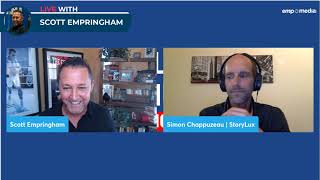
Recorded masterclass (Scott Empringham interviewing Simon Shapazo) that explains practical, repeatable LinkedIn strategies for coaches and B2B professionals. Key takeaways: use LinkedIn targeting (Sales Navigator) or content to build a focused audience of "100 true fans," craft hook-driven posts (get the "See More" click), be personal/authentic using story frameworks (Hero’s Journey/StoryBrand), batch and recycle content, engage on others’ posts (comments over likes), and convert engagement into an email list as a fallback.
Chapters
Sam foreign.
Hey, we are live. I am super excited for those of you who are joining us, our master class, we're going live in a bunch of locations. Today's going to be a really cool day. And by the way, if you notice Simon Chapazo, he is in South Africa. They have a planned power outage there. So he is making do. It's what time is it at night?
It's 10 at night now, 10 o' clock at night.
His wife is off camera holding his iPhone to adapt, improvise and overcome. So thank you everybody for being here today. We're talking, talking to Simon Sh Shazo and we're talking LinkedIn. And specifically, if you are a business coach, if you're a thought leader, if you're in the professional service business, if you're an author, if you're an innovator, you need to be using LinkedIn. And the question is always, how do I use LinkedIn to my fullest advantage? How do I create content that people are going to love? How am I going to create content that's going to connect with my audience? And how am I going to create content in a consistent way and cool content and engaging content that's going to reinforce my brand proposition, engage people and pull them in and ideally provide leads? Well, I'm asking those questions all the time. And so I'm on LinkedIn all the time. And many times I'm on LinkedIn and just one day I came across Simon's post and I was engaging with this post and I saw these posts. We're getting 40, 50, 60, 70, 80, 90, 100 comments every single post. And I was blown away by Simon. So I'm joined by Simon. Welcome. If you're just joining us right now, we're talking LinkedIn and. Oh, and the planned power outage is back. Perfect timing because new people are joining us. This is really good.
This is really good.
Welcome. My name is Scott Impingham, Ever Again Media Group, and we are talking LinkedIn. We're talking about how to create compelling content, how to create content in a way that builds an audience, that creates leads for your business. As I mentioned a moment ago, I was on LinkedIn one day and I saw Simon's post and I was engaging with it and I looked, I saw how many engagements it had, how many comments it had. It had 50, 60, 70, 80 comments. Every day I would see his content just, you know, producing enormous amounts of engagement. And next thing I know, I was communicating with him via direct message. And I thought to myself, this guy really knows what he's doing. And I want to just do a very, very brief introduction with Simon.
He.
For more than two decades, he worked in film and print and event marketing, and he does a lot of storytelling with his business. And I'm not going to steal his thunder, but all those, all those disciplines really came to his advantage. One day he sold everything. He went to London. I'm going to let him tell you a little bit about that story. But one thing led to another and as he, as he reset the new direction for his life and his business, he went into this space of storytelling, of helping businesses and authors, professional services and people connect with their business. So he's already given me lots of value. He's got a presentation. I do want to encourage you to make comments and we will show them up on the screen and make sure we answer them. But if you're looking to take full advantage of LinkedIn, I'm going to now introduce you to Simon Shapazo and he's going to walk you through how to create a marketing machine using LinkedIn for your business. Simon, I'll let you take it away. Cool.
Thank you very much, Scott. So very excited to be here. And it's always great to learn also from others like you with the one page marketing plan. So I'm very excited that we can do this together today. And, yeah, I'm also very, yeah. Touched that you saw my posts and saw the engagement. It's always interesting to see who engages with content and how that works. Yes. So let me start the presentation.
Let me go ahead and bring it on in.
Yes, please.
All right, There you go.
Cool. Thank you. So, yeah, let me start with one overarching thought that I have for LinkedIn and for every kind of marketing we do, which is that we don't need a million followers. All we need are 100 true fans. And looking back on what I've done over the past 20 years, there was always an element of community building to it. And that comes down in this realization that we don't need like these million followers that sort of are somewhere out there, but we need 100 people that are really committed and interested in what we do. And if we have these hundred people, then marketing becomes so much easier because we can speak with them, we can engage with them, they give us feedback, and that makes it then much, much easier to develop your product, to develop your service, and to do something that people really want and are happy to pay for. So, a little about myself. My background is in film. That is about 20 years ago I was at UCLA. I was a student of story analysis, something I didn't know back then existed. But in essence what it teaches you is how to analyze movie scripts. And there's kind of a science to it, to storytelling. I worked in that industry for I think about like three, four years, but left that because I saw better opportunities elsewhere. But the interesting thing is that, that the skills that I learned with storytelling stayed with me through my whole career. So after being in film, I did a print magazine where I could use storytelling. I did marketing for an event space and where we did a lot of storytelling with our clients. And then I sold the event space in 2016. And since then I've basically done lead gen marketing full time as a service. And I've done a lot of work on LinkedIn, which is the primary focus of what I'll be talking about today. Talking about LinkedIn, the thing that I really like is this. The tools that I learned from film analysis, I took these tools, story analysis, and applied them to about a thousand posts that I saw on LinkedIn. Trying to see why some posts get like a ton of responses and others are just like dead fish and water. And I could see that the same principles that apply to storytelling also work with a lot of LinkedIn posts. And I've now made this a business and helps people and myself to, to create better content on LinkedIn.
Simon, Simon, quick question. What you could go back to this one second. I'm curious, what storytelling tools did you use or what story, what storytelling tools do you suggest other. Other folks use?
I'm not trying to understand the question.
You said with my story analysis tools, I've analyzed over a thousand posts and I'm curious, what story, what story tools are we talking about? Like story frameworks, like the Hero's Journey or the Epiphany Bridge.
Exactly. The hero's journey to make sure that you have a character and there's a flow to the story. And it's also touching on copywriting to have good writing, clear writing. And there are more tools with the storytelling that are more technical where you look. But, but that's more like for movie scripts that you can really see, you can visualize why certain scripts don't work because I don't know, like the main character only appears like on page 30 when it should, when he or she should really appear on page two. And you can really break down a script with color charts and see certain things that all come down to the hero's journey in a very detailed way. But that essentially Is the core that you have a hero, that there's a challenge, that somebody really tries to do something. And that is basically what we see in all good posts or stories that we find online that people like.
Do you recommend the folks on this call, they sit down and develop that hero's journey that they can articulate in their posts or throughout their posts over the course of the next quarter, moving forward in their content?
Great question. So, luckily, you guys don't have to do all the stuff that I did, because now there's a guy called Donald Miller who does storybrand. He has written a bestseller, I think, New York Times bestseller, where he basically takes the ideas of the hero's journey, breaks it down into seven steps, and applies that to brands, to companies, to solopreneurs. So you can tell your own story in seven simple steps, and you can find them online. And it's super simple, and it's really super actionable. So you don't have to read this whole Hero's Journey, which I think is a book by Robert, by Campbell, 500 pages, something. It's like. You don't have to read that. Excellent.
All right, thank you for that.
Cool. So then let's look at LinkedIn. Why LinkedIn? I think that's a thing that a lot of people oversee, that LinkedIn is not just a platform for CVs or it's another social media tool. I think it's very unique because it's the only platform where you can see people with their background. And it's a B2B platform. It's a platform for professionals. But you see who you can target on Facebook, all you can do, you rely on an algorithm to show your content to some people. And then you can build a list. On LinkedIn, you can essentially build your own list because you can filter for specific roles, industries, geographics. You can, if you look for companies, filter for revenue, you can filter for headcounts. It's an amazing tool to really target specific people. And that is one of the things that makes LinkedIn unique and very exciting. So we spent, I think, three years using LinkedIn, basically only for list building, using all these filters to build lists. But then there's the other side of LinkedIn, which is the content engagement, which is more like what we know from Facebook, which is more the passive side, because things come in and we create content and people see that and then engage with us. But it's sort of like two sides of the same metal that we can use to our advantage. And I'll show later how we're going to do this. So I think one of the things to understand why LinkedIn is not just a good tool, it's a great tool on what cases it is. First of all, if we want to target or if we know who we want to talk to. So to give you an example, we've done a lot of work with business coaches, and business coaches want to talk with the founders and owners of companies. And you can break this down into specific industries, the specific revenue brackets or geographics, and it's a very clear Persona. In other industries or for other products, a lot of people could be your client. So I have the example here with events and going back to my previous business that I had a long time ago, I had an event space and my problem was I never knew who wanted to host an event because everybody could do something at any time, any point in time. But we had one opportunity per year. That was during the Berlin International Film Festival. That was a period of 10 days. We knew that during those 10 days we had a couple of hundred film companies come to the city and they wanted to rent a space. And because we were in the middle of the festival grounds, we were like the best location for them. So all I had to do in this case to make an example for targeting is I had to pull up a list of all these 400 companies coming to the city, call them, offer them the space, and we signed, I don't know, like 20 to 50 of them. So that was like the beauty, because we could really target people. And that is the thing that you can do in LinkedIn, which is so great. Then the other thing.
Simon, quick question from someone and I might be related here. Does LinkedIn advertising allow for clear attribution, even with iOS updates, clear cost per conversion, etc. His business or her business is custom menswear, and they're targeting attorneys, real estate, mortgage and financial advisors. So I think I know who this is. And so he's targeting those folks. Does it allow for clear attribution?
I'm not quite sure. We don't use LinkedIn advertising. We dabbled a little with it and what we liked was that you can give it a list of contacts that it says it will target. But we found that to not really work that well because strangely enough, it wouldn't find these people, only like 30% of these people. And then you had to build gigantic lists. But theoretically, if that works and you can really feed it a list of your targets and show them your ads, then that would be amazing. But the Last time I checked that it didn't really work that well.
Yeah, so, so there's. There's two, two parts that I think and just to piggyback on what you're saying, I think the ant. I would agree with your answer. It's you can have attribution because you can deliver lead gen. Lead gen ads in LinkedIn. So if you're targeting a group of people and you have lead gen ads and you've on the back end, it's hooked into your CRM then theoretically you would be able to provide clear attribution. Cost per lead, cost per sale. Does it work well, how efficient is it? How targeted, you know those things the cost pers are, Are you getting a return on ad spend? That's probably a different conversation. But I do know that they do have a lead gen feature in LinkedIn and therefore if you've got the targeting, you got the lead gen, you've got that hooked into your CRM and connect to your sales staff then you should have clear cost purs on your lead and ultimately sale.
Yeah, yeah, theoretically. Our dream was always to have a list and for one client we wanted to address London based tax advisors and they are not like they're like a thousand or something or 2000. So we had to build a list of a thousand contacts and that would have been amazing had that worked because hey, I see you are a London based tax advisor and so add a couple of more like things and an ad that is really highly customized. That was the idea. It didn't work because yeah, just didn't work. But anyways, let's continue. The other thing that we found with LinkedIn, well it's a great tool not only if you know who exactly you want to talk to but also if what you want to sell is not like super, it's not like something that you sell on price or something that people want every day. Coming back to the example with business coaches, nobody really looks for a business coach. It's a thing that you decide on a gut feeling whether you like someone. With LinkedIn you can build a relationship and then people will remember you when they're ready to hire you as a business coach. So taking this example here, with a wedding, nobody on LinkedIn looks for like a wedding planner or maybe for a wedding planner. But it's not like you would go to LinkedIn to organize your wedding. You would probably use Google and search for professionals on Google for certain services. But that's just to give a bit of context tying into that. The other thing that is great on LinkedIn is that you can build a relationship because you can be visible with your content and you can target this content specifically to certain people. I'm going to show you how. Analyze, slide. And the other thing that we found that really works nice is high price point products and services. So everything around consulting on LinkedIn really works nicely. So the other thing, the second part of the strategy evaluation is what do you really want to get out of LinkedIn? And we see two big groups of people. One is people that already have a network that have grown over the years just by connecting with people they meet at business functions or from the industry. And they have, I don't know, a couple of thousand people in the network. We see a lot of these people that just want to be seen in their network, so they're not really interested in like having this massive following in LinkedIn or a massive social media following. All that they want to do is to be seen in their network so people remember them and when there's a need, they can recommend them. So that's the one group. The other group is. Or the other strategy is to really actively grow your network on LinkedIn because it's, it's. Yeah, because you constantly need new leads and that can also be done. Question.
I'm so sorry, Simon, a quick question. This just came in on, on a text somebody's watching how often, and you may be touching on this, how often is too often, how often is not enough. Because I really love the idea of being seen in your network and something the person, a professional service said.
How often.
Should I mention.
My favorite question? How often? So that, that I think again, depends on the strategy and on the feedback on the quality, what the quality of the content. So if you just want to be seen in your network, I think it's okay to post once per week or like do two posts. Because if you have a post sitting for a day, it's shown to all the people that come online during that day. And if you keep that post for a couple of days, it will also be seen by other people that come online over the next couple of days. Because everybody is online every day on LinkedIn so you can have one post.
So for folks who are just starting out, a Tuesday, Thursday schedule is a solid schedule to aim for.
Yeah, and I think it's also easier to start with like fewer posts because you get into rhythm to write and you develop a feeling for what works and what doesn't work. So I wouldn't sort of go straight for daily post because it takes a lot of time in the beginning and we'll talk about how to make this faster later on. Excellent.
Thank you.
But yeah, really. So to sum it up, two. Two big philosophies. One is just be seen in the existing network and the other one, grow your network and really turn this into a business machine, lead machine for yourself. So I'll make this brief. It's going back to the targeting capabilities of LinkedIn, which are unique. If you have the LinkedIn Sales Navigator, you have amazing sales filtering tools beyond what you get on the regular profile. You can filter accounts, you can filter companies for revenue, for geographic, for industries. You can use Boolean search to look for specific terms that companies have in their profile. So it's an amazing search tool to build lists, highly targeted lists of people that you're interested in or companies you're interested in. The other thing that you then can do is you can follow specific people that you're interested in so you don't have to connect with them, you just follow them. You can see there's a follow button on the profile and you can use that. Also different to Facebook, you can use that to focus, to hone in on people that are relevant to you, and you can mute other people that are not interesting to you. So huge difference to Facebook and all the other LinkedIn social media tools, you have control over who you see and you can control who you don't want to see because they're not of value to what you want to do. And you're going to see in a minute how this, this comes together. Scott.
Sorry, I was just. You're probably going to. You probably mentioned. I'm going back to this. The gentleman who asked the question about custom men's menswear or any other business, really. I didn't know that you had that ability. Not only could you, obviously, I know you could follow people, but you could actively follow them in Navigator. To make it even more precise, follow your top Dream 100 clients and then mute everybody else so it doesn't turn into a distraction, but literally cultivation of content from your dream customers.
That's. That's really cool. That's great. Thank you. So to make it more. More concrete, in my case, for a while, I was targeting only business coaches, so I could essentially mute all my connections that were coming into my notification feed and I could just set these business coaches to alert or to follow them and to set them to alert. That is the second thing that I just pointed here. So. So you can just follow people. So LinkedIn still shows you what LinkedIn things is the most engaging post. And then you can top that and you can set the alert bell that pops up on the right top corner. And what it does, it shows you every post of that person. And in my case, I wanted to do that because I wanted to see whenever one of my target clients, business coaches, would post something so I could respond to that post and be seen by them because I liked or I commented on their post. So that's a way for me to build a relationship without sending them a cold request, a cold message, or a cold email. And just by discreetly following them and taking advantage of me being able to engage with content the minute they publish something awesome.
And you're going to show us a little bit about where that is and how to do that.
Theoretically, I can. This I can do.
You know, you don't have to do that now. I thought you mentioned that you were going to show a little bit of those features there in the press.
Yeah, well, yeah, not. Sorry, no, not today. And yeah, I already mentioned this. So if you follow certain people that are of interest to you and you set their profile to a lot, you can engage on content. And that's the real beauty of the system, that you can be seen without being obnoxious and hammering people. And the last thing you can do with this targeting and the list building on LinkedIn is that you can build lists of people that are interesting and then you can filter these lists for specific events so you can engage at certain opportunities. It's a bit more complicated, but Trust me, the LinkedIn Sales Navigator is an amazing tool that really, really allows to target people in a very specific way and in a way that you will pop up when it's relevant to these people. And that's the beauty, because we always want to be seen when people have a need that we can meet, and we don't really need to be seen if there's no need for what we do.
All these features are available in Navigator.
Absolutely. Yeah, I can share this, but I don't know how to put it.
No, that's okay.
Keep going. Cool. Then after targeting, the core of the engagement on LinkedIn is great content. And just to make one thing clear, I mean, the analogy to good content with SEO, everybody's sort of so obsessed with, like, having the perfect SEO for the web page to be found by Google, and so invests a lot of time and finding the right keywords and optimizing that. And all Google tries to do is to bring the best results to what people are looking for. And they do this by trying to be as human as possible. And the same is true with content on LinkedIn. The best content is the content that is easiest to read that people like. That is just like something we would love to consume because it's just very human. And so the whole thinking that we should apply with when we create content on LinkedIn is always from a point of view that it's easy to read, easy to consume, and the main goal is to have content that is engaging for people. And that sort of maybe sounds a bit like abstract, but we will see this in a minute. So we're going to talk about stuff like specifics of content creation in a minute. But here it's really about the idea to understand that content rules it all. Great content is what people like. The engagement that we get is measured mainly in three areas. One, the obvious one, the click. The like, everybody's chasing for that. Then there's the comment, which is better. But then there's another click that people kind of overlook, which is the little link to the See More button. So you have a post and you write your text and this post appears in the newsfeed and then you see the first two or three lines and then it stops and you see this little See More button. And then you have the. The picture and the usual post. And LinkedIn really measures how many people click to see more link because that's a very strong indicator for the quality of the post. And so we really want to try to think how we make this post very catchy with the first line. So people click the See More button so the whole post opens. That's a very Strong signal for LinkedIn that this is a post that is engaging for people. And then likes are nice, comments are better, but these come after we manage to get somebody to see the. To click the See More button. Another big thing is always the question, what kind of content? What, what format should I choose? And you have all seen videos, I think, and pure text posts. And then you have like just picture posts and slideshows and polls. And so like LinkedIn comes up with a lot of these different formats. The reach for all of these formats changes depending on how LinkedIn feels. You might remember like half a year ago, you would see like tons of polls because everybody was quizzing people about stuff at the time. LinkedIn really pushed these polls. And we could see at the time we could ask the stupidest questions and we would get like amazing reach with these polls. And then we would have like this brilliant piece of content that was worthy of Nobel Prize. And nobody saw that because LinkedIn sort of didn't really push that as much. So different kinds of content are great. Mix them, use your creativity and focus on the ones that, that work better. At the moment, it's slide decks that work well. Pictures are always good, videos are nice, come with a lot of work, but just be flexible. And then the other thing, some of.
Your posts that have done well, because I'd love for you to show some of the types of posts that you're doing right now, if you can, later on in the presentation.
Sure.
At the end we can share screen.
Yeah. Then we can look at posts that I've done. Sure. And another aspect to content engagement is the consistency. And this has two sides to it. One is we have to think about that. We want to condition people that whenever they see our content that they have a certain expectation as to what to expect from me because we've built some sort of a brand. So this is one side of the consistency. That's what I wanted to say now. And the other one is to be consistent with how often you post, be it every week or every day or every other day, ideally, pick a time, pick, pick a date, stick to it, and also communicate that you do that. So we see a lot of people that say, or succeeding people who say, hey, I post my slideshow every Monday at 9:00am you want to follow me? Stay tuned on Monday at 9 and then you will see the latest slideshow. So being very clear and having a rhythm helps people to, to know when to check your profile and come back to you. And the other thing is to stick to this and be consistent so they know when to expect a post and to know what to expect. So that is more a style thing. You want to develop a style for how you post. Maybe certain colors, certain images, maybe a certain type of selfie you do. But to have sort of a characteristic style that people can recognize. And then the last bit to the content engagement, which is the most time consuming but maybe also the most rewarding one, is that LinkedIn really appreciates you spending time on other people's posts. So we've seen that the more we engage in other people's posts, the more reach we get. And I think there are two sides to it. One is the technical side that I think LinkedIn gives people that really spend time on the platform a bit more of a push with the reach of the posts. But the others, I think also that the more you engage with other people the more you have other people come back to your profile, check you out, see your content and if it's relevant to them, they probably going to start following you and you can start building a relationship here. But it's really.
One quick question, Simon. So let's say, let's say I'm, I've got a custom menswear business or I've got a roofing business, whatever the business is. And I'm super busy but I've gone into Navigator and I've followed and set alerts for like my top 100 dream customers customers knowing that I will benefit if I'm active on their accounts and I want to be active on accounts that I'm, I'm presumably interested in, in doing business with. Could I then give my virtual assistant access to my account and let my virtual assistant engage with them? And to what degree do I have to engage with them for LinkedIn to start to favor me? Is a liking up or is a comment required where the virtual assistant would then need to comment on your behalf? What's, what's, what's the, what's the depth of, of interaction that's required?
Great question. So, yeah, it's, it's, yeah, it's like, I mean it depends on the, the quality of your assistant and what we see a lot of people do. They have someone in the Philippines and you can train them to, to, to like and like back on posts. But very often we see there's sort of a lack of like engagement capability because what people really like, I mean you write, you write. Just imagine, I mean you, you write a piece and you are really proud of that and sort of, you really put an effort into that thing and.
You get a, like, you know.
Yeah. And you get a lot in a question. Yeah. But if you get a comment and somebody asked you something on your piece and sort of really comes back to you with like a 5, 5 line, 10 line comment, it's great. I mean that that's what we want. We want people to, to engage or we want people to speak with us and that's, that's basically people speaking. And that kind of engagement is kind of hard to do if you have someone that is not like fully engaged in your business. We do see people, business coaches that have highly trained assistants who can act on their behalf and they understand what the business coach does. They can reply in a very knowledgeable way and in these cases it definitely works. But coming back to your point, a like is, is nice, but it's not, it's not Enough and you are stealing yourself from an opportunity. Because if you like someone's post, the person who wrote that post will see that you like that and they, they will sort of like that. But if you leave a comment on someone post, everybody that sees that post will see your comment. So it's amazing way to get more visibility with people because you basically hijack the reach of another person's post by leaving a comment. And everybody who sees that other person's post sees your comment. And that, that's one of the ways how I'm growing my following at the moment that I leave posts on other people's, that I leave comments on other people's posts and I see these people come to my profile and check me out and start to follow me. So.
Got it, Got it. Thank you.
Then finally, content creation. I think that's what everyone wants to talk about and that's sort of coming back to my storytelling days. So I think the biggest thing that I see on LinkedIn and the main thing that I try to sort of beat out of my clients is don't be afraid to be personal. It's like everybody tries to be like super professional and super cool and ideally only talk about the successes and everything what we see. The posts that do best are always the personal posts. It's always the posts where somebody either is with a family and sort of is a vacation shot or I don't know, the graduation celebration of the daughter or some personal stuff. And I understand some people are sort of like hesitant because LinkedIn is a professional platform and you want to be professional. But coming back to this thought of like selling complicated long sales cycle complex trust based services and products. And again, coming back to business coaches, nobody's going to book a business coach based on their qualifications. It always comes down to, hey, do I like this guy? Do I think I can work with this guy? And yes. If yes, then I look at the qualifications and that's the whole story on LinkedIn. If we become like natural humans on LinkedIn and people get a sense of like, hey, I like the Scott guy, he's funny, he always makes these great comments on LinkedIn, then I'm probably more likely to extend that trust to a working relationship. So people who only post professionally, they miss out a big opportunity because they fail to build this personal trust.
Quick question. On the personal side, I'm super interested in this. I had a client who would not post anything that was authentic. It was always super polished, almost dry. And we kept pushing to have him. Yeah, talk about story and he just didn't want to do it. And it just felt very. Almost just like an antiseptic. Now, here's my question, though, is I know what he was afraid of. He was afraid of making it too personal and becoming like Facebook, sharing vacation photos, things like that. Is there a set of criteria that you would recommend so that it can be authentic? It can be authentic to you, and it can be real and human, but it doesn't bleed into. It's a Facebook post and it doesn't belong. Do you have any sort of set of guidelines or suggestions to make it personal? But as it relates to your business, as it relates to your hero's journey, as it relates to your story of why you're doing what you're doing, is that maybe that where you want to be?
Yeah, absolutely. So. So in that case, what you can do, you can tell stories from your personal career. So if you've been in business for 10 or 20 years, think about episodes, experiences, and learnings that you've had that you can wrap up in a story that makes a statement, illustrates a point that you want to make, but it's still professional. It's. It's your history. And that's what I try to say here with the backstory. Give a bit of context to where you came from and what you've done. I've done this in the beginning of the presentation when talking about, hey, I had this training as a story analyst, and then I had this business with event space and added some print and some film. So there was a story of what I did in the past. It gives you a backstory that allows you to contextualize everything that I now say in a bigger context of what I've done. And you can do this with your experiences that you've had at work. So I would share stories of, I don't know. At one point, I bought a business because I had an amazing social media channel, was an event venue. And I didn't. I. I got the venue, but I had a falling out with a. With a seller, and I didn't get the social media channel. I thought, like, hey, still great. I have this venue. And then I realized that I was really. Because that channel was what kept this business alive. And I lost a lot of money because it didn't have this channel and was a good experience about the value of a good social media challenge. So that. That's a story that I've experienced that I can use to illustrate in my case here, the power of social media.
Okay, so I'm understanding is make it personal, but have a thread back to why you do what you do, how you do what you do, or what you do. Having a thread back to the business and be authentic.
No. Okay.
Okay. Thank you.
So one of the big questions, and it's like, I know it's really hard. It's like, how do I come up with more content ideas and more stories? And it's quite simple. I mean, just steal from other people. There's not really anything new that we have to share or to tell, because I think everything has been already set in one form or another. But the unique thing is how you share and how you tell these things. So by stealing from others, I don't mean that you steal like verbatim like a post and just repost it. We've seen that it can work, but it doesn't serve you in the long run because you fail to develop your own unique voice. So what I do is whenever I. I'm on LinkedIn and I see a great post that I see works well or that I just like, I save that, I bookmark that, and I take that as an inspiration for something that I could write like that. Very often I take a post, I copy it, and then I start to rewrite it. And as I rewrite that post, it becomes my own. And very often it sort of moves completely away from the original thought because as I try to bring in my personal experience, it becomes my. My story. And so I've maybe stolen the inspiration, but the piece in the end looks like completely different. You would not be able to tell that this is sort of like stolen, which I think it's not stolen, but it's sort of like, so. So one way to come up with great content ideas is just to look what other people do and. And take the ones that you like. You can look for these with hashtags. You can follow thought leaders in your industry and just build a library of stuff that you really, really like and get inspired by that and develop a sense of what works and what doesn't work. And then you will see things that pop into your mind that you think might work, and you develop your own ritual ideas. Excellent. Thank you. So then what I do, I take all these ideas that are stolen from other posts on a trello board and just store them. Maybe leave a couple of thoughts, why I like that post or what is sort of like the take that I see in this story and just store it. And also other ideas that just come into my mind, I put it all in the Storyboard and, and I just let it sit there. And after a while I just go back or when I sit down once a week to write the content for the next week, I go through this long list of ideas and there are always ideas that jump my eye and I take them and then, okay, this week I want to talk about this thing. I had it sit there for like four months and now is the time to take this and turn this into something. So sort of have this backlog of ideas and then things will pop up when bubble up when the time is right for you. And the other thing, pre write ideas at the beginning of the month or the week. So I find it much, much easier to sort of get myself in the space, sit down and spend an hour or something, two hours, three hours. But pre write a lot of ideas and then I can take, depending on how many I want to publish in a given week, I can take the 1, 2, 3, 4, 5 and put them on this week's Trello column and have them pre written. They might not be like completely ready, but then when I go back to that post on Monday, it sort of in the back of my mind, it has sort of solidified, crystallized, and it then takes me like 10 minutes to finish this thing off. And it's a very fast thing. So to make content creation easier, look what other people do. Get inspiration from thought leaders in your space. Get inspired by what they do. Collect these ideas on a Trello board and let them sit until you feel the time is right. And then the other thing, pre write in batches for the week or the month by sitting down for a couple of hours, getting in the zone, writing like 10, 20 pieces and have them like on the, on the back burner for that week and then tweak them when you publish them.
It just occurred to me, I just was doing some quick math too. If you were to batch content, if you were to decide you wanted to be on LinkedIn and you want to really get engaged, you want to do something that you never done before and you committed to two posts a week, just two posts a week, that's only eight posts a month. If you sat down and batched batch that content before the end of the month and for the following month, that take you about maybe two hours, two hours and 15 minutes to write up those eight posts. And then for about 15 minutes on Tuesday and Thursday when you've already got the content there, if you posted for, you know, post, it takes you a moment and then for the rest of the 15 minutes actually comment on your dream 1/ hundreds post. That's a total investment of 15 minutes every Tuesday and Thursday. All in for the month. You're at it for about four hours. Beginning at four hours a month to be interacting with your dream customers, engaging with your dream customers and, and trying to get comments and likes and, and kind of have that conversation. It's a lot more manageable in my brain if I think like that too.
About four hours.
I can do four hours. I do four hours in a month. So that's really good. I love the idea of pre writing at the beginning of the month too. It's so much easier to pre write and then post and not be doing at the same time. And the phone's ringing, emails going off.
Yeah, it's, it's, it's hard to do and takes triple the time. And the best thing, this was an eye opener to me when I realized I just built a library of content and after three months or four months or five months, I just go back and start reposting the stuff from back three, four, five months ago. Because simply first of all, if people have seen that piece, they've probably forgotten about it. You've added new people to your network that haven't seen any of this stuff so you can reuse it. And if you post something, you usually only fraction of your network actually sees that piece. So it's totally cool to reuse posts from the past and save yourself a ton of work. That is one side, you save yourself a ton of work but the other thing that is really cool is if you use the same piece, either you use it like as is without any changes, I do little tweaks after three, four months because you've learned things that work better, you can start to compare pieces and that gives you a better sense of what works and what doesn't work. And it also gives you a sense of like when something is maybe because of LinkedIn and not your writing. So to give an example, I do every Wednesday I do a quiz and I ask five people facts about LinkedIn. Like you've to spot a lie among five facts that I state. And I've been doing this now for many, many weeks and it's become a series. And I can now compare every Wednesday's post with the previous week's post and I see sort of how the reach increases or decreases or how I get more fewer likes and comments. So I can I get more data, I have more comparability because I have these very similar posts and I've started The new series on Fridays. Coming back to my story analysis day, I analyze viral posts, posts that went viral, and I use my script analysis tools, but I can't see how I will. I've just started this, so I don't have many posts with that. But after a couple of weeks, I will see this kind of similar piece that I've done every Friday performed differently on different Fridays. And it might be because my writing was different, might also because LinkedIn sort of gives different reach to us on different days. So last week, Thursday, Friday, Saturday, my reach was very much depressed. And then suddenly on Sunday, it shot up again and was higher than any other Sunday before, which was weird. But yeah, anyways, you can build a library, recycle after three months and save yourself a ton of time and work because you can just sort of use what worked and you can sort of discard pieces that didn't work at all and just sort of take the top pieces and then add a few new pieces to the mix and see how they perform and then go back. So a very efficient system. Then I'm conscious of the time. And this is more like questions, I think.
Go ahead, keep going, keep going.
More like the very basic stuff. I mean, as I said in the beginning, make it easy to engage. Make great content by using stories and making easy to engage. You do by stating values or having stories that illustrate values where people can have an opinion. So what I see very often is that people post something like, hey, we had a great workshop. I mean, what do you expect people to say here? It's like, you can't give a. Like. But it's nothing where you can really engage. Yeah, great. They did a great work. Fantastic. So, but like, try to find things where people have an opinion because it's something that's relevant to them. And one thing that I love to see is people who jump on political events or current events and then use that as a post. And I'm just remembering a post about when Angela Merkel was still in office. She would come to a disaster site that was like a flooding. She went there and sort of held the hand of somebody and some. But the interesting thing was that this story, we saw that same story on different profiles, different, different takes, but all of these stories went viral because it highlighted the value of an individual who took a stand and helped another human in a very dire situation. And the interesting thing was that this thing worked at that particular moment in time because everybody was aware of the flooding and the everything that came with that. So people were aware of that and receptive to that. And that's when stories really work. It's conveying some values. It's giving people something to have an opinion and to say something about it. Then like really no brainers. I mean, keep it simple. Simple language. Don't be like super convoluted with Latin sounding words. The basic vocabulary of the base thousand words in English is sort of the easiest that people understand. And you always have to think about that person is probably going to read this post on the subway scrolling through this thing and if you splatter that with like Latin words, it's very hard to sort of like take it in with the cognitive load that you have with the subway. So keep it simple, keep it as short as possible. We see that the shorter the post usually the better it works if people know who you are and if they have recognize you as a brand. So keep it just as short as possible. And yeah, be human, be personal, be funny, be self aware. Don't take yourself too serious. That's something that we always see really works well. People are just sort of like honest and authentic about themselves. Yeah. And we are coming to the end.
I'm super into this. Even if we wrap up, what are some of the nuggets? How do we build our email list? And we can, we can certainly wrap and here. But this is super interesting. How do we build the list? I've seen you do it and I'd love to show some of your posts or if you're going to go through it, let's go through it. But I've got your post pulled up and that's how I got kind of on your list and by dming me for the answers. But I'm super interested to hear what you have to say and this might be really, really good takeaway to end on.
Yeah. So maybe. Yeah. So favorite hacks. I mean, let's not forget LinkedIn is not a channel that we own or control. And like in June my account was blocked for three days because I had to authenticate my identity, which was a bit cumbersome. But for three days I couldn't do anything. I was like cut off from the world. And that reminded me that we always, always should have a fallback option. And that is the amazing tool we call email list. So whatever we do, I believe on LinkedIn we should always try to capture as many people as we can to get them on a mail list. And the easiest way is to offer them something that they can subscribe to. If you have a consistent flow of High quality posts. You can take the best performing posts of the past month, turn that into a mailing, pimp it up a little, make it a bit longer, add a bit more meat, but you can essentially take the winner of the past month and use that as mailing. Doesn't take a lot of work. You can give more value and you have something you can promise people to get if they give you their email address. And the minute you have the email address, you are independent of LinkedIn because you can reach out to these people on your own terms and, and you're not reliant on an algorithm or a platform that you don't own. So that is my favorite thing, my favorite hack with email list building off of LinkedIn.
I'm going to try to do something here if I can. Can I share your post and give some context for some folks?
Sure, sure, sure.
Let me see if I can pull this off here. How do I present slides? Shoot. Actually, you know what, I don't know how to do that. Actually pull in my screen or share my screen if I did. Stop cam. Present slides. Extra camera. Video file. Oh, present screen. Okay, tell me if you can see this, Simon. Okay, here we go. So can you see my screen?
Yes.
Okay, so a couple of things. So if you're interested in building your list, if you're interested in actually Getting leads from LinkedIn, this is how Simon sucked me in and sucked a lot of other people in. So this post was one of his bad performing posts. It's just 34. He gets 50, 60, 70, 80, 100. His, his slide is. And you'll notice he's got three things going on here that I think he's already talked about. Number one, he's used to see more brilliantly. It's that time of week again. Wednesday is quiz day. Guess which of my five links in fact is a lie. And if you're curious, you sort, you hit this and then he goes into a little bit more detail. So really clever there. He's got a, he's got kind of a hook at the beginning, but this is what I love. The second part that I love is this. Are you a LinkedIn expert? If you, you want more people to read your post here, I'll share five that work for me, but be careful. One is a lie and it's back to, you know, I'm going to tell three lies and a truth. And so you look and it says click here. Super easy, creative. But then you go through oop, here we go. Oh, no, I didn't Refresh. Here we go. Let me try this. So here you go. One, avoid dark background slideshows, the white fonts, blah, blah, blah, True or false. Want to rank higher in searches? He gives you sort of the tip is that true or false? Another true or false. Another true or false. Another true or false. Really easy to click through with the end call, call to action at the end. But what I love is at the, at the end he invites you to guess and then he'll DM you the answer. And after DMing you the answer, he says, if you want more great stuff, let me know and I'll put you on my email list. So the three things I love is number one, you use the. See more brilliantly. Use that slideshow with three, you know, three lies and the truth or whatever it is to get them engaged. And then you have them answer and then you DM them and then you DM them with all the answers in a hook to say, hey, if you'd like more of this stuff, get on my email list. I think that's a brilliant strategy that other businesses could use. No matter whether you're in the clothing, the roofing business, if you're engaging with your dream 100, you could come up with really creative things to test their knowledge. People are interested that, and it's not about you, it's about LinkedIn, presumably what they're interested in. So I think it's really well done. I want to show that example. So was that, was that your presentation?
That was my presentation, yes.
All right, well, good. I'm glad I, I shared that. We are going to wrap it up, but what I did is I said to get more LinkedIn training. Be sure to follow Simon on his LinkedIn channel or just go to his LinkedIn profile, check him out. I posted that. I'll make sure I post that in the groups. Check it out because every day or virtually every day, I see really good LinkedIn training and you're making, you're asking questions on how to use LinkedIn, testing knowledge, engaging with them. And so I really, really appreciate it. I had so many more questions. I wrote a bunch of questions down. But I will follow up with you in the comments section on your threads. And I really like what you said about batching content and, and engaging with other people's posts. And it can be simple, it doesn't have to be super complicated. So thank you for your time. If there are any final, final questions, drop them in the post. But I'm going to assume that you had the opportunity during the. During the, during the webinar. I know there's some people left. Thank you so much for being on. Please connect with Simon. And Simon, thank you for the information. Thank you for your expertise and really appreciate you engaging, great, fun talking.
Thanks for having me. Scott was amazing.
My pleasure. My pleasure. Now you can get some rest.
I will. It's bedtime now.
All right. Awesome. Thanks so much. Thank you.
Thank you, Scott. Bye.
More from Scott

🔥 PRESSURE IS A PRIVILEGE #PressureIsAPrivilege #LeadershipMindset #MentalToughness


🚨 YOUR NEXT LOCATION WON’T FIX YOUR PROBLEMS #BusinessScaling #MarketingSystems #FranchiseGrowth

🚨 AI CAN ACTUALLY MAKE YOUR MARKETING WORSE #AIMarketing #MarketingStrategy #BusinessGrowth


🔥 STOP RUNNING FROM WHAT’S CHASING YOU #FaceYourFears #KeepGoing #MentalStrength

🎥 STOP EDITING EVERY CLIP YOURSELF #AIVideoEditing #ContentRepurposing #ContentCreation