How to Launch Your Startup | Sharif Shameem
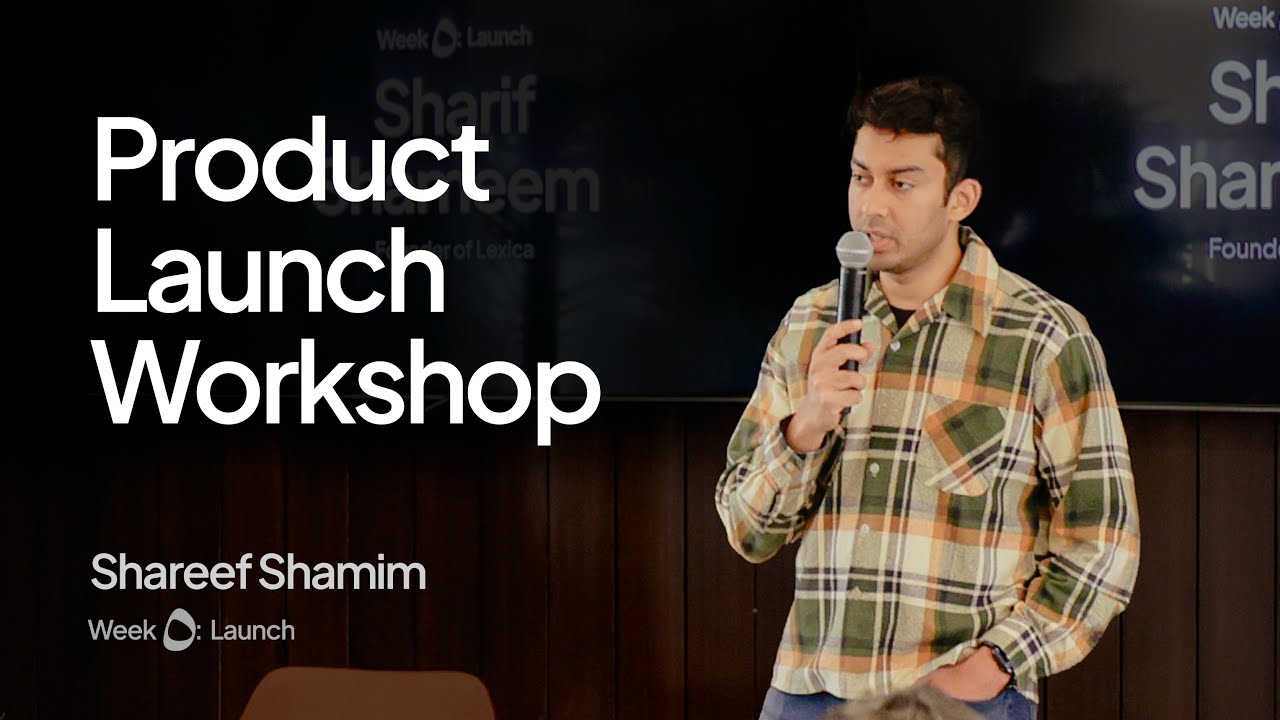
Sharif Shameem, founder of Lexica, explains how to launch a startup: ship early with an imperfect product, pick one core feature you'd use yourself, and gather real feedback. He turned Stable Diffusion's chaotic prompting into a searchable image tool, treats pricing as an experiment, and warns against feature creep by staying focused on your North Star.
Chapters
Launching is kind of an interesting thing with companies because founders tend to be perfectionists, and perfectionists don't like to show the world what they're working on until they're absolutely certain it's really good. But the thing is, you can never really build something great in isolation. The only way to build something great is by having the real world interact with it and then use that feedback to refine what you're working on. Yeah, I've worked on a company before Lexica called dBuild where We spent way too long on not launching something because we thought we would have to make it really, really good in order for people to care about it. And that was a mistake. What we really should have done was get something out there as quickly as possible. And kind of Lexica is the counterexample to this. So just the quick backstory on Lexica is I was in the Stable Diffusion Discord and I was like really interested in how like all these people were generating images and like all these prompts were really long and complicated and no one really knew what they were doing. They were kind of like copying each other's prompts and like adding a few words to it. And I really wanted to have a way to like turn this, just like not even science, just like this art of prompting into a science. So I really wanted a way to just like search all the prompts and images and see what would come up when you like typed in a word without having to actually generate it. 'Cause it used to take 3 or 4 minutes to generate a single like set of images. So like the very, very first version of Lexica was literally a website with one search bar. It looks really similar to what it is today, honestly. But when you would type in a word, it would show you images generated with that word. It took about 2 and a half days to get the first version live. And then we launched with that. It was just that website. It was like the quality, the level of quality for me to launch it was, is this something that I find useful only for myself and no one else? And it was just like barely useful for me. And I thought it was interesting. So I just decided to launch it. And that ended up working out really, really well because we launched it the day that the Stable Diffusion weights were open source. So we got really lucky in riding that, like, zeitgeist of interest in this first open source image generation model. And oftentimes people would just, like, share a link to Lexica alongside that. Had we waited, like, 3 or 4 more months to launch something better, it not— very likely the company would not have worked out. So launching early is probably critical to the success of Lexica. Had we even launched maybe 2 or 3 weeks later, I still don't think it probably would have worked out. The earlier you launch, the better. And then even if it's something pretty unimportant or pretty— if it seems useless to most people, but it's useful to at least one person, it's probably a good time to launch. I would also say you can launch multiple times. No one really tells you this, but you can actually just launch your company like 5 times in a row and no one's gonna care. You can also just like— like the Airbnb folks were famous for this. They launched Airbnb, I think, like 7 or 8 times. And for the first 6 times, like no one really cared. No one really paid attention. But like by the 7th time, someone like— they were doing enough. Their product was good enough for people to actually care. So launching is not a one-time thing. You can just launch again. And the thing about startups is that there's so many of them and very few people are like able to capture a large mindshare. You can just keep launching until like something big happens. Like it's actually just that easy. You don't need to like wait for— a specific date or like set a date in your calendar and like, okay, this is our launch day. You can launch every week or even every month if you want to. Yeah. And then the thing is like launching is kind of just the starting point. Use your launching as a way to actually start working on your product. You kind of think of launching, you should think of launching as like just building this random product in like this huge search space of things to build. And you can kind of try to build a product without launching and like using only your head. To figure out what people want. But launching is like, okay, I'm gonna pick this point in space and now I have to use the real world to give me feedback to decide where to go in this search space of products. So some people might say, oh, I really want like the feature to search by images in Lexica. So that's like something we should probably build. I thought that's something people would've wanted, but I wasn't sure. So I launched without it. Turns out I was right. I should have probably, that was like probably a good feature to build. But then there were other things that I never would've thought people would've wanted. The biggest one being like the ability to generate images directly within Lexica. That was really important. And I never would have thought of doing that until we had launched. So there are many things you'll realize about your product that you won't really notice until you have people actually interacting with it. Getting people to interact with your product and give you feedback is like the most important thing and nothing else matters. That's like really the only thing you should be doing when you're working on your company. It's either like interacting with your customers or building your product.
Yeah.
We can also just like jump right into questions because I feel like that'll guide this a bit more. Yeah. I think Twitter is a really good, or X is a really good place to launch your products just because the algorithm on X is a bit more engagement-based now than it used to be before. So you can actually gain a large amount of eyeballs on your product launch post. If it's like genuinely something very interesting to people, by like pure nature of people liking and sharing or liking and viewing your video, that'll kind of boost its engagement score and then it'll show it to more and more people. Because the feed is primarily algorithm-based now. So you can have probably maybe 10 to 20 followers. If you launch a really compelling video and at least like one person catches on, it's very likely it'll bubble up somehow and people will find it interesting and it'll probably go really viral. if it's truly something people actually cared about a lot. So Twitter is probably the best way to do it. Other things would probably be maybe Product Hunt. Or if there are communities specific to the customers of your product, launching in those communities would be a really good idea. One example of this was I would spam the Lexica link in the Stable Diffusion Discord. And then it got so— people saw it so much that they ended up recommending it to other people themselves. They didn't know how they saw it. It was me, I was posting it, but it was more, it was common enough for them to be like, oh, just use this website. So if you have any community specific to the customers of your product, that's a really good place to launch as well.
Like that, I mean, do you ever worry about like, you know, I'm gonna leak some alpha to my competitors and then they're gonna just copy me and my advantage is gone?
You kind of just have to be better than them and just know that even if they do see what you're building, that you can outship them. And that's really it. Like there is very little alpha in the specific idea and it's kind of all just in like the execution of it. And the way I think of company ideas is that there is this phenomenon in science where whenever there's a really big discovery, for example, Einstein discovering E=mc², it's very often in the next few days or even weeks, another scientist will discover the exact same thing somewhere else around the world. And these are for very, very important discoveries that change the world. For startup ideas, you will probably have hundreds, if not thousands, of other people with the exact same idea you have. So, you kind of just have to assume that everyone knows what your idea is, and it's really up to you to kind of build a better version of whatever that product might look like. The idea itself is honestly important in the sense that you have to pick a good, important idea to work on, but it's not important in the sense that you have to keep it a secret. You can just tell everyone about it, and that probably won't change anything.
Yeah.
What'd you think about pricing?
Pricing is a very, very important topic. It's very hard and you should treat it like a science. There are models for pricing your product accordingly. You can ask questions like, what, what, how much would you be willing to pay for this product? Or what is the, what is the most uncomfortable price you'd be willing to pay for this product, but still be willing to pay for it? And that's usually like a good way to set your price. You can just survey your users on like, what is the most amount of money you're willing to pay that will make you very uncomfortable, but you should be willing to pay for? And then you can kind of— it's really just like a grind to test out a bunch of different pricing models and experiments. There's really no secret to it, but you should treat it as if it were a science and run a lot of experiments to optimize your pricing. There are, there are a few pricing models out there. So if you just do a search for like, Optimize your pricing models. There are a few surveys you can give your customers and then it'll give you like upper bounds and lower bounds for what you should probably price it based on what their responses are.
How would you tailor your advice to like creative projects like games? Sometimes it's not very easy to just launch, you know, right away. And usually also with that, it's like you don't want to give a bad impression We first launched.
So.
Yeah. Games and creative projects are a bit different because they usually take a bit longer to build than your typical, like, SaaS or consumer software tool or product. It's a really good question. I would say try to— the same advice probably still applies, but If you can come up with like a version of the game that is still fun to play, like what is the, what is the most basic version of the game that is still fun to play is probably what you should be trying to build. And the moment it's fun to play is probably when you should launch it to people. But also, I think a lot of times people think that games can't be launched more than once, which is totally not true. You can absolutely like launch a really bad game. and then just put updates out. Like, to give a more concrete example of this, like Fortnite today looks nothing like Fortnite in 2016. Like, they've just continuously been updating it. So you actually can just like— like the world is large enough where you can just launch it to an entirely new cohort who's never seen the first version that was pretty bad. And they've only ever seen the second version that you've launched. And you can just keep doing that as you launch new and new versions. And you probably will never run out of people to like test out the new version you're working on that's not been like negatively influenced by a previously worse old version. And the benefit of this is that you're gonna get way more important playtest or user testing feedback from the people who play the game than trying to like perfect the game solely in isolation.
Yep.
So what's your take on if the day you launch or when you're launching a product, and there's like off the bat millions and millions of people that will actually engage with your product, see what it is. How do you go about doing that? Because I mean, so I do social media and, you know, I have a decent amount of followers. When it comes to building a product or service, my biggest concern is the judgment I would get from what people see and how people feel when they see my product, especially when it's something that's like I know is not even close to it being fully done or being fully built, right? Obviously I want to get something out there just so I can get user feedback and be able to build from there. But the only problem I feel like I am dealing with in this case is there's a lot of eyes to begin with. And so how— what would you— what would be your advice going around with that? Like, yeah, because my concern is like, if there's so many people watching from the very beginning, I, I don't want them to like, you know, Yeah.
What is your product, by the way?
So we're, so we're building an AI software that, uh, essentially gives UGC creators an ability to like, uh, uh, prompt out a script that is high converting, high engage, like very engaging and like viral based off of like, uh, viral ads that have already been put on social media. Um, and also like trends that are coming about, um, like, you know, on a day-to-day basis.
Yeah. Um, Most products only do like really, like most products have one thing that people really just care about the most. And then everything else is just kind of a nice to have. I would try to focus on making that one thing, which it sounds like for you is just given a prompt, you just give them a really, really good script. And it sounds like you're probably also trying to do things like automate the making of the video itself to make it really easy for them to export. I would just ignore all of that and just focus on making the scripts that it generates really, really good.
We don't make the, we don't make the videos themselves. Like we, Obviously, creators are gonna make the videos, but we just supply the scripts.
Yeah, I would, I would focus on making that one thing really, really good. And then that's gonna be a lot easier than trying to make a bunch of other things. But I would make that one feature extremely well, work extremely well, and then just launch with that.
So, okay, so you would say to hold off on launching until this is something that's—
Well, if it's, if it's useful for you, it's probably useful for other people. So once it's useful for you, I would launch with that.
So after you launch, how do you think about which feedback From users you take in and actually work on? And then how do you go about prioritizing from an engineering perspective?
Yeah, this is a good question. Prioritizing feedback. You kind of can't just build everything your users ask you to build. One, there might be just too much feedback. And 2, it might just not be good. Like, they might be pulling you in a bunch of different directions. So this is where having, like, a good product sense and a product vision comes in handy. You actually have to know what you want to make. And you can kind of use the feedback as, like, I would say, like, a high-level overview to understand which directions people are pulling your product. But it's up to you to, like, actually navigate and figure out how to get there. Sorry, let me— I said that backwards. The users will, like, ask for specific features and things they want. And it's up to you to kind of figure out how that ties into, like, a more cohesive experience. So one thing that was not a specific concrete piece of feedback, but one interesting way we observed people using Lexica was they would use Lexica and then have like another tab or another window open for another image generation service, like usually Stable Diffusion or Midjourney or something else. And then we noticed that they would often just like alt-tab back and forth between Lexica and then this other image generation service. Go to Lexica, copy a prompt, paste it in the image editor, maybe change a few words, and then generate. Go back, like, paste the image that was generated back into Lexica, search for similar images, look for similar prompts. So we saw this tool, we saw Lexica being kind of used as a tool in this larger workflow. So we decided to just build all of that directly into Lexica, where you could kind of generate images without having to go use a separate tool. And build it such that it was a cohesive workflow where you can kind of prompt for images, generate them, search for them without ever having to leave the website. And this was less so a specific thing people use, people just asked for, but more so something you observe by people using your product. So yeah, there were a bunch of other things that people asked for that we never ended up building. Just because it didn't fit into like this larger workflow of like people using these tools as creative tools and like using them to create things that they wouldn't have been able to create otherwise. So I think having a good product sense for where you want to go with what you're building is important. And then trying to build the specific features that will align with your larger product direction and product goal and also satisfy those users' needs or help them use your product in a better way. Yeah. Yep.
To tack on to that, how do you like stop Feature creep where you're trying to service all your users?
What's the criteria to, like, have some focus? Yeah. The only good answer I have to this is I would only ever build things for Lexica that I would want to use myself. If it's not a feature I can see myself using, we just don't build it. So it's a lot easier when your target user is just one. Which is yourself, because you can iterate on features in your head without ever having to build them and kind of think, would this be something I use? Probably. I might as well prototype it. Like, oh, this is actually not that useful. Let me scrap it. Whereas if you're trying to satisfy a large number of users, you're gonna end up building a lot of things and you just don't have like the engineering bandwidth to do that. But if you're building only for yourself, it's a lot easier to figure out what's important and what's not. If you're just being honest with yourself, like, you wouldn't lie about your, like, what features you would want to use in your product. So, like, if you can build it for only yourself, it's gonna make your life a lot easier. I don't have any advice for people building products where they wouldn't be one of the target users for their product. I don't know how to do that.
Yep.
What is, like, the North Star for Lexica then that maybe, because, like, Although, I mean, like, you could always build off your whim, but likely you said something about creative tools, like, likely there's a North Star that you're building towards.
Yeah, so the North Star we're building towards is like kind of hand-wavy and weird, but we're really trying to build like a camera for your imagination where you can kind of— people have like this internal monologue. They also have like this internal vision of things they see, and there's really no good way to get that out into the real world unless you're a really good artist. So we're kind of trying to build a camera that lets you like capture whatever's in your imagination and bring that into reality. So like, that's kind of what we're building. And what that can look like as a product can be like many different things. But generally speaking, it's like helping people broaden what's possible in terms of bringing their imagination into reality. So if you're someone who cares about drawing, this may be— this may just look like a better like drawing tool, for example, like Procreate on the iPad. If you're someone who's interested in AI, it might look like image or video generation models. If you're someone who's interested in music, it might look like making music generation models. So there are many different, like, variations of what this product might look like. But, like, generally the North Star is people have this idea, this concept, this thing in their heads, and we want to get them to create that in the real world, as high fidelity as possible. to capture whatever's in their heads. So that's kind of our North Star.
Yep.
So you launched in a time where there's a lot of competition, you know, DALL-E being out there, Midjourney being out there, and then having a lot of investment. How do you think about like competing against people that, you know, are innovating as well? And you're also in the space. How do you differentiate? Yeah, that's a good question. Usually you don't want to be the first person to build the product. Google was absolutely not the first search engine. It was like number 20. You should really try to just be the last person to build that product. Because if you're first, you're probably not going to do it right. And then if you're second, you'll probably improve on the first person's attempt and then make it a bit better. But the fact that there are a lot of people building something and like, they continue to build products in a similar space means that no one has really built a product that's really, really good. Like today, it's probably not, or like for the past 20 years, it's been like a really bad idea to build a search engine just because Google is really good. Why build a better search engine when Google actually solves all your problems? Unless you're Microsoft. But if there are a lot of competition, if there's a lot of competition in the space you're working on, it means the problem has yet to be solved, which means you still have a pretty good shot at trying to solve it. The amount of funding someone has raised is kind of irrelevant. Like, once you have enough to fund a team of engineers, that's like really it, which is not that much money. You can make do with a lot of, with a very, very small amount of funding. Yeah, like some of the best startups in the world have raised like less than $5 $3 to $5 million and are incredibly successful. Yeah, funding doesn't translate into like product success. Competition is also something that you should be aware of when you're trying to manage your morale and your kind of emotional runway on your project. If you have a competitor that's kind of doing something really well and your startup is just trying to do exactly that, plus some tiny feature that might make it better. That's probably not a good idea. But if you do have some like deep user insight into why they're doing their product wrong and like why it should be done a completely different way, or like their approach is wrong and you have a way to solve the problem they're trying to solve, but in like a completely different instantiation of what their product might look like, maybe that's a good idea. It's kind of nuanced and you kind of have to figure that out for yourself.
So just to follow up on that.
So would you say like it's like There's competition. And then if you focus more on like maybe the experience of like your user that you're trying to serve and how that can be more streamlined, is that like a good direction to like think about like solving? I don't think just having a better user experience is enough to differentiate the product. It also depends on exactly what the product is. This, the answers to this are very different for like a consumer product versus like a B2B SaaS tool. I think if your product is, if you, if the, if the competitor's product is kind of used by people because they have like no other choice and it's like the only thing they can use and they're kind of frustrated by using it anyways, that's probably a good sign that you could probably build something much better that people will actually enjoy using, which still solves their problem. But if people are happy using the competitor's product and they're like, this is amazing, I love this, probably not worth your time to go after that specific competitor or like that specific market. But if it's like, I'm trying to do this and it's not really working, but there are no other tools that let me do this. And it's like really hard to get what I want. And I'm just like really upset, but I have no other choice. That's probably a good idea to like work on that product. Yeah.
So I have a dumb question.
What is Lexica? Yeah, Lexica today is a website where you can search for images and then also generate new images. What we kind of see Lexica as, as a company is kind of just like this way to build this sustainable lab for building new research projects and turning them into useful products. So there's like the Lexica, the product, and like Lexica, the organization. The product is an image generation service, and the organization is we're trying to train really, really good models to do things that people previously thought were impossible.
So is this something you're like, Building on your own or you're using like Stable Diffusion and building on top of that and then doing some like annotations?
So for our current product, do you mean? Yeah, our current product started with Stable Diffusion. We used the open source model and then we decided that it actually wasn't good enough. So we fine-tuned the open source model and then we began to charge money for it and people were paying for us. So we decided to train our own models from scratch. We spent a few, we spent around a year and a half doing that because we were kind of limited by what the open source models could do. So we built the, I guess, technical aptitude to begin training our own models. And then we did that and then we deployed our own models and then we began working on even newer and better models. And then we're kind of, we started using Stable Diffusion originally to kind of prove that this was something people wanted. Then we fine-tuned it, which is a bit harder than just launching with a pre-trained model. And then we began training from scratch. So I absolutely would not recommend training from scratch from the get-go. If there are open-source models that can do what you're trying to build, probably just use them. And then only once you've like absolutely validated that training from scratch is the way to go, then I would recommend doing that.
So when you say training from scratch, that's like your own foundational image generation model?
Yeah.
And you do that yourself?
Mm-hmm.
I see. So what do you think about OpenAI? Like you talked about like competitors very like distinct, very soft, you know, like do you think they're in the generation space or like Sora, like when it comes to like video? What about Chinese companies? Like do they ever affect you?
Haven't yet. The Chinese companies don't really affect us. We haven't heard of any that are like pretty decent competitors. OpenAI is kind of in like the AGI space where, well, previously they were in the AGI space. Now they're in like the AI assistant space. They are competitors in the sense that they are also training models, which happen to be image generation models, but directionally their organization is aligned towards making really good AGI. So models which are generally intelligent and capable of doing things like conducting scientific research on their own. Whereas Lexica as an organization is kind of aligned towards bringing your imagination into reality. So we have very different kind of goals as organizations. It just so happens that in this current instantiation of our project, of our products, they kind of look similar, but it's like 2 vectors crossing. They might have like one, one point where they meet, but over time they'll eventually go different directions. So I kind of see it like that.
Do you see your users being like, Like customers, enterprises, schools?
Yeah, our users are mainly just consumers. Like 80% of our users are just like regular people. Yeah. So when you guys, you raised your money, you raised your round, it's a $5 million round, kind of like in the field of AI.
How did you go about deciding what amount of money to raise? And then how did you go about pitching?
Yeah, so the way we raised our round was very different than the way most companies raise their round, which is like you have a huge fundraising process and then you reach out to fundraisers or investors and you pitch them for a few weeks. And then you like narrow it down and then you convert them. And then like eventually you've like hopefully raised your allocated or your expected amount. Our approach was a bit different. We kind of had a good, good relationship with one investor, Daniel Gross. And because I had built this good relationship over a while, it was a bit easier for us in that We kind of just decided to raise one weekend and then by the next weekend we had closed the round. So this is very, this is not common and I don't think it's really good advice. Better advice for fundraising would probably be to turn it into a process, make it something where you have a spreadsheet and you actually like set up multiple calls. So I wouldn't recommend, like for a first-time founder, I wouldn't recommend this approach, which is very hard. But I would recommend the approach where you have a spreadsheet and turn it into a process and like Try to get the amount of money you need, the minimum amount of money you need to like become profitable, I would say. What were the expenses you were calculating? Yeah, it was just payrolls and GPUs. That was really it. Yeah. Why did you guys choose not to go get an office, you know, hire a marketer, do all those things? Yeah, I think we were growing fast enough without any of that stuff. And I'm generally a fan of building kind of your growth directly into your product and not really doing anything else. And that's mostly been working for us so far.
So, the million in one month ARR, that was before the $5 million raise?
This was after it. This was not before it.
So, the $5 million raise was like what?
We had zero revenue.
And like, but you've launched?
We've launched, yes. We had launched and we had people talking about the website.
And what year did you raise? I'm totally confused.
This was, I think, 2022, I think. Yeah.
So basically you didn't think about the business model monetizing at all?
We actually, yeah, we had no idea what the business model was. Like genuinely, I was concerned that I had no idea how we would make money eventually. But in the short, like I was concerned, but I kind of knew that if we had built something people wanted, I'd figure it out. And which happened to be the case. We just figured it out eventually. Like, classic example is like Google thought, no one thought Google would ever make money like 6 years into the business. No one was like, no one knew how to monetize a search engine. But if you're creative enough, you can find a way to get people to pay for a product that they really, really like. Even if it's like indirectly through AdSense, you'll still find a way to make money.
So it's more important to focus on adoption?
Yeah. The way to think about making money is like you're creating value for people and then you're just trying to capture a small part of that value. So, you should not try to, like, you should essentially try to focus on maximizing the amount of value you create for people in the world. And then once you monetize, you're just like, oh, I'm gonna take a small chunk of this for myself to keep working on things. But really, like, instead of trying to make that chunk bigger, you should try to make the overall, like, size of value you create bigger. And then by doing that, you can make the subset that you're taking away much larger. So, really, you just wanna try to make something that's, like, maximally useful and interesting for people. And then monetizing will just be like pretty straightforward after that. If it's something people are like actively finding value— valuable.
So, what keeps you up at night? What are you struggling with?
Not much, honestly. I'm like pretty good at managing my own psychology. If you're staying awake at night stressed out, you're probably NGMI. You have to figure out how to like get good sleep at night. But like things I find useful or things I think about often today are We're mainly doing a lot of research. So just thinking about like the research around training better models. But from like a stress point of view, it's really important to like not stay awake at night and actually know you'll like figure things out eventually. It's going to make it a lot easier. And just like from taking a step back, like you should take a debugger to your own personal motivations for working on this company. And figure out why am I actually working on this? Am I doing this to make a lot of money? Am I doing this because I like building things? Am I doing this because all my friends are doing it and I kind of want to do it too? You have to make sure your motivations are sustainable and will last. If you're doing this to make a million dollars, when you make a million dollars, you'll want to make $10 million. When you make $10 million, you want to make a billion dollars. You'll never be happy. But if you're doing this because you just love making things, You'll end up being happy the day you make things, which is like every day. So for me personally, I actually— the reason we monetized Lexica was just so I could keep working on it. We were— our goal is to not make money. Our goal is to build really cool products. And then our sub-goal is to kind of make money just so we can keep building really cool products. And that's kind of how I think about the company is we're really just here to like have a good time and make cool things. And then we need to make money so we can keep doing that and keep the music playing. But beyond that, that's not really our main goal of making— our main goal is not making money. Our main goal is just to ship really cool things.
Like VCs, right? They say typical SaaS business, you want to have 80% profit margin. Like, are you still— and that's more money than keeping the company alive. Do you still try to keep the 80% or what?
What do you mean by that?
Yeah, so like, let's say If you look at your models and the cost per generation costs, let's say, $1, and you charge $5 per image, like, are you pricing in a way where net monthly cost, you're making 80% more?
It's a bit, it's more than that, but it's less so something we're like hyper-optimizing and more so like, is this a sustainable business practice? Or is like, is this a sustainable business model? If it is, you're probably fine. If it's something where like you're going to run out of money in a year, you probably should figure something out. But generally it's just, it's actually once you've made something valuable, it's not that hard to do it in a profitable way. Yeah.
When you divvy things up amongst your team or co-founders, like what parts of the launch did you focus on? What parts did you like have them focus on?
How do you get people to like own their work shoes and make that work? Yeah, so before we launched, I was the only person working on it, so I I had just done everything. After launch, as you manage a team, you kind of want to figure out what people are good at and what they enjoy doing and try to find a way for them to do the things they're good at and enjoy doing. One thing I also like doing is like not growing your team too big where the amount of like network connections between each people will grow exponentially. So if you have 2 people, you have 1 connection. You have 3 people, you have 3. And then so on and so forth. It just keeps growing. This slows down. So you like don't increase your marginal productivity by like 10% adding your 10th employee. That's not really how it works. It's maybe like 1 or 2%. So keeping the team size relatively lean, I think is a really good idea for most companies until they hit like a certain scale. And then at that point, having like smaller clusters of teams, I think is the good way to do things and not like larger teams, like keeping them limited to like maybe 5 or 6 people per team is a good way to do it. And then they just work on a project which is completely isolated from another project.
So, you know, the sub— or like these, you know, the undercurrent of what you've been saying about how you've approached your vision and company building and everything has basically been without thinking about how to raise capital or how capital most important for your future growth. You know, one, that could seem like it's because, you know, you kind of had a different path to raising capital, right, where it didn't seem like it was critical. But I mean, how are you thinking about that moving forward, right? Is there like a Series A? I mean, we know that another company in this space raised like $40 mil or something crazy, right? So like, are you thinking about that, or do you think that this is like a new age of company organization where you're just gonna stick with your 10 guys and And just scale it.
Yeah, I think, I think we are in a new age of like building companies where you can have really small teams that make really, really great products that are used by hundreds of millions, if not billions of people. Yeah, so for raising new rounds, we're profitable, so it's not something we need to do, which is very nice. I really, I'm like happy we don't have to continue to like raise every round every like, couple of months. That's something that means— it means we can just focus on building really good products and not have to worry about that. Raising money. The reason you should raise money is if you can, like, you have a team that can take more money, turn that into better and more useful products. And beyond a certain amount, like, you just saturate how much you can make or how much you can take, or your team can only take, like, you can only grow your team so much before, like, you're not actually improving your product or building useful things. What I mean by this is raising $40 million means you can hire a lot more researchers and a lot larger team and maybe get more GPUs, but it is unlikely to make you a 40 times more productive company than a team that's only raised $1 million. And in some cases, I'd argue like the team that's raised $1 to $2 million will probably be more productive overall in the absolute terms than the team that's raised $40 million. Because now their investors are pressuring them to like grow at all costs and like focus on monetization and hyper-optimizing their like funnel and whatnot. Whereas the team that's only raised $1 to $2 million usually have raised it from like smaller investors who are typically angels. And you can kind of just like build a really good product, which people will care about more. So I think like the amount of money you raise is like very, very loosely correlated with the one thing that really matters, which is like building the product that people actually care about.
Like, more towards the front end?
Yeah.
So, like they said, like 10% of all code that's written today is like front end UX, like user-facing code, and 90% of all code that's written is back end or like microservices and upstream downstream requests. I think like 5 to 10 years from now, like 50 to 75% of all code is going to be data. Do you agree with that? Like agents and agent-like entities?
I don't know. I haven't really thought about the ratio of code that'll be agents to non-agents. Yeah, interesting idea though.
Do you think it could head that way or no?
Maybe, yeah. Very possible that could be a reality.
That's our pitch.
Nice. Awesome. Yeah, any last questions?
Cool.
I think we're good.
More from Sharif


Buildspace - live w/ Sharif from Lexica | from Zero to 1 million users in one month
