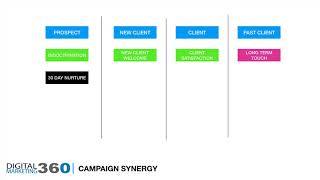
In this instructional video, Shaun Whynacht of Blue Cow Marketing walks small‑business owners through a structured digital‑marketing framework built around the customer journey. He first defines four distinct audience buckets—prospect, new client, client, and past client—explaining how each stage requires a unique marketing approach. For prospects, he introduces an "indoctrination" email (or similar first‑touch content) that showcases the business’s personality and value, followed by a 30‑day nurture sequence that addresses objections, price concerns, and social proof. New clients receive a 15‑day welcome sequence (emails, gifts, coupons, or direct‑mail) to reinforce the purchase decision, after which they transition into a client‑satisfaction automation. Ongoing clients are kept engaged through satisfaction surveys, product updates, and appreciation events. Past clients are nurtured with long‑term touches (newsletters, holiday cards) aimed at referrals, testimonials, and occasional gifts. Shaun emphasizes the importance of timing (30‑day prospect nurture, 15‑day new‑client welcome) and shows how automation tools—Facebook custom audiences, Infusionsoft, and Canada Post direct‑mail—can automatically drip the appropriate content to each bucket. The video concludes by positioning the Digital Marketing 360 course as a comprehensive solution that blends strategic thinking with hard‑skill execution, and invites viewers to learn more at bluecowmarketing.ca/training.
Chapters
Hey, it's Shaun here with Blue Cow Marketing Incorporated, working on our Digital Marketing 360 course, recording a lesson today on campaign synergy. There was a slide which we're going to show you here in a second that I felt was necessary to create additional content for social media, for our Facebook and our YouTube channel, because a lot of small businesses may not think about their marketing and their customer journey this way, and it is absolutely crucial and essential to do so. And by this, what I mean customer journey is when somebody comes to your business, you know, when the first point they meet your business, whether it's a website or calling your office or coming into your, your store, they are a prospect, right? They're not a customer at that point until they make that purchase. And we need to treat them differently. And we do that through different types of marketing. Now with our course, with Digital Marketing 360, we are teaching digital marketing skills. And it's not necessarily all about how do you post to Facebook, how do you, you know, write a blog, how do you do this kind of digital stuff. It's talking about strategy as well, and this is one of the key elements to think about in your business. So let's take a few moments to go through this, and I re-recorded this just right now to use the existing slide for this purpose of strict 100% education for you as a small business owner. So we look at, you know, the 4 potentially different types of silos you could put people into in your business. Number 1 being a prospect. A prospect or a lead, whatever you want to term it, is somebody who has not made a purchase yet. They haven't crossed that chasm from non-purchasing individual to a purchasing individual. Once they make a purchase the very first time, they are a new client or customer. All right, so the new client or customer is a great time for you to really show them some love, right? You know, just like a first date, you're gonna call that person the next day, you might send them flowers, right? You're really showing your affection for these clients because they are new, and that is crucial to digital marketing. Once they go through that new phase, once that new client smell has worn off, so to speak, they become a client, right? And we're going to talk about more about what you should consider for each of these. And then lastly, what would be the last one? Past clients. So somebody who is either no longer using your product or service, uh, or they just have stopped buying from you for one reason or another, and why this is crucial to consider them still in your digital marketing strategy. Now with a prospect, the very first time somebody comes in contact with you and you get them into your database you need to introduce or indoctrinate them. We call this indoctrination. This is where we have a chance to show them more about who we are, why we do what we do. And for your business, it could be different. It could be, you know, it could be 3 emails, it could be a video, it could be a free digital gift. Doesn't matter what it is, but it needs to talk more about what makes you special, what makes you unique, and why do you love the work that you do. In our business at Digital Mark— or at Blue Cow Marketing Incorporated, our indoctrination is one single email that goes out to that person. It's not corporate feeling, it's very personally written by myself, has a picture of me and my son in it, talks about why I love the work that I do, and I've gotten lots of great response from that. So that's our indoctrination. The key with this is somebody only gets it once. So if you've got 2 or 3 free offers on your website, doesn't matter, the first time they go and opt into it, they get indoctrinated. After that, they don't get an indoctrination again, because the last thing you want anybody to do is get the same thing twice, right? Makes you seem spammy, makes you seem disorganized. It just, it looks bad. Okay. So now with a new client, you've got a new client welcome, like I talked about with the dating, sending flowers and so forth. It's our chance to show that you really care, right? Make them feel really special. Because if that's how you treat your new clients, then it's a great business to be connected with, especially as a client or customer. It's just an overall win-win for both you and the client. And that new client welcome can last a variety of timeframes, and we'll talk about a general one here in a second. When it comes to clients, so after they've gone away from that new client period, then you're reaching out to them and communicating around client satisfaction, right? So it's either sending them more updated information about the products or services that they have, uh, it could be a client satisfaction survey, it could be inviting them to customer appreciation events. Doesn't matter. Your whole focus, your whole purpose is to keep this client satisfied. Okay, past clients— these are long-term touches. So these are You know, maybe it's monthly, quarterly, it could be a newsletter that they become subscribed to, it could be just a Christmas card, it doesn't matter, you still need to stay in touch with them. A lot of people will say to me, well, what if they just don't need my product or service anymore? Well, that's fine, but there's a difference between them who have already used your product and service and already had a relationship with you to somebody who hasn't. It's the fact that they have already liked trusted you. And now they just don't need it anymore, right, which is okay. But they know people who may need it. So there's a lot of chances that you could get referral clients from these past clients. So we don't need to just cut them dry, set them adrift and forget about them, we need to stay in touch. And your long-term touch for this may ask for referrals, right, it may be that you're asking them if they know other people that could use your product or service. This is a time when you ask for those testimonials, this is a time when when you show your appreciation, maybe send them a gift depending on how long they've been a client of yours. Let's go back to that prospect. So once they become a prospect, they opt in for something, you've got that phase of, you know, you're gonna make that offer to them to either make that first purchase or have that free consultation, whatever it is. If they don't take you up on that offer, you know, as soon as you make it, you need to nurture them. You need to overcome a lot of their objections, whether it's information about your product or service that they may not know about, maybe it's price objections they have, you know, maybe it's social pressure, proof. They want to know that have other people they know, or do other people they know use your product or service, or there are other people in the world that use it, or in their town. You know, it's that social proof, you know, showing testimonials as social proof. We spend that, that period, and 30 days is a great time period for that type of nurture. You know, 30 days, once that 30 days has passed, they still haven't gone from being a prospect to a client or to a new client, then we need to look at putting them into a long-term nurture. And just like the long-term touch on the past client, a long-term nurture is still talking about, you know, why you do what you do, but you're also educating them. You're giving them small wins. Depending on your industry, you are teaching them more about how they can use your product or service to better their life. Maybe you're gonna give them some stuff that they could utilize right away. But you're giving away some really great stuff. Your best stuff is given away at this point. Because if they don't go from a prospect to a new client, they're just, it's not a right fit. And there will be people who fall into your prospect bucket who just aren't a right fit at this point in time, and that's okay. You figure how long you wanna run this long-term nurture, and then at the end you just cut 'em loose, okay? That's okay to cut. Cut it off at the beginning. Now looking at that new client, new client welcome, you know, on average, you see them about 15 days, right? It could be an email every 5 days. Maybe you're going to mail them out something. So they bought something, you're gonna have a shipping address, you're going to mail them out a new client welcome. Maybe it's a coupon, a gift card, it could be some videos. But 15 days on average is a good timeframe. Once that 15 days is up, They automatically shift from new client to client and then get put into that client satisfaction automation sequence. So the reason we do this is because it makes building that customer journey a heck of a lot easier because we can have custom audiences in Facebook based on what type of prospect they are, you know, what type of bucket they are. I mean, whether they're prospect, new client, client, past client, we can have content automatically drip out to them. Using your email. We use Infusionsoft with our clients, using those systems to deliver upon that. You can leverage the, you know, if you're in Canada, the Canada Post direct mail system to send stuff out to them. You know, there's a ton of opportunity. So this is why having an actual digital marketing course as opposed to taking a workshop on using Facebook is key and essential to every business, because it's not just the hard skills that you look at It's thinking about your business in this granular detail that's going to make using those hard skills that you learn a heck of a lot easier. So thank you very much for watching this video, and if you're interested in more about our digital marketing course, you can check out the URL that you see on the screen, bluecowmarketing.ca/training.