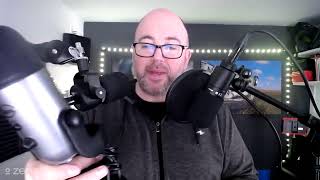
Shaun Whynacht breaks down microphone types for podcasters: condenser mics need phantom power and pick up more detail, while dynamic mics are rugged and forgiving. He recommends the Audio-Technica AT2020 and Rode dynamic mic, and warns that cheap cables or poor setup will tank your sound no matter what gear you buy.
Chapters
Here we are. It's episode number 2 of Launched, the podcast where we help you launch your first podcast as a small business owner. Today I'm going to talk to you about microphones. Now, if you're watching this video, and sorry for those of you that are just listening to the podcast, you won't be able to see this, but I'll do my best to explain everything that I'm going to talk about and show here in this episode, especially for you guys on the video. So let's talk about recording a podcast. Now, a podcast ultimately is audio, and I had a radio instructor back when I was in broadcasting school that always said great audio is visual. And think about it, back in the day— back, you know, we love that phrase, back in the day— but way back when radio was the thing, this is before TV, people would gather around the transistor radio and they would listen to radio shows. And the ability to bring you into that space, to capture your imagination, was imperative. It was absolutely crucial. And in today's world with podcasting, you can do the exact same thing. However, if your audio is poor, it's a distraction. So we need to make sure that we are recording the best possible audio. Now, today I'm using a different microphone for recording this because prior to recording this episode, I was doing some voiceover for an explainer video. So I wanted to use this microphone right here that you're hearing me on at this very moment. This is the highest quality microphone that I have in my studio at the moment. It is called a condenser microphone. And what is a condenser microphone? Well, a condenser microphone, while it may look like other studio microphones like this one here that I'll show you in a second, it requires something called phantom power. There's no battery in it, but hooked up to the audio mixer, there's a little button called phantom power. It's 48 volts. What it does is it sends a little bit of current through the cable to charge the sensor in that microphone. By doing that, it gives my audio a higher level of sensitivity, meaning that the range in which it can pick up my voice, the clarity, is much higher than a dynamic microphone, which doesn't require that power. A lot of audio mixers do have that ability to have that 48 volts. If you have the ability to pick up a condenser microphone for your podcast or your studio, I would highly recommend that you do that. So this one right here is a condenser microphone. Now, what is this little round thing in front of it? This is called a pop filter. Now, if you go on Amazon or any kind of audio store and you look for a pop filter, you will find it. The key behind this is that it creates a barrier between my mouth and the microphone. So anytime I go "pees" or popping, we're not hearing like a thud against the microphone. It's basically stopping that air from hitting the diaphragm in that microphone. This would be as important on a dynamic microphone as well as a condenser. The condenser is just going to be a lot more sensitive to those type of little nuances in your voice. The other thing that I put on a microphone is called a wind filter. It's just a foam filter that slides over it as a protector. And that is gonna give you a little bit of protection against those type of things that are there. Also, if you've got multiple people using a microphone, it's a good kind of sanitary thing to have those. You change a mode every now and then. Okay, so that is a condenser microphone. Now let's talk about a dynamic microphone. This one here on the other side of me is a dynamic. Does not require phantom power to work, but it is a podcast-specific microphone. It is made by a company called Rode. As you see, the boom arm that I have that I'm using for this one is a Rode one as well. They have a RodeCaster, which is a complete podcasting mixer. Great company if you're looking to get started. This one will do absolutely fantastic audio for you. If I'm doing voiceover, I will require a condenser microphone. But for a podcast, the average person won't tell the difference between this dynamic microphone and this condenser one here that I'm using. I do like this one because it can point directly at me. It is very flexible to move around. And with the articulating arm, if I'm sitting or if I'm standing, I can move that around very easily. Now, what other options may be available to you? Well, maybe you don't want to get a mixer. Maybe you just want to get a good quality microphone and connect it to your laptop. Well, you might want to go the route of a USB studio quality condenser microphone. This one here is from the Yeti brand. It is a Yeti Blue, and it is not blue in color. This was the dark gray one that I have purchased. This one is great as well, works really well. If you're on the road and you're doing a lot of podcasting, maybe you're traveling and you got your laptop, you want something to take with you, this will do fantastic for you. Plugs in by USB. You can even get an adapter and plug it into an iPad and use an audio recording program on there. The thing that I also like about these is the fact that there's a headphone jack in the bottom. So it has an audio interface built right in so you can plug it in. If you're on a Zoom call, then you can use that. You can adjust the volume, the level. You can also sit this between two people and have the audio pick up on the front and back. And there's a selector switch on the back to do exactly that. This microphone is going to probably run you in around the $200 mark. You can get it cheaper on sale. You know, a proper condenser microphone. Now they range in a lot of different prices, obviously, just like anything.. But you know, the ones that I'm using here is an Audio-Technica AT2020. That's the model name of this one here. This is around the $170 mark. And this dynamic mic here was about $150 as well. Now there's one other type of microphone that you might commonly see. It is also a dynamic microphone. And you might see this very similar to, you know, if a band is performing or there's somebody giving a speech on stage, you know, this is what we consider like a handheld microphone. You can mount it in a stand. This will work very well as well for you. You can also put that foam cover over it, but this would probably be your very entry-level type of microphone for a podcast. If you're really gonna get serious about your podcast, think about investing in either a USB if you're gonna be very mobile. If you have a stationary setup, go with something with an articulating arm that you can clamp to your desk or table and it's basically gonna stay in place. And if you're really serious, go with a dynamic one, get a nice mixer, plug it in. You know what? It's always going to be the quality of the audio is going to be the level of the weakest part of the link. If you are going from a dynamic microphone, or sorry, a dynamic microphone, which is on this side here, or a studio quality microphone, you don't want to go with a cheap audio cable. There is quality to the cabling. Get something that's going to be of good quality. If you have no idea, Go to your local music store, your audio store, and ask them right there what you should get. You want good quality that's there, and your mixer— go with a nice brand name mixer there. That's going to help you out. If you want some recommendations on equipment that we recommend, you can go over to launchmypodcast.ca, scroll down on the homepage. I have links to the actual products that I recommend and that I use in my podcast and with different clients. So in summary, your audio, extremely important. And if you're watching this video portion of this podcast, the audio is being fed into the video as well. So you're hearing it through this microphone right here. That's going to be key. You never want to just use the microphone that is built into your computer. You don't want to really use the microphone that's just in your phone. If you're just doing a proof of concept, great, you could do that. But if you're serious about launching a great podcast that people are going to really want to listen to and follow you and subscribe, you're going to need to invest in the proper equipment.