Marketing is Easy, People are Lazy: Nathan Yeungs Take on Streamlining Business Growth
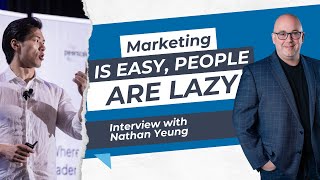
In this interview, Nathan Young, founder of the agency Find Your Audience, shares his 15‑year executive background in finance, operations, SEO, and media buying, and explains how his firm helps primarily B2B SaaS companies (and a range of other industries) build functional, revenue‑generating marketing. He argues that generative AI will increase the importance of organic search, because AI models rely on large datasets that include search rankings. He stresses the need to start SEO early, treat it as a sustainable, long‑term activity, and use a practical framework: map every potential customer touchpoint, rate its influence, and prioritize the high‑impact, feasible actions. He introduces a “piggybacking” content workflow where a single asset (e.g., a blog post) is repurposed into transcripts, long‑form video, and short‑form clips, maximizing efficiency. Nathan recommends a suite of tools—Ahrefs for SEO, ChatGPT/Claude/Gemini for generative tasks, PAGE.io for sales enablement, and SmartLead for outbound email. He highlights mobile‑first website design (distinct from merely responsive) and a daily content cadence, with a “reverse Jeopardy” keyword method: identify the top‑5 answers for a keyword and craft content that directly answers that question. Regarding AI‑generated content, he believes quality and user‑need fulfillment matter more than origin, though search engines will continue to evolve detection. Finally, he outlines his ideal clients: early‑stage startups needing advisory/coaching and larger B2B SaaS firms ($2‑$50 M ARR) seeking to turn their marketing function into a revenue engine.
Chapters
Nathan, thank you so much for joining me today. You know, when we started and I read through your intake form, one of the things you titled the show, because I ask all our guests, give me a potential title, was that marketing is easy, people are lazy. And that was something that made me chuckle when I read it. And I kind of want to dive into that because, I mean, for somebody to say marketing is easy and for somebody listening to this show, they may feel that marketing is hard and challenging. So Let's first start with telling our listeners where you are in the marketing space. Who are you and what do you do?
Awesome. So my name is Nathan Young. I have about 15 years worth of C-suite type experience called executive work. But more specifically, I have 18 years of search engine optimization work and about 9 years of media buying work. So I've been in marketing for quite a bit, but my background's a little bit different. I started in finance and then I went into operations and then I went into marketing. And so I find myself running this firm for about 7 and a half years, just called Find Your Audience. And we predominantly work with B2B SaaS, but I'd be lying to say that if we didn't do some fun stuff outside of B2B SaaS. So we've worked with restaurants, we've worked with really unsexy things like infrastructure, we've done financial services, professional services. We've really touched every single asset class, talking about, you know, 60, 70 different clients in total. And we fundamentally just help companies make their marketing function work. And what that means is it adds value to your business. And that could mean a different, a lot of things to a lot of different businesses, but to a lot, obviously that means generating leads.
Now, why did you get in marketing? I mean, you've been in other industries. Why did you go into that field?
It's a great question. I got into marketing because I was a management consultant for a little bit, so operational consultant for a couple angel investors. And frankly speaking, a lot of the times I would watch these companies do marketing and I would kind of just get puzzled, to be honest. I would look at it on an operational perspective. I'd be confused because they're listening to these agencies. And I have a lot of friends who are bootstrap founders, you know, companies that are going through VC rounds. And, you know, I was just really frustrated listening to the advice. And a great example, I just did a great conference down in Toronto. You know, we, I was talking to a client, a potential client where one of the other people attending the conference switched domain names and that was just because they're like, oh, we need to change the brand name. And I said to them, I was like, you know, there's a 30 to 40% chance that you're going to lose a significant amount of traffic. And they're like, oh, well, we weren't really aware that the branding was really important. So it's like you make these marketing decisions, but you don't look at the holistic impact. And I just got frustrated. So I just started helping friends and family with their businesses, and now it's turned into this full-fledged agency where, you know, frankly, we work with some of the largest companies in Canada.
It seems like quite a, quite a journey. Now we know that, you know, things are changing so rapidly. There's so many things that, that are coming into play— AI, reputation. I mean, most people don't even understand how, how people, find their website through search engine optimization and that, that kind of thing. But in the space that you're in and what you're seeing, what is, is going to be the, the biggest change that people are going to need to be prepared for, uh, with marketing their business?
So it's really interesting. There's a, there's a, there's a ton of, um, you know, rumors, trends. People were kind of concerned that, uh, generative AI was going to destroy search engine optimization, uh, I will argue against that and say, in fact, it's just going to make it more important. Um, and the reason is because generative AI uses large datasets and one of those large datasets is organic rankings. Um, and so in my opinion, um, I think search engine optimization and ranking organically, whether that's on Bing or Google, is going to become more important. Rather than less important. And I think a lot of people need to be focusing on how are they actually doing on SEO. It's a constant battle with a lot of our clients. It's a constant battle for a lot of businesses because they delay it. And the one thing that I'll say is, is that SEO gets easier with time. So the earlier you start and the more, you know, the more effort you put in, the easier it gets. And that literally just means you have to start today. A lot of companies wait and they wait longer and they wait longer, and all that does, it gives a competitive advantage to your, to your, essentially your competitors. If they've started before you, they will naturally rank easier and better than, than your website. So it's problematic just to delay it for so long.
Do you think we're going to see these search engines giving the results back in an AI-generated form versus just the links that are there?
100%, and it's a bold prediction that I hope to see it come true. I suspect the generative AI tools may do pay-per-click advertising, meaning you could pay to play to have your results come up in their data point when a question comes up that's relevant to their business.
Interesting. Yeah, I mean, the, the idea of this, I mean, I think a lot of people have, you know, spend a lot of focus on creating content, um, you know, whether it's in blogs and videos and formats like that, um, and also trying to get their, their websites to show up in search ranks. What can, what can they do to kind of be prepared for this, this AI movement that's happening?
Um, well, there's two things, right? So, so one, I think just in terms of your business, I would highly recommend that we make sure You're using AI and you're not shying away from it. I think if you're shying away from it right now, you're, you're just gonna be, you're, you're gonna be in big trouble in, in the next couple years. So if you're shying away from AI, start using the tools and just remember the tools don't necessarily give you outcomes, but what they do do is they give you workflows. So this idea that you're going to go into Runway and build a brand new video, that's incorrect. You're gonna go into Runway and it's just gonna be one more way for you to get videos for, for your clients. For anything that you're doing. You go into any generative AI image tool, you're not gonna get your final image, but you're gonna get it pretty darn close. So knowing that you have to learn the AI tool to fit your workflow and build that workflow is going to be incredibly important and an incredible skillset. So I actually recommend a lot of, you know, junior level employees to learn generative AI because I think it's incredibly important for anyone to really know that going forward. Um, and then again, I would say SEO, just like you have to start producing content, you have to start ranking today.
Absolutely. Now I know there was talk about the, you know, the whole idea of voice, you know, with the Alexas, the Googles and all those things that came out and people trying to position for coming up in kind of voice searches. Is that something that's still relevant anymore?
Yes, but I wouldn't say— I think it's always going to be relevant. Um, I don't see it as being a huge thing going forward. I think it'll be, it'll take a couple more years, to be honest. I don't see, like, at least in the businesses that we work, voice is not a huge thing. It might be more for like a consumer brand where I think voice does play a role. But when it comes to B2B, I don't see that becoming a huge thing. I don't see people using Alexa in the middle of the night asking how they're going to solve a fundraising issue, right?
For sure. Now, you know, your business, uh, which is Find Your Audience, and you'd made that claim that, hey, marketing's, marketing's pretty easy, just people are lazy. Walk me through, through how you approach marketing, uh, with a client, uh, to help them, you know, find their audience and grow their business.
Yeah, so, um, we take, we take what I call a practical and sustainable approach. And what that really means is we go with the client and we do a bunch of exercises that you don't have to have $1 million to do, right? So the first thing is, is, you know, or you should know your customer pretty darn well. And I've asked this to so many CEOs. I was like, have you ever just put onto a piece of paper all the potential touchpoints you think your potential decision maker has received. So whether that is them reviewing a document, whether that's your salesperson talking to them, whether that's them seeing an ad online, whether that's going on Reddit and seeing a review, that's going on YouTube and watching a long review. Have you ever just gone through that exercise and placed what you think is the actual journey? And so many people have not done that. And it's a really, really great exercise for you to understand where you need to focus your marketing. Because what's really important, and for all those listening, I really recommend looking at the Zero Moment of Truth studies by Google. It really shows that omnichannel is a thing. Um, getting impressions across multiple channels is incredibly important because different channels have different levels of influence. And you want to focus on the ones that have the highest impact of influence. And some of that might be anecdotal, meaning, you know, when you get a sales call for a demo, it's high impact. You know, when you see someone for a meeting, it's high impact. You know, when someone's watching a YouTube review, it's high impact. And the reason why you need to categorize it as high impact, those become your priority items. And then you come down to the question is, is it practical and sustainable for my organization to actually do it? And why that's really important is because you're always gonna have a shiny object problem. You're always gonna see the latest and greatest in marketing and be like, I need to do that. But the fact is, is that you have to be able to do it well, execute well, which is the practicality part. And you have to do it over a sustained period of time, which means can you actually keep this activity up for a sustainable period of time? Because you have to be out there and repeated. That's why frequency is a thing. You have to be able to keep up this activity for a long time and also not completely destroy your internal resourcing. Meaning like if you're a terrible person making short-form video and you're trying to make short-form video, you're just taxing your time. It's not a great opportunity cost for you. So I really recommend that people go through this journey anecdotally kind of give it ratings from 0 to 10 on the influence of each of these touchpoints. Look at the touchpoints, then look, just be honest with yourself. Can I go to networking meetings? Can I make phone calls? Do I know how to use email systems? Do I know how to use media buying systems like pay-per-click or social media? And can I do that well? And then just ask yourself, what is the most practical and sustainable thing and prioritize that based on the impact. And that's going to be the basis of your business. There's a whole bunch of additional things you have to do which are constraint-oriented around your ideal customer profile, but that's kind of later. So if you want something quick and easy, that's the first thing you got to do.
I mean, just listening to that, I mean, it sounds like a lot. It sounds like a lot to, to do the exercise. Not, you know, not that big of a project initially. But when you, when you talked about all the different channels, all the different touchpoints and things like that, I think people can get, get overwhelmed. Now, if you're a small business, maybe you have, you know, a couple employees, maybe it's just yourself. What are some, some guidance around that? Because you mentioned, you know, maybe you're not good at short-form video. We know that short-form video is, is widely consumed now and very popular. Do you, do you create content that is for those short-form videos, or do you create longer-form content and try to splinter out content from that to fit in?
That's a great question. So one of the things that we do when we implement projects is I call piggybacking. Okay. And piggybacking is just where I know there's an activity that we can do that ultimately assists multiple other activities. So a great thing is a blog post can be the basis of a transcript. A transcript can be then used into a long-form video. The long-form video then can be used for short-form. So my idea is, is you, you know, again, this is the more complex part. I try to give the easier exercise first, is once you do this activity, you try to be as efficient as possible. So you try to bundle activities so that you produce multiple type of assets. And ultimately those assets are the ones that go into the market to help distribute your messaging or value prop and things like that.
Absolutely. You know, and I do the similar, similar thing. And what we try to think of is, or the advice I kind of give clients is, is find something that you're— it's more natural for you, right? So whether you're a writer, whether you're, you know, good on camera, but maybe you're long-winded, right? Just let them, let them roll with that. Now, when it comes to tools that are out there, I like to ask our guests, you know, are there any tools that you've come across that, that really help you streamline your workflow or do these things that you're mentioning a lot better?
Um, I think for me, uh, when it comes to SEO, Ahrefs is, is probably one of my my favorite tools to use for generative AI. I can go very long-winded on that, but I would say all the major tools, Claude, GPT, Gemini, they all have different use cases. Recommend you review those use cases. Gemini is great for large datasets. ChatGPT is an overall winner. So if you don't want to get too bogged down, I would just go on a ChatGPT. Generally speaking, it does well in almost all different types of activities. The, there's some competitive intelligence tools that are super interesting. Sales enablement tools. There's a, there's a company called Page, P-A-A-G-E, yeah, P-A-A-G-E.io, which is an amazing tool for sales enablement at scale. There's an email platform called SmartLead for outbound. Really recommend that. The founder's a great, great guy and great product.
Those would be kind of the big name ones that I would drop right now.
Okay.
Now I want to, in the last part of this, is talk more on that SEO side of things, knowing that's some history that you have there and some experience with that. What should people be looking at in their online web presence that's really going to help them and not hurt them now? Is it making sure that the mobile side is your number one focus? Is it more content, um, you know, mixed media content? What, like, what would be the things that somebody could go, I'm going to go look at my website after this podcast and I'm going to look for these things?
So usability is becoming more and more important, um, and there's obviously a large trend away from desktop. So I think just looking at your mobile usability of the website is really important, making sure that your website is built for mobile. And it's not just responsive, right? So just, just to be very clear, there's a difference between responsive and built for mobile. Generally when we build websites, the mobile website is essentially a completely different website. Yes, it is responsive, but it is very specifically built to arrange content for mobile. In, in terms of content and how much you're producing, I hate to say this, but if you could produce content, a piece of content a day, That would be great. Mm-hmm. Um, but remember it does take a little bit of time. It takes up to 3 months for what, for kind of Google to start recognizing you as a website that's producing content consistently. Um, so you're going to have to do that for a little while before they start kind of considering you an authority or consider you a website that is consistently updated. Uh, so again, this is what I mean by sustainability. You have to be able to persist through time with this activity. But all this all being said, if you were to force a gun to my head and said, hey Nate, there's one thing you got to do, I would just go, just do something I call reverse Jeopardy, which is look up the keyword. You don't want to pay for a $400 SEO tool. Just look up the keyword, whatever that keyword is going to be, and just ask yourself what question is being answered by the first top 5 results. And whatever that is, that's the core piece of content you want to write for that keyword. That's the main thing that is, that, that needs to be done. So all, all, everything else I said is like a nice to have, but if you're not doing this one piece, if you're not answering that one question that's clearly being answered by the top 5, you're not going to rank for that keyword.
It's great advice. Now, how sensitive do you think the search engines are for this AI-generated content? I mean, people are getting on ChatGPT. And they're, they're writing blog posts and they're writing, you know, these scripts there with very little identity or personal flair that's in them, um, and they're just pumping them out on their website. Is that actually hurting them?
There's a ton of argument on this, and, you know, I'm by no means a programmer, um, but I do have some programming background. And the one thing that I can't wrap my head around is if an algorithm can produce content and an algorithm is required to find patterns, there can be an algorithm made to be random, which is meant for any type of algorithm to identify content that is a pattern to not see the pattern. And so there's this argument saying, oh, AI content won't rank. But the reality is, is that there's going to be someone smarter and there are a bunch of companies that are already doing this. Where they've created algorithms to prevent it to look like there's a pattern. And so there's going to be this constant battle between trying to identify AI content and AI content creating better algorithms to look like it's not AI content. And so in my opinion, AI content, as long as it's good AI content, will likely continue to rule so long as it answers those questions. So I think that goes back to the fact is, is this article actually a quality piece to read and sometimes they're not. Mm-hmm. So, um, I, I think AI content will be fine going forward, but you still have to make sure it's, it's doing fundamentally what SEO needs, which is you're answering users' needs. And if you're not answering the user's needs, then, then you're, you may rank, but you're likely not gonna stay ranking.
Absolutely. Great advice. Now, just as we wrap up here, What type of clients do you work the best with and like who are you looking to find for your audience?
Yeah, awesome. Well, we, you know, we have a variety of different services that we've built through time because we've recognized there's all kinds of people that need help. For more early stage and startup companies, we provide advisory services, which is on the lower end of things, which means you're essentially, I'm your marketing accountability coach, but I help you guys focus, right? And I think that's the really important part. It's very easy to get lost and not have any direction when it comes to marketing. But for a majority of our clients, it's large B2B SaaS companies anywhere between $2 to $50 million in ARR where we're helping really build their marketing function into becoming a revenue engine.
Excellent.
And your website is?
Findyouraudience.online. Excellent. Nathan, thank you so much for sharing this, these years of experience and wisdom with us.
Well, it's my pleasure. Thanks for having me on.
More from Shaun


Julie Vanexan recognizes Shaun Whynacht from Blue Cow Marketing at the Nova Scotia House of Assembly








