How To Achieve a 75% Follow Up Conversion Rate
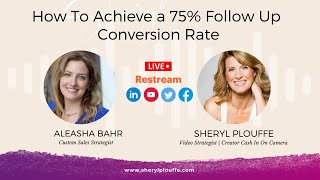
In this Cash In On Camera interview, host Sheryl Plouffe talks with sales‑marketing strategist Alicia Barr about how to dramatically improve follow‑up conversion rates, aiming for a 75% success rate. Alicia explains why generic “just checking in” emails fail and advocates a value‑first approach: embed client success stories, relevant industry articles, new ideas, or timeline‑based prompts in each follow‑up. She stresses asking for decision timelines during the initial sales call, using direct but non‑aggressive language such as “Have you made a decision yet?”, and customizing each outreach rather than relying on one‑size‑fits‑all funnels. The conversation also covers how to gauge the appropriate follow‑up cadence, when to stop pursuing a prospect, and a more conversational way to handle objections by exploring them instead of delivering canned rebuttals. Alicia shares her preference for concise, attention‑span‑friendly content and introduces her free “3 Steps to Pitch Weaving” framework, which subtly weaves the pitch throughout a call without feeling salesy. Throughout, both hosts emphasize reciprocity, genuine effort, and the importance of tailoring communication to the prospect’s needs.
Chapters
Everyone wants to increase their conversion rate, right? And you probably have heard different percentages thrown out there in terms of what is a good conversion rate. And when I met Alicia Barr through another person who was on Cash In On Camera through Katie Brinkley, we met. And when Alicia started talking about the types of percentages that we're talking about today in this topic, which is how to achieve a— here's the punchline— 75% follow-up conversion rate, my ears perked. So, Alicia, so great to have you here on Cash In On Camera. This is something that a lot of coaches, consultants, service providers, entrepreneurs, solopreneurs, like, they want to know, how can I leverage and maximize my conversion rate through following up with people to the rate of 75%? That's amazing. How do they do it?
Yeah, so I mean, a lot of people understand that sales happen through follow-up more so than they happen on the call, but they just are like, I don't know what to say. Yeah. So they usually just, um, keep checking in, following up, or touching base, or circling back. Um, you know, did you— basically it sounds like, do you want to buy my thing? Like, are you going to buy my thing or not? And so there's nothing in it for the other person. So think about you. Do you like when people check in with you if you're going to buy their thing? Do you want to respond? Right.
And I've been guilty of this. When you said this to me, you're like checking in, circling back. I've been guilty of doing that. I think a lot of people are like, yes, I've done that. Why is that not effective?
Yeah, because it feels like there's nothing in it for the person who's receiving the email. You're basically just saying, 'Hey, are you gonna buy from me?' So there's not a real reason for them to want to respond. So, um, if you, if you contact them with something in value, with value for them, it makes a huge difference. So, um, and that's, you know, I, I think that people understand in their intuition that I don't want to just check in again, I feel stupid, you know, like that's why they don't follow up. So instead, you want to say things like, well, first of all, hopefully in your sales conversation, you talked about like, what is your timeline for making a decision on this? So you can understand if like, they have somebody coming in town next week that they need to talk to, or they need to get through this launch first, or, you know, they have to have this done by third quarter or whatever it is. And those are really good reasons to, to reach out and follow up. But Also, um, client success stories. So I just got, um, done with a reporting call for my client. We were able to increase their leads by an extra 150 since we started working together. Can't wait to do the same for you. Have you made a decision yet?
Right. A results-oriented angle to that reach out to that follow-up.
Yes, something that gets them excited. So that's one example. But there are lots of other examples. Should I give the other example?
Well, listen, before we do that, I want to kind of dive in and just let the audience know that you are coming at this from a lot of experience, like 14 years plus in sales and marketing. And I was really, you know, I just love the fact that you help people convert, you know, 80% of their leads, a custom sales strategist. And doing these frameworks is really what's leading to people to get the results that you've achieved, which is $50 million in services yourself that you've sold and $10.2 million for others in the last 2 years alone. So, Alicia is somebody who knows what she's talking about. And I love the fact that you take this angle of the subtle selling, right? There's so much that we see online like, rah, rah, rah, hitting people over the head, buy my stuff, buy my stuff. And that's not your approach at all, which I appreciate because I don't think anybody really wants— people want to buy buy things, but they don't want to be sold.
It's so very true. Um, and custom is just— I don't know why all sales training is, um, so one-size-fits-all. And a lot of times they tell people you have to be extroverted and you have to be uncomfortable and you need to do it 100 times and be uncomfortable before it starts working. And who wants to do that? I mean, that just sounds Terrible. So I mean, it's the same for you, Cheryl. You find out what people want with video and then you customize it to them. It's not like a swipe file of video. It's very tailored and that always will work better.
Well, any time that I've ever sold a high-ticket package, it is more of that approach, right? It's like customized approach. I may not have sold to the level you have here, but I've sold packages Um, you know, um, gosh, you know, $35,000, $50,000, $75,000 packages. Uh, that is something that doesn't come from creating a funnel.
No, it doesn't.
I didn't have a funnel for that. I didn't create a funnel to sell a $75,000 package. What it was though was building relationships and customizing the approach. So I very much appreciate that you specialize in this area because this is something that a lot of, I think entrepreneurs kind of overlook because they're so focused on creating the automated marketing funnel that they're kind of not focusing on where I believe the true advantage or benefit is doing it this way.
Yeah. A lot of people think they just need more leads, but really it's so much easier if you just convert more of the leads that you have. You just save a lot of time and make a lot more money.
Well, let's go back to the different ways that we can do this, right? To achieve a 75% follow-up conversion rate, which is very high. Let's say we have the leads, what are the next steps? What are the things that we need to keep in mind?
Yeah. So in your sales conversation, hopefully you got those future entry points that we were kind of talking about. Like, is there some seasonal urgency that can come, that's coming up? Some, deadline for their project, somebody coming in town they need to talk to, any of those things. And then outside of that, you know, the client success is definitely a great way to reach out to somebody. Another really great way is to say, you know, if you thought of a new idea that you could use for them. So like for Cheryl, she's like, oh, I saw this really great video. That someone did, um, engage— like, it was a skit, but it's so beautifully illustrated how they provide the solution and how it's different. And I could see doing this for you too. Um, have you made a decision yet? So something that they can get excited about that has value for them. Um, another option could be like an industry article. So like, for Cheryl, just I know what you're talking. You could say like, you know, they're saying that 95% of people are making buying decisions on video now, and that's just increasing. You know, check this out from Forbes. Would love to make this part of your process so that it becomes really easy to move clients forward. You know, have you made a decision yet? Or we can triple your leads or whatever their goal was. Yeah, um, so those are some examples, just— but do you get the idea where it's like, offer something that they can feel excited, not just, can you buy my thing?
Yeah, you know, it's so funny with this, with this, you know, with Cash In On Camera and guests that we bring on the show, there seems to be this through line and narrative around reciprocity and this idea of giving without asking for anything in return. Like, this comes up a lot in a lot of different ways. It's coming up again. And I think the thing that we have to keep in mind is, like, if you try to again hammer stuff over people's heads, people are not stupid. They're savvy. They know. They see through you. Their spidey senses are tingling. They know you're trying to sell them something if you don't come at it from a genuine place. And so these examples that you're giving, I believe especially if they are coming from a giving place, right? If you are actually putting in the effort, it takes effort to find the article or to make that connection between I read this and this person who I need to follow up with. You have to kind of put those two things together and then action that piece. It takes effort. It takes a bit of time, you know, but it's worth it to put in that time and effort so that you don't come across as the person who's trying to bang someone over the head with their product or service.
Yeah. I mean, it does take some effort, but you've already put effort into the sales call. So it's almost like it's a waste to not capitalize on that effort. It's usually the closest way to money, honestly. And a big part also of that that I do want to highlight, a lot of people are like, let me know, which is very passive. Just say, have you made a decision yet? Be very—
I noticed that you kept saying that, and I wrote that down. Have you made a decision yet? Was the phrase that has come up in this conversation. And yes, it's not passive at all. It's, it's, it's not aggressive either. Yeah, it's just, have you made a decision yet?
Yeah, people are so scared to, um, just be direct. But when you're like, what's going on? Like, just let me know. Nobody's mad about that, right? Like, nobody's like— they can understand your position. It's understandable that you're asking, you know.
Okay, let me, let me frame it this, this way. Let's say you have a sales conversation with someone and you discovered that the timing is not now, but they want to— and sometimes they ask and say, hey, could you follow up with me in 6 months from now because I've got this project, I got to get this off my plate, blah blah blah. And then you're, you know, you're gonna follow up and then say you do follow up and still not the right time. It's 6 months again. You know, how long is too long for there to be like a follow-up pattern? Is there kind of like any point at which you just kind of pull the plug on it and say, okay, this is not gonna go anywhere? Or is it like a case of nope, keep following up? Does it matter if it takes a year and a half to, you know, like what is the timeframe where you may need to put the brakes on the follow-up?
Yeah, that's a great question. And it's a question that has so many variables. It depends on what the normal sales cycle is for whatever you're selling. So like my husband sells air compressors, they're like multimillion-dollar machines and it takes 6 months to 5 years to sell one of those projects. If it's something like not millions of dollars, but like under, you know, $100,000, I would, you know, you don't need to follow up for a million years. You can also kind of like understand it depends on the person. Like, I personally am like, you know, if you want to work with me, let me know, I'm here. Sometimes prospects like to be like, oh, chase me, chase me, chase me. And it's like, you have to prioritize your time too, um, and where you're getting the best return for that time. So if you're selling something that's like $5,000, I would definitely not be following up a year later. I mean, you could, but it's probably not going to convert because it's very clear that that person is not making you a priority in any way, shape, or form. Right.
Okay. Um, what do you think is the biggest mistake that entrepreneurs and business owners are making as far as follow-ups are concerned?
Yeah, I would say not doing it is like number one.
Yeah.
Number 2 is not asking on the actual sales call, like, what's your timeline for making a decision so that you know, like, so often the conversation ends and they're like, I'll get back to you. And it's like, okay, great. And then you just never know when that's going to be and you end up in this little hole. So being proactive about it in that way. And then basically just not offering anything of value, but just basically being like, hey, can you let me know if you're going to buy this? Um, and I think a lot of attention is spent on—
and preparation is spent on dealing with objections, right? We hear a lot about that in like in sales coaching, you know, type of things, like have an answer for every objection that's going to come up. And I didn't hear you say that. You didn't really talk about objections.
Um, so Yeah, I have a very different approach to objections. A lot of people want you to just overcome or have an answer, but if you think about how you feel when you bring up a concern to someone and they just like dismiss it, you know, just, "It's not valid, you should buy it, what you're saying doesn't matter and here's why," you know, instead of giving it like, "Okay, well let's talk about it, maybe it's valid, tell me what's making you say that," What's making you think that? Really understanding the other person. And it's usually not valid, but helping— when you guys can come to that conclusion together rather than you just dismissing your objection, um, it's a lot more of an empowered, um, like, infor— you're empowered with information. The both of you are.
Or, or having some type of pat answer for the objection that you're expecting. Kind of thing. It seems so formulaic and it seems rehearsed.
I don't like that. And the person on the receiving end is just like, yeah, of course you're going to try to overcome my objections. So I'm not really listening to you and you're not convincing me. And I just want to keep my objection because I don't trust you.
Right. Yeah. And you're right. I mean, there could be an underlying trust issue and things of that nature. So yeah, I love that. One of the things that we do here on Cashy on Camera is we have a segment called Stop Marketing Like It's 1999, if you know the Prince reference. So what is a tip, a tool, a tactic, or technique? It could be related to this topic of achieving 75% follow-up conversion rate or not. But what is something that's working for you, Alicia, today to help you market yourself?
Yeah, I mean, I think that I'm a little different in the way that I don't like really lengthy content. I keep it short. Like, people definitely comment on that quite frequently. I think that we don't— I mean, you've seen this in video, I'm sure. People just don't have the same attention spans.
I know they don't.
They really, really don't. And in 1999, I mean, I have some magazines from 1950 and it's like, whoa, it's like a, it's like a small book.
Is it?
I'm like, how did they have time to read this thing? Or those mailers that would go out that were like extensive stories. I know. And we have time for like a headline, maybe.
Well, we have— I mean, I think they say that we have the attention span less than a goldfish, right? So we have to— yeah, it's, it's like, I can't remember what the statistic is, but it's like our attention span is less than a goldfish. Uh, so that says something about it. So what you're saying is then the content you're creating, that you keep it short and that's the strategy.
Yeah. Yeah. It's just concise and to the point. It's not like building this whole— I mean, the other thing that is helpful if you're going to go long is storytelling, which people have been talking about storytelling and sales and marketing forever and ever. It definitely makes it easier to digest what you're talking about. And it's a very powerful thing in Both sales and marketing, for sure.
I love it. Alicia, where do people— actually, you have a free gift, I think, on your website, right?
I do. I do. So I have the 3 Steps to Pitch Weaving. So a lot of people have a format to their sales call that's like Q&A, Q&A, Q&A, Q&A, Q&A, pitch, which is just one person talking for like 10 or 15 minutes and the other person sort of glazing over and half hearing them. So this is a different approach that allows you to kind of like subtly weave it in through the beginning of the call. So there's not so much heavy lifting at the end of the call.
I like it. So the subtlety that you're known for kind of weaves its way into this process.
Yeah. And it doesn't feel salesy. It's just honest. Yeah. I love it.
Alicia, this has been fantastic. Thank you so much for coming on the show. And the URL for that again is Um, it is alicia—
pitchweaving.aleishabar.com, I believe, or sales.
Uh, actually, you know what, I think it's, uh, sales.aleishabar.com/pitchweavingformula.
Okay, thank you, thank you, Cheryl.
I'm gonna put that actually in the comments below the video so that people can click it, and that will be easier, I think.
Okay, perfect. Fantastic.
We'll do that. Awesome. Alicia, thank you so much. So glad that Katie connected us and that we had this conversation. We'll have to have you back to talk more about sales and marketing and your unique approach to it. Thank you so much for being here today.
Thank you so much for having me, Sharon.