Nathan Brooks demonstrates Elite's 2020 bow tuning, showing how tiny adjustments to the drive screws in the limb pocket shift the cam and change where arrows hit paper. He explains the full range of adjustment and how a 10-degree stabilizer angle fixes both look and performance.
Questions this video answers
About 2 inches of range of motion.
On the back of the limb pocket (indicated in the demo as the set screw on the back of the bow).
One full revolution returns the bow back to approximately zero (the original perfect bullet-hole tune).
Chapters
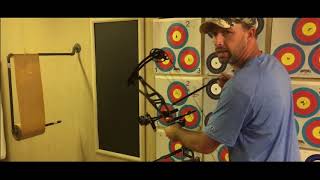
I want to show you this bow is at zero at the moment. What I mean by that, it is tuning a perfect bullet hole for me. But what I want to show you is the amount of range that we have in the set technology. So I'm going to shoot some different holes or some different arrows through the paper, show you the holes, show you what directions they're moving, that sort of thing. So I'm going to go ahead and shoot one through right now. And if you've never paper tuned before, I'll show you exactly what the holes, what they mean and what they look like. Alright, so here's a perfect hole arrow went through. You can see right where it poked through three fletcher, one here, one there, one there. So that's a perfect bullet hole. No left, no right, perfect. And as you can see at the moment, my set technology, everything here is set pretty even. If you look at the middle, right here where the set screw is on the back, that will indicate where the pocket is pivoted. And so you can kind of see it's in the middle. Now this is a prototype version. So if you see those little marks on there, those are marks that I made before we have the finished version and what it actually looks like when you guys get the bow. But this is how we're working on it. So you can see that's kind of in the middle and it's that way, top and bottom. It's not just the top. Is this way and the bottom different. They're both, they're both the same. So right now going to loosen the set screw, which is this one right here on the back of the bow. I'm going to loosen that up and I'm going to move the drive screw clockwise as far as I can move it. So from where I was at at rest there, that was a full turn. So I'm going to lock that down, do the same thing with the bottom. I'm going to move it clockwise as well. That's a full turn. Lock it back down. Now let's see what kind of paper tear we get now. I know what tear it's going to be. It's going to be a right tear, but I'm going to show you what it looks like and then how to fix it. I said right tear. I meant to say left tear. So that's a left tear. You can see what happened. The point went in right here, right there. And as it went into the paper, the fletching kicked hard to the left, hard to the left. So why did it Give me a hard left tear. Well, what happened when I moved the set technology, when I moved the drive screw, it made my cams lean to the right. And when I say lean to the right, I'm talking the end of the cam point to the right when I'm holding the bow. So it made it lean towards the cable side of the cam system. So in order to fix that, obviously you know where we're at before, that's almost, that's a good full inch left tear. Right. So in order to fix that, I know that one full revolution has me back at zero. So I'm going to go all the way the other direction with it counterclockwise just to see how far it will move. And I mean by paper how far it will move. So there's a full turn, got about almost a turn and 3/4. Alright, so that's as far as I can go counterclockwise, which is going to make my cams lean to the left. So if they're leaning to the left, then I'm going to get a right tear like I said earlier, except this time I got it right. Okay. So I went from a full inch left hair to a solid full inch right tear. No problem either way. So that, that means there's a, there's a 2 inch range of motion in this set technology. Now for me again, I know that if I can turn this right back to about three quarter turn clockwise now, I'll get it back to zero. So that's not a problem. So let's talk a little bit about what makes this happen and the stability that's behind it. This system obviously is all adjusted by the set technology, which is in the pocket. When you turn the drive screw, it makes the limb pocket pivot like this. And that creates the lean in the cam because it drops one limb lower than the other, raises one limb higher than the other and that allows the cam to lean one way or the other. So once that happens, what also happens in the bow? Okay. Something you're going to notice is your stabilizer. If you've got long stabilizer on the bow, it's going to go from pointing maybe straight to way to the right or way to the left. There's an easy fix for that. If you're a little bit OCD and you don't like that stabilizer running out to the left or to the right, it's really simple. If your botune is good, it doesn't matter where your stabilizer is at in that aspect, but you can put a 10 degree down disconnect on the front of your stabilizer bar, and you can swing that stabilizer and get it in perfect alignment with your arrow, if that's what you so choose to do. There's several videos out there on that sort of thing. There's lots of different stabilizer manufacturers that make those. So that's something that can kind of help that little bit of OCD problem that a lot of us have. And wanting to see everything in a straight line. Another thing that happens when this is adjusted like that, and it pivots in great. In a great range of motion. Like, you see, you got two inches worth of adjustment there. Another thing that happens is, obviously, you're just going to notice your cam leaning to one side or the other. I mean, that's obvious with what we're doing here. But I just want to make sure that you understand that you're creating cam lean, which is what makes an arrow tune out of your bow the way it needs to. I get those questions all the time about how does this tune and why does that do this and why does it do that? Because you're making the cam lean. It fits your shot style. We're so different amongst shooters. We have to be able to have that adjustment, and I think that's what this bow is going to accomplish for so many people.