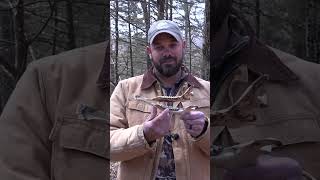
Richard Bowen, a pro archer and wildlife biologist, shows how to age a deer by looking at its jawbone. Count the cusps on the third premolar: three means around 1.5 years old, two means 2.5 or older. Then check molar wear by comparing brown dentine to white enamel to narrow it down further.
Chapters
Hi, I'm Richard Bowen, pro shooter for elite archery and wildlife biologist here in my home state of Arkansas. We found this jawbone today on a deadhead out in the woods. And I want to give a brief overview of how you can get a field estimate on the deer's age based on his jawbone. We're going to start here at the third tooth on the jaw, which is the premolar, and see how many cusps or peaks it has on that tooth. If it has three, then you know that year's year and a half or younger. If it has two like this one, you automatically know it's two and a half or older. The three cusps premolar is a baby tooth. They will lose and replace it with a two cusp adult tooth. From there we'll go back down the jaw and look at the brown in the jaw teeth, which is the dentine, and compare that to the width of the white, which is the enamel. As the deer gets older and the tooth tends to wear down more, that enamel wears away and exposes more of the brown dentine on each tooth. So based on the amount of dentine we can see on the molars of this jaw, I'm gonna say this is a three and a half year old deer. We have some other samples we can look at that will show a very thin brown line of a two and a half year old deer versus a much wider brown line of a four and a half or five and a half year old deer.