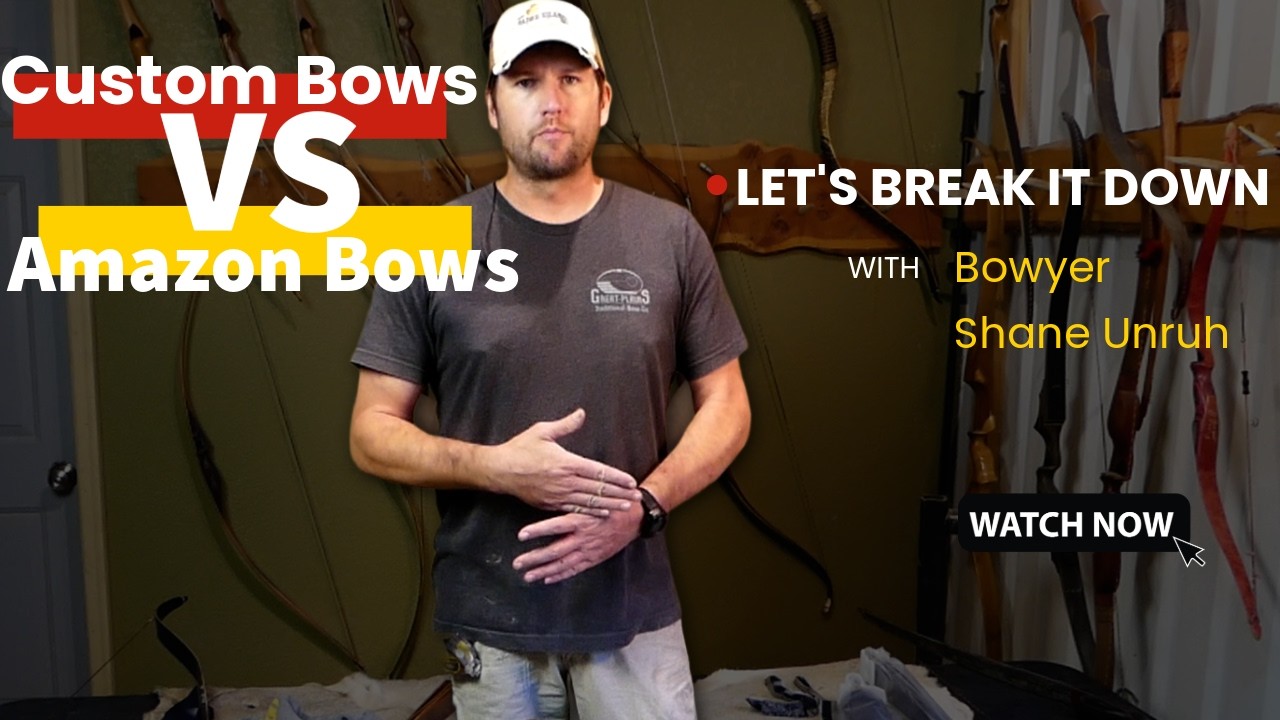
Shane from Great Plains Bow Company walks through picking arrows for your bow. Measure your draw length, add an inch, then use the manufacturer's spine chart for your poundage. Aim for about 10 grains of arrow weight per pound of draw weight, and stick with common 100 to 125 grain broadheads.
Questions this video answers
Add 1 inch (e.g., 28" draw → 29" arrow).
About 10 grains per pound of bow weight.
Approximately 450 grains total arrow mass.
The field point should weigh the same as the broadhead.
A 500 spine shaft (Easton Carbon Legacy) is shown as appropriate for about a 45 lb bow.
Chapters
Hey guys. Shane with Great Plains Bow company and today I wanted to talk to you about arrows. I want to make it really simple for everyone. If you're getting into archery, one of the most confusing things to get into is what kind of arrow should I get, what spine, what weight, how should I fletch it? I approach it very simply and that's what I'm going to do in this video for you. You don't have to over complicate it. If you like to micromanage your arrow setup, this video is probably not for you. This is just if you're getting into archery and you want to get some arrows that work great out of your bow, the basics are just find out your draw length. If you have a 28 inch draw length, add 1 inch because you need that extra inch in case you put a broadhead on it. If you have a 28 inch draw length, your arrow is going to be 29 inches long. So then you need to find your spine. The simplest, easiest way, uncomplicated way is, is to decide what arrow you're going to get. So this, this one is a Easton carbon legacy. These are great arrows. Once you've decided which arrow you want, whether it be carbon or aluminum or wood usually, almost always that company will have a spine chart. So go onto their website, go onto the spine chart, find the poundage and the, and the length of your arrow on the spine chart. Get that spine order that spine of arrows. This one here is spined at 500. So this would be like 45 pound bow. This is a 3 fletch and this is a right hand, right helical shield cut 3 fletch arrow. This just has a standard insert in it. You can see you can get, you can get heavier inserts, but I wouldn't recommend it. Just put the standard insert in. When you're setting up your arrow for practice, you want this arrow to be the exact setup that you're hunting with. It's not a good idea to change it for your hunting. You don't want to have a hunting setup and a target setup because when you go hunting, you're going to run into a problem. Your arrow is not going to shoot the same, so you want the same. This is called the field point. You want the field point to weigh the same as your broadhead and that will give you accurate, consistent aeroflight arrow weight. How heavy of arrow should I shoot? So most bowyers will say if you go under eight or nine grains per pound of bow weight, you'll damage their Bows, and some of them, you will even lose your warranty if you go that low. I would recommend on a good average for hunting and for 3D is 10 grains per pound of bow weight. So if I had a 45 pound bow like what this arrow is made for, I would need an overall grain weight of 450 grains. So you can build that in by either the point. This is 125 grain point. You can build it in with the insert, you can get 50 grain inserts, you can put weights behind the insert, you can do all those things. But to make it simple, when you get your arrows, the most simple way of doing it is to build that weight into the shaft behind the insert and just get your standard 100 or 125 grain heads there. Again, if you're micromanaging your arrow setup, this probably is not for you. But if you want something simple, the vast amount of broadheads available in the 100 grain and 125 grain weights is incredible. So you can get any kind of broadhead pretty much in those weights. Whereas if you go 175 grain or 200 grain or 250 grain, you're going to be very limited on the amount of broadheads you can shoot going back over it. Draw length 1 inch past your draw. And when you measure your draw, I'll just show you real quick here. So your draw length is the bow completely fully drawn to the. This is called the back of the bow. So when I draw this right here, right there, that's my draw length. So you're going to add an inch and that's your arrow length. Number one, find your draw length. Number two, find your spine weight by going on to the website on the spine chart. Get your spine in relation to the weight of your bow. They'll have a grid there. Number three, build up your arrow weight to 10 grains per pound of bow weight. Whether you build weights in behind the insert or weight tubes, you can get weight tubes that go the full length of the arrow. And number five, you want your broadhead to either be 100 or 125 grain because your weight is going to be built into your arrow. That's the simplest way to set up an arrow. Now, it's not the micromanaging way. You can get really, really into it and paper, tune and all kinds of fun stuff, but this, we're just showing you how to set up an arrow fast and easy and it will shoot great. If you want a fast track to get the perfect arrows, I'm going to give a shout out to Three Rivers Archery. Those guys are good. They're professionals. They know their arrows, they know their setups. So if you get a bow and you're like, hey, where do I start? Just give those guys a call. You can talk to their bow experts there, their arrow setup experts. You can say, I've got a 45 pound bow. My draw length is 28 inches. I want to hunt with this bow. I need a hunting weight arrow. You can specify the amount of fletchings, the kind of fletchings, the color of fletchings, and you can get tons of broadheads there. That is a fast track. And 98% of the time, that arrow is going to come out of your bow like a laser beam.