Bowyer Reviews Amazon Bow
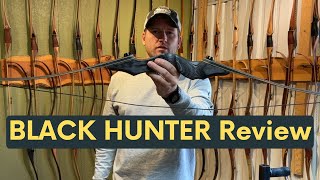
Pro Archer Shot-Coach reviews the Black Hunter Recurve bow, comparing it to the Samick Sage. He covers the fit, finish, grip, and how it actually shoots, giving potential buyers a real sense of what the bow does.
Chapters
Black Hunter Recurve. What's up, guys? We've noticed in the traditional archery world lately that the Black Hunter Recurve has really been getting a lot of attention. There's a lot of companies that are selling this bow. They're putting their own kind of logo or brand on it, marketing under a different name. But it appears to all be the Black Hunter. And so we got one. The review I'm doing on it is what it comes with out of the box. Like if you didn't add anything special to it, the fit and the finish, the same string, all that stuff, we're going to shoot it, talk a little bit about it, and give you our take on the Black Hunter. The one we got, they put their own medallion in this and it says ASDW Archery. And this thing was only like 75 bucks with shipping. Kind of a tremendous value for what you get. Initial impressions, getting it out of the box. We did notice that of the riser, the actual finish, it's pretty good. I'm sure it's a conversion varnish of some type. The finish on the limbs, a matte finish, it's kind of a dull finish. I don't feel like it's a super good finish on the limbs because just us handling it and touching it, it's taken on a lot of marks on it. Not necessarily scratches, just you can see where we touched it and handled it. It doesn't seem like the finish is just top of the line, but there again, that really doesn't matter for a $75 bow if you're not expecting. Expecting a really, really high end finish. Now, when we went and looked at the fitment of this bow, it's okay, it's not great. You can see there's, there's ledges there. There's a pretty good ledge right here. This Benzel that they have here hangs over the top of that limb. This one's back a little bit, but there again you can see it's. It's not perfect. Not a perfect fitment on there. The tips, we first, when we got it out of the box, we thought, okay, those are delaming. They're not actually delaming. I think what they do purposely is they leave that a little proud and then they just glue it on and clamp it. And they don't, they don't fade it back or file it, flush or form it onto the limb. And it probably saves them. Well, I know it saves them a lot of time. When you first look at that, you're like, oh, that's coming apart. I don't think it's actually coming apart. It just looks that way because it's probably a lot cheaper and faster for them to build it that way. The tips themselves, the way they're formed is pretty good. I don't see a big issue with that. I always look for right in here. If there's a ledge, if you have like a sharp point right in here, that will end up cutting the string. I don't see any of that. I would feel confident on this bow that it would not cut my string. The string groove, I can see that's done with some sort of CNC machinery. It's milled. How I know that is. It's not faded out on the ends. This is done by hand. And you can see how it's kind of faded out to a point. More flows. This looks better, but it pretty much is the same function. I don't think it would make that big a difference on performance. If you look at it, you can see there's discrepancies kind of all over it. On tooling, where you can see the tools didn't do a uniform job when they were building it. I'll go back to the limbs, but first I want to talk about the riser. Just looking at it, it looks pretty appealing. I. I don't mind how it looks, honestly. In fact, for a $75 bow, I was pleasantly surprised. The grip, it actually feels pretty good. Now, one thing I do not like about the grip is right here now. And this is, I would say as a caveat, this is personal opinion here. I see even custom bowyers, high end bowyers that build their grips like this. This grip would more benefit the open hand style of shooting where you. Where you just grip it in the webbing and maybe put a couple fingers on, shoot it like that. That's not how I shoot. So I don't care for the grip. I like a flat back here and I like this to be fuller right here for my palm. Because the way I shoot, I put my palm on there and I use that whole area to stabilize. If you've got a close style grip, it wants to do this number to you as you're shooting. You can adjust for it. It's not that big. Shelf radius is pretty nice. The radius is centered pretty much in the center of the riser versus back or over the webbing. Ideally, you want the highest point of the radius to be over the webbing of your hand right here. That gives you the most accuracy. It's not just a huge thing to worry about. It just gives you a little bit of an edge on the riser itself. I would have expected this bow to be a center shot bow. It is not a center shot bow. It is actually not even quite cut to center. It's cut a little deeper than like a typical longbow would be. But there's quite a bit of mass left there. And if you measure the riser up here, you've got about an inch and 5, 8. It's probably a 16th proud on this particular one, this way of center. So it's. It's not a center shot bow. You could probably call it a cut to center bow. Even though it's not quite. That does make a little bit of a difference when you're shooting it. If you're used to a center shot bow, you have to allow for that. And for a right hand bow, you have to move it over a little bit to the. To the right to get on target. Depending on, once again, on your shooting style, the limb pads on this bow, I'm just going to compare it to some of our bows. You can see there's a pretty aggressive angle. What that does is that allows for a little smoother draw and it accommodates a little longer draw on shorter bows. This is a 58 inch bow. And the recurve is not curved too much. It's pretty normal. But if you look at our swift here, the curve on our swift is way more aggressive. You got way more potential energy in our swift limb than you do in the black hunter. The limb itself on this bow allows for longer draws. But on the swift, the limb pad is not cut quite as steep, which throws those limbs forward and stores more energy. Also, this will probably allow for a fairly smooth draw simply because of the sharp limb pad cut and also the somewhat open recurve on the limbs. All right, so I was looking at the wedges on here. We cut our wedges different. They faded the wedges out on the belly side of the bow. On ours, all of our bows, we faded out on the back of the bow. And I'm sure there's a. There's a particular reason, probably manufacturing reason why they do that on theirs. I don't see that as being a huge game changer on performance. It's just different ways of doing it. I can see there's definitely a good size taper on the limb core on this black hunter, which is good. We were comparing it to. This is a 58. And this Swift is also a 58. If you look at the limb shape. It's quite a bit different limb shape than our Swift. But if we compare it to our B model bow, it's getting fairly close. Imagine this. This would shoot more similar to our B model recurve than our Swift. This is a Samick Sage. This used to be the go to bow for introductory traditional recurves. Everybody had a Samick Sage. I feel like the Black Hunter has kind of replaced this bow. I would definitely say the Black Hunter is quite a bit better value, better looking, better feel than the Samick Sage. Now on the Samick Sage it comes with a bunch of different inserts. The Black Hunter comes with no inserts whatsoever. You got the quickie quiver on the Samick, you've got stabilizer, you can put bow fishing reel on the samick. A lot of different things, but just the overall look. The Black Hunter looks so much better than the Samick Sage. I mean, so much better. And it feels so much better. The Samick is not radiused at all. There might be a tiny bit of radius on the shelf, but there's no radius on the side plate, which is important because the biggest thing the radius does for you is it reduces arrow contact, which makes the less contact you have on that arrow, the more accuracy you have. That's why compound bows have drop away rests. So literally there's nothing touching that arrow when it's released. So on the Black Hunter you can see this is radiused nicely on the side plate and a nice radius on the rest. If I was starting out in archery and I didn't have the money, man, I would get me a Black Hunter quick. I personally do not understand how they are able to produce a three piece recurve for $75. That hardly makes sense to me other than just doing thousands and thousands of them at one go to get the price down, which I imagine is what they're. It looks to me like the limb core is action bamboo. Actually. I know it is just by looking at it. Let's go ahead and string these up and do some comparisons. The string is pretty much junk. I imagine this string is Dacron. You can pick up a good bowstring for not that much money. And that's probably the first thing I would do is replace the bowstring. But it would get you in the woods and really that's all that matters. Alright, let's check and see how straight we are. So the bottom lip's dead straight on this thing. The top limb is just, just a hair off. So this one's 45 pounds. We're gonna go measure the weight on it. When I get it back to about right here, I feel it start to stack a little bit. That is probably due to it being a fairly shallow recurve on the limbs. So the recurve runs out of working properties and you feel just a little bit of stacking. But it's clear at the end. One thing we do want to check, a very, very important thing, is to check the tiller on this bow. We checked the straightness already. The tiller can make and break a bow for sure. On a recurve. I have 6 and 3/4 on the top limb, and I have 6, 7, 8 on the bottom limb. So what that means is this bow came with reverse tiller. The bottom limb is actually weaker than the top limb. When we shoot it, we're probably going to get some porpoising, so we can correct that within five minutes here at the bow shop. But if you got this bow and yours had reverse tiller like that, you may have some trouble tuning arrows to it. We'll go ahead and string up a Swift. We might string up that B model also. Okay, that's perfectly straight. Perfectly straight there. Again, I really think looking at this string on the samick, it looks like the same string as what's on that Black Hunter. Throw this one up just quickly. Let's go ahead and look at these profiles strung up. So you can see on the Swift, the limb pad angle is far shallower, which stores more energy than the Black Hunter. There's a bigger swell on the Swift right through here, which is actually storing more energy. Also, the recurve portion of the Black Hunter is not quite as aggressive. When they're strung, they actually look fairly similar. But you'll notice this is a lot longer. This is a longer area. On the Swift, it's a lot shorter. So you've got more of a bullwhip effect on the Swift at the end of the string stroke versus this long recurve. It's not gonna. It's just not gonna store as much energy. I'm pretty impressed with it overall. The Black Hunter, this is a little longer bow, so it's not gonna be entirely accurate. Now, you can see now this. The recurve portion on the B model is really close to the Black Hunter. That's nearly identical, honestly. And then the Black Hunter actually has more of a swell right in here than the B model. That's a sammick stage versus the Black Hunter. So see how much longer. Now I've got these Limbs right up against each other. The samick is a. Oh, that's a 62. But that's just a longer riser getting that 62 inch length. If I back them up a little bit, there's a lot more stored energy in that Black hunter. This doesn't have a lot of profile to it. It's very minimal on the profile. Also, I can see just looking at the tapers on this samick sage. The tapers are not very aggressive at all. I definitely expect this to completely outshoot the samick sage. Okay, let's go. Take them out into the ship. All right, here we are over at the. Give me just a second. All right, here we are over at the tuning tree and we're going to go ahead and weigh this thing and see how close to weight they got it. You need to be able to trust those numbers if you buy one. So that's at 28 inches. 47 pounds at 28 inches. That's not just a huge difference. I wouldn't worry about that too much. I have seen some of them where they're off by as much as five or six pounds. I don't think that would be the norm. But it can happen. So let's go give it a whirl. So these are 400 spine. I have a 29 inch draw. These are going to be about right. Not too bad. Now, like I was saying, it does shoot to the left. I'm not. I'm used to my recurves shooting pretty much spot on because they're center shot. My three piece recurves. Let's adjust that and see if we can hit where we're aiming. Still shooting to the left. Try to adjust that over. There it is. Even with the reverse tiller, I didn't see too much of a porpoise. The way I anchor is underneath my eye. I actually moved that over about 8 inches to hit that can. We have a rest and a side plate on here. That would have pushed it over even more to the left. Here's our swift. Same length of bow. Very, very similar poundage. So I just shot that. I still have that feel in my muscle memory in my head what that felt like. Let's go ahead and shoot this one. Much smoother, much deader in my hand. Much quieter. I kind of had a bad release, but I still hit the can, what I'm aiming at. Hit the can again. That's three times I hit the can. I like the grip on this swift so much better though. As far as the performance, I mean, everything Just feels better on this swift. It's got a better fuller handle, more flat back, more center shot. It shoots where I'm pointing. It's smoother to draw. Overall, it shoots nice. It really does. Little stiffer draw. Probably not quite as smooth as a high end recurve. Actually, I would say quite a bit stiffer than a high end recurve. The fit and the finish, the feel of it, everything. For $75, it's an amazing bow. File the tips down. I could fit the riser to the limbs, retiller it, carve this out just a little bit more, make it a center shot bow, high quality string on it, make sure the limbs were straight. I'd probably put new bezels in here, drop down and move them out a little bit so that they weren't so close Here. Put inserts in here. Have it really nice for about 225, $250 total price. So we may do that to this one. We're thinking about doing a refit, refinish. You're just getting into archery. I probably wouldn't hesitate. I'd go for it. You would not waste your money buying one of these.
More from Pro




Choosing a Traditional Bow for Beginners | Custom or Amazon? | Which is Right for you?
Vintage Bow Restoration | Ben Pearson BP-H52 | Very Twisted Limb, Bad Finish, Holes in Riser

