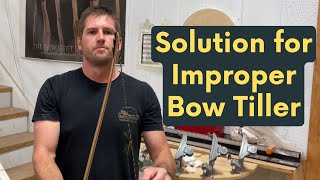
A Pro Archer Shot-Coach YouTube video demonstrating Great Plains' adjustable-tiller ambidextrous longbow. The presenter explains a common tiller problem in ambidextrous dual-shelf bows and shows how adding two string grooves per limb lets the bow be rapidly set up for right- or left-handed shooting by changing which groove the string uses. The video includes live shooting tests comparing even tiller (which produced porpoising) and correct tiller (straight, 'laser' flight). The bow was commissioned for contestant Matt Wright and his left-handed wife on Discovery Channel's Naked and Afraid so they could share one bow as a single tool option.
Questions this video answers
Matt Wright (and his wife) from Discovery Channel's Naked and Afraid.
150 spine.
About 46 pounds.
125 grain field point.
Chapters
So this is our ambidextrous bow from Great Plains. And we are super excited about it because it's different than any other ambidextrous bow on the market. Now, this part is not different. This is a dual shelf ambidextrous bow. We got your left hand side here, which is pretty typical for an ambidextrous bow. On this side, you got your right hand. Of course, all that is like it's been built before, many times. However, when you build an ambidextrous bow of this design, you run into a tiller problem. Do you tiller it even if you tiller it, even the center of the bow being 2 inches below the shelves, if you tiller this bow even, you have a bad tiller problem. You've got an aero porpoise problem. So then you end up messing around with your knocking point. You mess around with your spines, you mess around with your release to get that arrow to fly perfectly. So when you build an ambidextrous bow of this design, that is the problem you run into. So we have solved that problem. And the way we've done that is we've created an adjustable tiller ambidextrous bow. And it has two string grooves on both ends of the limb, of course. And the way this works is if you're going to shoot it right hand, you put the string in the top groove on the top limb, the bottom groove on the bottom limb. And of course, what that does is that that draws more on the bottom limb and releases the top limb more aggressively. Why more aggressively? Because you're 2 inches above center instead of 1 inch above center like our other bows, which makes that tiller perfectly. So it tillers perfectly for a right hand. This way, if I want to tiller left hand, I'm just going to reverse that. I'm going to put the string on the top here and the bottom here, or the closest one to the handle here. And automatically you have a perfectly tillered left hand ambidextrous bow. The reason we designed this bow is for one of the contestants on Discovery Channel's Naked and Afraid show, Matt Wright and his wife. She's left handed. She's. He's right handed. And if they take two bows, they use up two of their tool options when they go on a challenge. So he requested that I build ambidextrous bow, that they could use one tool option and then they can still take another tool with them, like a big old knife or shovel or an axe. He said Shane can You build an ambidextrous bow that my wife and I can use on the show. And I said, yeah, we can do that. So the very first one that's being used is in their hands that we built. And I talked to Matt, he said it works awesome. He loves it. Necessity is the mother of invention, of course. And that's why we designed the adjustable tiller ambidextrous bow. Now we're going to show you why it matters and we're going to shoot it with even tiller because of course you can make this even tiller, this bow by just putting the string in the same string groove on both ends of the limb. So we're going to show you even tiller shooting and then we're going to show you proper tillered shooting. So we're going to move that down, twist it clockwise, release that brace. I love this stringer by the way. If you want to, if you want a stringer just like it, check out our toe hit stringers that we have for sale on our website. Same concept and they are amazing. Alright, let's give it, let's drop it just a little bit more. Problem with this stringer is we don't like to take it to shows because it's so heavy. It takes up a lot of room in the truck. Well, now we don't have to. We've got our tow hitch stringers and they just go on to the quick hitch. Okay, that's gonna work. We're gonna leave it braced like that. Okay, that's a braced even tiller and we're gonna shoot it. I got here is carbon express heritage. Now this arrow, from what I understand, it's discontinued on the mass market. But you can still buy these if you call directly up to the company which these are amazing arrows. Probably my favorite carbon arrow on the market. This is a 150 spine, which is about right for a 46 pound bow. And it's got 125 grain fill point. It's probably sitting in there between 400 and 450. Maybe a little bit more total grain weight. Remember, this is even tiller, so I'm trying to have a smooth release as possible on this. Okay. So that porpoise really badly that, that tail kicked. It kicked straight up. And I'll shoot one more so you can. This is the same. This is. These fletchings aren't great, but they won't matter. This is Same arrow, still 150 grain. Here we go again. That one was even worse. You could really see that, that porpoise. Okay, gonna unstring it. And now we're going to give it proper tiller and I'll show you how big a difference this makes and why it's so important. I will have to increase the brace height quite a lot now because we're shortening up the string. Now, when this bow is out in the field, if you have a hunting partner, it's you and your wife or you and your husband and you're left and right handed, you're not going to have to twist or untwist this string because it's going to stay the same brace height. I'm only doing this because of the. When you make it even tiller, you're moving it clear out to the, to the end of the bow. So we're going to put it on the second string groove here and we're going to get the exact same brace height because we want this test to be very, very fair. So I need to give it a little bit more. Okay, try that. See where we're at? That's about 16th off. I'm going to got to have this. Perfect. All right. Dead on. Perfect. That's probably within, I don't know, 10,000 on the brace height. Housekeeping. Hi. Housekeeping. Just checking. I'm alive still. Here we go. Same arrow. I'm gonna shoot this one first, just like we did before. Very same arrow, very same spine, same everything. But now, now we have proper tiller. So here we go. So I don't know if you can see that, but that arrow flew like a laser, perfectly straight. There was no whipping up on the end, no porpoising. I didn't hit very good. I hit low, but I'll try to hit a little closer to the target this time. Okay, second arrow, same arrow as was shot before. All right, perfect. Perfect arrow fly. On an ambidextrous bow, there will be people that will tell you, hey, it doesn't matter. You can tiller them even and it's good enough. It might be good enough for them, but it's not good enough for Great Plains. We build an ambidextrous bow. We're gonna have it so that arrow comes out like a laser beam. It is not good enough to have an even tiller and have you porpoising and have to be fighting, fighting, fighting. Adjusting your knock point, adjusting your arrow spine, adjusting your release, your fletchings, that's not good enough. That simply is not good enough. For what we produce here, you have to be able to have an arrow that you can trust, and hence we have the adjustable tiller. Ambidextrous longbow. That was close. I almost got your GoPro there, but it flew straight. I missed the target.