A first-person product/demo monologue (YouTube) by Pro Archer Shot-Coach describing Great Plains Bow Company’s heel-style (ASL/Howard Hill-style) longbow. The speaker explains design choices made to reduce hand shock and increase speed: long, gradual limb fade-outs; an 18-inch riser on a 64-inch bow faded to paper-thin; 2° backset to balance string-follow and energy storage; aggressive tapers on back and belly laminations; bamboo-core use in many bows (but this demo bow is solid Osage); and a contoured palm-swell grip covered in buckskin. The speaker claims this is the smoothest, fastest heel-style they’ve built and demonstrates shooting it.
Chapters
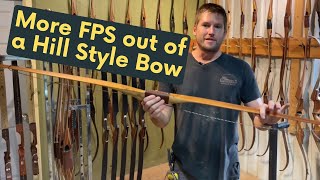
Heel style bows, call them straight laid bows, call them ASL bows. They're famous from Howard Hill. He was a legend and they have generated a tremendous following because of Howard Heel. They're a fun bow. However, for years Great Plains did not have a heel style bow. Mainly because I was hesitant to build them because a heel style, a straight laid ASL longbow tends to have more hand shock. They are slower and I just didn't know if I wanted to get into that market. I thought about it and decided that we would try to build one that had the least amount of hand shock and was the smoothest and the fastest. And so I'll tell you what we did here to make this heel style perform amazingly. We feel like it's the best hillstyle bow we've ever shot. Now there's amazing talented heel style bowyers out there. So there's a lot of guys doing great stuff with heel bows. Just going to go through several things that we did with ours that made a huge difference in the performance. First of all, talk about the riser. It'll be hard to see on the video, but this is a 64 inch hill bow and we have tested and tested the amount of working limb from the tip to the fade out to design the best performing heel style limb that we could possibly design. One thing that we found is long fade outs. Long, long, smooth, gradual fade outs working into the limb makes the limb perform better. And not only that, it minimizes hand shock because you're soaking more of the energy up into the fades and it also produces more speed because you're using a little bit of that fade on the riser going into the limb to make that limb work better. So this particular bow on the 64 inch, it actually has an 18 inch riser that has been faded out to paper thin on a long, long, gradual slope. What that does is reduce the hand shock, but it also gives more mass in here for the limbs. When the vibration hits it soaks it up into that riser. That's one thing that has made a huge difference. The next thing we did is we found that the ones with the most string follow tend to be smoother. But when you have a lot of string follow on a heel style or ASL bow, you lose speed because you're taking away a little bit of the potential energy stored in the limbs when you have too much of a string follow or the tips bending too far to the archer. So to combat that we put 2 degrees of back set. We dish this riser out just a Little bit. And you're probably not going to be able to see it. But we dished it out on the form and we grind a little bit of dish into the riser. And so we set these limbs on a 2 degree back set. What that does, it's not enough to totally do away with the string follow. There's still a little bit of string follow in our ASL bows after they've been strung and shot. That little bit of backset in there stores more energy. So you have the best of both worlds. You have a fast heel style and you have a smooth heel style. We also experimented a lot with the tapers in this bow and we found that a fatter limb creates more hand shock. So what we did is we designed our tapers. There's two of the laminations in. All of our heel bows are tapered and we core almost all of them with bamboo because bamboo is in general three times stronger than wood and it's got more stored energy. But we tapered the back lamination and the belly lamination. Now, I'm not going to say exactly how much taper is in there, but we worked and worked to make sure to get that formula just right. And that allows us to make this limb a little bit thinner and maybe just a hair wider than some hill bows. That taper that we put in there has also generated a lot of smoothness and speed. The last thing I want to talk about in our heel bow is our handle. If you're a heel style fan, probably the first thing you'll notice about this hill bow is, is we have a swell in here and we've ground this out where the webbing of your hand goes. That's not typical for a hillstyle bow. And we can still build the straight riser heel style bows if somebody prefers that. But we were after the highest performing ASL bow on the market. And so by putting this in there with the palm swell, it's comfortable you it indexes and it gives a tremendously good feel. The grip is covered with buckskin. On this one. We can cover it in about anything. I think I've covered pretty much all the points. The longer riser, the thinner fade outs to soak up the energy, the aggressive tapers to give it speed and smoothness. The 2 degree backset so that it's got a little string follow, but it's also got a little backset to make this bow perform flawlessly. Let's try it. That's nice and smooth. Very smooth and very minimal on the hand shock. Now On a hill style bow, you're not going to get away from hand shock just because of the physics of it. There's going to be more hand shock than would be like on a hybrid longbow or reflex deflex longbow just because of the physics of the limb. Very smooth shooting. This one here is solid Osage. The core everything is Osage on this bow. And Osage is kind of a springy wood. Sometimes Osage will be a little shockier than say, Pacific yew or bamboo. But this bow here is just very little hand shot. Very smooth shooting. A lot of fun to shoot it. Very enjoyable. One more shot here. So that's it. That's the asl heel style longbow from Great Plains. This one has the contoured grip. You can get it in the straight grip. Very high performance and just a pleasure to shoot. Yeah, I did. Oh, yeah. Oh, yeah, baby. Oh, I mean, dead center. Bullseye. Another one. This bow is fun to shoot. Thanks for watching. Okay, I'm going to shoot this arrow and then you're going to go get the arrows. Fetch, fetch, fetch, fetch.