HOW TO SHOOT A BOW FROM A TREE STAND (New Vertical Stands)
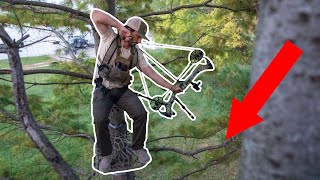
Pro Archer Shot-Coach walks through shooting a bow from a tree stand. Use an angle-compensating rangefinder on slopes, keep your shoulders square to avoid torque, and practice in actual tree stands to stop missing shots you should make.
Chapters
All right, today's video, we are going to kind of COVID all the basis on how I like to set up and shoot from a tree stand. We've done this video before out of saddle, but I've never done it out of a tree stand. There's a couple key things that are really important to consider that just kind of help you in the moment. Make a good shot. We're just on solid ground right now. I'm going to shoot a couple I haven't shot in a couple days, so we're going to rip a few. And you know, obviously when you're on flat ground, everything is neutral. Like your anchor points in the same spot. Everything is in the same spot and how it should be on level. And, you know, over the years shooting, say, competition archery and field Archery and 3D Archery and total archery challenges, you're constantly dealing with ups and downs, side hills, weird things that really affect your shot. And especially, you know, the number one important thing when shooting from a tree stand is having a good range finder that has angle compensation. You know, when you're dealing with those shots, like maybe you're on a big side hill and you're actually shooting like way down the side hill. You know, your ranges can really get messed up if you got a pretty steep angle and you're always, you know, I've heard this before. It's like when you're uphil, you add distance, and when you're downhill, you cut distance. Well, you're always cutting distance off. But if you get a good range finder, this is the Leupold rx full draw 3. I have the rx full draw 5 too. All good rangefinders that set up to your bow to, to cut well. So. So you know, when you're shooting on flat ground, you're not cutting every anything. You're ranging. It's a flat distance, everything is neutral point. But it's always good to get up in a tree stand every now and again. And money, well, everything's still on. That's good. Bo's been in and out of trucks past couple weeks. So obviously I'll talk about the differences when we get up in the tree and start shooting angles. But your anchor point is the most consistent thing to make sure you're looking through the peep site correctly. And the number one thing out of anything is looking through the peep sites, centering it up to center around your pin. Not only your housing, but your pin. As long as your peep site is around your pin perfectly, your arrow is going to hit what you're aiming at. The second thing when dealing with shooting out of tree stands and everything is torque. But we're going to, we're going to get up in the stand here and kind of go through a couple things. Look at that group down there. All right, let's hang this bad boy somewhere. Always use proper footwear while climbing up stands. So obviously when you're shooting out of a tree stand, you're up high, shooting down low, there's no upward shooting, but it's all kind of the same, the same thought process when you're shooting up or down. So I think the, the best thing to start out with this is, is kind of to talk about the most common bad things that people do. When you're aiming down low, it's really easy to throw your whole anchor off, throw your whole form off. And because of that you could torque it super bad. Especially when shooting broadheads. The arrow flight is very, very affected by just any little torquing movement, face pressure on the string, anything. You know, sometimes those mysterious misses can really come from not practicing on a tree stand. First thing that people really do is when they drop back, all they do is move, move their arm straight down. They don't move their whole torso, they don't move their whole shoulders. All they do is move their arms straight down. What that does is it just brings everything out of alignment. And what you're trying to keep is make sure everything is in alignment. So you hear people talking about bend at the waist, and you bend at the waist and you keep everything in line, your anchor points in line, you're essentially keeping that horizon line with your waist. And that is true, but that is a very like dumbed down version. And the easy way to kind of comprehend it. As long as you've been at the waist, you can always keep your anchor point in line and everything. But if I was aiming straight down and bending out my waist, I'd be falling out of the street stand. There's just no possible way to actually bend at the waist properly. So what's a little bit, you know, better to kind of say that is, is always keep your shoulders aligned. As long as your shoulders, you draw a straight line through your shoulders. As long as those either aiming up or aiming down are always in line. Your torso doesn't necessarily need to be bending like crazy because not only are you putting a bunch of muscles at stress when you bend out your torso, but it's just not really necessary. All you need is your shoulders to be straight in line. So you can see, let's just say I have a shot way down here. I draw back. I'm really not even paying attention to the horizon. I'm just making sure my shoulders are in line now. I'm not bending at the waist. I'm just making sure that my shoulders and my movement is all in line. And what that does is it allows me to still anchor relatively the same. It allows me to still look through my peep sight and ultimately just have the same form as if I was on the ground. So that's kind of step number one. And what a lot of people mess up about is they just point at what they're shooting compared to bending and keeping their shoulders aligned. George Ryle has always said, no matter where the target is, you want to point to it first and then bring everything in. So you point to the target and keep everything aligned and bring everything in. So I think that's just really important. As long as you kind of have that mentality, whatever you're shooting at, you can kind of just keep everything the same. We're right by a road, so I apologize if you hear that. Number two, I kind of already touched on, but it's just being prepared. Number one of being prepared is to have a good bow hook and have it right over top of your lap, or all you have to do is just grab it and go. And the second thing that I'll, I'll say along with being prepared is having some sort of release that can hang on your D loop or have it around your wrist just ready to go at all times. You know, I shot a hinge for a long time before we came out with like the hunting bracket with everything where you can keep it around your wrist. I was always like fumbling in my pockets and it's almost costed a couple, couple opportunities. So having your bow at the ready at all times is like huge. Like, I think it's underrated. Every time you get in the stand, the first thing I always do is bow, bow, bow, bow. Because you never know when your opportunity is actually going to show up. Next thing is actually like shooting positions where, you know, what am I doing? I actually love sitting. I do not want to get up off of my stand and most of that reason is just movement. So if we see a deer, I have my shooting lane set up mainly in this quadrant over here. I don't really want to shoot over here. I can, but it's mainly this quadrant over here. And I just want to remain sitting. And that doesn't change my form that doesn't change anything. If and if anything, I feel like it makes it a little bit more stable if you do have to stand up. What I love, especially about this vertical stand, especially is it's a giant platform, so it's super comfortable and the seat can go up super quiet, but then that opens up this whole quadrant over here. You can easily spin and shoot. And the same form, same principles apply of just making sure your shoulders are aligned and ultimately as long. Like I was saying when we were on the ground, as long as your peep sight is aligned with the pin, it's gonna hit where you're aiming. As long as you don't have contact clothing, face pressure, torque, it's gonna hit what you're aiming at. So I guess that goes where we have four. Now, point number four is practice like you play. I've. I've done an article for Matthews on this before and I've talked about it several other times, but practicing like you play is super important. Just like we're up here, we're trying everything out. We got our safety harness on, we have a bino harness on. What I would really, really love everyone to do is put heavy clothing on and then shoot. You don't really realize, you know, your collars or your neck collars and everything when you're in a situation and pointing down and twisting around, trying to shoot around the tree, it really becomes quite challenging if you've never really done it before. So practicing like you play is huge. And on top of that is shooting actually down. Like it takes a little bit of time to get used to. So if you're newer, really haven't done a lot out of it, get up in a tree stand because it just is a confidence thing. If you know you're confident and can do it, it's going to be night or day when you're in the moment. I feel like that's probably pretty good about tree stand tips. These are the new vertical stands. We haven't done a whole lot on them because we've just been getting a few of them, but we got them all out on the farm now. Really love the giant platform for all of the reasons I just talked about. Just shooting from them is so much better and more enjoyable and safer, honestly. So we're gonna shoot a couple, you know, super pull off the hook, draw back, align your shoulders, bada bing, bada boom. It would help if I had my sight at 20. Lucky I still kept it on there. But it's not rocket science, people. There's no, there's no over complicating it. It's still a simple thing. It's all about staying aligned. You don't have to bend at your waist. You don't have to feel like you're falling. You just have to make sure your shoulders are aligned and you're bending, but you don't have to over bend. And that is a problem that I also have. It's a little lower than I want. You want it to be high enough to where you're not hitting it with your bow, but low enough to where it's right in your lap. And that is a dead deer that went right where I was aiming. So now if we were standing, same concepts on. Apply another thing too, like with tree stands and shooting out of trees in general, is make sure your bow is not hitting anything. Make sure, you know, like you after you shoot your limbs, not hitting stuff. Your sidebars aren't hitting stuff. I noticed. You know, sometimes when you're sitting down, you can kind of be tight to the tree if you're spinning around. So you just got to be careful with that too. You know, take the extra second to look like just like that. I'm kind of hitting that branch there. Shoulders align. Feels good. Center the peep. Done. Hand for distance. This is. This is pretty close, but yeah, it's reading 6 yards because of the cut. It's probably actually like 12:15, but because of the cut straight down, it's 6, which I'm still hitting right on it for 6 yards, which is good. There. You got it, guys. Couple tips to hopefully help you guys be a little bit more prepared when you're tree stand hunting this fall in the woods with your bow and arrows in hand. Go have fun. Go shoot some stuff. We'll catch you guys in the next one.
More from Pro




Choosing a Traditional Bow for Beginners | Custom or Amazon? | Which is Right for you?
Vintage Bow Restoration | Ben Pearson BP-H52 | Very Twisted Limb, Bad Finish, Holes in Riser

