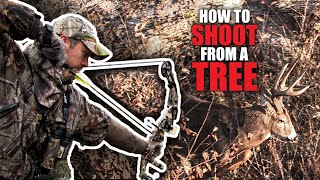
Bill Winke shares a single technique for shooting accurately from a tree stand. The key is avoiding canting, which throws off your shot when you're at an angle above the target.
Chapters
Welcome to the setup. Last week I talked about arrow trajectory and how to use your sight pins to predict where your arrow is going to be at different distances away from the bow. And I mentioned that I was going to do a three part series on arrow flight, but I'm going to condense that on this week's episode down to just a total of two. So this week I'm going to talk about two things. I'm going to talk about why we shoot to the right from a tree stand, if you're right hand, if you're right handed, and why you may shoot high from a tree stand. They both have to do with the same thing. This is really kind of a universal tree stand shooting tip that maybe you've heard it before, but you probably didn't understand exactly why it mattered. When you're in the tree getting ready to take a downward shot, you have to bend over the side of your hip. So you want to keep the same relationship, the same 90 degree relationship between your bow arm and your upper body. And you want to go over the side of your hip to make that downward shot angle. So if you, if you just drop your bow arm and you don't bend at the waist, you change the relationship between your eye and the peep sight. And the peep site then starts to pull away from your face because now the, the angle of the bow is down here, but you haven't bent over to keep up with it, so the angle changes. So you end up having to elevate your bow just a little bit in order to get that pin back in the middle of your peep site. And that's going to cause a high hit because again, now you're artificially feeling like you need to raise your bow in order to get back in the middle of the peep. The other problem that you have, if you don't bend at the waist over the side, and this is a little bit more complicated, but if you stick with the physics on this, it's actually kind of cool. So let's say that you bend forward to make the downward shot angle. Rather than bending over the side of your waist, you just bend forward. Well, now your bow, which when you're shooting into the backyard is vertical. You're looking at your pins and they're straight up and down. The arrow leaves the bow at an angle upward, it goes up, crosses the line of sight like we talked about last week, and then drops right back down onto that line of sight and hits the target. But what if you tip your bow a little bit. So now the arrow doesn't go straight up anymore. Now the arrow is going up at an angle because as it sits on the bow, you got your 30 yard pin on the target. For example, the arrow is angling upward. But what if you lay the bow over to the side called canting. What if you cant the bow a few degrees in my case to my right. Now the arrow goes up and to the right of the sight line. It's going up and staying to the right and then dropping to the right. Because gravity doesn't pull it back at an angle back to the sight line. Gravity brings it straight down. So now you're going to get if you can't the bow to the right, the arrow is going to hit to the right. And this is something that you combat on the range and while you're hunting normally using the bubble level on your site. If you don't have a bubble level, you really need to get one. Because every time you take a shot, that should be a secondary thing that's part of your sight picture. Making sure my bubble is in the middle. Now I know that I'm getting that perfect arrow flight. There are going straight up across the line of sight, dropping straight down to the line of sight. But if the bow is canted again, like I said, goes up, never actually go crosses the line of sight, stays to the right of it in my case the whole way and then falls off to the right. Because gravity is pulling straight down. So hopefully that part you got. So now what you're thinking about in the tree stand and you make your downward shot angle by bending forward at the waist in order to get that shot angle. It's really hard in that situation not to cant the bow. You've got to really work hard to twist that bow back around and get that bubble level centered. A lot of times in the moment of truth and the excitement, you're not really paying as much attention to that detail as you should. So you hit full draw. You're excited. The deer is 25 yards away. You bend forward at the waist, you're going to make that shot. But now when you shoot, the arrow stays to the right. If you're right handed of your line of sight and falls straight down to the right of the intended impact spot. That's a problem obviously. And you think, well, the guys that are shooting traditional bows like recurves and longbows, they naturally can't the bow at full draw, the arrow is resting really close to their hand. So the pivot point and where the arrow is resting is right at the top of their hand because that's they're shooting off the shelf, typically, but with a, you know, a typical arrow rest. Now you can see that the arrow is going to be resting about 2 to 3 inches above my hand. So if I'm canting it now, the arrow is to the right of my line of sight. So anyway, the whole point is it's okay with the traditional shooting because the arrow is so close to the top of their hand that everything pivots around that spot. And they don't really get that, you know, effect of the arrow staying to the side of the line of sight. But with a compound bow, you do not want to cant the bow while you're shooting. Real common fault. I mean, I've done it many times and I have to practice a lot, you know, in the tree when I'm taking those practice draws to really focus on making sure that I'm bending over the side of my hip, you know, that I'm not just bending forward at the waist. So keep that tip in mind. That's why everybody always stresses that, you know, if you hear somebody talk about how to shoot from a tree stand, they always focus on that one tip. But this is why it's so important. So hopefully that helps you. I think next week I'm going to come back and talk about string jumping. It really should be an episode in Bowhunting Whitetails. So maybe I'll skip it here in. In the setup, but that is a super, super important part of making an accurate shot. And the other reason why people shoot high, I mean, it's not because they're shooting high. It's because the animal is moving. And that's something that we really need to spend a lot of time talking about. So maybe I'll hit that in a future episode of Bowhunting Whitetails. So I'm not exactly sure what's going to be in the next episode of the setup, but I'll have something for you next week. Please keep checking back. I appreciate it. And I'll see you back here again next week for the next episode of the Setup. And remember to always dream big.