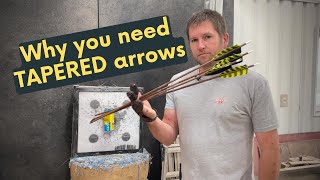
Sam compares parallel and tapered arrow shafts, showing how tapered designs like Three Rivers Archery's parallel-to-taper shafts produce tighter groups and more forgiving shots. Tapered shafts improve accuracy modestly but won't fix bad form.
Chapters
Welcome, Great Plainsmen. Today we're going to be talking about tapered arrow shafts. Tapered arrows are not a new concept. They've been around for centuries and centuries. The Indians used tapered arrow shafts. They would cut different sized saplings and use them depending on where the taper was or where the straightness of the sapling was. Here's a straight shaft which is completely parallel, no taper in it whatsoever. We found that they are relatively the same price for tapered arrows versus straight arrows. These particular arrows are straight for a significant distance. They're parallel, perfectly straight, and then they taper down to very small at the tail of the arrow on the nock side, there's less resistance for your finger to mess up the shot because you have a smaller knock, you have a smaller diameter of shaft at the fletching side, and they tend to be more forgiving if you have a poor release. So there's several different taper options out there. The barrel tapered arrow is your most accurate arrow, which means that it's thicker in the center. Like a wine barrel, it tapers to both sides. With a barrel tapered arrow, you have three different spine zones. So they're a little bit harder to tune to a bow. But with proper tuning, they actually are the most accurate design out there. Now, the problem with barrel tapers is because of the difficulty of manufacturing three different spine zone and a taper here, taper here, and a bigger spot here. Virtually, they are not available for purchase. You can't find them. What you can find, though, is these parallel to taper from Three Rivers Archery. When I'm tuning bows and I pick up an arrow, it seems like I'm always reaching for these tapered shafts. Like I mentioned earlier, there's less mass back here to get in the way of an improper release. And they just. You just seem to get tighter groups with the tapered arrow shaft. We haven't been shooting them for that long. We just kind of got into it. We're not the final authority on tapered arrow shafts, however, in our experience, we like them and we feel like they definitely up your game. So give tapered shafts a whirl if you. If you feel to. They're not that much more expensive and the benefits that they give you for the amount of money they are is definitely worth it. It might be the difference in you getting that deer or winning that 3D archery competition because they are just a little bit more accurate. And if you can tighten your groups up from this to this, then it's totally worth it dead on. Another hit. Another one. Perfect. Ah, had the flyer bad release, but you can see on a good release, they're all perfect. That last one was a bad release, but let's go look at it. So these are all good release. Even with a bad release, it's still pretty close. I mean, obviously that's not going to get your bullseye, but, you know, that's still in the eight ring easily on some targets. It might even be in the 10. But these are all really good. I felt good about my release on all these shots. You can see the tapered shafts are really beneficial. Now, if you have a very poor release, your equipment is not going to make up for that deficit. You're going to have to fix that. If you're shooting tapered shafts, you know, this is well within the kill zone of an animal, so it very well could be the difference between you getting your animal and making a good, clean kill or missing. If you're using tapered shafts, it could give you that edge that makes the difference in you harvesting your monster buck or your tiny little pig, whatever you're shooting. Awesome arrows. Thanks for watching, Sam.